

P0121 on 2006-2013 GMC Yukon: Throttle Position Sensor, Reduced Power, and Fixes
On a 2006-2013 GMC Yukon, code P0121 is most often caused by a dirty throttle body restricting the throttle plate's movement, leading to a 'Reduced Engine Power' message. Cleaning the throttle body and performing a specific idle relearn procedure is the most common and successful first fix. If cleaning fails, the entire throttle body assembly likely needs replacement, with OEM parts being strongly recommended.
- P0121 on a 2006-2013 Yukon almost always points to an issue with the electronic throttle body.
- The most likely cause is carbon buildup. Always start by thoroughly cleaning the throttle body before replacing parts.
- After cleaning or replacing the throttle body, you MUST perform an idle relearn procedure.
- If you must replace the throttle body, using an OEM (ACDelco) or reputable OE-supplier part is recommended to avoid further issues.
- This code will likely put your truck in 'Reduced Engine Power' mode, so address it promptly for safety and drivability.
What's Unique About the 2006-2013 Gmc YUKON
For this generation of GMC Yukon and other GM trucks (GMT900 platform), P0121 is very frequently linked to carbon buildup in the throttle body, especially on higher-mileage vehicles. The electronic throttle control system is sensitive, and even a small amount of grime can cause the throttle plate to stick, leading to a mismatch between the commanded and actual throttle position. This is so common that GM issued a Technical Service Bulletin (TSB #PIP4578B) directly addressing this issue. While wiring or sensor failure can occur, starting with a thorough throttle body cleaning is a well-documented and often successful first step for these trucks, as confirmed by countless owner experiences.
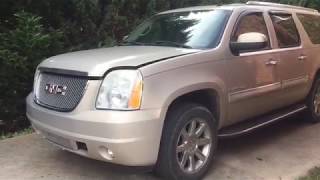
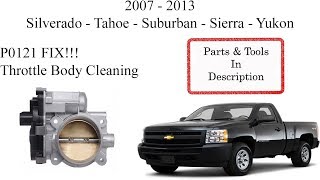
🎬 Watch: A quick guide to cleaning your Yukon's throttle body.Diagnostic Flowchart
Tap your situation to follow the diagnostic path that matches what you're seeing on this vehicle.
Generation note: The 2006-2013 range covers two Yukon generations: the end of the 2nd Gen (GMT800, 2006) and the 3rd Gen (GMT900, 2007-2014). Both generations use a similar electronic throttle control system and are prone to this issue. The primary cause and fix (cleaning or replacing the throttle body) are consistent across both generations covered in this range, with the GMT900 platform being particularly well-documented for this specific problem.
Symptoms You May Notice
- Check Engine Light is on
- "Reduced Engine Power" message on the dash
- Vehicle has very limited acceleration and speed (limp mode)
- Rough or unstable idle, sometimes fluctuating between 1500-2500 RPM after a cleaning attempt.
- Engine may hesitate or stumble during acceleration.
- Engine may stall, especially when coming to a stop
- Hard starting
- Intermittent stumble or surge on acceleration or deceleration.
- Replacing the accelerator pedal position (APP) sensor. While the APP sensor is part of the throttle control system, P0121 specifically points to a performance issue at the throttle body itself, not the pedal. Some owners have replaced the pedal assembly only to have the problem persist.
Most Likely Causes
- Dirty Throttle Body 🔴 High Probability → Shop Fuel Injection Throttle Body As documented in GM TSB #PIP4578B, carbon buildup from the PCV system is extremely common on high-mileage GM V8 engines. This buildup restricts the movement of the throttle plate, causing the sensor's reported position to be out of sync with what the ECM expects, triggering the performance code.
How to confirm: Visually inspect the throttle body bore and plate for a layer of black carbon or grime. The plate may feel sticky or sluggish when moved by hand (with the engine off). A scan tool may show a throttle position percentage at idle that is higher than expected (e.g., over 20%), which drops significantly after cleaning.
Typical fix: Remove the throttle body from the intake manifold and clean it thoroughly with a dedicated throttle body cleaner and a soft brush or rag. Do not spray cleaner directly into the electronic components. After reinstallation, an idle relearn procedure is required.
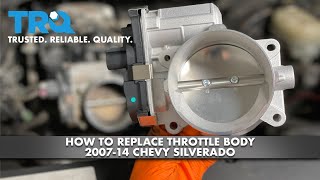
Est. part cost: $5-$15 for cleaner - Faulty Throttle Body Assembly 🟡 Medium Probability → Shop Fuel Injection Throttle Body The Throttle Position Sensor (TPS) is integrated into the throttle body and is not sold as a separate component. If the internal sensor electronics fail, which is common, the entire assembly must be replaced. Many owners report that cleaning the throttle body provides only a temporary fix, with the code returning weeks later, indicating the sensor itself was failing. Using cheap aftermarket throttle bodies is known to cause persistent issues; an OEM ACDelco or Delphi unit is strongly recommended. 🎬 See this step-by-step walkthrough for replacing the entire assembly.
How to confirm: If a thorough cleaning does not resolve the code, and the wiring is confirmed to be good, the sensor within the throttle body is likely faulty. A scan tool can be used to monitor the TPS voltage for dropouts or erratic signals while operating the pedal, though sometimes the failure is intermittent.
Typical fix: Replace the entire throttle body assembly with a new unit and a new gasket. An OEM or high-quality aftermarket part (like ACDelco or Delphi) is strongly recommended. Perform the idle relearn procedure after replacement.
Est. part cost: $150-$400 - Wiring Harness or Connector Issue ⚪ Low Probability The wiring harness leading to the throttle body can rub against engine components, causing chafing and intermittent shorts or opens. One user specifically noted the harness rubbing on a bolt on the back of the passenger side valve cover/coil pack area. The connector pins can also suffer from fretting corrosion, leading to a poor connection.
How to confirm: Visually inspect the wiring harness near the throttle body, tracing it back as far as possible for any signs of damage, rubbing, or sharp bends near brackets or bolts. Unplug the connector and check for corrosion on the pins. Perform a 'wiggle test' on the harness and connector while monitoring TPS voltage on a scan tool to see if the signal drops out.
Typical fix: Repair the damaged section of wire or replace the connector pigtail. Apply dielectric grease to the connector pins to prevent future corrosion.
Est. part cost: $10-$50
Rare But Worth Checking
- Faulty Powertrain Control Module (PCM): This is very rare. All other possibilities, especially the throttle body and wiring, should be exhaustively ruled out before considering PCM replacement.
- Poor Ground Connections: In some frustrating cases where multiple parts have been replaced without success, owners have found the solution to be cleaning body and engine ground wires. One owner specifically fixed the issue by cleaning the ground wires on the frame under the driver's side door and the ground on the firewall.
Diagnosis Steps
- Confirm P0121 is present using an OBD-II scanner. Check for any other related codes like P1516, P2101, or P0068.
- Remove the air intake tube connected to the throttle body.
- Visually inspect the throttle body bore and the edges of the throttle plate for black carbon buildup. This is the most likely cause.
- If carbon is present, disconnect the negative battery terminal. Unplug the throttle body connector and remove the four 10mm bolts holding it to the intake manifold.
- Thoroughly clean both sides of the throttle plate and the bore using a dedicated throttle body cleaner and a soft cloth or brush. Avoid spraying cleaner directly into the black plastic electronic housing. Replace the throttle body gasket.
- Reinstall the clean throttle body, torquing the bolts to specification (typically around 89 lb-in). Reconnect all components.
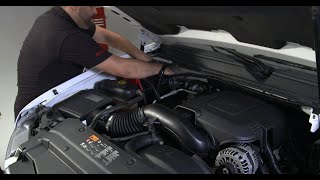
- Perform the Idle Relearn Procedure. The most commonly cited method is: Start the engine and let it idle in Park for 3 minutes. You may notice a high idle initially. Turn the engine OFF for 60 seconds. Start the engine again and let it idle in Park for another 3 minutes. The idle should now be normal. 🎬 Watch: How to properly perform the electronic throttle relearn procedure.
- If the idle is still high or the code returns, a drive cycle may be needed. Drive the vehicle at speeds over 44 MPH, including several decelerations and extended idles.
- If the code returns after cleaning, inspect the wiring harness to the throttle body for any chafing, damage, or loose connections, paying close attention to the area near the passenger-side valve cover.
- If wiring is good and cleaning did not work, the throttle body assembly itself is likely faulty and requires replacement.
Parts You'll Likely Need
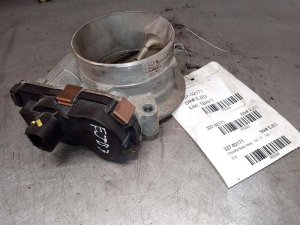
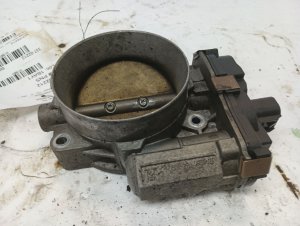
- Throttle Body Assembly
(OEM #ACDelco 217-3153 (GM 12670839) - Verify with VIN, but this is a common part number for 5.3L/6.0L/6.2L engines in this era.)— This is the most common repair if cleaning fails. The internal Throttle Position Sensor (TPS) is integrated and cannot be replaced separately on these models.
Trusted brands: ACDelco (GM Genuine), Delphi, Hitachi
OEM price range: $250-$400
Aftermarket price range: $150-$250 - Throttle Body Cleaner — Required for the most common and first-step fix: cleaning the carbon buildup from the throttle plate and bore.
Related Codes That Often Appear With This One
- P1516 — This code relates to Throttle Actuator Control (TAC) Module Throttle Actuator Position Performance. It often appears with P0121 because both point to a problem with the electronic throttle body's operation. It is explicitly mentioned in TSB PIP4578B alongside P0121.
- P2101 — This code means Control Throttle Actuator Control Motor Circuit Range/Performance. It is another code indicating a fault within the electronic throttle body assembly and is also listed in TSB PIP4578B.
- P0068 — This code indicates a MAP/MAF - Throttle Position Correlation error. The ECM compares the throttle position to the air flowing into the engine. A sticking throttle plate can cause this correlation to fail, triggering both P0068 and P0121.
- P2176 — This code is for 'Throttle Actuator Control System - Idle Position Not Learned'. It is often set after cleaning or replacing the throttle body if the idle relearn procedure has not been completed or was unsuccessful.
Technical Service Bulletins (TSBs) & Recalls
- PIP4578B: Addresses idle surge, reduced engine power, and DTCs including P0121 on high mileage vehicles. It states that as carbon builds up, the PCM learns to compensate. If the throttle body is cleaned without performing an 'idle learn reset' with a scan tool, the PCM may continue to compensate for the now-absent carbon, causing new issues and codes.
Platform-Specific Known Issues
- GM Technical Service Bulletin PIP4578B directly links P0121 with several other throttle-related codes to carbon buildup in the throttle body on high-mileage vehicles, recommending cleaning and an idle learn reset as the primary fix.
- Many owners on forums like TahoeYukonForum.com report successfully fixing P0121 simply by cleaning the throttle body, though some find the fix is temporary and replacement is eventually needed.
- A high or erratic idle after cleaning the throttle body is a very common complaint, which is resolved by performing the idle relearn procedure.
Mechanic-Grade Diagnostic Values
- TPS Signal Voltage at Idle (Closed Throttle) — expected: ~0.5 Volts. Failure: A significantly higher voltage can indicate the throttle plate is not closing fully due to carbon buildup or an internal fault.
- TPS Signal Voltage at Wide Open Throttle (WOT) — expected: ~4.5 Volts. Failure: Voltage that does not reach this level or is erratic during throttle opening indicates a sensor or wiring problem.
- TPS 5V Reference Voltage at Connector — expected: 4.8 - 5.2 Volts. Failure: No voltage or low voltage indicates a problem with the PCM or the wiring between the PCM and the TPS connector.
- Scan Tool: Throttle Position Percentage at Idle — expected: Typically under 10-15% after a proper idle learn.. Failure: A reading of 20% or higher at idle often indicates heavy carbon buildup preventing the throttle plate from closing, which triggers the P0121 performance code. After cleaning, this value should drop significantly (e.g., to ~7%).
Scan Tool Commands That Help
- GDS2/Tech2: Idle Learn Reset / Reset ECM Learned Values — This function should be used after cleaning or replacing the throttle body to wipe the old learned idle values from the ECM. This forces the system to immediately begin learning the new, correct idle position, which is often faster and more effective than the manual idle relearn procedure.
Wiring & Ground Locations
- Throttle Body Connector (8-Pin) — Plugged into the side of the electronic throttle body assembly.. This is the central connection for all power, ground, and signal wires for the integrated throttle position sensors and the throttle actuator motor. Testing for voltage and ground at these specific pins is critical for diagnosis. The pinout is: Pin E & H (5V Reference), Pin B & D (Low Reference/Ground), Pin G (TP Sensor 1 Signal), Pin F (TP Sensor 2 Signal), Pin A & C (TAC Motor Control).
- Harness Chafe Point — The engine wiring harness may rub on a bolt for the coil pack located on the back of the passenger-side valve cover.. Vibrations can cause the harness insulation to wear through at this specific point, leading to an intermittent short or open in the TPS circuits, which can trigger P0121. This is often missed during a standard visual inspection.
- Connector Fretting Corrosion — At the pins inside the throttle body electrical connector.. GM has noted issues with 'fretting corrosion,' a light, often invisible corrosion that builds up from micro-vibrations in electrical connectors. This creates a poor connection that can cause intermittent P0121 codes. Unplugging the connector, applying dielectric grease, and reconnecting can sometimes resolve the issue.
Real Owner Repair Stories
- Tahoe Forum user (2007 Tahoe 5.3L) — P0121 code
❌ Tried (didn't work) Replacing the throttle position sensor (not possible as it's integrated), Replacing the accelerator pedal assembly
✅ What actually fixed it The owner was told by a dealer they needed a new throttle body for ~$800. Instead, the owner removed the throttle body, gave it a thorough cleaning, and performed the idle learn procedure. This resolved the code and saved hundreds of dollars. - Tahoe Yukon Forum user (N/A) — P0121 code, occasional stalling
❌ Tried (didn't work) Cleaning the throttle body.
✅ What actually fixed it Cleaning the throttle body cleared the code, but it returned after a couple of weeks. The final fix was replacing the entire throttle body assembly, which indicated the internal sensor was failing and cleaning was only a temporary solution.
OEM Part Supersession History
12627217, 12669073→12670839— Standard part design updates.
Heads up: Warning: While GM part 12670839 is listed as the replacement, some parts catalogs associate it with smaller 2.5L engines in other GM vehicles. The V8 engines in the Yukon may require a different specific part number. Always verify the part number with the vehicle's VIN before purchasing to avoid incompatibility.
Helpful Videos
We Have This Part in Stock

The information in this article is provided for general reference and educational purposes only. Vehicle specifications, procedures, and part compatibility can vary by production date, trim level, and region. Always consult your vehicle's factory service manual and verify part numbers before purchasing or performing repairs. Safety-critical components such as airbags, seat belts, and braking systems should be installed by a qualified professional.
- Gmc YUKON:
- 🧭 Diagnostic Flowchart
- 🎬 Helpful Videos
- 🛍️ Shop This Part
- What's Unique About the 2006-2013 Gmc YUKON
- Symptoms You May Notice
- Most Likely Causes
- Rare But Worth Checking
- Diagnosis Steps
- Parts You'll Likely Need
- Related Codes That Often Appear With This One
- Technical Service Bulletins (TSBs) & Recalls
- Platform-Specific Known Issues
- Mechanic-Grade Diagnostic Values
- Scan Tool Commands That Help
- Wiring & Ground Locations
- Real Owner Repair Stories
- OEM Part Supersession History
- 🎟️ Get 5% Off