

P0121 on 2003-2008 Honda Pilot: Throttle Position Sensor Causes and Fixes
On a 2003-2008 Honda Pilot, code P0121 is most often caused by a dirty throttle body or a failing throttle position sensor (TPS). Start by cleaning the throttle body and performing an idle relearn procedure. If that doesn't work, a replacement aftermarket TPS costs about $40-$80 and is a common DIY fix, as Honda did not sell the sensor separately from the expensive throttle body assembly.
- Before buying any parts, the first and cheapest step is to thoroughly clean the throttle body.
- After cleaning the throttle body or replacing a sensor, you MUST perform an idle relearn procedure to avoid idling problems.
- If cleaning doesn't fix it, the Throttle Position Sensor (TPS) is the next likely culprit and can be replaced separately from the throttle body using affordable aftermarket parts.
- Symptoms like hesitation, rough idle, and stalling are classic signs of this code.
- Do not let a shop replace the entire throttle body assembly for this code without first attempting to clean it and/or replace the standalone aftermarket TPS.
What's Unique About the 2003-2008 Honda Pilot
For this generation of Honda Pilot, the P0121 code is a very common issue that often points to one of two things: either the throttle body is dirty with carbon buildup, preventing the throttle plate from moving smoothly, or the Throttle Position Sensor (TPS) itself has failed. A critical distinction exists within this generation: 2003-2004 models use a mechanical throttle cable with a replaceable TPS, while 2005-2008 models use a Drive-By-Wire (DBW) system where the sensor is integrated into the throttle body assembly and diagnosis also involves the Accelerator Pedal Position (APP) sensor. While Honda originally sold the throttle body as a complete, expensive assembly, the aftermarket now offers the TPS as a separate, affordable part for early models, making DIY replacement a popular and cost-effective repair. After any repair involving the throttle body or TPS, an 'idle relearn procedure' is crucial for restoring stable engine operation.
Symptoms You May Notice
- Check Engine Light is on
- Hesitation or stumbling during acceleration.
- Rough or unstable idle.
- Engine stalling, especially at low speeds.
- Poor or sluggish engine power.
- Transmission may not shift smoothly or may feel jerky.
- Sudden surges in speed or unpredictable throttle response.
- Replacing the entire throttle body assembly when only a cleaning or a new aftermarket sensor was needed.
- Confusing the Throttle Position Sensor (TPS) on the throttle body with the Accelerator Pedal Position (APP) sensor on the gas pedal assembly, although both can cause this code.
Most Likely Causes
- Dirty Throttle Body 🔴 High Probability → Shop Fuel Injection Throttle Body The PCV (Positive Crankcase Ventilation) system can route oil vapors and deposits into the intake, which build up as carbon on the throttle plate and bore over time, causing the plate to stick.
How to confirm: Visually inspect the throttle body by removing the air intake hose. Look for a black, sticky layer of carbon around the throttle plate and where it seats in the bore. The plate may feel sticky or slow to move when operated by hand.
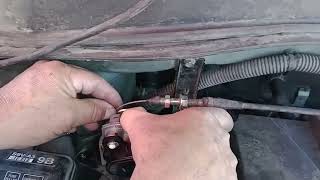
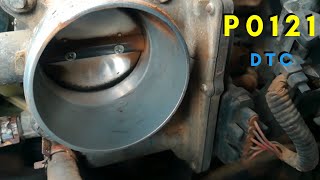
Typical fix: Thoroughly clean the throttle body using a dedicated throttle body cleaner and a soft brush or rag. Ensure the throttle plate moves freely after cleaning. 🎬 Watch: Step-by-step guide to cleaning your Honda Pilot throttle body. An idle relearn procedure must be performed afterward.
Est. part cost: $5-$15 - Faulty Throttle Position Sensor (TPS) 🔴 High Probability → Shop Fuel Injection Throttle Body The TPS is a mechanical sensor with a wiper that moves across a resistive strip. Over millions of cycles, this strip wears out, leading to 'dead spots' in its electrical output where the signal drops out or becomes erratic.
How to confirm: Using a scan tool with live data, watch the TPS voltage as you slowly open and close the throttle; it should be a smooth sweep from ~0.5V to ~4.5V with no jumps or dropouts. Alternatively, use a multimeter to back-probe the signal wire and check for the same smooth voltage sweep.
Typical fix: Replace the throttle position sensor. Aftermarket sensors are widely available and attach with two screws. An idle relearn procedure is recommended after replacement.
Est. part cost: $40-$80 - Faulty Accelerator Pedal Position (APP) Sensor ⚪ Low Probability → Shop Accelerator Pedal Assembly Though less common than a TPS failure, the APP sensor, located on the accelerator pedal assembly (in-cabin) or under the hood (attached to the throttle cable on 2005+ models), can also fail and send conflicting signals to the PCM, triggering a P0121 code.
How to confirm: Diagnosis is similar to the TPS. Use a scan tool to monitor the APP sensor's live data (usually listed as APP Sensor 1 and 2). The voltage should sweep smoothly as the pedal is pressed. Check for any erratic readings.
Typical fix: Replace the APP sensor, which is typically mounted to the accelerator pedal bracket or under the hood 🎬 See this walkthrough for replacing the accelerator pedal position sensor. near the throttle body.
Est. part cost: $50-$100 - Damaged Wiring or Connector ⚪ Low Probability Engine heat and vibration can cause wiring insulation to become brittle or connectors to become loose or corroded over many years, particularly at the TPS connector on the throttle body.
How to confirm: Visually inspect the wiring harness going to the TPS for any signs of cracking, fraying, or melting. Wiggle the connector and harness with the engine running to see if it affects the idle. Check that the connector is securely plugged in and that the pins are clean and free of corrosion.
Typical fix: Repair the damaged section of wire or clean/replace the connector pigtail.
Est. part cost: $10-$30
Rare But Worth Checking
- Faulty Powertrain Control Module (PCM): This is extremely rare. Before considering PCM replacement, all other possibilities, including the sensor, wiring, and throttle body, must be exhaustively ruled out by a professional.
Diagnosis Steps
- Read the code with an OBD-II scanner to confirm P0121 is present.
- Visually inspect the TPS connector for a secure fit and check the wiring for any obvious damage, corrosion, or loose connections.
- Remove the air intake hose from the throttle body.
- Inspect the throttle body bore and plate for carbon buildup. If dirty, clean it thoroughly with throttle body cleaner and a soft cloth or brush. Pay special attention to the area where the plate rests at idle.
- Reassemble, clear the code, and perform the Idle Relearn Procedure (see step 10). Test drive to see if the issue is resolved.
- If the code returns, use a multimeter or a scan tool's live data function to monitor the TPS voltage.
- With the key on and engine off, slowly press the gas pedal (or manually move the throttle linkage). The voltage should increase smoothly from approximately 0.5V to 4.5V. Watch for any sudden jumps, drops, or 'dead spots' in the voltage sweep.
- If the voltage is erratic or shows dead spots, the TPS is faulty and needs to be replaced.
- If the TPS signal is good, check the APP sensor signal using the same method. If both sensors and wiring appear good, the problem may lie in the wiring between the sensors and the PCM, or, in very rare cases, the PCM itself.
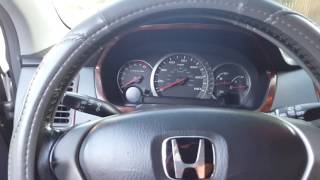
- Honda Idle Relearn Procedure: After cleaning the throttle body or replacing the TPS/APP sensor, this procedure is necessary. a. Ensure all electrical accessories (A/C, radio, lights) are OFF. b. Disconnect the battery for at least 10 minutes to reset the PCM. Reconnect it. c. Turn the ignition to ON (II) for 2 seconds. d. Start the engine and hold it at 3,000 RPM (in Park or Neutral) until the radiator fan comes on, or until the engine reaches normal operating temperature (around 194°F / 90°C). e. Let the engine idle for 5 minutes with the throttle fully closed. Do not count the time the radiator fan is running. 🎬 Watch: A quick video demonstration of the Honda idle relearn procedure.
Parts You'll Likely Need
- Throttle Position Sensor (TPS)
(OEM #N/A (Sold with throttle body))— This is the most common part to fail and directly cause the P0121 code when a dirty throttle body is not the culprit. Only available as an aftermarket part.
Trusted brands: Dorman, Standard Motor Products (SMP), NTK, Walker
OEM price range: N/A (Sold with throttle body)
Aftermarket price range: $40-$80 - Accelerator Pedal Position (APP) Sensor
(OEM #37971-RBB-003)— A less common but possible cause, especially on 2005-2008 Drive-by-Wire models. This sensor is located under the hood, connected to the throttle cable.
Trusted brands: Honda (OEM), Dorman
OEM price range: $70-$120
Aftermarket price range: $50-$100 - Throttle Body Gasket
(OEM #16176-P8A-A00)— Recommended to replace if you remove the throttle body for a more thorough cleaning.
Trusted brands: Fel-Pro, Mahle, Victor Reinz, Honda (OEM)
OEM price range: $5-$15
Aftermarket price range: $3-$10 - Throttle Body Cleaner — Required for the most common and simple fix: cleaning carbon buildup from the throttle body.
Trusted brands: CRC, Berryman, Gumout
OEM price range: N/A
Aftermarket price range: $5-$15
Related Codes That Often Appear With This One
- P0122 — This code indicates 'TPS 'A' Circuit Low Input', which can be caused by the same failing sensor or wiring issue.
- P0123 — This code indicates 'TPS 'A' Circuit High Input', also pointing to a fault within the same sensor circuit.
Platform-Specific Known Issues
- A very common repair story on forums involves owners being quoted over $800 by a dealer to replace the entire throttle body assembly. The owner then either cleans the throttle body for under $15 or replaces the aftermarket TPS for under $100, completely resolving the issue.
- Failure to perform the idle relearn procedure after cleaning or parts replacement is the #1 reason for a persistent rough or high idle, even after the P0121 code is fixed.
Mechanic-Grade Diagnostic Values
- TPS Signal Voltage (at sensor's Red wire) — expected: Approx. 0.5V at closed throttle, sweeping smoothly to approx. 4.5V at wide-open throttle.. Failure: Any sudden jumps, drops, or 'dead spots' in voltage as the throttle is slowly opened.
- TPS 5V Reference Voltage (at sensor's Yellow wire) — expected: Approx. 5.0V DC with key in the ON position.. Failure: Voltage significantly lower or higher than 5.0V indicates a problem with the PCM or wiring.
- TPS Ground Circuit (at sensor's Green wire) — expected: Continuity to chassis ground (less than 1.0 Ohm resistance).. Failure: High resistance or no continuity indicates a bad ground connection.
- APP Sensor Voltage (2005-2008 models) — expected: Two separate voltage signals that move in opposite directions (e.g., Sensor 1 sweeps 0.5V to 4.5V, Sensor 2 sweeps 4.5V to 0.5V). The key is a smooth sweep without glitches.. Failure: Erratic readings, dropouts, or one sensor not responding indicates a faulty APP sensor.
Scan Tool Commands That Help
- Honda HDS (Honda Diagnostic System): TP SENSOR A/B CHECK — On 2005-2008 Drive-by-Wire models, this function in the dealer-level scanner allows the technician to see the correlated voltage of the two internal throttle position sensors (A and B) simultaneously to quickly identify discrepancies that set the P0121 code.
- Honda HDS (Honda Diagnostic System): THROTTLE BODY CLEANING/REPLACEMENT RESET — While a manual idle relearn often works, the HDS has a specific service function to force the PCM to forget old learned throttle values and relearn the new baseline after a cleaning or replacement, which can be more effective for stubborn idle issues.
Wiring & Ground Locations
- TPS Connector (2003-2004) — On the throttle body, where the throttle cable linkage is.. This is the primary connection point for testing. Pin 1 (Yellow/Black) is 5V reference, Pin 2 (Red/Black) is the signal wire, and Pin 3 (Green/Black) is the sensor ground. Verifying power, ground, and signal at this connector is the core diagnostic step.
- APP Sensor (2005-2008) — Under the hood, mounted on the firewall/strut tower area, with the accelerator pedal's cable attached to it.. This is often misdiagnosed. On DBW models, the driver's pedal input is read here, not at the pedal itself. A failure in this sensor or its cable linkage can cause P0121 as the PCM sees a mismatch between the driver's request (from APP) and the throttle body's actual position (from TPS).
- G101 — Typically located on the thermostat housing or nearby on the engine block.. This is a primary engine management ground point. A loose or corroded G101 can cause erratic voltage readings for multiple sensors, including the TPS and APP, leading to a P0121 code that is difficult to diagnose because the sensor itself is not faulty.
Real Owner Repair Stories
- Piloteers.org forum user (2006 Honda Pilot EX-L, 165,000 miles) — Check engine light with VSA light, vehicle went into limp mode with severe lack of power, code P0121 present.
❌ Tried (didn't work) Cleaning the throttle body (no change)., Replacing the in-cabin accelerator pedal assembly (no change, as the primary APP sensor is under the hood).
✅ What actually fixed it The problem was the under-hood Accelerator Pedal Position (APP) sensor (Part No. 37971-RBB-003). The cable from the gas pedal actuates this sensor, which had failed. After replacing the under-hood sensor and adjusting the cable tension, the code was cleared and did not return.
OEM Part Supersession History
16400-RCA-A01→16400-RKB-003— Part revision for the electronic throttle body assembly used on 2005+ models.
Heads up: While both are for the J35A, there may be minor differences in calibration or connectors. It is critical to match the part number to the specific year and VIN of the vehicle. Using the wrong assembly can lead to persistent idle or performance issues.
Model Year Variations Within This Range
- 2003-2004: These models use a traditional mechanical throttle cable directly connected to the throttle body. The TPS is a separate, replaceable sensor mounted on the throttle body. Diagnosis focuses on the TPS, cable adjustment, and cleaning the throttle body.
- 2005-2008: These models use a Drive-by-Wire (DBW) system. The gas pedal pulls a cable connected to an Accelerator Pedal Position (APP) sensor under the hood. The PCM reads the APP sensor input and commands a motor in the throttle body to open the throttle plate. The throttle body has its own integrated (and generally non-replaceable) TPS to report its position back to the PCM. A P0121 code on these years requires checking both the APP sensor and the throttle body assembly, as the code is set when their signals don't correlate correctly.
Diagnostic Flowchart
Other Known Issues on This Vehicle
Issues unrelated to this code that are worth knowing about as an owner of this generation:
- Automatic Transmission Failure 🔴 High — Very common, especially in 2003-2005 models. Can manifest as slipping, harsh shifting, or complete failure, often before 150,000 miles. (Ref: A recall was issued for 2003-2004 models to install a revised oil cooler return line to improve lubrication to second gear.)
- Failing Active Control Engine Mounts 🟠 Medium — The electronically controlled front and rear engine mounts are prone to leaking hydraulic fluid and failing, causing excessive vibration at idle and during VCM operation (on applicable models).
- Worn Front Lower Control Arm Compliance Bushings 🟠 Medium — The large compliance bushings in the front lower control arms frequently tear, leading to clunking noises over bumps, steering wheel vibrations, and imprecise handling.
- Power Steering Pump Whine and Leaks 🟡 Low — The power steering pump is known to develop a whining noise, especially in cold weather. Leaks can also occur from the pump itself or the high-pressure hose O-rings.
- Variable Cylinder Management (VCM) Issues (2006-2008 FWD) 🟠 Medium — On 2006-2008 front-wheel-drive models equipped with VCM, issues like spark plug fouling, excessive oil consumption, and engine vibrations are common.
Used vs. New Parts: Buying Guide for This Vehicle
When a used part is the smart pick: For 2005-2008 models, a used throttle body assembly from a low-mileage donor vehicle can be a cost-effective alternative to a new OEM unit, as the TPS is integrated. For 2003-2004 models, buying a used TPS is not recommended; a new aftermarket sensor is inexpensive and reliable.
Donor-vehicle mileage cap: roughly under 100000 miles for the part to have meaningful remaining life.
What to inspect on the donor part:
- Check for minimal carbon buildup inside the throttle bore.
- Ensure the electrical connector pins are clean, straight, and free of corrosion.
- Verify the part number on the donor throttle body matches the required part for your vehicle year.
- If possible, ask for the donor vehicle's VIN to check for accident history.
OEM-only on this vehicle (don't cheap out):
- While aftermarket options exist, the Accelerator Pedal Position (APP) sensor (for 2005-2008 models) is a critical component where using an OEM part (Honda Part No. 37971-RBB-003) is often recommended for highest reliability and to avoid repeat failures.
Aftermarket brands forum-validated for this vehicle:
- NTK
- Standard Motor Products (SMP)
- Delphi (for sensors)
Brands owners have reported issues with on this vehicle:
- Unbranded, 'white box' sensors from online marketplaces often have high failure rates and may not be calibrated correctly, leading to persistent issues even after replacement.
Real Owner Stories
Aggregated from forums and TSBs cited above. Mileages and costs reflect what owners reported in those sources.
2003-2008 Honda Pilot 3.5L J35A V6
Symptoms: Owner was quoted over $800 by a dealer to replace the entire throttle body assembly due to throttle-related codes.
What fixed it: The owner either cleaned the throttle body for under $15 or replaced the aftermarket TPS for under $100, which completely resolved the issue.
Cost: $15-$100
Source hint: vehicle_specific_issues
2003-2008 Honda Pilot 3.5L J35A V6
Symptoms: Persistent rough or high idle after the P0121 code was supposedly fixed by cleaning or parts replacement.
What fixed it: Performing the Honda Idle Relearn Procedure (disconnecting battery, reaching operating temperature, and idling for 5 minutes).
Source hint: vehicle_specific_issues
Related OBD-II Codes
Frequently Asked Questions
The dealer quoted me over $800 to fix P0121 on my Honda Pilot by replacing the whole throttle body. Is there a cheaper way?
Why does my 2003-2008 Honda Pilot keep idling roughly even after I cleaned the throttle body to fix the P0121 code?
Where is the APP sensor located on my 2005 Honda Pilot?
Is there a specific recall for the transmission issues I'm having alongside the P0121 code on my 2003 Pilot?
Can a dirty PCV system cause the P0121 code on my J35A engine?
Helpful Videos

We Have This Part in Stock

The information in this article is provided for general reference and educational purposes only. Vehicle specifications, procedures, and part compatibility can vary by production date, trim level, and region. Always consult your vehicle's factory service manual and verify part numbers before purchasing or performing repairs. Safety-critical components such as airbags, seat belts, and braking systems should be installed by a qualified professional.
- Honda Pilot:
- 🧭 Diagnostic Flowchart
- 🎬 Helpful Videos
- 🛍️ Shop This Part
- What's Unique About the 2003-2008 Honda Pilot
- Symptoms You May Notice
- Most Likely Causes
- Rare But Worth Checking
- Diagnosis Steps
- Parts You'll Likely Need
- Related Codes That Often Appear With This One
- Platform-Specific Known Issues
- Mechanic-Grade Diagnostic Values
- Scan Tool Commands That Help
- Wiring & Ground Locations
- Real Owner Repair Stories
- OEM Part Supersession History
- Model Year Variations Within This Range
- Other Known Issues on This Vehicle
- Used vs. New Parts: Buying Guide for This Vehicle
- Real Owner Stories
- 2003-2008 Honda Pilot 3.5L J35A V6
- 2003-2008 Honda Pilot 3.5L J35A V6
- Related OBD-II Codes
- Frequently Asked Questions
- 🎟️ Get 5% Off