

P0121 on 2000-2004 Isuzu Rodeo V6: Causes and Fixes for Throttle Position Sensor Issues
On a 2000-2004 Isuzu Rodeo V6, code P0121 is most often caused by a failing Throttle Position Sensor (TPS) or a dirty throttle body. A new TPS costs around $40-$100 for an aftermarket part, and replacement is a straightforward DIY job (2/5 difficulty). Before replacing the sensor, a thorough cleaning of the throttle body is highly recommended as it can resolve the issue for a much lower cost.
- P0121 on your Rodeo most likely means you need a new Throttle Position Sensor (TPS).
- Before replacing the TPS, always inspect and clean the throttle body, as carbon buildup can cause the same symptoms and is a very common fix.
- A faulty MAP sensor can trick the computer into setting a P0121 code; if a new TPS and clean throttle body don't solve it, the MAP sensor is the next logical suspect.
What's Unique About the 2000-2004 Isuzu Rodeo
The 2000-2004 Isuzu Rodeo with the V6 engine uses a traditional, cable-actuated throttle body. This means the P0121 code is almost always related to the sensor on the throttle body itself, its wiring, or physical gunk in the throttle bore. Unlike newer 'drive-by-wire' systems, you don't have to worry about complex accelerator pedal sensors or throttle actuator motors. However, on this Isuzu system, the PCM's logic heavily relies on the Manifold Absolute Pressure (MAP) sensor to validate the TPS signal, making a faulty MAP sensor a key potential misdiagnosis. The service manual explicitly states to check for a skewed MAP signal, as an incorrect reading can cause the PCM to miscalculate the predicted throttle position and falsely trigger P0121.
Symptoms You May Notice
- Check Engine Light is on
- Hesitation or stumbling during acceleration
- Rough or unstable idle
- Engine stalling, especially at low speeds
- Poor fuel economy
- Transmission may not shift correctly or smoothly
- Sudden surges in speed or lack of throttle response
- Black smoke from exhaust during acceleration
- Replacing the TPS without checking for a faulty Manifold Absolute Pressure (MAP) sensor. A skewed MAP signal can cause the PCM to incorrectly calculate the predicted throttle angle, triggering a P0121 code.
- Replacing the entire throttle body assembly when only the sensor was faulty or the bore was dirty.
- Replacing the Accelerator Pedal Position (APP) sensor. This vehicle uses a mechanical throttle cable, so it does not have an APP sensor related to this system.
Most Likely Causes
- Faulty Throttle Position Sensor (TPS) 🔴 High Probability → Shop Fuel Injection Throttle Body The TPS is a high-use potentiometer that wears out over time. Its internal electrical contacts develop dead spots or provide erratic signals, leading to performance issues. This is the most common failure point for this code.
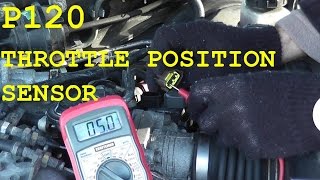
How to confirm: Use a scan tool to watch the TPS voltage live data. It should sweep smoothly from about 0.6V to 4.5V as you slowly open the throttle. Any jumps, dropouts, or flat spots indicate a bad sensor. Alternatively, use a multimeter to back-probe the signal wire and perform the same test. 🎬 Watch: How to test and replace a faulty TPS
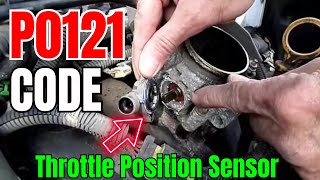
Typical fix: Replace the Throttle Position Sensor. It is mounted to the side of the throttle body 🎬 See this walkthrough for replacing the Rodeo's TPS with two screws.
Est. part cost: $40-$100 - Dirty or Clogged Throttle Body 🟡 Medium Probability → Shop Fuel Injection Throttle Body Over time, carbon and grime from the PCV and EGR systems build up in the throttle body bore and on the throttle plate. This can prevent the plate from closing properly or cause it to stick, leading to a mismatch between where the sensor thinks the throttle is and where it actually is.
How to confirm: Visually inspect the inside of the throttle body after removing the air intake hose. If it is coated in black grime, it needs cleaning. The throttle plate should move smoothly without sticking.
Typical fix: Clean the throttle body thoroughly with a dedicated throttle body cleaner and a soft brush or rag. It is highly recommended to do this before replacing the TPS, as it is a frequent cause of the code and a much cheaper fix. A new throttle body gasket should be used if the throttle body is removed for cleaning.
Est. part cost: $5-$15 - Damaged Wiring or Poor Connection ⚪ Low Probability Engine bay heat and vibrations can cause wires to become brittle and crack, or connectors to become loose or corroded over time. The harness connector at the TPS is a common point of failure.
How to confirm: Visually inspect the wiring harness and connector going to the TPS for any signs of damage, fraying, or corrosion. With the engine running, wiggle the connector and harness to see if it causes a change in idle or TPS data on a scan tool.
Typical fix: Repair the damaged section of wiring or replace the TPS connector pigtail.
Est. part cost: $10-$30
Rare But Worth Checking
- Faulty Powertrain Control Module (PCM): This is very rare. All other possibilities, especially the TPS, wiring, throttle body condition, and MAP sensor, should be exhaustively ruled out before considering the PCM as the cause.
Diagnosis Steps
- Use an OBD-II scanner to confirm P0121 is the primary code. Check for any other codes, especially those related to the MAP sensor (P0106, P0107, P0108).
- View live data on the scanner. At idle, the TPS voltage should be steady around 0.6V. Slowly press the accelerator to the floor; the voltage should increase smoothly and consistently to ~4.5V with no dropouts or spikes.
- Visually inspect the TPS connector and wiring for any obvious damage, corrosion, or loose connections. Wiggle the harness with the engine running to check for changes.
- Remove the air intake tube and inspect the throttle body for heavy carbon buildup. Actuate the throttle by hand to feel for any sticking or binding of the throttle plate.
- If the throttle body is dirty, clean it thoroughly using throttle body cleaner and a soft brush. Clear the codes and test drive to see if the problem is resolved. This is a common fix.
- If the TPS signal was erratic in Step 2, or if cleaning the throttle body did not fix the issue, replace the Throttle Position Sensor.
- If the code persists, investigate the MAP sensor's live data to ensure it is reading correctly and responding to changes in engine load. A skewed MAP sensor can trigger P0121 on this platform.
- If all else fails, use a multimeter to check for continuity and proper voltage at the TPS connector (5V reference, ground, and signal wires) to rule out a wiring issue between the sensor and the PCM.
Parts You'll Likely Need
- Throttle Position Sensor (TPS)
(OEM #Isuzu 8-97163164-0 (Verify with VIN, may also be listed under Hitachi SERA486-07))— This is the most common part to fail, causing the P0121 code directly by sending an incorrect signal.
Trusted brands: Delphi, NGK/NTK, Standard Motor Products, ACDelco, Hitachi (OEM supplier)
OEM price range: $73-$120
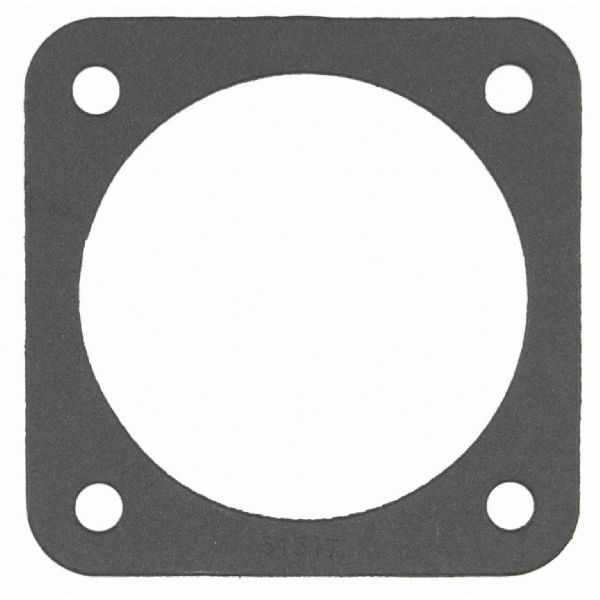
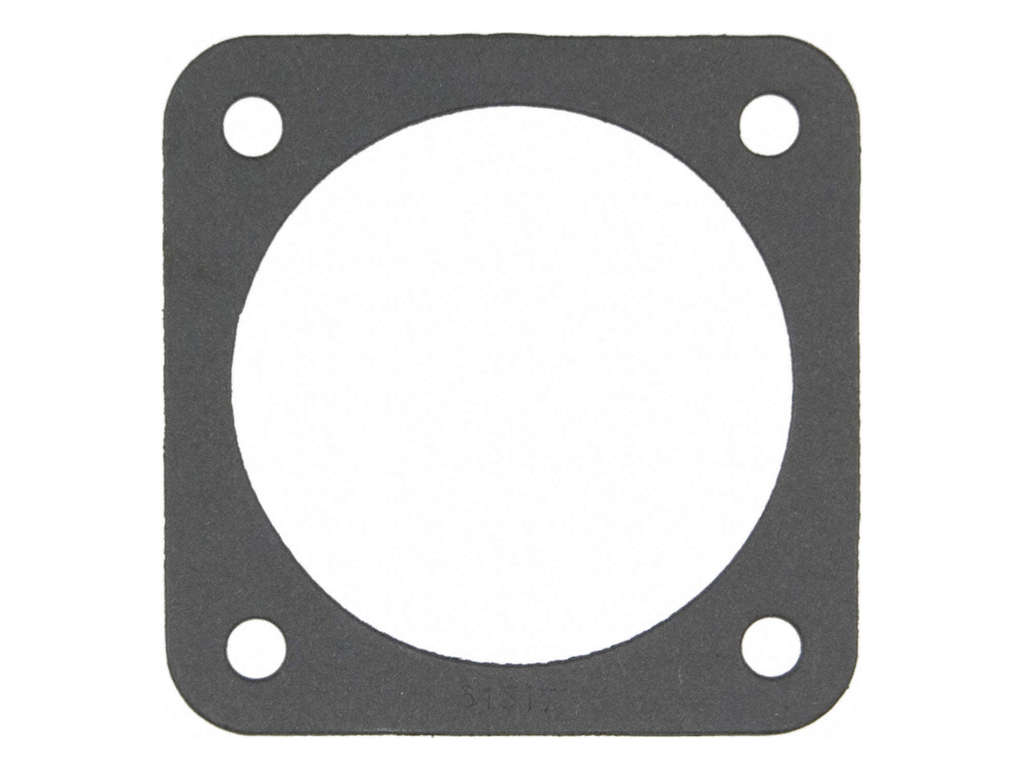
Aftermarket price range: $37-$75 - Throttle Body Gasket — This should be replaced if you remove the throttle body for cleaning to prevent vacuum leaks.
Trusted brands: Fel-Pro, Mahle
OEM price range: $10-$20
Aftermarket price range: $5-$15
Related Codes That Often Appear With This One
- P0122 — This code indicates 'TPS Circuit Low Voltage', suggesting a short or a completely failed sensor, which is a related failure mode.
- P0123 — This code indicates 'TPS Circuit High Voltage', suggesting an open circuit or sensor failure, which is a related failure mode.
- P0106 / P0107 / P0108 — These codes relate to the MAP sensor. If you see a MAP sensor code alongside P0121, it strongly suggests the MAP sensor is the root cause of the incorrect throttle correlation. The Isuzu diagnostic procedure specifically mentions checking for MAP DTCs first.
Technical Service Bulletins (TSBs) & Recalls
- A software update was issued for some 2000 model year Rodeos to correct idle speed on a cold start, which can sometimes be related to throttle control issues, though not directly for P0121.
Platform-Specific Known Issues
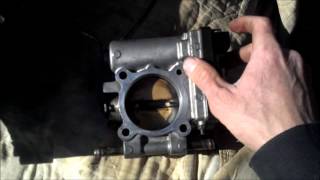
- A dirty throttle body is a very common cause for P0121 on these V6 engines. Many owners have resolved the code simply by performing a thorough cleaning, as demonstrated in several DIY videos. 🎬 Watch: How to clean the EGR tube and throttle body
- The diagnostic logic for P0121 on this platform is sensitive to MAP sensor input. An aging MAP sensor that hasn't failed completely (and thus hasn't set its own code) can provide skewed data that leads the PCM to incorrectly flag the TPS.
Mechanic-Grade Diagnostic Values
- TPS Resistance (Ohms) — expected: Closed throttle: 0.5-1.5 kΩ, Wide Open Throttle (WOT): 3.5-4.5 kΩ. Resistance should change smoothly with no jumps or dead spots.. Failure: Readings outside the specified range, or abrupt jumps/drops in resistance as the throttle is moved, indicate a worn or faulty sensor.
- TPS Reference Voltage at Connector — expected: 4.8V - 5.2V between the 5V reference wire and the ground wire with the key on, engine off.. Failure: Voltage below 4.8V or above 5.2V points to a problem with the PCM or the wiring, not necessarily the sensor itself.
- TPS Ground Circuit Voltage Drop — expected: < 0.1V between the TPS connector ground pin and the negative battery terminal.. Failure: A reading higher than 0.1V indicates excessive resistance in the ground circuit, which can skew the sensor's signal. This could be caused by a corroded ground point (like G104 or G120) or a damaged wire.
Scan Tool Commands That Help
- Manual Procedure (No Scan Tool): TPS Voltage Relearn Procedure — After disconnecting the battery, or replacing the TPS or Transmission Control Module (TCM). This procedure forces the TCM to re-learn the idle and wide-open-throttle voltage values from the new or reset sensor. Failure to do this can cause shifting problems and may even re-trigger the P0121 code. The procedure involves a specific sequence of turning the key, shifting, and pressing the accelerator and brake pedals.
Wiring & Ground Locations
- G104 — Left rear corner of the engine compartment.. This is a primary ground point for the Data Link Connector (DLC) and the Engine Control Module (ECM). Corrosion or a loose connection at G104 can cause erratic sensor readings and communication issues with a scan tool.
- G120 — Right side of the engine, on the intake manifold.. This is a critical ground point for the ECM and several sensors. A poor connection here can directly affect the reference ground for the TPS, causing the signal to be skewed and triggering P0121.
- G117 — Right rear of the engine (for the 3.2L V6).. This is another engine-block ground point. Any engine ground issue can create a voltage potential difference between the engine block (where sensors are grounded) and the chassis, leading to floating ground issues and incorrect sensor readings.
- TPS Connector Pins — The connector on the Throttle Position Sensor itself.. Testing requires knowing the function of each pin: 5V reference, signal, and ground. Probing these wires is necessary to confirm if the sensor is receiving correct power and ground, and if its output signal is correct.
Real Owner Repair Stories
- Reddit user in r/AskMechanics (Vehicle not specified, but symptoms and parts match the Rodeo case.) — Persistent P0121 code, rough idle, hesitation.
❌ Tried (didn't work) Cleaning the throttle body, Replacing the throttle position sensor (TPS), Replacing the accelerator pedal position sensor (on a drive-by-wire car, but relevant to the diagnostic process)
✅ What actually fixed it The user was advised that a manual or scan-tool 'relearn' procedure is often required after replacing a critical sensor like the TPS for the ECM to accept the new part's parameters. The issue was likely not the parts themselves, but the lack of a post-installation calibration. - PlanetIsuzoo.com forum (composite of multiple threads) (2000-2004 Isuzu Rodeo V6) — P0121, sometimes with MAP sensor codes (P0106/P0107). Hesitation, stalling, poor shifting.
❌ Tried (didn't work) Replacing the TPS sensor alone., Cleaning the throttle body alone.
✅ What actually fixed it In many documented cases, the ultimate fix was replacing a faulty MAP sensor. Even without a specific MAP code, a skewed MAP sensor was providing bad data to the PCM, which then incorrectly flagged the TPS signal as being out of range. The Isuzu service manual's diagnostic logic points to this as a key possibility.
OEM Part Supersession History
Isuzu 8-97163164-0→N/A, still a valid number.— N/A
Heads up: This part number is cross-referenced with Hitachi SERA486-07 and SERA486-08. While SERA486-07 is correct for many Isuzu/Nissan/Infiniti applications of this era, SERA486-08 is listed for some Holden/Isuzu diesel models and may have a different rotational direction or resistance sweep. It is critical to match the exact part number or verify VIN fitment, as a physically identical but electronically different sensor will not work.
Model Year Variations Within This Range
- 2004: For the 2004 model year, the 3.2L V6 (6VD1) was replaced by a 3.5L V6 (6VE1) with direct injection. While both use a cable-actuated throttle and a similar TPS, the diagnostic logic and interaction with the direct injection system's high-pressure fuel pump can be slightly different. The fundamental causes of P0121 remain the same, but diagnosis may involve additional checks related to fuel pressure correlation.
Diagnostic Flowchart
Other Known Issues on This Vehicle
Issues unrelated to this code that are worth knowing about as an owner of this generation:
- Excessive Oil Consumption (3.2L V6) 🔴 High — Extremely common, often starting around 80,000-100,000 miles. Many owners report consuming 1 quart of oil every 500-1000 miles. The issue is widely attributed to a design flaw in the piston rings' oil drain-back holes, which get clogged.
- 4L30-E Automatic Transmission Failure 🔴 High — The GM-sourced 4L30-E transmission is a known weak point, prone to failure, hard shifting, and loss of forward gears. Problems can appear after 100,000 miles and rebuilds are costly. Some issues can be traced to failed solenoids or band adjustments.
- ABS Light due to Damaged Wiring 🟠 Medium — A common complaint is the ABS warning light illuminating due to damaged wheel speed sensor wiring. The wiring is susceptible to damage from road debris or suspension movement.
- Frame Rust 🔴 High — Particularly in regions that use road salt, these vehicles are subject to severe frame rust, especially in the rear section near the suspension mounts. Several recalls were issued for this problem (e.g., NHTSA 10V436000). (Ref: NHTSA Campaign ID: 10V436000)
- Oil in Spark Plug Tubes 🟡 Low — The valve cover gaskets and spark plug tube seals are prone to leaking oil into the spark plug wells, which can cause engine misfires. This is a common maintenance item.
Used vs. New Parts: Buying Guide for This Vehicle
When a used part is the smart pick: A complete, used throttle body assembly from a junkyard can be a good value. It often comes with the TPS, Idle Air Control (IAC) valve, and the throttle body itself for less than the price of a new OEM TPS alone. This is a smart choice if you suspect multiple issues or want 'swap-and-see' diagnostic parts.
Donor-vehicle mileage cap: roughly under 120000 miles for the part to have meaningful remaining life.
What to inspect on the donor part:
- Check for minimal carbon buildup inside the throttle bore. A thick, black coating suggests a hard life.
- Ensure the throttle plate snaps back crisply when opened by hand; any sticking or binding is a red flag.
- Inspect the plastic TPS connector housing for cracks or broken locking tabs.
- Look for a donor vehicle that was wrecked from the rear, suggesting the engine was running well at the time of the accident.
Aftermarket brands forum-validated for this vehicle:
- Hitachi (OEM supplier)
- NGK/NTK
- Delphi
- Standard Motor Products (SMP)
Brands owners have reported issues with on this vehicle:
- Ultra-cheap, no-name sensors from online marketplaces are frequently reported on forums to be dead-on-arrival or fail within a few months. The small cost savings are not worth the repeated labor and diagnostics.
Real Owner Stories
Aggregated from forums and TSBs cited above. Mileages and costs reflect what owners reported in those sources.
2001 Isuzu Rodeo V6 — ~125000 miles
Symptoms: Check Engine Light was on, and the truck would hesitate and stumble when trying to accelerate from a stop.
What fixed it: Resolved the code by performing a thorough cleaning of the throttle body, which was coated in black grime. This was done before replacing any parts.
Source hint: vehicle_specific_issues section noting that many owners resolved the code with a cleaning, as seen in DIY videos
2002 Isuzu Rodeo V6 — ~155000 miles
Symptoms: The engine had a rough, unstable idle and the Check Engine Light for P0121 kept coming back.
What fixed it: After cleaning the throttle body didn't solve the problem, replacing the Throttle Position Sensor (TPS) finally cleared the code and smoothed out the idle.
Source hint: PlanetIsuzoo.com and 4x4wire.com forum discussions
2000 Honda Passport V6 — ~140000 miles
Symptoms: Poor throttle response and the transmission was not shifting smoothly. The Check Engine Light was on.
What fixed it: Inspected the wiring to the TPS and found the connector was loose and corroded. Repairing the connector pigtail fixed the P0121 code and the shifting issues.
Source hint: common_causes section detailing damaged wiring or poor connections at the TPS harness
Related OBD-II Codes
Frequently Asked Questions
I have a P0121 code on my Rodeo. Should I replace the Throttle Position Sensor (TPS) right away?
My transmission is shifting erratically and I have a P0121 code. Are the two issues related?
I also have a code for my MAP sensor (like P0107). Could this be causing the P0121?
Does this P0121 guide also apply to my 2001 Honda Passport V6?
My Rodeo has severe frame rust. Was there a recall for this?
Where can I find a video showing how to clean the throttle body on this specific engine?
Helpful Videos
We Have This Part in Stock


The information in this article is provided for general reference and educational purposes only. Vehicle specifications, procedures, and part compatibility can vary by production date, trim level, and region. Always consult your vehicle's factory service manual and verify part numbers before purchasing or performing repairs. Safety-critical components such as airbags, seat belts, and braking systems should be installed by a qualified professional.
- Isuzu Rodeo:
- 🧭 Diagnostic Flowchart
- 🎬 Helpful Videos
- 🛍️ Shop This Part
- What's Unique About the 2000-2004 Isuzu Rodeo
- Symptoms You May Notice
- Most Likely Causes
- Rare But Worth Checking
- Diagnosis Steps
- Parts You'll Likely Need
- Related Codes That Often Appear With This One
- Technical Service Bulletins (TSBs) & Recalls
- Platform-Specific Known Issues
- Mechanic-Grade Diagnostic Values
- Scan Tool Commands That Help
- Wiring & Ground Locations
- Real Owner Repair Stories
- OEM Part Supersession History
- Model Year Variations Within This Range
- Other Known Issues on This Vehicle
- Used vs. New Parts: Buying Guide for This Vehicle
- Real Owner Stories
- 2001 Isuzu Rodeo V6 — ~125000 miles
- 2002 Isuzu Rodeo V6 — ~155000 miles
- 2000 Honda Passport V6 — ~140000 miles
- Related OBD-II Codes
- Frequently Asked Questions
- 🎟️ Get 5% Off