

P0122 on 2002-2005 Chevrolet Cavalier 2.2L Ecotec: Causes and Fixes for Low TPS Voltage
On a 2002-2005 Cavalier with the 2.2L Ecotec engine, code P0122 almost always means the Throttle Position Sensor (TPS) has failed or its wiring is compromised. A new sensor is the most common fix, costing around $25-$60 for an aftermarket part and is a simple DIY replacement. After replacement, an idle relearn procedure is recommended.
- P0122 on a 2002-2005 Cavalier 2.2L points directly to a problem in the Throttle Position Sensor (TPS) circuit.
- The most likely fix is replacing the TPS itself, which is an inexpensive part and a very easy DIY job. The ACDelco OEM part number is 213-912.
- Before replacing the part, check for a steady 5V reference and good ground at the connector to rule out a simple wiring issue.
- Symptoms like poor acceleration and harsh shifting are common and should not be immediately mistaken for a transmission problem.
What's Unique About the 1995-2005 Chevrolet Cavalier
The specified 2.2L Ecotec L61 engine was used in the 2002-2005 Cavalier. Unlike many modern cars, these models use a traditional mechanical throttle cable, not a drive-by-wire system. This means the Throttle Position Sensor (TPS) is a simple, separate, and easily replaceable component mounted on the side of the throttle body, making diagnosis and repair relatively straightforward for a DIY mechanic.
Generation note: The 1995-2005 year range covers the end of the second generation and all of the third generation Cavalier. However, the specified 2.2L Ecotec L61 engine was only available in the third generation, from 2002-2005. This guide is specific to those 2002, 2003, 2004, and 2005 models.
Symptoms You May Notice
- Check Engine Light is on
- Hesitation or stumbling when accelerating
- Rough, unstable, or low idle
- Engine stalling, especially when coming to a stop
- Lack of power or poor acceleration
- Harsh, delayed, or erratic shifting in automatic transmission models
- Engine surging
- Replacing the entire throttle body. On the 2002-2005 Cavalier 2.2L Ecotec, the TPS is a separate component. The throttle body itself rarely causes a P0122 code unless it is so dirty that it prevents the throttle plate from closing properly.
- Assuming an internal transmission failure. The symptoms of a bad TPS, like harsh and erratic shifting, can mimic a failing transmission. Always diagnose engine codes first when experiencing shift quality issues.
Most Likely Causes
- Faulty Throttle Position Sensor (TPS) 🔴 High Probability → Shop Fuel Injection Throttle Body The sensor is a moving part with an internal carbon track that wears out over time, creating dead spots or a permanent low voltage reading. Aftermarket sensors are also reported to have a shorter lifespan than OEM.
How to confirm: With the key on and engine off, use a multimeter to back-probe the TPS signal wire. The voltage should be around 0.5V at closed throttle and sweep smoothly up to ~4.5V at wide-open throttle. If the voltage is stuck low, jumps erratically, or has dead spots, the sensor is bad. 🎬 Watch: How to diagnose a P0122 low input code An analog multimeter can be better for spotting dropouts.
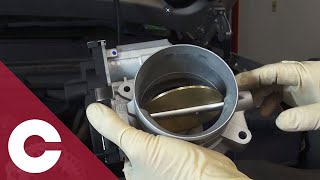
Typical fix: Replace the throttle position sensor. It is typically held on by two T20 Torx screws. 🎬 See this TPS testing and replacement walkthrough After replacement, perform an idle relearn procedure.
Est. part cost: $25-$60 - Wiring or Connector Issue 🟡 Medium Probability Engine vibration and heat can cause wires in the harness near the throttle body to break or chafe through the insulation, causing a short to ground. The connector pins can also corrode or become loose, creating a poor connection.
How to confirm: Visually inspect the TPS connector and wiring harness for any signs of damage, corrosion, or loose connections. With the key on, check for a steady 5-volt reference and a solid ground at the sensor's connector using a multimeter.
Typical fix: Repair the damaged section of wire or replace the pigtail connector.
Est. part cost: $15-$30
Rare But Worth Checking
- Short in a Shared 5V Reference Circuit: A detailed forum post for a 2005 Cavalier showed a recurring P0122 was caused by another sensor (like the A/C pressure or fuel tank pressure sensor) on the same 5-volt circuit shorting to ground. This can pull the voltage down for the entire circuit, falsely implicating the TPS. If a new TPS doesn't fix the code, this is worth investigating by unplugging other sensors on the shared circuit one by one.
- Faulty Powertrain Control Module (PCM): This is very rare, but the PCM can fail internally and stop providing the correct 5V reference or incorrectly read the signal from the TPS. This should only be considered after all other possibilities have been exhausted.
Diagnosis Steps
- Scan for Codes: Connect an OBD-II scanner to confirm P0122 and check for any other related codes.
- Live Data Check: Use the scanner's live data function to view the TPS percentage or voltage. With the key on, engine off, it should read near 0% (or ~0.5V) at closed throttle and increase smoothly to 100% (or ~4.5V) as you slowly press the gas pedal. Any jumps, dead spots, or a reading that is stuck low points to a problem.
- Visual Inspection: Inspect the TPS connector and its wiring harness for any obvious signs of damage, corrosion, or chafing, paying close attention to the area where the harness flexes near the throttle body.
- Test the Circuit at the Sensor: Disconnect the TPS. With the key on, use a multimeter to verify the three circuits at the connector: one should have a 5-volt reference, one should have a good ground (near 0 volts), and the third is the signal return to the PCM.
- Test the Sensor: If the circuit tests are good, the sensor itself is the most likely culprit. Replacing it is the next logical step.
- Advanced Diagnosis: If a new sensor and a good harness do not resolve the issue, investigate for a possible short in another sensor that shares the same 5V reference circuit, as noted in the 'rare causes' section.
- Post-Repair Relearn: After replacing the sensor, perform an idle relearn procedure to ensure the PCM correctly calibrates to the new sensor's baseline voltage.
Parts You'll Likely Need
- Throttle Position Sensor (TPS)
(OEM #ACDelco 213-912 (GM 88967283))— This sensor is the most common point of failure for code P0122. It is a wearable electronic component that fails with age and use.
Trusted brands: ACDelco (Original Equipment), Delphi (SS10465), Standard Motor Products (TH289), Walker Products (200-1308)
OEM price range: $50-$80
Aftermarket price range: $25-$60
Related Codes That Often Appear With This One
- P0121 — This code indicates a TPS performance/rationality error. It can appear alongside P0122 if the sensor's signal is erratic, not just low.
- P0123 — This code for TPS Circuit High Input can appear if the sensor's internal components short in a way that causes intermittent high and low voltage readings.
- P0222 — On drive-by-wire vehicles that share the Ecotec engine family, P0222 (TPS 'B' Circuit Low) is a common companion code, but it is not applicable to the cable-driven throttle on the 2002-2005 Cavalier.
Platform-Specific Known Issues
- An idle relearn procedure is highly recommended after replacing the TPS. A common method is to turn the ignition ON (engine off), slowly press the accelerator to the floor, slowly release it, turn the ignition OFF, then start the engine and let it idle for 10-15 minutes without accessories on. This helps the PCM sync with the new sensor's values.
Mechanic-Grade Diagnostic Values
- TPS 5V Reference Wire Voltage — expected: 4.5 to 5.0 Volts DC. Failure: Voltage below 4.5V indicates a problem with the PCM or a short in the 5V reference circuit.
- TPS Ground Wire Check — expected: 10 to 12 Volts DC (when testing between battery positive and the ground wire). Failure: No voltage indicates a bad ground connection from the PCM.
- TPS Signal Wire Voltage (Closed Throttle) — expected: 0.2 to 0.9 Volts DC. Failure: Voltage stuck below 0.2V will trigger code P0122.
- TPS Signal Wire Voltage (Wide-Open Throttle) — expected: ~4.5 Volts DC. Failure: Voltage does not reach ~4.5V or does not sweep smoothly, indicating a worn or faulty sensor.
- TPS Connector Pinout (2.2L Ecotec) — expected: Pin 1: 5V Reference (Gray wire), Pin 2: Signal (Dark Blue wire), Pin 3: Ground (Black wire). Failure: N/A - Reference for testing.
Wiring & Ground Locations
- G101 / G106 — Located at the front of the engine, lower block, and jumpers to the frame cross rail under the crank pulley.. This is a primary ground for the Engine Control Module (ECM). A poor connection here can cause various sensor errors, including TPS codes.
- G102 — Located at the left rear of the engine.. Provides ground for the ignition coils. While not directly for the TPS, a bad ground here can cause erratic engine behavior that might be misdiagnosed.
- G103 — Located on the cowl in the left rear of the engine compartment, above the brake booster.. This is a major body and module ground, grounding the BCM, Instrument Panel Cluster (IPC), and Data Link Connector (DLC). A fault here can cause communication and diagnostic issues.
- TPS Harness Chafe Point — The section of the engine wiring harness that runs near the main C100 connector and flexes with engine movement.. Vibration and heat can cause wires within this loom to chafe and short to ground. A forum user found the gray 5V reference wire had worn through its insulation in this area, causing a recurring P0122.
- Shared 5V Reference Circuit — Wiring to TPS, A/C Pressure Sensor, and Fuel Tank Pressure Sensor.. These three sensors share the same 5V reference from the PCM on the 2005 Cavalier. A short to ground in any one of these sensors or their wiring can pull the entire circuit's voltage down, triggering a P0122 code even if the TPS is good.
Real Owner Repair Stories
- ScannerDanner Forum (2005 Chevrolet Cavalier 2.2L Ecotec Automatic) — Recurring P0122, sometimes accompanied by P0452 (Fuel Tank Pressure Sensor Low Voltage). Symptoms included poor throttle response and incorrect transmission shifting.
❌ Tried (didn't work) Replaced the Throttle Position Sensor (TPS), Replaced the Fuel Tank Pressure sensor, Replaced the PCM with a junkyard unit, then a remanufactured unit, Cleaned the PCM ground on the cylinder head, Rewired the TPS 5V and signal wires directly from the PCM to the sensor
✅ What actually fixed it The owner found a gray wire in the main engine harness near the C100 connector that had two holes worn through the insulation, causing an intermittent short to ground. Repairing this section of the wire finally resolved the P0122 code. - 2CarPros Forum (1997 Chevrolet Cavalier 2.2L) — Persistent P0122 (TPS Voltage Low) that only appeared during the cold winter months and would disappear in warmer weather.
❌ Tried (didn't work) Replacing the TPS multiple times.
✅ What actually fixed it A professional technician suggested the cause was not the sensor but a break or corroded splice in the 5.0-volt reference wire. Temperature changes can cause wires to expand and contract, explaining the intermittent connection that was only present in cold weather. The final fix was to trace and repair the compromised 5V feed wire between the main splice and the TPS connector. - NHTSA ODI #11323165 (Chevrolet Owner Report) — An owner reported receiving a P0122 code after fast acceleration, which was accompanied by a constant shudder at low RPMs (30-50 mph), making it feel as if the car did not know what gear it wanted to be in.
- NHTSA ODI #10809597 (Chevrolet Owner Report) — A report describes a vehicle experiencing "Reduced Engine Power" and a series of OBD codes including P0122, P0010, P0202, and P0335, indicating that multiple electrical faults can sometimes manifest alongside the throttle circuit low input code.
OEM Part Supersession History
88967283 (GM)→The part number 213-912 (ACDelco) is the current and widely recognized replacement.— Standard part lifecycle update.
Heads up: The TPS for the 2.2L Ecotec is not adjustable. Attempts to adjust it are futile and may damage the new sensor.
Diagnostic Flowchart
Other Known Issues on This Vehicle
Issues unrelated to this code that are worth knowing about as an owner of this generation:
- Timing Chain Tensioner Failure 🔴 High — Very common on 2002-2004 models. The original tensioner design can fail due to oiling issues at idle, leading to chain rattle on startup, and if ignored, can cause the chain to jump time, resulting in catastrophic engine damage. (Ref: No official recall, but GM released an updated tensioner part. It is a highly recommended preventative maintenance item.)
- Fuel Pump Failure 🔴 High — Widespread reports of premature fuel pump failure, often occurring with little warning. Symptoms include a crank-no-start condition or engine stalling. (Ref: No recall, but a very common complaint among owners.)
- Ignition System Problems (Module/Coil/Switch) 🟠 Medium — Failures of the ignition control module, coil pack, and ignition switch are frequently reported, leading to random misfires (P0300), rough running, and no-start conditions. (Ref: There were recalls related to the ignition switch on other GM models, and while the Cavalier was affected by similar issues, formal recall coverage varied.)
- Leaking Intake Manifold Gaskets 🟠 Medium — The L61 uses four individual intake runner gaskets which are known to degrade over time, causing vacuum leaks. This can lead to a lean condition (P0171), rough idle, and poor performance.
Used vs. New Parts: Buying Guide for This Vehicle
When a used part is the smart pick: For this repair, buying a used Throttle Position Sensor is not recommended. It is a low-cost electronic wear item, and a used part from a junkyard has an unknown history and may fail quickly. The savings are minimal compared to the risk of having to do the job again.
What to inspect on the donor part:
- Not applicable as a used TPS is not advised.
OEM-only on this vehicle (don't cheap out):
- While not strictly 'OEM-only', using a known quality brand for electronic sensors like the TPS is critical. Cheap, unbranded sensors are a common source of repeat failures.
Aftermarket brands forum-validated for this vehicle:
- ACDelco (Original Equipment)
- Delphi (Often the OE manufacturer)
- Standard Motor Products (SMP)
- NGK/NTK
Brands owners have reported issues with on this vehicle:
- Unbranded, 'white-box' parts from online marketplaces are frequently cited in forums as having high failure rates for electronic components.
Real Owner Stories
Aggregated from forums and TSBs cited above. Mileages and costs reflect what owners reported in those sources.
2003 Chevrolet Cavalier 2.2L Ecotec
Symptoms: Check engine light for P0122, hesitation when accelerating, rough shifts, rough idle, vehicle will stall if given too much gas, cooling fan comes on and never goes off.
What fixed it: The owner had not found a fix at the time of posting despite replacing the TPS and inspecting wires.
Source hint: Reddit r/MechanicAdvice
2005 Chevrolet Cavalier 2.2L Ecotec
Symptoms: Recurring P0122 code.
What fixed it: Investigation into a possible short in another sensor sharing the same 5V reference circuit.
Source hint: ScannerDanner Forum thread titled '2005 Cavalier recurring P0122'
1997 Chevrolet Cavalier
Symptoms: P0122 code along with a P0300 random misfire; monitored TPS signal via OBD-II software showing a smooth sweep.
What fixed it: The smooth sweep pointed away from the sensor itself and towards an intermittent wiring or other issue.
Source hint: j-body.org - 'pulled the codes tonight'
Related OBD-II Codes
Frequently Asked Questions
How can I tell if the TPS on my 2.2L Ecotec Cavalier is actually bad or if it's just a wiring issue?
Is there a specific procedure I need to follow after replacing the TPS on my Cavalier?
Why does my Cavalier shift harshly or delay shifts when the P0122 code is active?
Are aftermarket sensors okay for the 2.2L Ecotec, or should I use OEM?
Could another sensor cause my P0122 code on a 2005 Cavalier?
What tools do I need to replace the TPS on my L61 engine?
Helpful Videos

We Have This Part in Stock

The information in this article is provided for general reference and educational purposes only. Vehicle specifications, procedures, and part compatibility can vary by production date, trim level, and region. Always consult your vehicle's factory service manual and verify part numbers before purchasing or performing repairs. Safety-critical components such as airbags, seat belts, and braking systems should be installed by a qualified professional.
- Chevrolet Cavalier:
- 🧭 Diagnostic Flowchart
- 🎬 Helpful Videos
- 🛍️ Shop This Part
- What's Unique About the 1995-2005 Chevrolet Cavalier
- Symptoms You May Notice
- Most Likely Causes
- Rare But Worth Checking
- Diagnosis Steps
- Parts You'll Likely Need
- Related Codes That Often Appear With This One
- Platform-Specific Known Issues
- Mechanic-Grade Diagnostic Values
- Wiring & Ground Locations
- Real Owner Repair Stories
- OEM Part Supersession History
- Other Known Issues on This Vehicle
- Used vs. New Parts: Buying Guide for This Vehicle
- Real Owner Stories
- 2003 Chevrolet Cavalier 2.2L Ecotec
- 2005 Chevrolet Cavalier 2.2L Ecotec
- 1997 Chevrolet Cavalier
- Related OBD-II Codes
- Frequently Asked Questions
- 🎟️ Get 5% Off