

P0122 on 2009-2017 Chevrolet Traverse 3.6L: Throttle Body Causes and Fixes
On a 2009-2017 Traverse with the 3.6L V6, code P0122 is almost always caused by a failing electronic throttle body assembly. The internal sensors wear out, triggering 'Reduced Engine Power' mode. The fix is to replace the entire unit, as the sensors are internal. This was such a common issue that GM issued Special Coverage Adjustment #14515 to cover replacement for 10 years/120,000 miles. Expect to pay $150-$280 for a quality aftermarket or OEM part, with DIY difficulty being 2 out of 5.
- P0122 on a 2009-2017 Traverse almost always means the throttle body assembly has failed.
- Symptoms will be severe, including 'Reduced Engine Power' mode, making the vehicle unsafe to drive in traffic.
- The fix is to replace the entire throttle body; the sensors inside cannot be replaced separately.
- This was a known issue covered by GM's Special Coverage Adjustment #14515 for 10 years/120,000 miles.
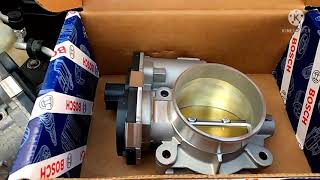
- Use a quality OEM (ACDelco) or reputable aftermarket (Bosch, SMP) part to avoid premature failure of the replacement part.
- After replacement, a simple idle relearn procedure is necessary and can be done without special tools.
What's Unique About the 2009-2017 Chevrolet Traverse
The first-generation Traverse and its GM Lambda platform siblings (GMC Acadia, Buick Enclave, Saturn Outlook) with the 3.6L V6 are well-known for electronic throttle body failures. The internal, non-serviceable sensors wear out, leading to codes like P0122. This issue is so common that GM issued Special Coverage Adjustment #14515 to address it. The simultaneous appearance of 'Reduced Engine Power,' 'Service Stabilitrak,' and 'Traction Control Off' warnings is often called the 'terrible trifecta' by owners when the throttle body fails.
Symptoms You May Notice
- Check Engine Light is on
- "Reduced Engine Power" message displayed on the dashboard
- "Service Stabilitrak" and/or "Traction Control Off" messages appear
- Poor, delayed, or no acceleration
- Rough or unstable idle
- Vehicle may stall, especially when coming to a stop
- Hard starting
- Replacing only the accelerator pedal position (APP) sensor. While the APP sensor is part of the throttle control system, P0122 specifically points to an issue at the throttle body itself.
- Cleaning a dirty throttle body. While carbon buildup can cause other idle and performance issues, it will not fix an electrical circuit low voltage code like P0122.
Most Likely Causes
- Failed Throttle Body Assembly 🔴 High Probability → Shop Fuel Injection Throttle Body The internal electronic sensors of the throttle body are a known failure point on this platform. They are not sold separately, requiring the replacement of the entire assembly. This was so common GM issued Special Coverage Adjustment #14515, extending the warranty on this part to 10 years or 120,000 miles.
How to confirm: Use an OBD-II scanner with live data to monitor the 'TP Sensor 1' voltage. With the key on and engine off, the voltage will likely be stuck below 0.2V and will not change smoothly as the gas pedal is pressed. A healthy sensor should read around 0.4-0.5V at closed throttle and sweep smoothly up to ~4.5V at wide-open throttle.
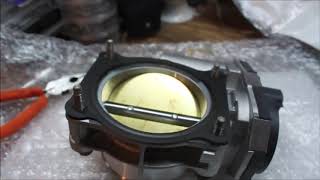
Typical fix: Replace the entire throttle body assembly and the throttle body gasket. 🎬 Watch: Step-by-step Chevrolet Traverse throttle body replacement guide After replacement, an idle relearn procedure must be performed.
Est. part cost: $150-$280 - Wiring Harness or Connector Issue 🟡 Medium Probability The wiring harness leading to the throttle body can be susceptible to damage from heat, vibration, or improper servicing, leading to a short to ground or an open circuit. The connector has 6 pins that control the throttle motor and send sensor signals.
How to confirm: Visually inspect the wiring and the 6-pin connector for any signs of damage, corrosion, or loose pins. Perform a 'wiggle test' on the harness while watching live data for voltage changes. Use a multimeter to check for the 5V reference signal, ground, and signal wire continuity at the connector terminals per the service manual.
Typical fix: Repair the damaged section of the wire or replace the connector pigtail.
Est. part cost: $20-$50
Rare But Worth Checking
- Faulty Powertrain Control Module (PCM): This is extremely rare and should only be considered after all other possibilities, including the throttle body and wiring, have been exhaustively tested and ruled out. A faulty PCM could fail to provide the 5V reference to the sensor.
Diagnosis Steps
- Connect an OBD-II scanner to verify the P0122 code and check for any other related codes like P0222 or P2135.
- Access live data on the scanner and monitor the voltage for 'TP Sensor 1'. With the Key On, Engine Off, the voltage should be low but not near zero (typically ~0.4-0.5V).
- Slowly press the accelerator pedal to the floor. The voltage should increase smoothly to ~4.5V. If the voltage is stuck at a very low value (e.g., under 0.2V) or does not change, the throttle body is likely faulty.
- If the voltage is erratic, perform a 'wiggle test' on the wiring harness near the throttle body connector to see if the voltage reading jumps, indicating a wiring issue.
- If wiring is suspected, disconnect the throttle body connector. Inspect the 6-pin connector terminals for corrosion, damage, or being loose.
- Using a multimeter and the vehicle's service manual, check for the correct 5V reference and good ground at the connector.
- If all wiring and connections test good, the high probability cause is a failed throttle body assembly.
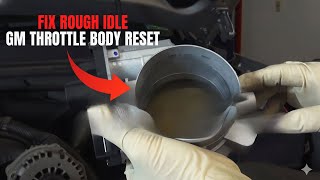
- After replacement, perform an Idle Relearn Procedure. 🎬 See how to manually perform the GM idle relearn This typically involves turning the ignition on (engine off) for 60 seconds, then off for 30 seconds, and then starting the vehicle.
Parts You'll Likely Need
- Throttle Body Assembly
(OEM #12694873 (supersedes 12670981, 12632172))— This is the most common cause of P0122 on this vehicle because the internal throttle position sensors are a known failure point and are not serviceable separately.
Trusted brands: ACDelco (GM Genuine), Bosch, Standard Motor Products (SMP), Hitachi
OEM price range: $200-$280
Aftermarket price range: $150-$220 - Throttle Body Gasket
(OEM #12620321)— The gasket provides the seal between the throttle body and the intake manifold. It is crucial to replace it anytime the throttle body is removed to prevent vacuum leaks. New throttle bodies often come with a new gasket.
Trusted brands: ACDelco, Fel-Pro, Mahle
OEM price range: $5-$15
Aftermarket price range: $3-$10
Related Codes That Often Appear With This One
- P0222 — This is the code for 'Throttle Position Sensor 2 Circuit Low Voltage'. Seeing both P0122 and P0222 together strongly suggests a problem common to both sensors, like a loss of the 5-volt reference or ground circuit at the throttle body.
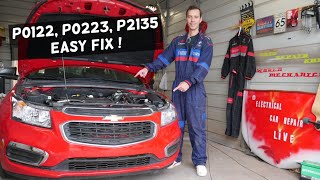
- P2135 — This code for 'Throttle/Pedal Position Sensor/Switch 'A'/'B' Voltage Correlation' is very common with P0122. It means the signals from Sensor 1 and Sensor 2 do not agree, which is expected when one sensor has failed and is reporting a low voltage. GM TSB 11-06-04-007B was issued for this code, 🎬 Watch: How to diagnose and fix these correlation codes often leading to throttle body replacement.
Technical Service Bulletins (TSBs) & Recalls
- GM Special Coverage Adjustment #14515: Specifically covers the throttle position sensor failure causing reduced power mode for 10 years/120,000 miles. It instructs dealers to replace the throttle body assembly.
- GM TSB 11-06-04-007B: While not for P0122 directly, this TSB is often cited for diagnosing the related code P2135, which frequently appears with P0122 and also leads to throttle body replacement.
Platform-Specific Known Issues
- The electronic throttle body is a widely-recognized weak point on the 2009-2017 GM Lambda platform vehicles, including the Traverse.
- Failure often triggers a 'trifecta' of warnings: Check Engine Light, Reduced Engine Power, and Service Stabilitrak.
- GM acknowledged this widespread issue by issuing Special Coverage Adjustment #14515, which extended the warranty for this specific failure to 10 years or 120,000 miles.
Mechanic-Grade Diagnostic Values
- Throttle Actuator Control (TAC) Motor Resistance — expected: 2 to 15 Ohms. Failure: An Over Limit (OL) reading indicates an open circuit in the motor.
- TPS Sensor Resistance (between shared terminals C and E) — expected: ~1.5 kOhms. Failure: A reading of less than 1 Ohm indicates a short; an OL reading indicates an open circuit.
- TPS1 Sensor Sweep Resistance (terminals D and E) — expected: Starts at ~2.7 kOhms (closed throttle), smoothly increases as throttle opens.. Failure: No change, erratic jumps, or gaps in resistance reading as the throttle plate is moved.
- TPS2 Sensor Sweep Resistance (terminals E and F) — expected: Starts at ~2.2 kOhms (closed throttle), smoothly decreases as throttle opens.. Failure: No change, erratic jumps, or gaps in resistance reading as the throttle plate is moved.
Scan Tool Commands That Help
- GDS2 (GM Global Diagnostic System 2): Module Diagnostics > Engine Control Module > Control Functions > Throttle Body Relearn — Required after replacing the throttle body assembly to allow the ECM to learn the new sensor's idle and wide-open throttle positions. Failure to perform this can result in incorrect idle speed, poor performance, and persistent codes.
- GDS2 (GM Global Diagnostic System 2): Data Display > Engine Data — To monitor live voltage readings of TP Sensor 1 and TP Sensor 2 simultaneously while operating the throttle. This is the primary method for confirming a sensor failure, as one will typically be stuck at a low voltage while the other may respond normally.
- Tech2/Tech2Win: Special Functions > Idle Learn Reset — For earlier models in the range (approx. 2009-2012), the Tech2 scanner may be used. This function resets the learned idle values in the ECM, forcing a relearn.
Wiring & Ground Locations
- G103 / G104 — G103 is on the front of the passenger side (Bank 1) cylinder head. G104 is on the rear of the driver's side (Bank 2) cylinder head.. These are primary engine grounds for the ECM. A loose or corroded ground at these points can create an unstable reference voltage for all engine sensors, including the throttle position sensors, leading to false codes and erratic behavior.
- Throttle Body Connector (X108) — The 6-pin electrical connector attached directly to the throttle body assembly.. This is the single point of failure for all signals to and from the throttle body. Technicians back-probe this connector to test for 5V reference, ground, and the two separate TPS signal wire voltages to isolate the fault between the wiring harness and the throttle body itself.
- X202 Connector — A large bulk connector located behind the driver's side kick panel, near where the driver's left foot would be.. The wiring for the Accelerator Pedal Position (APP) sensor runs through this connector. If the sunroof drain tubes get clogged, water can leak into this area and cause corrosion in the X202 connector, leading to throttle-related codes like P2135, which is often seen with P0122.
Real Owner Repair Stories
- 2CarPros Forum (Vehicle not specified, but GM with electronic throttle) — Check engine light with codes P0122, P0223, and P2135.
❌ Tried (didn't work) Replaced the throttle body with a new Bosch unit., Disconnected the battery for 20 minutes to reset the ECM.
✅ What actually fixed it The issue was diagnosed as a problem in the wiring or connectors, not the new throttle body. The expert advised checking live data for both TPS sensors and inspecting the pins in the throttle body connector for looseness or corrosion, as even a small voltage discrepancy can prevent the relearn procedure from completing and keep the codes set as 'permanent'.
Documented NHTSA Reports
- An owner of a similar GM vehicle reported receiving a P0122 code specifically after fast acceleration, accompanied by a shudder at low RPMs between 30-50 MPH (NHTSA ODI #11323165).
- NHTSA ODI #10809597 describes a scenario where Stabilitrak and Reduced Engine Power warnings were accompanied by a large cluster of codes including P0122, P0010, P0202, and P1682.
OEM Part Supersession History
12616995, 12607330, 12593591→12632172, then 12670981, final is 12694873— GM regularly updates part designs to integrate new materials and technologies, likely to improve the durability of the internal sensors that were a common failure point.
Heads up: The latest part number, 12694873, is the recommended replacement for all years in this generation. Using older, superseded part numbers is not advised.
Model Year Variations Within This Range
- 2009-2012 (LLT) vs 2013-2017 (LFX): The LLT and LFX engines, while both 3.6L V6, have different electrical connectors for the throttle body and use different ECMs (Bosch for LLT, Delphi for LFX). While the throttle bodies may physically bolt on, they are not electrically interchangeable without modifying the wiring harness. It is critical to order the part specific to the vehicle's model year and engine code.
- 2010+ vs pre-2010: Diagnostic software requirements changed. Models from 2010 and newer require the GDS2 software platform for dealer-level diagnostics, while earlier models may use the older Tech2/Tech2Win system.
Diagnostic Flowchart
Other Known Issues on This Vehicle
Issues unrelated to this code that are worth knowing about as an owner of this generation:
- Premature Timing Chain Stretch (LLT Engine) 🔴 High — Very common on 2009-2012 models, often appearing between 70,000 and 120,000 miles. Triggers codes like P0008, P0017. (Ref: Special Coverage Adjustment 11340C extended warranty to 10 years/120,000 miles.)
- Cracked 3-5-R Wave Plate (6T70/6T75 Transmission) 🔴 High — Common on 2009 models, leading to loss of 3rd, 5th, and Reverse gears. Can occur around 100,000 miles. (Ref: Special Coverage Adjustment 14404B extended warranty to 10 years/120,000 miles for this specific failure.)
- Power Steering Pump Failure / Leaks 🟠 Medium — Common on earlier models (2009-2012), causing whining noise and loss of power assist, especially at low speeds. (Ref: Special Coverage Adjustment 14329 extended warranty to 10 years/150,000 miles for pump replacement.)
- EVAP Purge Valve Failure 🟡 Low — A frequent but less severe issue causing a P0496 code, rough idle after refueling, and difficulty starting.
- Leaking A/C Lines to Rear HVAC 🟠 Medium — The aluminum lines running to the rear A/C unit are prone to corrosion and leaking refrigerant, causing loss of A/C performance.
- Master Power Window Switch Failure 🟡 Low — Very common failure of the driver's side window switch panel, causing one or more windows to become inoperable.
Used vs. New Parts: Buying Guide for This Vehicle
When a used part is the smart pick: A used throttle body is a high-risk purchase for this specific vehicle. Because the internal electronics are a known, common failure point, a used part from a junkyard has a high probability of either being faulty already or failing shortly after installation. It should only be considered in an extreme budget crunch where the donor vehicle's history and low mileage (<60,000 miles) can be verified.
Donor-vehicle mileage cap: roughly under 60000 miles for the part to have meaningful remaining life.
What to inspect on the donor part:
- Verify the part number matches the required one for your specific year (LLT vs LFX).
- Inspect the electrical connector pins for any green or white corrosion, or any bent pins.
- Look into the throttle bore; excessive, thick black carbon buildup may indicate the donor engine had other issues.
- Ask for the donor vehicle's VIN to check for any open recalls or to confirm mileage if possible.
Aftermarket brands forum-validated for this vehicle:
- ACDelco (GM Genuine/Original Equipment)
- Bosch (Often the OEM supplier)
- Hitachi
- Standard Motor Products (SMP)
Brands owners have reported issues with on this vehicle:
- Unbranded, 'white box' parts from online marketplaces are frequently cited in forums as failing prematurely or being dead-on-arrival.
- Dorman has a mixed reputation among DIY communities; while some 'OE Fix' parts are improvements, their standard replacement parts are sometimes considered lower quality than OEM or other premium aftermarket brands.
Real Owner Stories
Aggregated from forums and TSBs cited above. Mileages and costs reflect what owners reported in those sources.
2012 Chevrolet Traverse 3.6L V6
Symptoms: Dashboard displayed 'Stabilitrack' and 'Reduced Engine Power' lights simultaneously.
What fixed it: Replacement of the throttle body assembly.
Source hint: traverseforum.com thread titled 'Stabilitrack/ Reduced Engine Power'
2009 GMC Acadia 3.6L V6
Symptoms: Vehicle threw codes P0122 and P0223.
What fixed it: Replacement of the throttle body assembly.
Source hint: 2CarPros thread via acadiaforum.net
Related OBD-II Codes
Frequently Asked Questions
Is there a warranty extension for the throttle body on my 2012 Chevrolet Traverse?
My Traverse is showing 'Reduced Engine Power' and 'Service Stabilitrak' at the same time. Are these related to P0122?
Can I just replace the sensor on the throttle body to fix the P0122 code?
What is the 'Idle Relearn Procedure' I need to do after replacing the throttle body?
Does GM TSB 11-06-04-007B apply to my P0122 code?
Are there other common issues on the 2009 Traverse I should watch for while fixing this?
Helpful Videos
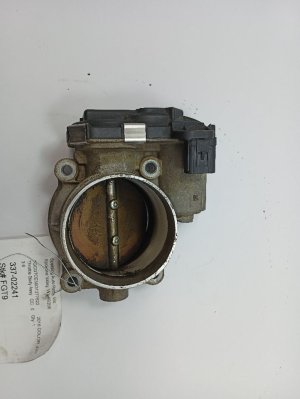
We Have This Part in Stock

The information in this article is provided for general reference and educational purposes only. Vehicle specifications, procedures, and part compatibility can vary by production date, trim level, and region. Always consult your vehicle's factory service manual and verify part numbers before purchasing or performing repairs. Safety-critical components such as airbags, seat belts, and braking systems should be installed by a qualified professional.
- Chevrolet Traverse:
- 🧭 Diagnostic Flowchart
- 🎬 Helpful Videos
- 🛍️ Shop This Part
- What's Unique About the 2009-2017 Chevrolet Traverse
- Symptoms You May Notice
- Most Likely Causes
- Rare But Worth Checking
- Diagnosis Steps
- Parts You'll Likely Need
- Related Codes That Often Appear With This One
- Technical Service Bulletins (TSBs) & Recalls
- Platform-Specific Known Issues
- Mechanic-Grade Diagnostic Values
- Scan Tool Commands That Help
- Wiring & Ground Locations
- Real Owner Repair Stories
- Documented NHTSA Reports
- OEM Part Supersession History
- Model Year Variations Within This Range
- Other Known Issues on This Vehicle
- Used vs. New Parts: Buying Guide for This Vehicle
- Real Owner Stories
- 2012 Chevrolet Traverse 3.6L V6
- 2009 GMC Acadia 3.6L V6
- Related OBD-II Codes
- Frequently Asked Questions
- 🎟️ Get 5% Off