

P0122 on 2007-2014 Ford Edge: Throttle Body Failure Causes, Symptoms, and Fixes
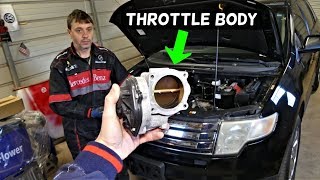
On a 2007-2014 Ford Edge, code P0122 almost always means the electronic throttle body has failed, causing a sudden loss of power or 'limp mode'. The only reliable fix is to replace the entire throttle body assembly. Expect to pay $100-$250 for the part, with a DIY difficulty of 2/5.
- P0122 on a 2007-2014 Edge is a critical code that makes the vehicle unsafe to drive due to the risk of sudden power loss.
- The cause is almost certainly a failed electronic throttle body assembly; this is a very common and well-documented problem for this vehicle, acknowledged by Ford with an extended warranty program.
- Do not waste time or money just cleaning the throttle body; the entire unit must be replaced as the fault is internal and electronic.
- Ensure you purchase the correct part number, as it differs between 2007-2010 (7T4Z-9E926-FA) and 2011-2014 (AT4Z-9E926-B) models.
- After replacement, perform a KAM reset and throttle relearn procedure for proper idle and performance.
What's Unique About the 2007-2014 Ford Edge
The first-generation Ford Edge with the 3.5L/3.7L V6 is notorious for premature electronic throttle body (ETB) failure. The internal electrical contacts within the sealed ETB are prone to contamination and wear, causing intermittent signal loss. This issue was so widespread that Ford issued Customer Satisfaction Program 13N03, extending the warranty on the ETB to 10 years or 150,000 miles for many vehicles. While cleaning the throttle body is a common first step for many codes, it is almost never a permanent fix for P0122 on this platform; the problem is an internal electronic failure within the sealed sensor unit, not just carbon buildup on the throttle plate.
Generation note: The 2007-2014 year range covers the entire first generation of the Ford Edge. However, there was a significant mid-cycle refresh for the 2011 model year. This is important because the throttle body part number is different for 2007-2010 models versus 2011-2014 models.
Symptoms You May Notice
- Sudden and severe loss of engine power ('limp mode')
- Wrench warning light illuminated on the dashboard
- Check Engine Light on
- No throttle response (pressing the gas pedal does nothing)
- Unstable, rough, or high idle
- Engine stalling, especially when coming to a stop
- Hesitation or stumbling during acceleration
- Service AdvanceTrac warning message may appear simultaneously
- Replacing the accelerator pedal assembly. While the pedal also has position sensors, the combination of codes (P0122, P0223, P211x) and the known history of ETB failures on this platform make the throttle body the primary suspect.
- Attempting to clean the throttle body. While a dirty throttle plate can cause idling issues, it will not fix the internal electronic failure that triggers code P0122 on this vehicle.
Most Likely Causes
- Failed Electronic Throttle Body (ETB) Assembly 🔴 High Probability → Shop Fuel Injection Throttle Body A known widespread defect involving contamination of the internal electrical contacts of the throttle body motor. This was acknowledged by Ford's Customer Satisfaction Program 13N03, which extended the warranty to 10 years/150,000 miles.
How to confirm: Scan for codes P0122, often accompanied by P0223, P2110, P2111, or P2112. The primary symptom is the vehicle entering 'limp mode' with the wrench light on. If these conditions are met, the ETB has almost certainly failed.
Typical fix: Replace the entire electronic throttle body assembly. Cleaning the old unit is not a reliable or long-term solution because the failure is internal to the sealed electronics.
Est. part cost: $100-$250
Rare But Worth Checking
- Wiring Harness or Connector Issue: Check the wiring harness and electrical connector at the throttle body for damage, corrosion, or loose pins before replacing the part. A poor connection can mimic the symptoms of a failed sensor.
- Powertrain Control Module (PCM) Failure: This is extremely rare. The PCM should only be considered a potential cause after the throttle body has been replaced with a known-good part and all wiring has been thoroughly checked and confirmed to be in good condition.
Diagnosis Steps
- Use an OBD-II scanner to confirm code P0122 and check for other related codes like P0223, P2110, P2111, or P2112.
- Note the symptoms. If the vehicle is in 'limp mode' with the wrench light on, a failed throttle body is the most probable cause.
- Visually inspect the electrical connector and wiring harness leading to the throttle body. Look for any obvious damage, corrosion, or loose connections.
- Given the extremely high failure rate of this part on the Ford Edge, if the codes and symptoms point to the throttle body, the most direct and effective step is to replace the entire assembly.
- After replacement, clear all diagnostic trouble codes.
- Perform a Keep Alive Memory (KAM) reset and throttle relearn procedure. A common method is to disconnect the negative battery terminal for at least 15-30 minutes. After reconnecting, start the engine with all accessories off and let it idle until it reaches normal operating temperature, then let it idle for at least one more minute. Finally, turn the A/C on and let it idle for another minute. Driving the vehicle for 10-15 miles will help the PCM and transmission fully adapt. 🎬 See how to perform a proper electronic throttle calibration.
Parts You'll Likely Need
- Electronic Throttle Body Assembly (2007-2010)
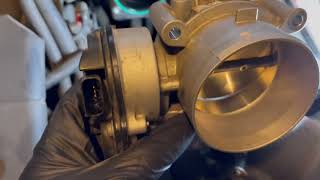
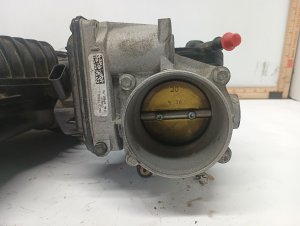
(OEM #7T4Z-9E926-FA)— This is the specific part for the pre-refresh first-generation Edge. It contains the sensors and motor that fail, causing code P0122. This part supersedes 7T4Z-9E926-EA.
Trusted brands: Motorcraft, Bosch, Hitachi, Standard Motor Products (SMP)
OEM price range: $180-$250
Aftermarket price range: $100-$160 - Electronic Throttle Body Assembly (2011-2014)
(OEM #AT4Z-9E926-B)— This is the specific part for the refreshed first-generation Edge (3.5L/3.7L). It supersedes part number AT4Z-9E926-A.
Trusted brands: Motorcraft, Bosch, Standard Motor Products (SMP), Cardone
OEM price range: $200-$280
Aftermarket price range: $120-$180
Related Codes That Often Appear With This One
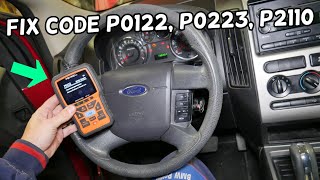
- P0223 — This code ('Throttle/Pedal Position Sensor 'B' Circuit High Input') refers to the second throttle position sensor circuit. When the 'A' and 'B' sensor circuits show opposite faults (one low, one high), it's a classic sign of internal throttle body failure. 🎬 Watch this video to see these specific codes diagnosed.
- P2110, P2111, or P2112 — These codes relate to the Throttle Actuator Control (TAC) system. They indicate the PCM has detected a problem with the throttle plate's movement (forced limited RPM, stuck open, or stuck closed) and has initiated limp mode as a result.
Technical Service Bulletins (TSBs) & Recalls
- Customer Satisfaction Program 13N03: Extended warranty coverage for the electronic throttle body due to 'contamination on the internal motor contacts of the Throttle Body, resulting in intermittent electrical connectivity'.
Platform-Specific Known Issues
- Ford's Customer Satisfaction Program 13N03 was issued to extend the warranty on the throttle body for many Ford vehicles, including the Edge, to 10 years or 150,000 miles due to a high rate of failure. This confirms a widespread manufacturing or design defect with the original part.
Mechanic-Grade Diagnostic Values
- TPS 'A' Circuit Voltage (TP1) — expected: Approx. 0.5V - 1.0V at idle, sweeping smoothly up to approx. 4.5V - 4.7V at Wide Open Throttle (WOT).. Failure: Voltage is below 0.2V - 0.3V with key on, engine off, or signal is erratic/has dead spots during sweep test.
- TPS 'B' Circuit Voltage (TP2) — expected: Operates inverse to TP1. Approx. 4.5V at idle, sweeping smoothly down to approx. 0.5V - 1.0V at WOT.. Failure: Voltage does not sweep smoothly or does not correlate correctly with TP1. A P0122 (low) on TP1 is often paired with a P0223 (high) on TP2, indicating internal failure.
- 5-Volt Reference Voltage at ETB Connector — expected: Steady 5.0 volts with key on, engine off.. Failure: Voltage is significantly lower than 5.0V or is absent. This indicates a wiring issue or a problem with the PCM.
- Ground Circuit at ETB Connector — expected: Near 0 volts when testing between the ground pin and the battery negative terminal.. Failure: Any significant voltage reading indicates a poor ground connection.
- Internal TPS Resistance (testing off-vehicle) — expected: Typically between 1-10 kΩ. Resistance should sweep smoothly as the throttle plate is manually moved.. Failure: Infinite resistance (open circuit), near-zero resistance (short), or jumpy/erratic readings during the sweep.
Scan Tool Commands That Help
- Ford IDS (Integrated Diagnostic System) or equivalent pro-level scanner (e.g., FORScan): Live Data Graphing (PID: TP1, TP2, APP1, APP2) — This is the most effective way to diagnose an intermittent failure. Graphing the two TP sensor voltages (TP1 and TP2) simultaneously while slowly operating the pedal (or with the engine running) can reveal voltage dropouts or glitches that a simple multimeter test might miss. The two signals should produce a clean, mirrored 'X' pattern on the graph.
- Ford IDS (Integrated Diagnostic System): PCM Reset / Clear KAM — This function must be performed after replacing the throttle body. It erases the old adaptive learning values stored in the Keep Alive Memory (KAM), forcing the PCM to relearn the idle and throttle positions of the new component. Failing to do this can result in a persistent high idle or poor performance after the repair.
- Ford IDS (Integrated Diagnostic System): Throttle Body Calibration / Service Functions — Some Ford models have a specific guided function to calibrate a new throttle body. Using this function ensures the PCM correctly learns the closed, open, and part-throttle positions of the new part.
Wiring & Ground Locations
- Electronic Throttle Body Connector (C1752 on some diagrams) — On the electronic throttle body itself, located between the air filter housing and the intake manifold.. This is the primary connection point for all power, ground, and signal wires related to the throttle position sensors and throttle motor. Corrosion or damage here is a common cause of P0122. The 6 pins are typically: Pin 1: TP2 Signal, Pin 2: TP Ground/Signal Return, Pin 3: TP1 Signal, Pin 4: 5V Reference, Pin 5: Throttle Motor (-), Pin 6: Throttle Motor (+).
- G103 / G104 (example identifiers) — Main engine-to-chassis grounds are typically located on the driver's side strut tower or on the engine block itself, connected to the frame rail. For the 2011+ models, a primary ground stud is located on the firewall to the right of the battery.. A poor engine ground can cause a voltage differential between the sensor's ground reference and the PCM's ground, leading to erratic sensor readings and codes like P0122. While not the most common cause for this specific issue, it's a fundamental check for any electronic fault.
- G201 / G202 — Located in the driver's (G201) and passenger's (G202) kick panel areas.. These are major interior ground points. While less likely to be the direct cause, they provide grounding for modules like the BCM which communicates with the PCM, and a fault here can cause a wide range of seemingly unrelated electronic issues.
Real Owner Repair Stories
- Ford Edge Forum User (2008 Ford Edge SEL 3.5L) — Engine stalling at stops and in low RPMs, fluctuating idle, but only after the engine is fully warmed up (30+ minutes of driving).
❌ Tried (didn't work) Replacing the throttle body with three different used units, Checking engine timing and cylinder head, Repairing catalysts, Replacing Crankshaft Sensor, Oxygen Sensors, MAF Sensor, Fan Module, Water Pump, Thermostat, and entire A/C system, Testing for vacuum leaks, Swapping the PCM with a test unit
✅ What actually fixed it The user did not post a final resolution, but their experience serves as a powerful cautionary tale: replacing the known-faulty throttle body with multiple used parts did not solve the problem, strongly implying that only a new, known-good part is a reliable fix.
OEM Part Supersession History
7T4Z-9E926-EA→7T4Z-9E926-FA— Likely an internal revision to improve reliability and address the contact contamination issue that led to widespread failures.AT4Z-9E926-A→AT4Z-9E926-B— Internal revision to improve reliability, similar to the pre-refresh part.
Model Year Variations Within This Range
- 2007-2010 vs 2011-2014: The electronic throttle body is physically different and has a different part number between the pre-refresh (2007-2010) and post-refresh (2011-2014) models. They are not interchangeable. The PCM and related wiring also changed with the 2011 refresh.
Diagnostic Flowchart
Other Known Issues on This Vehicle
Issues unrelated to this code that are worth knowing about as an owner of this generation:
- Power Transfer Unit (PTU) Failure 🔴 High — Common in AWD models, can fail as early as 40,000-50,000 miles. The sealed unit's fluid overheats and degrades due to proximity to the exhaust, leading to gear failure. (Ref: No recall, but a well-known design flaw. Dorman offers an OE FIX replacement with a drain plug (p/n 600-234XD) to allow for fluid changes.)
- Brake Booster Failure 🔴 High — A tear can develop in the booster's internal diaphragm, leading to a hard brake pedal and increased stopping distances. (Ref: Customer Satisfaction Program 13N02 / NHTSA 16S24/16V345 extended the warranty to 10 years or 150,000 miles for this component.)
- Door Ajar Sensor Failure 🟡 Low — Extremely common. The sensor switch inside the door latch assembly fails, causing the 'Door Ajar' light to stay on, which keeps the interior dome lights on and can drain the battery. (Ref: No recall. Common DIY fixes involve bypassing the faulty switch by grounding the sensor wire in the door harness or physically breaking the switch in the latch.)
- Coolant Intrusion in EcoBoost Engines 🔴 High — Primarily affects 2.0L EcoBoost engines (not the 3.5L/3.7L V6) from 2015-2018 models. A design flaw can allow coolant to leak into the cylinders, leading to misfires and eventual engine failure. (Ref: Subject of multiple class-action lawsuits (e.g., *Chalos v. Ford Motor Co.*).)
- Water Leaks into Cabin 🟠 Medium — Commonly reported issue where water leaks into the cabin, often from poorly sealed A-pillar body seams or clogged sunroof drains, potentially damaging electronics.
Used vs. New Parts: Buying Guide for This Vehicle
When a used part is the smart pick: For this specific repair (P0122 on a Ford Edge), buying a used throttle body from a junkyard or online seller is **NEVER** recommended. The part has a well-documented, high rate of internal electronic failure that is not mileage-dependent. A used part is highly likely to be already faulty or fail very soon after installation.
What to inspect on the donor part:
- Not applicable. Do not purchase a used electronic throttle body for this vehicle.
OEM-only on this vehicle (don't cheap out):
- Electronic Throttle Body Assembly
Aftermarket brands forum-validated for this vehicle:
- Bosch
- Hitachi
- Standard Motor Products (SMP)
Brands owners have reported issues with on this vehicle:
- Unbranded, 'white-box' parts from online marketplaces. While some may work initially, forum discussions and mechanic advice strongly favor sticking to OEM (Motorcraft) or reputable Tier 1 aftermarket suppliers for this critical component to avoid repeat failures.
Real Owner Stories
Aggregated from forums and TSBs cited above. Mileages and costs reflect what owners reported in those sources.
2007 Ford Edge SE
Symptoms: Car seemingly lost all power while driving on the highway, multiple dash lights including the wrench light illuminated, high/erratic RPMs (1200ish) when idle.
What fixed it: Replacement of the Electronic Throttle Body (ETB) assembly.
Source hint: Reddit r/MechanicAdvice
2008 Ford Edge AWD
Symptoms: Owner reported a PTU leak, which is a common related platform issue where sealed unit fluid overheats and degrades.
What fixed it: PTU replacement.
Cost: $1600-$1600
Source hint: Ford Edge Forum - '2008 Edge AWD PTU leak'
2013 Ford Edge
Symptoms: PTU issues requiring seal replacement or full unit replacement.
What fixed it: PTU seal replacement or full unit replacement.
Cost: $1300-$3000
Source hint: Reddit r/FordEdge - 'PTU issues'
Related OBD-II Codes
Frequently Asked Questions
Is there a warranty extension for the throttle body on my Ford Edge?
My Edge is in 'limp mode' with a wrench light and P0122; can I just clean the throttle body?
Why did my Service AdvanceTrac light come on at the same time as the P0122 code?
What is the correct throttle relearn procedure for the 3.5L Cyclone V6 after replacing the ETB?
Are there other major issues I should watch for on my 2007-2014 Edge besides the throttle body?
Helpful Videos

Used OEM Parts in Stock
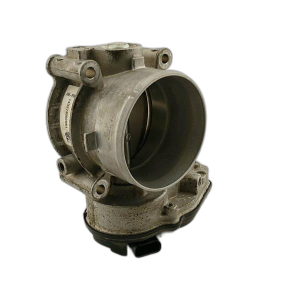
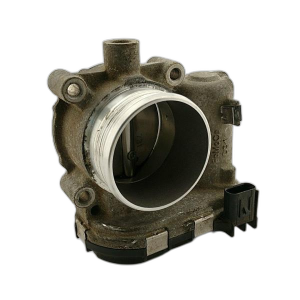
New Aftermarket Parts Available


The information in this article is provided for general reference and educational purposes only. Vehicle specifications, procedures, and part compatibility can vary by production date, trim level, and region. Always consult your vehicle's factory service manual and verify part numbers before purchasing or performing repairs. Safety-critical components such as airbags, seat belts, and braking systems should be installed by a qualified professional.
- Ford Edge:
- 🧭 Diagnostic Flowchart
- 🎬 Helpful Videos
- 🛍️ Shop This Part
- What's Unique About the 2007-2014 Ford Edge
- Symptoms You May Notice
- Most Likely Causes
- Rare But Worth Checking
- Diagnosis Steps
- Parts You'll Likely Need
- Related Codes That Often Appear With This One
- Technical Service Bulletins (TSBs) & Recalls
- Platform-Specific Known Issues
- Mechanic-Grade Diagnostic Values
- Scan Tool Commands That Help
- Wiring & Ground Locations
- Real Owner Repair Stories
- OEM Part Supersession History
- Model Year Variations Within This Range
- Other Known Issues on This Vehicle
- Used vs. New Parts: Buying Guide for This Vehicle
- Real Owner Stories
- 2007 Ford Edge SE
- 2008 Ford Edge AWD
- 2013 Ford Edge
- Related OBD-II Codes
- Frequently Asked Questions
- 🎟️ Get 5% Off