

P0122 on 2001-2008 Ford Escape: Throttle Position Sensor Low Input Causes and Fixes
For a 2001-2008 Ford Escape, code P0122 is almost always caused by a failed Throttle Position Sensor (TPS). On these models, it's an inexpensive, separate part that's easy to replace. Expect to pay $30-$60 for a quality aftermarket sensor, with DIY difficulty rated at 2/5.
- P0122 on a 2001-2008 Escape almost always points to a bad Throttle Position Sensor (TPS).
- Unlike newer Escapes, the sensor on these models is a separate, inexpensive part that is easy for a DIYer to replace.
- Symptoms include hesitation, stalling, and erratic automatic shifting.
- Before replacing the sensor, check its connector for corrosion and test the signal voltage with a multimeter to confirm the failure.
- Using a quality replacement sensor from a brand like Motorcraft, NGK, or Delphi is recommended for long-term reliability.
What's Unique About the 2001-2008 Ford Escape
A key advantage for the 2001-2008 Ford Escape is that the Throttle Position Sensor (TPS) is a separate, bolt-on component for all common engines (2.0L I4, 2.3L I4, and 3.0L V6). This makes the repair significantly cheaper and easier than on 2009 and newer Escapes, which use an integrated Electronic Throttle Body (ETB) that requires replacing the entire assembly. While some V6 models were recalled for a sticking cruise control cable, that was a mechanical issue separate from the electronic failure that triggers P0122.
Generation note: This range covers the first generation (2001-2007) and the first year of the second generation (2008). For this specific fault, the diagnosis and repair are consistent because these models all use a separate, replaceable Throttle Position Sensor rather than the integrated electronic throttle body found in later years. The 2008 model is a transitional year with new styling but the same powertrain and TPS design as the 2005-2007 models.
Symptoms You May Notice
- Check Engine Light is on
- Hesitation, stumbling, or a 'dead spot' when pressing the accelerator
- Rough, unstable, or surging idle
- Engine stalling, especially when coming to a stop or at low speeds
- Lack of engine power or sluggish performance
- Harsh, delayed, or erratic automatic transmission shifting
- Reduced fuel economy
- Car enters 'limp mode' with minimal acceleration
- Replacing the entire throttle body assembly. On 2001-2008 models, this is unnecessary as the sensor is sold separately.
- Assuming a transmission problem due to hard or erratic shifting, when the root cause is the incorrect signal from the TPS.
Most Likely Causes
- Failed Throttle Position Sensor (TPS) 🔴 High Probability → Shop Fuel Injection Throttle Body The sensor is a moving part (a potentiometer) that wears out over time from constant use and exposure to engine heat and vibration. The internal resistive track develops 'dead spots'.
How to confirm: With the key on and engine off, back-probe the TPS signal wire with a multimeter. The voltage should be around 0.5-1.0V at closed throttle and sweep smoothly to ~4.5V at wide-open throttle. If the voltage is stuck near zero, has dropouts, or doesn't change, the sensor is bad.
Typical fix: Replace the Throttle Position Sensor. It is typically held onto the side of the throttle body with two screws.
Est. part cost: $30-$80 - Wiring or Connector Issue 🟡 Medium Probability The engine bay environment can cause wiring insulation to become brittle and crack, or moisture can lead to corrosion on the connector pins, creating a short to ground or poor connection. A manufacturer service bulletin, TSB 16-0163, notes that various drivability issues and P0122 can be linked to wiring concerns across several Ford platforms. Additionally, NHTSA ODI #11697060 describes a case where a dealer found the wiring harness rubbing at the intake manifold, requiring disassembly to repair the damaged circuit.
How to confirm: Visually inspect the TPS connector and harness for green corrosion, chafed wires, or loose pins. With the key on, unplug the sensor and check for a 5V reference and a good ground at the connector terminals with a multimeter.
Typical fix: Clean the connector terminals with electrical contact cleaner. If wiring is damaged, repair or replace the pigtail connector.
Est. part cost: $10-$30 - Dirty or Binding Throttle Body ⚪ Low Probability → Shop Fuel Injection Throttle Body Carbon and oil vapor from the PCV system can build up inside the throttle body over time, preventing the throttle plate from closing completely.
How to confirm: Visually inspect the throttle bore and plate for heavy carbon buildup that could prevent the plate from closing fully and allowing the TPS to rest at its proper closed-throttle voltage. The plate should move smoothly without sticking.
Typical fix: Clean the throttle body thoroughly with a dedicated throttle body cleaner and a soft brush. This is often done as a preventative measure when replacing the TPS.
Est. part cost: $5-$15
Rare But Worth Checking
- Faulty Powertrain Control Module (PCM): This is very rare. The PCM should only be considered after the sensor, wiring, and connectors have been definitively ruled out as the cause. Manufacturer bulletin TSB18-2062 lists P0122 among codes that may require following specific service procedures to rule out electrical system concerns before replacing major components.
Diagnosis Steps
- Scan for any other trouble codes to see if other sensor circuits are affected.
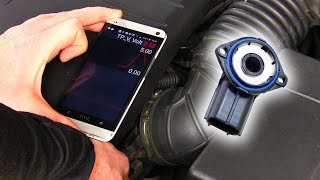
- Using a scan tool with live data, observe the Throttle Position Percentage (TP%). 🎬 Watch: How to test a TPS using a cheap scan tool It should be low at idle (e.g., 10-18%) and increase smoothly as you press the accelerator. If it's stuck at or near 0%, this points to a problem.
- Perform a visual inspection of the TPS sensor, its electrical connector, and the wiring harness. Look for any signs of damage, corrosion, or loose connections.
- Disconnect the TPS connector. With the key on, engine off, use a multimeter to verify there is a 5-volt reference signal and a good ground at the appropriate pins on the connector.
- Reconnect the sensor. Back-probe the signal wire with a multimeter. With the key on, engine off, the voltage should be low (approx. 0.5-1.0V) with the throttle closed.
- Slowly open the throttle by hand. The voltage should sweep smoothly and consistently up to approximately 4.5V at wide-open throttle. Any dropouts, spikes, or a signal that remains at 0V indicates a faulty TPS.
- If the sensor and wiring test good, inspect the throttle body for excessive carbon buildup that may be preventing the throttle plate from returning to the true closed position.
- If the sensor, wiring, and throttle body are all confirmed to be good, the issue may be a rare fault within the PCM.
Parts You'll Likely Need
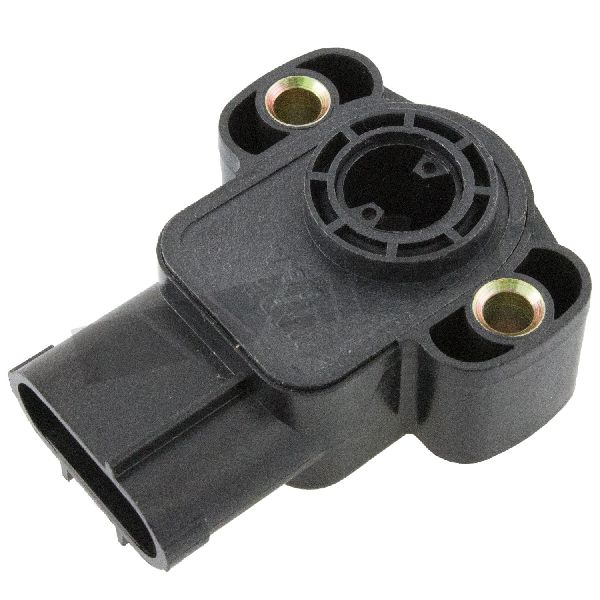
- Throttle Position Sensor (TPS)
(OEM #YS4Z-9B989-BB (fits 2.0L/2.3L), F6CZ-9B989-BB (fits some 3.0L V6))— This is the most frequent point of failure for code P0122 on this vehicle, as the sensor's internal resistive track wears out over time. Part number YS4Z-9B989-BB is widely cited for the 4-cylinder engines. Some V6 models may use F6CZ-9B989-BB. Always verify by VIN.
Trusted brands: Motorcraft, NGK, Delphi, Hitachi, Standard Motor Products (TH265)
OEM price range: $50-$90
Aftermarket price range: $30-$60
Related Codes That Often Appear With This One
- P0121 — This code indicates a 'performance/range' problem with the TPS. It can appear alongside P0122 if the sensor signal is erratic, sometimes reading too low and other times being out of its expected range.
- P0123 — This code for 'Circuit High Input' can appear with P0122 if the sensor is failing erratically, sending signals that are both too high and too low at different times, often due to internal shorting.
- P2135 — This 'Throttle/Pedal Position Sensor/Switch A/B Voltage Correlation' code is more common on newer drive-by-wire systems but can appear if the PCM detects a conflict between expected and actual TPS readings. A TSB for 2009-2010 models links P2135 with P0122.
Platform-Specific Known Issues
- A recall (NHTSA #12V-353, Ford #12S37) was issued for 2001-2004 V6 models where the cruise control cable could bind on the engine cover, causing a stuck throttle. This is a mechanical issue, not an electronic TPS failure, but relates to the throttle system.
- An owner of a 2005 Escape XLT with P0122 reported intermittent stalling on highway exits, which was permanently fixed by replacing the TPS after mechanics incorrectly suspected the MAF sensor.
Mechanic-Grade Diagnostic Values
- TPS 5V Reference (VREF) — expected: 4.5V to 5.0V DC with key on, engine off, sensor unplugged.. Failure: Voltage below 4.5V indicates a wiring or PCM issue.
- TPS Signal Voltage (Closed Throttle) — expected: 0.3V to 0.9V DC with key on, engine off, sensor connected.. Failure: Voltage stuck below 0.3V will trigger P0122.
- TPS Signal Voltage (Wide-Open Throttle) — expected: 3.5V to 4.8V DC with key on, engine off, sensor connected.. Failure: Voltage that does not reach at least 3.5V or does not sweep smoothly indicates a faulty sensor.
- TPS Sensor Internal Resistance — expected: Typically 1kΩ to 10kΩ, varying smoothly as the throttle is moved.. Failure: An open circuit (infinite resistance) or a reading outside the expected range indicates a bad sensor.
Scan Tool Commands That Help
- N/A - Manual Procedure: Throttle Body Relearn / Idle Trim Reset — After replacing the TPS or cleaning the throttle body, a relearn procedure helps the PCM adapt to the new sensor's baseline reading and prevent idle issues. A common method is to turn the key on (engine off), slowly press the accelerator to the floor and release it, wait 10 seconds, then turn the key off for 10 seconds before starting the engine.
Wiring & Ground Locations
- TPS Connector (2.0L Engine) — On the side of the throttle body, connected to the TPS.. This 3-wire connector is the primary interface for the sensor. Corrosion or damage here is a common cause of P0122. For the 2.0L, Pin C (BRN/WHT wire) is the 5V reference, the middle wire (GRY/WHT) is the signal, and Pin A is the ground.
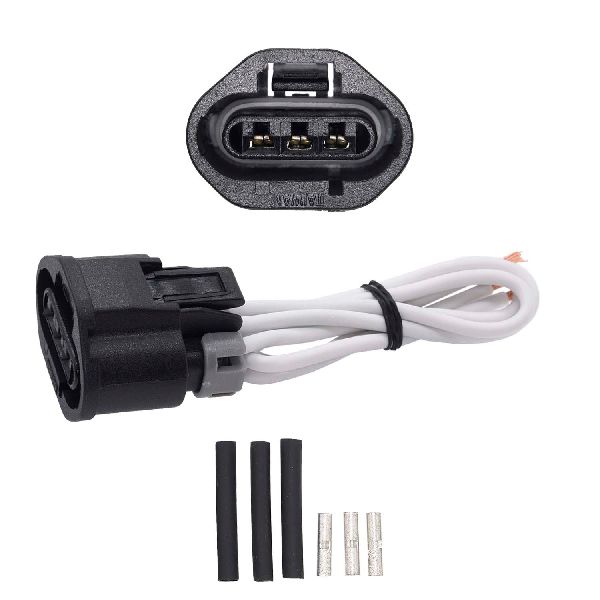
- TPS Connector Pigtail — The short harness and plug that connects directly to the TPS.. The pigtail itself can fail from heat and vibration, causing intermittent connections or shorts that trigger P0122 even with a new sensor. If the connector looks melted, brittle, or has loose pins, replacing the pigtail is necessary.
- PCM Connector — The main computer, typically located in the engine bay near the firewall or battery.. Water intrusion or corrosion at the PCM connector pins can cause a P0122 code by disrupting the 5V reference or signal return circuits. This should be inspected if sensor and pigtail tests pass.
Real Owner Repair Stories
- YouTube video comment/description (Ford F-150 (similar Ford wiring/logic)) — Persistent P0122 code immediately after starting the engine.
❌ Tried (didn't work) Replacing the Throttle Position Sensor (TPS) multiple times., Testing the wiring harness for continuity between the sensor and PCM.
✅ What actually fixed it The TPS pigtail connector receptacle was faulty. Replacing the entire pigtail connector resolved the persistent P0122 code. - NHTSA ODI #11467242 — An owner reported that after running diagnostics for P0122 and other codes, the vehicle would start and idle briefly but would die while driving.
- NHTSA ODI #10561056 — A report describes a situation where the vehicle would not accelerate above 1,000 RPM while throwing P0122 and several other throttle-related codes.
OEM Part Supersession History
988F-9B989-BA→YS4Z-9B989-BB— Standard part number update and consolidation by Ford.
Heads up: Part YS4Z-9B989-BB is the direct replacement and is interchangeable with 988F-9B989-BA and 988F-9B989-BB for the 2.0L and 2.3L engines.
Model Year Variations Within This Range
- 2001-2004: The 2.0L Zetec I4 engine was used, which has a specific TPS part number (YS4Z-9B989-BB) and wiring color code (e.g., GRY/WHT for signal).
- 2005-2008: The 2.3L Duratec I4 engine replaced the 2.0L. While it uses a physically similar TPS (often the same part number YS4Z-9B989-BB), wiring colors and PCM pinouts may differ slightly from the earlier 2.0L models.
- 2001-2008 (V6 models): The 3.0L Duratec V6 uses a different TPS part number (e.g., F6CZ-9B989-BB or Motorcraft DY-968) than the 4-cylinder models. The physical location on the V6 throttle body is also different.
Diagnostic Flowchart
Other Known Issues on This Vehicle
Issues unrelated to this code that are worth knowing about as an owner of this generation:
- Automatic Transmission (CD4E) Failure 🔴 High — Very common, especially on 2001-2005 models. Failures can occur under 100,000 miles. Symptoms include harsh shifting, slipping, loss of gears, or complete failure to move. (Ref: No specific recall for original transmissions, but some remanufactured units were recalled. Many owners report needing a full rebuild or replacement costing thousands.)
- Rear Shock Tower Rust 🔴 High — Extremely common in regions where road salt is used. The upper rear shock mount area in the wheel well rusts completely, allowing the shock to break free from the body. (Ref: No recall. Aftermarket repair kits and weld-in panels are widely available due to the frequency of this failure.)
- V6 (3.0L Duratec) Alternator Failure 🟠 Medium — Common failure item. The alternator is notoriously difficult to replace as it is located at the bottom rear of the engine, requiring removal of the passenger side axle shaft for access.
- Stalling Due to Failed Canister Purge Valve 🟡 Low — A common issue on many Ford vehicles of this era. A stuck-open purge valve creates a vacuum leak, causing a rough idle and stalling at low speeds, which can sometimes be mistaken for a TPS issue.
Used vs. New Parts: Buying Guide for This Vehicle
When a used part is the smart pick: A used throttle body assembly from a junkyard can be a cost-effective option if the entire assembly is needed, but for a P0122 code, it is almost never required. A used TPS sensor is NOT recommended. Given the low cost of a new, quality aftermarket sensor ($30-$60) and the fact that it is a common wear item, installing a used sensor with unknown history is a poor investment of time and money.
Donor-vehicle mileage cap: roughly under 80000 miles for the part to have meaningful remaining life.
What to inspect on the donor part:
- For a throttle body assembly: check for a clean throttle bore with minimal carbon.
- Ensure the throttle plate snaps back sharply and doesn't bind.
- Inspect the TPS connector on the donor part for any signs of corrosion, melting, or brittle plastic.
Aftermarket brands forum-validated for this vehicle:
- Motorcraft (OEM)
- NGK/NTK
- Delphi
- Standard Motor Products (SMP)
- Hitachi
Brands owners have reported issues with on this vehicle:
- No-name, unbranded sensors from online marketplaces are frequently cited in forums as being dead-on-arrival or failing within a few months. It is better to spend slightly more on a reputable brand.
Real Owner Stories
Aggregated from forums and TSBs cited above. Mileages and costs reflect what owners reported in those sources.
2005 Ford Escape XLT
Symptoms: Intermittent stalling on highway exits; mechanics incorrectly suspected the MAF sensor.
What fixed it: Replacing the Throttle Position Sensor (TPS).
Source hint: vehicle_specific_issues
2005 Ford Escape 2.3L
Symptoms: Stalling at stops and hesitation; cleaning the MAF and throttle body did not work.
What fixed it: Replacing the TPS with a Motorcraft part.
Source hint: Escape-City.com Forum Thread: 'P0121 and P0122'
2005 Ford Escape
Symptoms: Contradictory P0122 (Low Voltage) and P0123 (High Voltage) codes causing jerking motions.
What fixed it: Replacing the TPS sensor (part #988F-9B989-BB).
Source hint: Real-life fix for P0122 and P0123 on a 2005 Escape
2002 Ford Escape XLT — 142000 miles
Symptoms: Persistent symptoms including hesitation and stumbling.
What fixed it: Replacement of the TPS.
Source hint: AliExpress (Case Study)
Related OBD-II Codes
Frequently Asked Questions
Is there a recall for the throttle system on my 2001-2004 Ford Escape V6?
My 2005 Escape is stalling at stops; could it be the MAF sensor instead of the TPS?
Can a bad TPS cause my automatic transmission to shift harshly?
What should the voltage readings be when testing the TPS on my Escape?
Are there other common issues that cause stalling on the Escape that I should check?
Does the Mazda Tribute suffer from the same P0122 issues as the Escape?
Helpful Videos
Used OEM Parts in Stock
New Aftermarket Parts Available


The information in this article is provided for general reference and educational purposes only. Vehicle specifications, procedures, and part compatibility can vary by production date, trim level, and region. Always consult your vehicle's factory service manual and verify part numbers before purchasing or performing repairs. Safety-critical components such as airbags, seat belts, and braking systems should be installed by a qualified professional.
- Ford Escape:
- 🧭 Diagnostic Flowchart
- 🎬 Helpful Videos
- 🛍️ Shop This Part
- What's Unique About the 2001-2008 Ford Escape
- Symptoms You May Notice
- Most Likely Causes
- Rare But Worth Checking
- Diagnosis Steps
- Parts You'll Likely Need
- Related Codes That Often Appear With This One
- Platform-Specific Known Issues
- Mechanic-Grade Diagnostic Values
- Scan Tool Commands That Help
- Wiring & Ground Locations
- Real Owner Repair Stories
- OEM Part Supersession History
- Model Year Variations Within This Range
- Other Known Issues on This Vehicle
- Used vs. New Parts: Buying Guide for This Vehicle
- Real Owner Stories
- 2005 Ford Escape XLT
- 2005 Ford Escape 2.3L
- 2005 Ford Escape
- 2002 Ford Escape XLT — 142000 miles
- Related OBD-II Codes
- Frequently Asked Questions
- 🎟️ Get 5% Off