

P0122 on 2007-2012 Hyundai Santa Fe: Throttle Position Sensor Circuit Low
This code typically points to a problem with the throttle position sensor (TPS). On these Santa Fe models, the TPS is often part of the entire electronic throttle body assembly. The most common fix is replacing the complete throttle body, which can cost between $550 and $1,200 at a shop. This is a well-documented failure point for this vehicle generation.
- P0122 on a 2007-2012 Santa Fe means the throttle position sensor signal is too low.
- The most likely cause is a failed electronic throttle body assembly, as the sensor is usually built-in.
- Symptoms are serious and include stalling and entering a low-power 'limp mode', making the vehicle unsafe to drive for extended periods.
- Before replacing parts, use a scanner's live data to watch the TPS voltage while pressing the gas pedal to confirm the failure.
- Ensure you buy a throttle body that matches your specific model year and engine (2.7L/3.3L for 2007-2009, 2.4L/3.5L for 2010-2012).
What's Unique About the 2007-2012 Hyundai Santa Fe
The 2007-2012 Santa Fe uses an Electronic Throttle Control (ETC) system, also known as 'drive-by-wire'. Unlike older systems with a physical cable, the accelerator pedal sends an electronic signal to the computer, which then commands a motor to open the throttle blade. On all engines for this generation (2.4L, 2.7L, 3.3L, 3.5L), the Throttle Position Sensor (TPS) is integrated into the throttle body assembly and is not sold as a separate, replaceable part from the OEM. This means a simple sensor failure, often due to wear on the internal resistive tracks, requires the replacement of the entire, more expensive, throttle body unit.
Generation note: The 2007-2012 range covers the entire second generation (CM) of the Santa Fe, but it includes a significant mid-cycle refresh. - 2007-2009 (Pre-Facelift): Offered with a 2.7L V6 or a 3.3L V6 engine. - 2010-2012 (Facelift): Featured updated styling and new engine options: a 2.4L 4-cylinder and a more powerful 3.5L V6. While the P0122 code's meaning is the same, you must ensure you purchase the correct throttle body specified for your exact year and engine, as the part numbers and connector pinouts are different.
Symptoms You May Notice
- Check Engine Light is on
- ESC (Electronic Stability Control) OFF light may illuminate
- Engine goes into 'limp home mode' with reduced power and limited RPM
- Hesitation or stumbling during acceleration
- Poor or no acceleration
- Rough, erratic, or low idle
- Engine stalling unexpectedly
- Vehicle jerking or bucking
- Replacing only the Accelerator Pedal Position Sensor (APPS). The P0122 code specifically refers to the sensor at the throttle body (TPS 'A'), not the one connected to the gas pedal (APPS).
- Replacing spark plugs or fuel injectors without diagnosing the throttle control system first. While these can cause similar drivability issues, they won't typically trigger a P0122 code.
- Attempting to clean the throttle body. While a dirty throttle body can cause other issues (and is recommended by TSB 13-FL-002 before replacement), it will not fix the internal electronic failure of the TPS that causes P0122.
Most Likely Causes
- Faulty Electronic Throttle Body Assembly 🔴 High Probability → Shop Fuel Injection Throttle Body The Throttle Position Sensor (TPS) is integrated into the throttle body. The internal electronic components and sensor contacts (carbon tracks) can wear out or fail over time, leading to the low voltage signal. This is the most common failure point for this code on this vehicle.
How to confirm: Use an OBD-II scanner with live data to monitor the TPS voltage (often listed as 'TPS1' or 'Throttle Position'). With the Key On, Engine Off, the voltage should sweep smoothly from about 0.5V to 4.5V as you slowly press the accelerator pedal. A reading stuck below ~0.25V, or one that is jumpy and non-linear, confirms a faulty sensor/throttle body.
Typical fix: Replace the entire throttle body assembly. After replacement, a throttle body relearn procedure should be performed as outlined in Hyundai TSB 10-FL-018 to ensure proper idle and performance.
Est. part cost: $230-$700 - Wiring Harness Issue 🟡 Medium Probability Vibrations, heat, and age can cause the wires leading to the throttle body to break, chafe, or develop a short to ground. The connector pins can also become corroded or loose, causing an intermittent connection.
How to confirm: Visually inspect the wiring harness and the 6-pin connector for any signs of damage, corrosion, or loose pins. Use a multimeter to check for continuity, a 5V reference signal, and a good ground at the throttle body connector. Wiggle the harness while monitoring live data to see if the voltage reading changes erratically.
Typical fix: Repair or replace the damaged section of the wiring harness or clean/replace the connector.
Est. part cost: $10-$100
Rare But Worth Checking
- Faulty Powertrain Control Module (PCM): This is very rare. The PCM is the last thing to suspect after thoroughly checking the throttle body, wiring, and connections. A faulty PCM might not be sending the correct 5V reference signal or may be misinterpreting the signal from the TPS.
Diagnosis Steps
- Connect an OBD-II scanner and confirm P0122 is the active code. Check for any other pending or stored codes like P0121, P0123, P2135, or P2106.
- Using the scanner's live data feature, monitor the 'TPS' or 'Throttle Position' voltage. With the Key On, Engine Off (KOEO), the reading should be around 0.5V.
- Slowly depress the accelerator pedal to the floor. The voltage should increase smoothly and linearly to about 4.5V. Watch for any dropouts, spikes, or dead spots.
- If the voltage is stuck low (e.g., below 0.25V) or does not respond smoothly, the TPS/throttle body is the primary suspect.
- Turn the ignition off and disconnect the throttle body electrical connector. Inspect the 6 pins on both the harness and throttle body for corrosion, moisture, or damage.
- With the connector disconnected and ignition on, use a multimeter to check the harness-side connector. You should find a 5-volt reference wire, a ground wire, and the signal return wire.
- If the 5V reference or ground is missing, there is a wiring issue or a problem with the PCM. If both are present, the problem is almost certainly the throttle body assembly itself.
- If the throttle body is replaced, clear the codes and perform a throttle relearn procedure (see TSB 10-FL-018 or manual procedures) to allow the PCM to adapt to the new part.
Parts You'll Likely Need
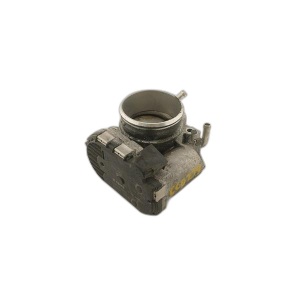
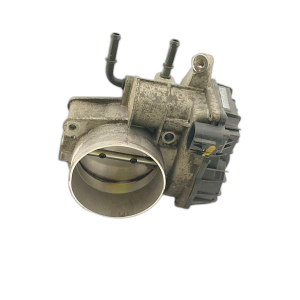
- Electronic Throttle Body Assembly
(OEM #35100-3C100 (for 3.3L V6), 35100-3C400 (for 3.8L V6, Veracruz), 35100-2G700 (for 2.4L I4), 35100-3C700 (for 3.5L V6). Always verify with VIN.)— This is the most common failure. On the 2007-2012 Santa Fe, the throttle position sensor (TPS) that causes code P0122 is integrated into the throttle body and not sold separately. Replacement of the complete assembly is required. 🎬 See this step-by-step throttle body replacement walkthrough
Trusted brands: Dorman, SKP, A-Premium, Original Equipment (Hyundai)
OEM price range: $574-$698
Aftermarket price range: $180-$350
Related Codes That Often Appear With This One
- P0121 — This code indicates a 'Throttle/Pedal Position Sensor/Switch 'A' Circuit Performance Problem,' suggesting the sensor's output is not rational or consistent with other sensor inputs. It often appears alongside P0122 when the sensor is failing intermittently.
- P0123 — This code is for 'Throttle/Pedal Position Sensor/Switch 'A' Circuit High Input.' Seeing it with P0122 could indicate a very erratic sensor or a complex wiring short that causes the voltage to fluctuate wildly.
- P2135 — Indicates a 'Throttle/Pedal Position Sensor/Switch 'A'/'B' Voltage Correlation' error. The ECU compares the signals from two separate TPS sensors (TPS1 and TPS2) for redundancy. A mismatch between them, which is common when one fails, will set this code along with P0122. 🎬 Watch: Diagnosing Hyundai throttle position sensor codes
- P2106 — Indicates 'Throttle Actuator Control System - Forced Limited Power'. This is not a fault code, but an informational code telling you the PCM has intentionally put the vehicle into 'limp mode' because of a critical fault it detected, such as the one reported by P0122.
Technical Service Bulletins (TSBs) & Recalls
- TSB 10-FL-018: This Technical Service Bulletin provides the procedure for performing an Electronic Throttle Control (ETC) adaptive value reset and relearn, which is recommended after replacing or cleaning the throttle body to ensure proper idle and function.
- TSB 13-FL-002: This TSB for 2010-2012 models advises technicians to thoroughly clean the throttle body before opting for a replacement, as carbon buildup can sometimes cause similar symptoms.
Platform-Specific Known Issues
- A petition (DP21-003) was filed with the NHTSA regarding the electronic throttle control systems on 2007-2016 Hyundai models, including the Santa Fe, for issues like stalling and loss of motive power. While NHTSA did not find evidence for a defect investigation leading to a recall, the volume of complaints highlights that the ETC system is a known problem area for owners.
- Owner experiences frequently mention that using aftermarket sensors or attempting a sensor-only replacement (where possible on older models) often fails to fix the issue or introduces new problems, reinforcing that a complete, quality throttle body assembly is the most reliable repair.
Mechanic-Grade Diagnostic Values
- TPS1 Signal Voltage (KOEO) — expected: ~0.5V (closed throttle) to ~4.5V (wide open throttle), sweeping smoothly.. Failure: Voltage is stuck below 0.25V for more than 0.1 seconds, or the sweep is erratic/jumpy.
- TPS2 Signal Voltage (KOEO) — expected: ~4.5V (closed throttle) to ~0.5V (wide open throttle), sweeping smoothly and inversely to TPS1.. Failure: Voltage does not sweep inversely to TPS1, is stuck, or is erratic. This often triggers a P2135 correlation code.
- TPS Connector 5V Reference (KOEO, harness side) — expected: Approximately 5.0V.. Failure: Voltage is significantly lower than 5.0V or is absent (0V), indicating a wiring or PCM issue.
- TPS Internal Resistance (Sensor removed) — expected: Between terminals 1 & 2: 0.71 ~ 1.38 kΩ; Between terminals 2 & 3: 1.6 ~ 2.4 kΩ (values from a similar Hyundai model).. Failure: Readings are OL (open circuit) or significantly outside the expected resistance range.
Scan Tool Commands That Help
- Hyundai GDS (Global Diagnostic System): Actuation Test: ETC Motor — With the key on and engine off, this command forces the throttle plate to open and close. While observing live data for TPS1 and TPS2, you can confirm if the sensors are responding correctly to the physical movement of the throttle plate, helping to isolate a sensor failure from a motor or binding issue.
- Hyundai GDS (or advanced aftermarket scanner): Special Function: Resetting Adaptive Values — This is the factory-recommended procedure to perform after replacing the throttle body. It clears the old learned values for idle and throttle response from the ECM, forcing it to relearn the characteristics of the new part. This is more reliable than manual relearn procedures.
Wiring & Ground Locations
- Throttle Body Connector (2007-2009 3.3L V6) — The 6-pin connector on the electronic throttle body assembly.. This is the primary test point. Pin 3 is the TPS1 signal wire that triggers P0122. Pin 4 is the 5V reference, and Pin 2 is the sensor ground.
- Throttle Body Connector (2010-2012 2.4L I4) — The 6-pin connector on the electronic throttle body assembly.. The pinout differs from the V6. Pin 5 is the sensor power (~5V) and Pin 3 is the ground. A fault on either of these pins will cause sensor codes.
- G52 — Located in the left rear of the engine compartment.. This is a major engine compartment ground point. While not exclusively for the TPS, a corroded or loose G52 ground can cause floating voltages and erratic behavior for multiple engine sensors, including the ETC system, leading to codes like P0122.
Real Owner Repair Stories
- Hyundai-Forums user (2013 Hyundai Accent 1.6L (similar ETC system)) — Check engine light with code P0122, vehicle entering limp mode, poor acceleration.
❌ Tried (didn't work) Replacing the entire throttle body assembly with a new OEM part.
✅ What actually fixed it The user found a section of the throttle body wiring harness rubbing against a metal transmission bracket. The insulation on the signal wire had worn through, causing a short to ground. Repairing the damaged wire resolved the code and symptoms. - NHTSA ODI #11292479 (Hyundai Azera - Cross-Manufacturer Reference) — An owner reported that after encountering codes including P0122, P2106, P1295, and P0123, the vehicle entered limp mode. The report highlights potential grounding issues, noting that grounding points were painted, which may have affected the electrical circuit integrity.
OEM Part Supersession History
35100-25200→35100-25400— Standard part revision/update by the manufacturer.
Heads up: The newer part number (35100-25400) is the correct replacement for the original.35100-3C100→35100-3C200— Standard part revision/update by the manufacturer.
Model Year Variations Within This Range
- 2007-2009: These pre-facelift models use different throttle bodies for the 2.7L and 3.3L V6 engines. The connector pinout for the 3.3L V6 has TPS1 Signal on Pin 3 and the 5V Reference on Pin 4.
- 2010-2012: The facelift models with the 2.4L I4 and 3.5L V6 engines use different throttle bodies than the earlier models. The 2.4L engine's connector has Sensor Power on Pin 5 and Ground on Pin 3. Part numbers are not interchangeable between generations or engines.
Diagnostic Flowchart
Other Known Issues on This Vehicle
Issues unrelated to this code that are worth knowing about as an owner of this generation:
- Faulty Fuel Level Sensor 🟠 Medium — Very common, especially on 2007-2009 models, often occurring around 85,000-100,000 miles. Causes erratic or empty fuel gauge readings and can trigger a Check Engine Light. (Ref: No official recall, but widely acknowledged as a common failure. TSBs may exist for diagnosis.)
- Valve Cover Gasket Oil Leak (V6 engines) 🔴 High — Extremely common on the 3.3L and 3.8L V6 engines. The front gasket leaks oil directly onto the alternator, causing alternator failure and potential stalling. (Ref: Hyundai issued a service campaign (TXXC) for 2007-2009 models to inspect and replace the gasket and potentially the alternator.)
- Engine Stalling / Crankshaft Position Sensor Failure 🔴 High — A noted problem leading to a class-action lawsuit for 2010-2012 models. The crankshaft position sensor can fail, causing the engine to stall while driving. (Ref: A settlement was reached for the engine stalling lawsuit. Sensor failure is a common individual repair.)
- Automatic Transmission Problems 🟠 Medium — Owners report harsh shifting, hesitation, or a feeling of the transmission slipping. Often noted on higher mileage vehicles. (Ref: Updating the Transmission Control Module (TCM) software is a common first step for dealers to address shift quality.)
- Worn Engine Mounts 🟡 Low — The hydraulic engine mounts can wear out over time, leading to increased vibration in the cabin, especially at idle. This is a common wear-and-tear item.
Used vs. New Parts: Buying Guide for This Vehicle
When a used part is the smart pick: A used throttle body from a junkyard is a high-risk, low-reward choice for this specific repair. The primary failure mode is the wear of internal electronic sensor tracks, which is directly related to age and use. A used part may have significant wear and could fail shortly after installation. It should only be considered as a temporary, budget-constrained measure to get the vehicle running.
Donor-vehicle mileage cap: roughly under 50000 miles for the part to have meaningful remaining life.
What to inspect on the donor part:
- Verify the donor vehicle's mileage is as low as possible.
- Inspect the electrical connector pins for any signs of corrosion, moisture, or damage.
- Ensure the butterfly valve moves freely without binding (though this does not guarantee electronic integrity).
- If possible, get a warranty from the salvage yard, even if it's only 30-90 days.
OEM-only on this vehicle (don't cheap out):
- While not strictly 'OEM-only', using a new OEM throttle body is the most reliable, albeit most expensive, option that guarantees compatibility and longevity.
Aftermarket brands forum-validated for this vehicle:
- Dorman
- SKP
- Spectra Premium
Brands owners have reported issues with on this vehicle:
- Unbranded, no-name parts from online marketplaces are frequently cited in forums as being dead-on-arrival or failing prematurely. While brands like A-Premium are available, they have less of a long-term track record compared to more established aftermarket names.
Real Owner Stories
Aggregated from forums and TSBs cited above. Mileages and costs reflect what owners reported in those sources.
2009 Hyundai Santa Fe 3.3L V6
Symptoms: P0122 code, ESC OFF light illuminated, and the vehicle entered Limp Mode.
What fixed it: Replacing the entire throttle body assembly.
Source hint: hyundai-forums.com - '2009 Santa Fe P0122, ESC OFF, Limp Mode'
2007 Hyundai Santa Fe
Symptoms: Simultaneous P0122 and P2135 codes along with drivability problems.
What fixed it: Replacing the throttle body after confirming harness voltages were correct.
Source hint: hyundai-forums.com - 'P0122 and P2135 on 2007 Santa Fe'
2007 Hyundai Santa Fe
Symptoms: Questioned if the sensor could be replaced separately from the assembly.
What fixed it: Complete throttle body assembly replacement; community confirmed the sensor is integrated and not separately replaceable.
Source hint: Reddit r/AskMechanics - '2007 Hyundai Santa Fe- Throttle body sensor vs entire throttle body replacement'
Related OBD-II Codes
Frequently Asked Questions
Can I just replace the sensor on my 2007-2012 Santa Fe instead of the whole throttle body?
Does TSB 10-FL-018 apply to my vehicle after fixing a P0122 code?
Why is my ESC OFF light on at the same time as the P0122 code?
Should I clean the throttle body before replacing it on my 2011 Santa Fe?
Is there a recall for the throttle issues causing P0122 on the Santa Fe?
Could an oil leak cause my electronic throttle issues?
Helpful Videos
We Have This Part in Stock

The information in this article is provided for general reference and educational purposes only. Vehicle specifications, procedures, and part compatibility can vary by production date, trim level, and region. Always consult your vehicle's factory service manual and verify part numbers before purchasing or performing repairs. Safety-critical components such as airbags, seat belts, and braking systems should be installed by a qualified professional.
- Hyundai Santa Fe:
- 🧭 Diagnostic Flowchart
- 🎬 Helpful Videos
- 🛍️ Shop This Part
- What's Unique About the 2007-2012 Hyundai Santa Fe
- Symptoms You May Notice
- Most Likely Causes
- Rare But Worth Checking
- Diagnosis Steps
- Parts You'll Likely Need
- Related Codes That Often Appear With This One
- Technical Service Bulletins (TSBs) & Recalls
- Platform-Specific Known Issues
- Mechanic-Grade Diagnostic Values
- Scan Tool Commands That Help
- Wiring & Ground Locations
- Real Owner Repair Stories
- OEM Part Supersession History
- Model Year Variations Within This Range
- Other Known Issues on This Vehicle
- Used vs. New Parts: Buying Guide for This Vehicle
- Real Owner Stories
- 2009 Hyundai Santa Fe 3.3L V6
- 2007 Hyundai Santa Fe
- 2007 Hyundai Santa Fe
- Related OBD-II Codes
- Frequently Asked Questions
- 🎟️ Get 5% Off