

P0122 on 2012-2016 Mazda CX-5: Throttle Position Sensor Circuit Low Causes and Fixes
This code indicates the throttle position sensor (TPS) is sending a voltage signal to the engine computer that is too low. On the Mazda CX-5, this often means the entire electronic throttle body assembly needs to be replaced, as the sensor is integrated. Expect costs to range from $250 to over $700 depending on the part source.
- P0122 on a 2012-2016 CX-5 means the throttle position sensor signal is too low.
- The most likely cause is a failed sensor, which is integrated into the electronic throttle body, requiring replacement of the entire assembly.
- Driving is not recommended as the vehicle will have severely limited power and may stall.
- Before replacing the expensive throttle body, always check the wiring and connector for damage or corrosion.
- Always replace the throttle body gasket when performing this repair to prevent future vacuum leaks.
What's Unique About the 2012-2016 Mazda CX-5
On the SKYACTIV-G engines in the 2012-2016 CX-5, the throttle position sensor is not a separate, replaceable part. It is integrated into the electronic throttle body assembly. This means that if the sensor itself fails, the entire throttle body must be replaced, which is a more expensive and involved repair than on older vehicles where the TPS could be unbolted and replaced individually. Furthermore, the throttle body is mounted to a plastic intake manifold, meaning its only ground path is through the wiring harness, which can be a point of failure.
Symptoms You May Notice
- Check Engine Light is on
- Severely reduced engine power (limp mode)
- Hesitation or stumbling during acceleration
- Rough, low, or high idle
- Engine may stall, especially when coming to a stop
- Poor fuel economy
- Incorrect or harsh transmission shifting
- Hard starting
- Replacing the accelerator pedal position (APP) sensor. While the APP sensor also relates to throttle control, P0122 specifically points to the sensor on the throttle body itself, not the one connected to the gas pedal.
Most Likely Causes
- Failed Throttle Body Assembly 🔴 High Probability → Shop Fuel Injection Throttle Body The throttle position sensor is integrated into the throttle body and is a common failure point. Internal wear or electronic failure of the sensor necessitates replacing the whole unit. This is the most frequent cause for P0122 on this platform. 🎬 Watch: How to test and replace a faulty throttle position sensor
How to confirm: Using a scan tool with live data, monitor the TPS voltage (TP1 or APP1). With the key on and engine off, the voltage should be around 0.5V at closed throttle and sweep smoothly up to ~4.5V at wide-open throttle. If the voltage is stuck below 0.2V or does not change with throttle movement, the sensor has failed.
Typical fix: Replace the entire electronic throttle body assembly. After replacement, a throttle position relearn procedure is necessary. This can be done with a scan tool or manually by disconnecting the battery for 5+ minutes, reconnecting, and letting the engine idle for 10 minutes with no accessories on. Some forums also suggest a key-on, slow pedal press/release procedure.
Est. part cost: $230-$775 - Wiring Harness or Connector Issue 🟡 Medium Probability Engine bay heat and vibration can cause wiring insulation to become brittle or connector pins to corrode over time, leading to a short to ground or an open circuit. The ground path through the harness is a specific weak point as the throttle body is mounted to a plastic intake manifold.
How to confirm: Visually inspect the wiring harness leading to the throttle body for any signs of damage, chafing, or melting. Disconnect the connector and check for corrosion or bent/backed-out pins. Use a multimeter to check for 5V reference voltage and a good ground at the connector with the key on. Check for continuity on the throttle motor circuit between throttle body connector pins E/F and PCM connector pins 2B/2A respectively.
Typical fix: Repair the damaged section of wiring or clean/replace the connector pigtail. In some cases, adding a redundant ground wire from a throttle body bolt to the chassis can resolve intermittent issues.
Est. part cost: $10-$50 - Excessive Carbon Buildup ⚪ Low Probability While not a direct electrical cause, heavy carbon deposits can prevent the throttle plate from closing fully, causing a mismatch between the physical and expected sensor readings. However, this more commonly causes idle issues rather than a persistent low voltage code. SKYACTIV-G engines are direct-injection, which can lead to carbon buildup on intake components since fuel doesn't wash over them.
How to confirm: Remove the intake air duct from the throttle body and visually inspect the throttle plate and bore for black, sticky carbon buildup.
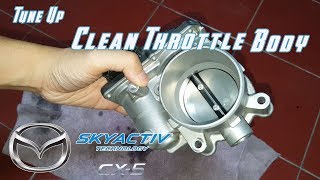
Typical fix: Clean the throttle body bore and plate using a dedicated throttle body cleaner and a soft cloth. Do not spray cleaner directly into the electronic components. 🎬 See this step-by-step Skyactiv engine throttle body cleaning guide A relearn procedure is required after cleaning.
Est. part cost: $5-$15
Rare But Worth Checking
- Faulty Powertrain Control Module (PCM): This is very rare. Before condemning the PCM, all other possibilities, including wiring and the throttle body itself, must be exhaustively ruled out. A PCM failure might also present with other, unrelated codes.
Diagnosis Steps
- Connect an OBD-II scanner to confirm P0122 is the primary code.
- Use the scanner's live data feature to monitor the Throttle Position Sensor 'A' (TP1) and 'B' (TP2) voltages.
- With the key on, engine off, check the voltage readings. TP1 should be ~0.5V and TP2 should be ~3.88V.
- Slowly press the accelerator pedal to the floor. TP1 voltage should increase smoothly to approximately 4.5V, and TP2 should decrease smoothly to ~0.38V, without any dropouts or spikes.
- If the TP1 voltage is stuck low (e.g., under 0.2V) or doesn't respond, proceed to check the wiring.
- Turn the ignition off. Disconnect the throttle body electrical connector. Inspect for corrosion, moisture, or damaged pins.
- With the connector disconnected and key on, use a multimeter to verify a 5V reference signal and a good ground on the appropriate pins of the harness-side connector.
- If the 5V reference and ground are present, the wiring is likely okay, and the throttle body assembly has failed.
- If reference voltage or ground is missing, trace the corresponding wire back to the PCM, looking for breaks or shorts. Check continuity for the throttle motor circuit between throttle body connector pins E/F and PCM pins 2B/2A.
- If wiring and the throttle body check out, the issue may be an extremely rare PCM fault.
Parts You'll Likely Need
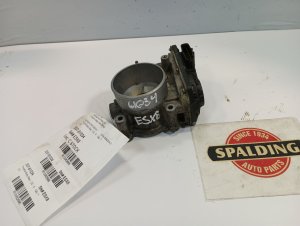
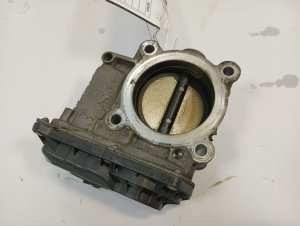
- Electronic Throttle Body Assembly
(OEM #PY01-13-640A)— This is the most common cause of P0122 on this platform, as the non-serviceable throttle position sensor fails internally. This part number is for the 2.5L engine.
Trusted brands: Mazda (OEM), Hitachi, Standard Motor Products, Spectra Premium
OEM price range: $450-$600
Aftermarket price range: $230-$775 - Throttle Body Gasket
(OEM #PE01-13-655)— This gasket should always be replaced when the throttle body is removed to prevent vacuum leaks.
Trusted brands: Mazda (OEM), Beck/Arnley, Mahle
OEM price range: $15-$25
Aftermarket price range: $5-$15
Related Codes That Often Appear With This One
- P0123 — Throttle Position Sensor 'A' Circuit High Input. Seeing both high and low input codes can indicate an intermittent wiring problem or a failing sensor with erratic readings.
- P2135 — Throttle/Pedal Position Sensor/Switch 'A'/'B' Voltage Correlation. This code appears when the signals from the two redundant throttle position sensors do not agree with each other, pointing strongly to a fault within the throttle body assembly.
Technical Service Bulletins (TSBs) & Recalls
- TSB 01-019/19: Addresses oil leakage and rattling from the drive belt auto tensioner due to insufficient sealing under high heat and load. This is a very common issue on 2013-2019 CX-5s with SKYACTIV-G engines.
- Bulletin #01-007-13-2767: While issued for a different model, this manufacturer bulletin notes that P0122 may be present alongside P2135 and P2111, with drivability symptoms including an intermittent rough idle or an idle speed below specification.
Platform-Specific Known Issues
- Owner Experience with Aftermarket Belt Tensioner: A user on Mazdas247.com reported that after replacing the common failing belt tensioner with an aftermarket GATES part, they experienced poor vehicle performance, specifically with the pedal kickdown switch. They recommended using the revised OEM (PE03-15-980C) or the INA equivalent (FT01291) to avoid these issues.
Mechanic-Grade Diagnostic Values
- TPS Signal Voltage (TP1) at Closed Throttle (Key On, Engine Off) — expected: ~0.5V. Failure: Voltage is stuck below 0.2V or does not match expected value.
- TPS Signal Voltage (TP1) at Wide-Open Throttle (Key On, Engine Off) — expected: ~4.5V. Failure: Voltage does not sweep smoothly or fails to reach ~4.5V.
- TPS Signal Voltage (TP2) at Closed Throttle (Key On, Engine Off) — expected: ~3.88V. Failure: Voltage is significantly different from expected value, indicating a correlation fault.
- TPS Signal Voltage (TP2) at Wide-Open Throttle (Key On, Engine Off) — expected: ~0.38V. Failure: Voltage does not sweep smoothly or fails to reach ~0.38V.
- Throttle Motor Actuator Circuit Continuity — expected: Continuity should be present.. Failure: No continuity indicates an open circuit in the harness or PCM.
Hidden / Shadow Codes Worth Checking
- Mode 2 / Freeze Frame Data: When P0122 is triggered, the PCM records a snapshot of sensor data at the moment of the fault. This data is invaluable for diagnosis, showing what other parameters (engine speed, load, temp, etc.) were when the code was set. (see via Accessible with most OBD-II scan tools that support Mode 2 or have a 'Freeze Frame' function.)
- PCM Fail-Safe Actions: Upon detecting P0122, the PCM will restrict engine torque, inhibit EGR control, and on diesel models, inhibit DPF regeneration to protect the engine and ensure minimal driveability. The throttle valve is set to a fixed opening of about 6 degrees or less. (see via This is not a visible code but a background strategy. The effects (limp mode, poor power) are the primary symptoms.)
Scan Tool Commands That Help
- Mazda M-MDS (or equivalent high-end scanner): ETB Learning (Electronic Throttle Body Learning) — This procedure must be performed after cleaning or replacing the throttle body to teach the PCM the new fully closed position. The procedure involves repeating Ignition ON (15 sec) -> Ignition OFF (15 sec) 3-5 times.
- Mazda M-MDS (or equivalent high-end scanner): Idle Learning — After performing the ETB learning, this procedure allows the PCM to learn the new idle characteristics. It involves letting the engine warm up fully and then idling for over a minute with various electrical loads turned on and off.
Wiring & Ground Locations
- Throttle Body Ground Path — The throttle body grounds through its electrical connector harness, not through its mounting bolts.. The throttle body is bolted to a plastic intake manifold, so it has no natural chassis ground. A poor connection or high resistance in the harness's ground wire can cause low voltage readings and trigger P0122, even if the sensor itself is functional.
- Throttle Motor Circuit at PCM — At the Powertrain Control Module (PCM) connector.. To test the harness for an open circuit, you need to check continuity from the throttle body connector to the PCM. The throttle motor control wires are at pins 2A and 2B of the PCM connector.
OEM Part Supersession History
PY01-13-640→PY01-13-640A— Minor revision or supplier change. The parts are interchangeable.
Heads up: The PY01-13-640A part is widely compatible with 2.5L SKYACTIV-G engines across the 2014-2018 Mazda3, Mazda6, and CX-5 models. A different part number is used for the 2.0L engine.
Model Year Variations Within This Range
- 2016: The 2016 model year had a mid-cycle refresh known as the '2016.5'. However, the changes were related to standard equipment packages (e.g., navigation and backup camera becoming standard on more trims) and did not affect the powertrain, throttle body, or wiring. The repair procedure for P0122 is identical for both 2016 and 2016.5 models.
Diagnostic Flowchart
Other Known Issues on This Vehicle
Issues unrelated to this code that are worth knowing about as an owner of this generation:
- Infotainment 'Ghost Touch' and System Failure 🟠 Medium — Very common on 2014-2016 models with the Mazda Connect system. The screen may register phantom touches, freeze, or reboot randomly. (Ref: A limited warranty extension program (CSP13) was issued for some models, but coverage can be inconsistent for the CX-5. TSB 09-003/22 applies to later models (2017-2020).)
- Leaking Serpentine Belt Tensioner 🔴 High — A very common failure point. The hydraulic tensioner leaks fluid, leading to a loss of belt tension, squealing noises, and potential belt failure. (Ref: TSB 01-019/19 addresses this issue, noting oil leakage and rattling noises. The revised OEM part is PE03-15-980C.)
- Intake Valve Carbon Buildup 🟠 Medium — As a direct-injection engine, carbon deposits can accumulate on intake valves over time (typically noticeable after 80,000+ miles), leading to rough idle, hesitation, and reduced power. The severity is debated, with some owners reaching high mileage without issue.
- Prematurely Cracked Windshields 🟡 Low — Numerous owner reports suggest the original windshields are prone to cracking from minor impacts or even temperature changes.
- Failing Daytime Running Light (DRL) LEDs (2016) 🟡 Low — Specific to 2016 models, the signature LED DRLs can fail, requiring expensive replacement of the entire headlamp assembly. (Ref: Safety Recall 4320A was issued for this problem.)
Used vs. New Parts: Buying Guide for This Vehicle
When a used part is the smart pick: A used throttle body from a salvage yard or online seller is a reasonable budget-friendly option, as the replacement procedure is not overly labor-intensive if the used part fails prematurely. Given that new OEM units can be expensive, a used part can save hundreds of dollars.
Donor-vehicle mileage cap: roughly under 80000 miles for the part to have meaningful remaining life.
What to inspect on the donor part:
- Source from a vehicle with verifiable low mileage.
- Inspect the electrical connector for any signs of corrosion, bent pins, or damage.
- Check the throttle plate for excessive carbon buildup or scoring on the bore, which might indicate a hard life.
- Ensure it comes from a vehicle that was not in a front-end collision.
OEM-only on this vehicle (don't cheap out):
- While not strictly OEM-only, the Powertrain Control Module (PCM) should be the last resort and is best sourced through official dealer channels to ensure correct programming.
Aftermarket brands forum-validated for this vehicle:
- Hitachi (Often the original equipment manufacturer)
- Standard Motor Products (SMP)
- Spectra Premium
Brands owners have reported issues with on this vehicle:
- No-name, unbranded units from online marketplaces can be a significant gamble with high failure rates and poor calibration.
Real Owner Stories
Aggregated from forums and TSBs cited above. Mileages and costs reflect what owners reported in those sources.
2013-2016 Mazda CX-5 SKYACTIV-G
Symptoms: Poor vehicle performance and issues specifically with the pedal kickdown switch after a recent repair.
What fixed it: Replacing an aftermarket GATES belt tensioner with the revised OEM part (PE03-15-980C) or the INA equivalent (FT01291).
Source hint: Mazdas247.com - '2013 - 2016 CX-5 Belt Tensioner + Serpentine Belt + Water Pump Belt (Install/Removal) Guide'
2015 Mazda CX-5
Symptoms: The owner needed to reset the throttle body parameters after a cleaning or replacement procedure.
What fixed it: Manual relearn procedure involving disconnecting the battery for 5 minutes followed by a 10-minute idle with no accessories on.
Source hint: Mazda Forum - '2015 CX5 throttle body reset'
Related OBD-II Codes
Frequently Asked Questions
Does TSB 01-019/19 regarding the belt tensioner relate to my P0122 code on a 2015 CX-5?
Can I just clean the throttle body on my SKYACTIV-G engine to fix P0122?
Is there a manual relearn procedure for the Mazda CX-5 throttle body after I replace it?
What is the specific OEM gasket part number I need if I remove the throttle body?
Why is the wiring harness a suspected weak point for the throttle position sensor on this vehicle?
Helpful Videos


We Have This Part in Stock

The information in this article is provided for general reference and educational purposes only. Vehicle specifications, procedures, and part compatibility can vary by production date, trim level, and region. Always consult your vehicle's factory service manual and verify part numbers before purchasing or performing repairs. Safety-critical components such as airbags, seat belts, and braking systems should be installed by a qualified professional.
- Mazda CX-5:
- 🧭 Diagnostic Flowchart
- 🎬 Helpful Videos
- 🛍️ Shop This Part
- What's Unique About the 2012-2016 Mazda CX-5
- Symptoms You May Notice
- Most Likely Causes
- Rare But Worth Checking
- Diagnosis Steps
- Parts You'll Likely Need
- Related Codes That Often Appear With This One
- Technical Service Bulletins (TSBs) & Recalls
- Platform-Specific Known Issues
- Mechanic-Grade Diagnostic Values
- Hidden / Shadow Codes Worth Checking
- Scan Tool Commands That Help
- Wiring & Ground Locations
- OEM Part Supersession History
- Model Year Variations Within This Range
- Other Known Issues on This Vehicle
- Used vs. New Parts: Buying Guide for This Vehicle
- Real Owner Stories
- 2013-2016 Mazda CX-5 SKYACTIV-G
- 2015 Mazda CX-5
- Related OBD-II Codes
- Frequently Asked Questions
- 🎟️ Get 5% Off