

P0122 on 2017-2024 Mazda CX-5: Throttle Position Sensor Causes and Fixes
P0122 on a 2017-2024 Mazda CX-5 almost always points to a failing electronic throttle body assembly. The throttle position sensor (TPS) is integrated into this unit and is not sold separately. Expect to pay $250-$500 for a new throttle body, with DIY replacement being moderately easy (2/5 difficulty).
- P0122 on your CX-5 means the throttle position sensor is sending a low voltage signal.
- The most likely cause is a failed electronic throttle body, which contains the non-replaceable sensor.
- Symptoms include poor acceleration, rough idle, and the vehicle entering a reduced-power 'limp mode'.
- Before replacing the part, check the electrical connector and wiring at the throttle body for damage.
- Replacement is a DIY-friendly job, typically requiring only basic hand tools and about an hour of work.
What's Unique About the 2017-2024 Mazda CX-5
For the 2017-2024 Mazda CX-5, the P0122 code is straightforward. Unlike some vehicles where this code could point to an accelerator pedal sensor, on this platform it is almost exclusively related to the throttle body itself. The throttle position sensor (TPS) is an integral, non-serviceable part of the electronic throttle body and cannot be replaced separately. This design, common across the SKYACTIV engine family, simplifies diagnosis but makes the repair more expensive, as the entire throttle body assembly must be replaced if the internal sensor fails.
Generation note: The 2017-2024 year range covers the second generation (KF) of the Mazda CX-5. A facelift was introduced in 2022, but the core powertrain, including the SKYACTIV-G engines and associated throttle body design, remained fundamentally the same. The information in this guide applies to all 2017-2024 models.
Symptoms You May Notice
- Check Engine Light is on
- Vehicle enters 'limp mode' (reduced engine power)
- Hesitation or stumbling during acceleration
- Poor or delayed throttle response
- Rough or unstable idle
- Engine stalling, especially when coming to a stop
- Poor fuel economy
- Incorrect or harsh transmission shifting behavior
- Replacing the accelerator pedal sensor. While the pedal sensor also relates to throttle control, P0122 specifically points to the sensor at the throttle body ('A' circuit), not the pedal assembly.
Most Likely Causes
- Failing Electronic Throttle Body Assembly 🔴 High Probability → Shop Fuel Injection Throttle Body The throttle position sensor (TPS) is integrated into the assembly and is a common point of failure due to internal wear. It is not available as a separate part from Mazda, making complete assembly replacement the standard repair.
How to confirm: With a scan tool, monitor the throttle position voltage (PID: TP1). It should read ~0.5V at idle and sweep smoothly up to ~4.5V at wide-open throttle. A reading that is stuck low (e.g., below 0.2V) or drops out intermittently confirms the issue.
Typical fix: Replace the entire electronic throttle body assembly. A throttle relearn procedure is recommended after installation.
Est. part cost: $250-$500 - Wiring or Connector Issue 🟡 Medium Probability The wiring harness connector at the throttle body is exposed to engine heat and vibration, which can lead to corrosion or loose pins over time. Moisture intrusion can cause green crusty buildup on terminals, increasing resistance and dropping the signal voltage.
How to confirm: Visually inspect the connector for corrosion, pushed-out pins, or damage. Wiggle the connector with the engine running to see if the idle stumbles or the code reappears. Use a multimeter to check for a stable 5V reference and a good ground at the connector with the key on, engine off.
Typical fix: Clean the connector terminals with a contact cleaner or repair the damaged section of the wiring harness. Dielectric grease can be applied upon reassembly to prevent future moisture intrusion.
Est. part cost: $5-$50 - Excessive Carbon Buildup ⚪ Low Probability As SKYACTIV-G engines are Direct Injection (GDI), they are prone to carbon buildup in the intake tract, including the throttle body. This buildup can prevent the throttle plate from closing completely, which can sometimes confuse the sensor's baseline reading, although it's less likely to cause a 'low input' code than a 'performance' code.
How to confirm: Remove the intake boot and visually inspect the throttle plate and bore for black, sooty deposits. The plate may feel sticky or slow to move by hand.
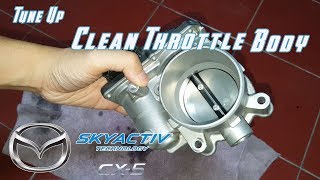
Typical fix: Clean the throttle body bore and plate with a dedicated throttle body cleaner and a soft brush. Do not spray cleaner directly into the electronic components. 🎬 Watch: How to clean a Skyactiv throttle body A cleaning may temporarily resolve symptoms but often the underlying sensor is already failing.
Est. part cost: $10-$20
Rare But Worth Checking
- Faulty Powertrain Control Module (PCM): This is extremely rare. Before condemning the PCM, all other possibilities, especially the throttle body and its wiring, must be exhaustively ruled out. A faulty PCM might also set other unrelated codes or fail to provide the 5V reference voltage.
Diagnosis Steps
- Connect an OBD-II scanner and confirm P0122 is the active code. Check for any other related codes like P0123, P0222, or P2135, as they strengthen the diagnosis of a bad throttle body.
- Using the scanner's live data function, monitor the Throttle Position Sensor 'A' voltage (TP1). The reading should be around 0.5 volts with the key on, engine off, and should increase smoothly to about 4.5 volts as you slowly press the accelerator pedal.
- If the voltage is stuck below 0.2-0.3 volts or is erratic and jumps around, proceed to inspect the hardware.
- Turn the ignition off. Locate the electronic throttle body at the front of the engine where the main air intake tube connects.
- Disconnect the electrical connector from the throttle body. Inspect the connector and the pins on the throttle body for any signs of corrosion, moisture, or damage. Pay close attention to green or white residue.
- If the connector looks good, use a multimeter to test the wiring. You should find a 5-volt reference wire, a ground wire, and one or two signal wires. Confirm the presence of 5V and a good ground.
- If the wiring and connector check out and the live data shows a consistently low or erratic signal, the throttle body assembly itself is faulty and requires replacement.
- As a final check, you can inspect the throttle bore for heavy carbon buildup that might be impeding the plate's movement, though this is less likely to be the primary cause for a low voltage code.
Parts You'll Likely Need
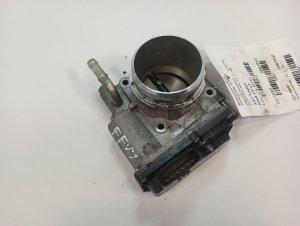
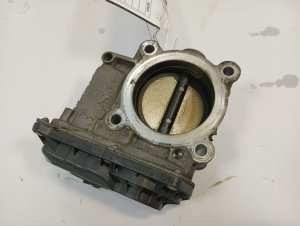
- Electronic Throttle Body Assembly
(OEM #PYFS-13-640 (for 2.5L Non-Turbo, 2018+), PY01-13-640A (for 2.5L, 2017))— This is the most common failure. The internal, non-serviceable throttle position sensor (TPS) fails, requiring replacement of the entire assembly. PYFS-13-640 is for 2018+ 2.5L non-turbo models. PY01-13-640A is listed for 2017 2.5L models. Always verify with VIN.
Trusted brands: Mazda (OEM), Hitachi
OEM price range: $400-$500
Aftermarket price range: $250-$350
Related Codes That Often Appear With This One
- P0123 — Throttle Position Sensor 'A' Circuit High Input. If the sensor is failing erratically, it may send signals that are both too low (P0122) and too high (P0123) at different times.
- P0222 — Throttle/Pedal Position Sensor/Switch 'B' Circuit Low Input. The throttle body has redundant sensors for safety. If both P0122 and P0222 are present, it strongly indicates a failure within the throttle body assembly or its connector.
- P2135 — Throttle/Pedal Position Sensor/Switch 'A'/'B' Voltage Correlation. This code is set when the PCM sees a disagreement between the two internal throttle position sensors. It's a very common companion code to P0122 and points directly to a failing throttle body. 🎬 Watch: How to test and replace electronic throttle bodies
Technical Service Bulletins (TSBs) & Recalls
- While no TSB directly addresses P0122, it's worth noting that Mazda recall 3719F / NHTSA 19V495000 was issued for a PCM software problem on 2018-2019 models. This issue could cause stalling and power loss, symptoms which overlap with a failing throttle body. Ensuring this software update has been performed is a good first step.
- A manufacturer service bulletin for other Mazda models, TSB Bulletin #01-007-13-2767, notes that P0122 may be present alongside P2135 and P2111, with drivability symptoms including an intermittent rough idle or an idle speed below specification.
Platform-Specific Known Issues
- Owner Experience: Sudden Limp Mode: An owner of a 2021 CX-5 with 68k miles reported multiple warning lights flashing, followed by the car entering 'limp mode' where it would barely accelerate. After turning the car off and waiting, it restarted with a Check Engine Light on. This behavior, especially when intermittent, is a classic sign of an electronic throttle body beginning to fail.
Mechanic-Grade Diagnostic Values
- PCM Voltage Threshold for P0122 — expected: Normal signal voltage is ~0.5V at idle to ~4.5V at WOT.. Failure: The PCM will log code P0122 if the input voltage from the sensor is below 0.28 V for more than 0.5 seconds (value from SKYACTIV-D engine documentation, but provides a specific Mazda benchmark).
- Throttle Body Motor Resistance — expected: A specific resistance value is not provided in general manuals, but the procedure is to measure resistance between terminals E and F on the throttle body connector.. Failure: An open circuit (infinite resistance) or a reading that deviates significantly from a known-good part would indicate failure. This test is primarily for the throttle actuator motor, not the sensor.
Hidden / Shadow Codes Worth Checking
- P2101, P2107, P2110, P2112, P2119: These are not hidden codes, but rather related fail-safe codes for the Throttle Actuator Control (TAC) system. If the PCM detects a critical problem with the electronic throttle control, such as what might be caused by a P0122 fault, it may also set one of these codes and force the vehicle into a severe limp mode. (see via Standard OBD-II scanner.)
Scan Tool Commands That Help
- Mazda M-MDS (IDS) or equivalent: ETB Learning (Electronic Throttle Body Learning) — This is a specific reset procedure documented in a Mazda TSB. It should be performed after cleaning or replacing the throttle body to teach the PCM the fully closed position. The procedure is to repeat Ignition ON (no start) for 15 seconds, then Ignition OFF for 15 seconds, 3-5 times.
- Generic OBD-II Scanner or Manual Procedure: Throttle Body Relearn/Calibration — Required after replacing the throttle body or disconnecting the battery to ensure a stable idle. A common manual method is to disconnect the battery for 5 minutes, reconnect, turn ignition ON (engine off) for one minute, turn OFF for one minute, then start the engine and let it idle until it reaches operating temperature without touching the accelerator.
Wiring & Ground Locations
- G03 (or similar) — Left front of the engine compartment.. The throttle body circuit requires a solid ground to provide an accurate signal. A corroded or loose engine bay ground point can cause a voltage drop, mimicking a sensor failure and potentially triggering P0122. This is a key location to inspect when diagnosing a persistent electrical fault.
- G02 (or similar) — Under the left headlight assembly.. Another primary engine bay ground point. Verifying all chassis grounds in the vicinity of the engine harness are clean and tight is a critical step if wiring is suspected.
- Throttle Body Connector Terminals — On the electronic throttle body itself.. Mazda service manuals refer to specific terminals for testing, such as 'terminals E and F' for motor resistance checks. Knowing these identifiers is crucial for following official diagnostic procedures with a multimeter.
OEM Part Supersession History
PY01-13-640A→PY01-13-640A (current for year)— This part number is specific to the 2017 model year with the 2.5L engine.
Heads up: May not be compatible with 2018 and newer models which use a different part number.PYFS-13-640→PYFS-13-640 (current for model)— This part number is used on 2018 and newer models with the 2.5L non-turbo engine.
Heads up: Not compatible with 2.5L Turbo engines.PY8V-13-640→PY8V-13-640 (current for model)— This part number is specifically for models equipped with the 2.5L Turbo engine.
Heads up: Not compatible with 2.5L non-turbo engines.
Model Year Variations Within This Range
- 2017: The 2017 2.5L model uses a specific throttle body, part number PY01-13-640A.
- 2018-2024 (Non-Turbo): Models with the 2.5L non-turbo engine use throttle body part number PYFS-13-640.
- 2021-2024 (Turbo): Models with the 2.5L Turbo engine use a different throttle body, part number PY8V-13-640.
Diagnostic Flowchart
Other Known Issues on This Vehicle
Issues unrelated to this code that are worth knowing about as an owner of this generation:
- Cracked Cylinder Head (2.5L NA with CD & 2.5T) 🔴 High — Affects 2018+ 2.5L NA with Cylinder Deactivation and 2019-2020 2.5T models. Can occur from 50k miles onward. Symptoms include coolant or oil loss. (Ref: TSB 01-002/23 (for 2.5T) and TSB 01-012/21 (for 2.5L NA oil consumption which can be related) address this issue.)
- Infotainment 'Ghost Touch' or Delamination 🟠 Medium — Common on 2017-2020 models. The screen registers phantom touches or becomes unresponsive. (Ref: Mazda initiated a Customer Service Program (CSP13 / SSPB6) extending the warranty for this repair. TSB 09-003/22 also applies.)
- Intake Valve Carbon Buildup (All GDI Engines) 🟠 Medium — A consequence of Gasoline Direct Injection (GDI). Becomes noticeable after 60,000-80,000 miles, causing potential hesitation or reduced performance.
- Prematurely Failing Low-Pressure Fuel Pump 🔴 High — Affects certain 2018-2019 models due to a faulty impeller. Can cause engine stalling. (Ref: NHTSA Campaign 21V875000 (Mazda Recall 5321K) was issued for this problem.)
Used vs. New Parts: Buying Guide for This Vehicle
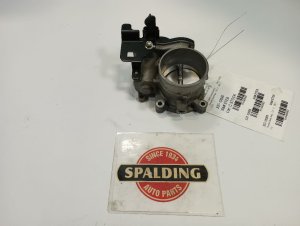
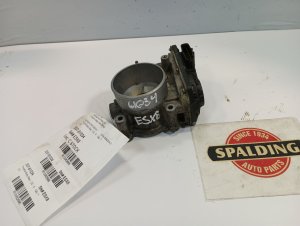
When a used part is the smart pick: A used OEM throttle body is a very practical and cost-effective repair for this vehicle. Since the failure is electronic wear, a part from a low-mileage, accident-damaged vehicle can provide significant savings ($50-$100 used vs. $400+ new OEM) with good reliability.
Donor-vehicle mileage cap: roughly under 80000 miles for the part to have meaningful remaining life.
What to inspect on the donor part:
- Butterfly Valve: Manually push the throttle plate; it should move smoothly without any sticking or binding and snap back firmly when released.
- Connector Pins: Inspect the electrical connector pins. They must be straight, clean, and free of any green or white corrosion.
- Cleanliness: Avoid units with excessive, caked-on carbon buildup inside the bore, as this may indicate the donor vehicle had other engine health issues.
- No Physical Damage: Check the plastic housing and mounting tabs for any cracks or damage that may have occurred during removal or from an accident.
OEM-only on this vehicle (don't cheap out):
- Electronic Throttle Body Assembly
Aftermarket brands forum-validated for this vehicle:
- Mazda (OEM)
- Hitachi (Often the original equipment manufacturer)
Brands owners have reported issues with on this vehicle:
- Unbranded, no-name units from online marketplaces should be avoided. The complex electronics and need for precise calibration make them a high-risk purchase that can cause persistent drivability issues.
Real Owner Stories
Aggregated from forums and TSBs cited above. Mileages and costs reflect what owners reported in those sources.
2021 Mazda CX-5 — 68000 miles
Symptoms: Multiple warning lights flashing followed by the car entering 'limp mode' where it would barely accelerate. After a restart, the Check Engine Light remained on.
What fixed it: Replacement of the electronic throttle body assembly.
Source hint: Reddit r/CX5 thread titled 'Big CX-5 issue as a first time Mazda owner' and 'Owner Experience: Sudden Limp Mode'
2017 Mazda CX-5
Symptoms: Severe hesitation and the inability to accelerate up a hill, making the car undrivable.
What fixed it: Replacement of the throttle body/pedal position sensor components.
Source hint: Reddit r/MechanicAdvice thread titled 'P2135 OBDII code throttle/pedal position'
Related OBD-II Codes
Frequently Asked Questions
Can I just replace the Throttle Position Sensor (TPS) on my 2017-2024 Mazda CX-5?
Does Mazda recall 3719F / NHTSA 19V495000 apply to my P0122 code?
Is there a specific part number for the throttle body if I need a replacement for a 2018+ model?
Could carbon buildup be causing my P0122 code on my SKYACTIV-G engine?
What should the voltage readings be for the Throttle Position Sensor (TP1) on my CX-5?
Are there any other common issues I should look out for while diagnosing my 2019 CX-5 2.5T?
Helpful Videos



We Have This Part in Stock

The information in this article is provided for general reference and educational purposes only. Vehicle specifications, procedures, and part compatibility can vary by production date, trim level, and region. Always consult your vehicle's factory service manual and verify part numbers before purchasing or performing repairs. Safety-critical components such as airbags, seat belts, and braking systems should be installed by a qualified professional.
- Mazda CX-5:
- 🧭 Diagnostic Flowchart
- 🎬 Helpful Videos
- 🛍️ Shop This Part
- What's Unique About the 2017-2024 Mazda CX-5
- Symptoms You May Notice
- Most Likely Causes
- Rare But Worth Checking
- Diagnosis Steps
- Parts You'll Likely Need
- Related Codes That Often Appear With This One
- Technical Service Bulletins (TSBs) & Recalls
- Platform-Specific Known Issues
- Mechanic-Grade Diagnostic Values
- Hidden / Shadow Codes Worth Checking
- Scan Tool Commands That Help
- Wiring & Ground Locations
- OEM Part Supersession History
- Model Year Variations Within This Range
- Other Known Issues on This Vehicle
- Used vs. New Parts: Buying Guide for This Vehicle
- Real Owner Stories
- 2021 Mazda CX-5 — 68000 miles
- 2017 Mazda CX-5
- Related OBD-II Codes
- Frequently Asked Questions
- 🎟️ Get 5% Off