

P0122 on 2007-2017 Mitsubishi Lancer: Throttle Position Sensor Low Input Causes & Fixes
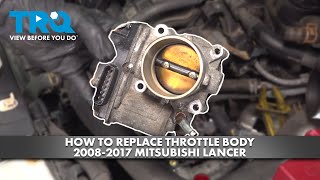
On a 2007-2017 Lancer, code P0122 almost always means the throttle position sensor has failed. Because the sensor is integrated into the throttle body, the entire assembly must be replaced. Expect to pay $250-$400 for an aftermarket throttle body and around 1 hour for DIY installation. A throttle relearn procedure is required after replacement.
- P0122 on this Lancer is a serious code that will cause significant drivability issues, including limp mode.
- The most likely cause is a failed throttle position sensor, which is built into the throttle body.
- The fix is to replace the entire throttle body assembly; the sensor cannot be replaced by itself.
- Before buying parts, check the throttle body's electrical connector and wiring for damage, as this can mimic a sensor failure.
- An aftermarket throttle body is a cost-effective solution compared to the much more expensive OEM part.
- After replacing the throttle body, a relearn procedure is mandatory for proper idle and throttle response.
What's Unique About the 2007-2017 Mitsubishi Lancer
For the 4B11 and 4B12 engines in this generation of Lancer, the throttle position sensor (TPS) is an integral part of the electronic throttle body assembly. Unlike some older vehicles where the sensor can be unbolted and replaced separately, fixing a P0122 code caused by a failed sensor on this platform requires replacing the entire throttle body. This design makes the repair more expensive, as you are replacing the housing, motor, and both the main and sub-position sensors at once. This design is shared with platform mates like the Mitsubishi Outlander, Dodge Caliber, and Jeep Patriot.
Symptoms You May Notice
- Check Engine Light illuminated
- Vehicle enters "limp mode" with severely reduced engine power
- Hesitation or stumbling upon acceleration
- Engine stalling, especially at idle or when coming to a stop
- Rough or erratic idle
- Poor or non-responsive throttle
- Inability to rev past a certain RPM (e.g., 3000 RPM)
- Replacing only the Accelerator Pedal Position (APP) sensor. This code specifically points to the sensor at the engine's throttle body, not the sensor at the gas pedal.
- Assuming a dirty throttle body is the cause. While cleaning a dirty throttle body is good maintenance, it will not fix a failed internal sensor that triggers P0122.
Most Likely Causes
- Failed Throttle Body Assembly (Internal TPS Failure) 🔴 High Probability → Shop Fuel Injection Throttle Body The electronic throttle position sensor is integrated into the throttle body and is a common failure point. The official Mitsubishi repair procedure is to replace the entire assembly. Forum users consistently report that replacing the throttle body resolves the code.
How to confirm: Use a scan tool to monitor live data for 'Throttle Position Sensor (main)'. The voltage should be around 0.3-0.7V at idle and sweep smoothly up to ~4.5V at wide-open throttle. If the reading is stuck at 0%, shows 0.0V, or if it drops out and doesn't move smoothly when the pedal is pressed, the sensor has failed.
Typical fix: Replace the entire throttle body assembly. After replacement, a throttle relearn procedure must be performed to calibrate the new unit.
Est. part cost: $250 - $450 for an aftermarket assembly; $900+ for OEM. - Wiring Harness or Connector Issue 🟡 Medium Probability Vibrations and heat can cause wires to chafe or connector pins to lose contact over time. This is often seen after other engine work where the harness was moved. Corrosion at the connector pins is also a possibility.
How to confirm: Visually inspect the wiring harness leading to the throttle body for any signs of damage, chafing, or melting. Unplug the 6-pin connector (B-11) and check for corrosion, moisture, or backed-out pins. With the key on, back-probe the connector to verify the 5V reference (Pin 5), ground (Pin 3), and signal (Pin 4) circuits are intact per the service manual.
Typical fix: Repair the damaged section of the wiring harness or clean/replace the connector.
Est. part cost: $10 - $50 for wiring repair supplies.
Rare But Worth Checking
- Failed Powertrain Control Module (PCM): This is extremely rare and should only be considered after all other possibilities, including the throttle body and wiring, have been exhaustively tested and ruled out. The service manual lists this as a final diagnostic step.
Diagnosis Steps
- Connect an OBD-II scanner and confirm P0122 is the active code. Note any other codes present.
- Use the scanner's live data function to view the 'Throttle Position Sensor (main)' reading (often shown as a percentage or voltage).
- With the key on, engine off, slowly press the accelerator pedal. The voltage reading should increase smoothly from its idle value (~0.3-0.7V) to wide-open throttle (~4.4-4.8V).
- If the reading is stuck at 0, jumps erratically, or doesn't change, the TPS has failed internally and the throttle body assembly needs replacement.
- If the live data seems okay, perform a visual inspection of the throttle body connector (B-11) and its wiring harness. Look for loose connections, corrosion, or damaged wires.
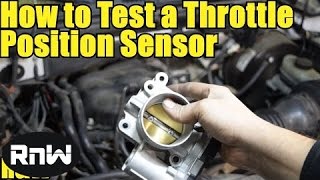
- If you have a multimeter, back-probe the connector 🎬 See how to test a throttle position sensor to test for the 5-volt reference signal from the ECM (Pin 5 to ground), a good ground (Pin 3), and the signal wire's voltage sweep (Pin 4).
- If wiring and connectors are good, but the sensor signal is bad, the throttle body assembly has failed and needs replacement.
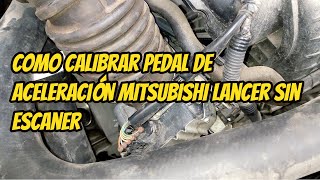
- After replacing the throttle body, perform an Idle Relearn Procedure. 🎬 Watch how to calibrate the throttle body without a scanner A common method is to warm the engine, turn it off, disconnect the battery for a few minutes, reconnect it, turn the key to 'ON' for 10 seconds (you may hear the throttle body motor actuating), turn off for 10 seconds, then start the engine and let it idle for 10 minutes without touching the throttle.
- If the sensor and wiring both test good, the problem may be an intermittent fault or, in very rare cases, a faulty ECM.
Parts You'll Likely Need
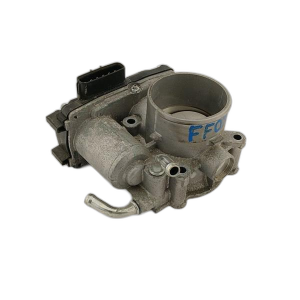
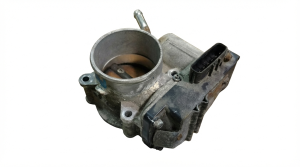
- Throttle Body Assembly
(OEM #1450A109)— This is the most common cause of failure. The throttle position sensor is integrated into this assembly and is not sold separately by the manufacturer for this vehicle.
Trusted brands: Hitachi (often the OEM supplier), Bosch, Standard Motor Products, Cardone (Remanufactured)
OEM price range: $930 - $1280
Aftermarket price range: $250 - $450
Technical Service Bulletins (TSBs) & Recalls
- TSB-13-13-001REV: While not directly for P0122, this TSB addresses reprogramming the ECM to correct improper misfire detection (P0300) logic that can be caused by certain driving conditions. It shows that Mitsubishi has addressed drivability issues via software updates, though it won't fix a failed TPS.
Platform-Specific Known Issues
- A user on EvolutionM.net reported getting P0122 after major engine work where the harness was disconnected. The issue was traced back to a wiring problem, highlighting the importance of checking connections after any repair in that area.
Mechanic-Grade Diagnostic Values
- Throttle Position Sensor (main) Voltage - Throttle Closed — expected: 300 - 700 mV (0.3 - 0.7 V). Failure: A reading below 0.2V for more than 0.3 seconds will set the code.
- Throttle Position Sensor (main) Voltage - Throttle Wide Open — expected: 4,400 - 4,800 mV (4.4 - 4.8 V). Failure: Voltage does not reach at least 4.0V or does not sweep smoothly from the closed position.
- TPS Reference Voltage at Connector B-11, Pin 5 — expected: Approx. 5.0 V. Failure: Significantly lower or no voltage indicates a problem with the ECM or the wiring from the ECM.
- TPS Ground at Connector B-11, Pin 3 — expected: Continuity to ground (Near 0 Ω). Failure: High resistance indicates a bad ground connection, which can cause incorrect sensor readings.
Scan Tool Commands That Help
- Mitsubishi MUT-III (or compatible advanced scanner): Data List Item 13: Throttle Position Sensor (main) — To monitor the live voltage output of the sensor to confirm if it is faulty, stuck, or has dead spots.
- Mitsubishi MUT-III (or compatible advanced scanner): Service Function: Idle Air Volume Learning — This is the official procedure required after cleaning or replacing the throttle body to teach the ECM the new idle position. Failure to do this can result in incorrect idle speed and poor drivability.
Wiring & Ground Locations
- B-11 — The 6-pin electrical connector on the electronic throttle body assembly.. This is the primary connection point for the throttle position sensor. All voltage and signal tests are performed here. Pin 4 is the signal wire for the main TPS, Pin 5 is the 5V reference, and Pin 3 is the ground.
- B-08 — One of the main connectors at the Engine Control Module (ECM).. This connector contains the corresponding terminals for the TPS circuit. The TPS signal goes to pin 10, the 5V reference comes from pin 12, and the ground is provided by pin 13. This is used for advanced diagnosis of wiring continuity between the sensor and the ECM.
- Intake Manifold Ground — A grounding point often located on a bolt on the intake manifold.. While the TPS is grounded through the ECM, a poor engine or manifold ground can introduce electrical noise that may affect sensor readings. Technicians often add or improve this ground point to resolve intermittent electrical issues.
Real Owner Repair Stories
- Reddit user on r/mitsubishi (2010 Mitsubishi Lancer ES 2.0L 4B11) — After cleaning the throttle body, the user experienced weird bumps in acceleration/deceleration and the car would continue to propel itself at low speeds without gas pedal input.
❌ Tried (didn't work) Cleaning the throttle body and MAF sensor initially resolved RPM fluctuations but introduced new drivability problems.
✅ What actually fixed it The user identified that a throttle body relearn procedure was necessary to recalibrate the ECU to the cleaned throttle plate's new closed position. The symptoms were caused by the ECU not knowing the new idle baseline. - EvolutionM.net user 'ApexGTS' (2009 Mitsubishi Lancer GTS 2.4L 4B12) — Spun crank bearings leading to complete engine failure.
❌ Tried (didn't work) Rebuilding the original engine was considered but a low-mileage replacement was chosen instead.
✅ What actually fixed it The user successfully replaced the original 2009 4B12 engine with a 4B12 from a 2015 Lancer. The long block and head were a direct fit, but some external components from the original engine had to be swapped over. This confirms cross-compatibility of the core engine across several model years.
Model Year Variations Within This Range
- 2008 vs 2009+ (GTS Trim): The 2008 Lancer GTS model was equipped with the 2.0L 4B11 engine. For the 2009 model year and later, the GTS trim was upgraded to the 2.4L 4B12 engine, which offered more torque.
- 2007-2017 (All 4B1x engines): While the physical throttle body assembly (Part No. 1450A109, 57mm diameter) is identical across the 4B10, 4B11, and 4B12 engines, the Engine Control Module (ECM) software may limit the maximum throttle plate opening based on the specific vehicle model and engine displacement.
Diagnostic Flowchart
Other Known Issues on This Vehicle
Issues unrelated to this code that are worth knowing about as an owner of this generation:
- CVT Transmission Overheating or Failure 🔴 High — Common, especially on earlier models. Often presents as a 'Slow Down' warning light and whining noises. Can occur at any mileage but is more frequent over 70,000 miles. (Ref: Software updates were issued to improve CVT calibration and responsiveness, but many failures are mechanical.)
- Prematurely Worn Suspension Bushings 🟠 Medium — Frequently reported after 70,000 miles. Leads to clunking or knocking noises from the front end, especially over bumps.
- Clear Coat / Paint Failure 🟡 Low — Widespread issue where the clear coat peels or chips easily, particularly on the roof and hood.
- Blower Motor Resistor Failure 🟡 Low — Common problem where the fan only works on the highest setting or not at all. The resistor is the typical point of failure.
- False P0300 Misfire Codes 🟠 Medium — The ECM logic could falsely detect misfires during certain conditions like cold starts or specific CVT downshifts. (Ref: TSB-13-13-001REV)
Used vs. New Parts: Buying Guide for This Vehicle
When a used part is the smart pick: A used throttle body from a reputable salvage yard is a very smart choice for this repair. The OEM part is expensive (over $900), and a tested, low-mileage used unit can provide the same function for a fraction of the price.
Donor-vehicle mileage cap: roughly under 100000 miles for the part to have meaningful remaining life.
What to inspect on the donor part:
- Check the electrical connector for any bent, corroded, or damaged pins.
- Manually move the throttle plate (if possible) to ensure it moves smoothly without binding.
- Ask for the donor vehicle's VIN and mileage to verify its history.
- Look for a seller that offers a short warranty (e.g., 90 days) on the part.
Aftermarket brands forum-validated for this vehicle:
- Hitachi (often the original OEM supplier)
- Bosch
- Standard Motor Products (SMP)
Real Owner Stories
Aggregated from forums and TSBs cited above. Mileages and costs reflect what owners reported in those sources.
2004-2010 Mitsubishi Lancer/Evo
Symptoms: The vehicle experienced hesitation and stalling. A scan tool showed the throttle position at 0% even when the pedal was pressed.
What fixed it: Replacing the sensor/throttle body assembly.
Source hint: EvolutionM.net - 'DTC P0122: Throttle Position Circuit Low Input' (2004-10-19)
2010 Mitsubishi Lancer/Evo
Symptoms: Code P0122 appeared immediately after the engine was dropped for a clutch change.
What fixed it: Checking the wiring harness and ensuring the TPS/throttle body was reinstalled correctly.
Source hint: EvolutionM.net - 'P0122 (tps) issue' (2010-06-16)
2024 Mitsubishi Lancer (General Platform)
Symptoms: Jerky acceleration and deceleration after the throttle body was cleaned.
What fixed it: Performing a throttle body relearn procedure to calibrate the unit.
Source hint: Reddit r/mitsubishi - 'Throttle Body Relearn Procedure?' (2024-01-04)
2007-2017 Mitsubishi Lancer 4B11/4B12
Symptoms: Vehicle entered 'limp mode' with severely reduced engine power and an inability to rev past 3000 RPM.
What fixed it: Replacement of the entire throttle body assembly followed by a relearn procedure.
Source hint: EvolutionM.net - 'DTC P0122: Throttle Position Circuit Low Input' (2004-10-19)
Related OBD-II Codes
Frequently Asked Questions
Does TSB-13-13-001REV fix the P0122 code on my Mitsubishi Lancer?
Can I just replace the sensor, or do I need the whole throttle body for my 4B11/4B12 engine?
How much should I expect to pay for a new throttle body for my Lancer?
Is there a specific procedure I need to follow after replacing the throttle body?
I just had a clutch change and now have a P0122 code; is this common?
What live data values should I look for on my scan tool to confirm a bad TPS?
Helpful Videos

Used OEM Parts in Stock
New Aftermarket Parts Available


The information in this article is provided for general reference and educational purposes only. Vehicle specifications, procedures, and part compatibility can vary by production date, trim level, and region. Always consult your vehicle's factory service manual and verify part numbers before purchasing or performing repairs. Safety-critical components such as airbags, seat belts, and braking systems should be installed by a qualified professional.
- Mitsubishi Lancer:
- 🧭 Diagnostic Flowchart
- 🎬 Helpful Videos
- 🛍️ Shop This Part
- What's Unique About the 2007-2017 Mitsubishi Lancer
- Symptoms You May Notice
- Most Likely Causes
- Rare But Worth Checking
- Diagnosis Steps
- Parts You'll Likely Need
- Technical Service Bulletins (TSBs) & Recalls
- Platform-Specific Known Issues
- Mechanic-Grade Diagnostic Values
- Scan Tool Commands That Help
- Wiring & Ground Locations
- Real Owner Repair Stories
- Model Year Variations Within This Range
- Other Known Issues on This Vehicle
- Used vs. New Parts: Buying Guide for This Vehicle
- Real Owner Stories
- 2004-2010 Mitsubishi Lancer/Evo
- 2010 Mitsubishi Lancer/Evo
- 2024 Mitsubishi Lancer (General Platform)
- 2007-2017 Mitsubishi Lancer 4B11/4B12
- Related OBD-II Codes
- Frequently Asked Questions
- 🎟️ Get 5% Off