

P0122 on 1998-2004 Subaru Forester: Throttle Position Sensor Low Input Causes and Fixes
On a 1998-2004 Forester, P0122 almost always points to a failing Throttle Position Sensor (TPS). This causes stalling, hesitation, and rough idle. A new sensor is the usual fix, costing around $70-$150 for the part, and it's a simple DIY job for most owners. The sensor sends a voltage signal to the ECU to indicate throttle opening; P0122 means this signal is below the expected minimum.
- P0122 on a 1998-2004 Forester is a straightforward code that almost always means the Throttle Position Sensor (TPS) has failed or is out of adjustment.
- Symptoms are noticeable and affect drivability, including stalling, hesitation, and a rough idle.
- Diagnosis is simple with a multimeter; check for a signal voltage below the 0.45-0.55V range at idle or an unsmooth sweep as the throttle is opened.
- Replacing the TPS is a beginner-friendly DIY job that requires basic hand tools and takes less than 30 minutes.
- Crucially, a new TPS must be adjusted by rotating it to achieve the correct idle voltage before tightening the screws.
- Always check the connector and wiring for damage before replacing the sensor, but expect the sensor itself to be the culprit.
What's Unique About the 1998-2004 Subaru Forester
The 1998-2004 Subaru Forester uses a simple, cable-actuated throttle body, making diagnosis for a P0122 code very straightforward. Unlike newer cars with drive-by-wire systems, this code almost exclusively points to the TPS mounted directly on the throttle body, its connector, or its wiring. The EJ25 engine in this generation is known for its reliability, but the TPS is a common wear-and-tear component that fails over time, sending an incorrect low voltage signal back to the ECU. This issue is shared with other Subarus of the era using the same engine, like the Impreza and Legacy/Outback.
Generation note: This range covers the first generation (SF: 1998-2002) and the first two years of the second generation (SG: 2003-2004). For the P0122 code, the cause, diagnosis, and repair are virtually identical across these model years as they share the same fundamental EJ25 engine and cable-driven throttle body design.
Symptoms You May Notice
- Check Engine Light is on
- Engine stalling, especially when coming to a stop or at idle
- Hesitation or stumbling during acceleration
- Rough or erratic idle
- Lack of engine power or sluggish performance
- Poor fuel economy
- Engine surging
- Inability to accelerate past a certain speed or RPM (limp mode)
- Replacing the entire throttle body assembly when only the sensor is at fault.
- Replacing the Idle Air Control (IAC) valve, which can cause similar idle issues but won't typically set a P0122 code.
Most Likely Causes
- Faulty Throttle Position Sensor (TPS) 🔴 High Probability → Shop Fuel Injection Throttle Body The TPS is a potentiometer with internal moving parts that wear out over time, leading to dead spots or a complete failure where the signal voltage drops below the required threshold. This is the most common failure point for P0122 on this platform.
How to confirm: With the key on and engine off, use a multimeter to back-probe the signal wire on the TPS connector. The voltage should be within the 0.45V to 0.55V range at closed throttle and sweep smoothly up to ~4.5V at wide-open throttle. A reading below this range or any dropouts during the sweep indicates a bad sensor. The sensor can be adjusted by loosening its mounting screws and rotating it to achieve the correct idle voltage.
Typical fix: Replace the Throttle Position Sensor. It is recommended to use an OEM or OEM-supplier part like Hitachi, as cheap aftermarket sensors are known to fail prematurely.
Est. part cost: $70-$150 - Damaged Wiring or Poor Connection 🟡 Medium Probability Engine vibration, heat, and age can cause wires to fray, break, or short to ground. The connector pins can also become corroded or loose, causing an intermittent or permanent low voltage signal.
How to confirm: Visually inspect the wiring harness leading to the TPS for any signs of damage, chafing, or melting. Unplug the connector and check for corrosion or bent/loose pins. Use a multimeter to check for continuity on the signal and ground wires and to verify the 5V reference from the ECM.
Typical fix: Repair the damaged section of wiring or clean/replace the connector pigtail.
Est. part cost: $10-$50
Rare But Worth Checking
- Faulty Powertrain Control Module (ECM): This is extremely rare. The ECM should only be considered after definitively ruling out the sensor and wiring as the cause of the problem.
- Dirty Throttle Body: → Shop Fuel Injection Throttle Body While less likely to cause a P0122 specifically, heavy carbon buildup can prevent the throttle plate from closing completely. More often, cleaning the throttle body is suggested as a general maintenance step that can sometimes resolve erratic idle issues that might be misdiagnosed as a TPS fault.
Diagnosis Steps
- Read the code with an OBD-II scanner to confirm P0122 is present.
- Visually inspect the Throttle Position Sensor and its electrical connector for any obvious damage, looseness, or corrosion.
- Inspect the wiring harness leading to the sensor for any signs of chafing, melting, or breaks.
- With the ignition in the 'ON' position (engine off), use a multimeter to test the TPS. Back-probe the connector to measure the signal wire voltage.
- At closed throttle, the voltage should be approximately 0.45-0.55 volts. A reading significantly below this (e.g., <0.2V) points to the problem.
- Slowly open the throttle by hand. The voltage should increase smoothly and steadily to about 4.5 volts at wide-open throttle.
- If the initial voltage is below the specified range or if the voltage jumps, drops, or has dead spots as you open the throttle, the TPS is faulty and needs replacement.
- If the sensor tests good, check for 5V reference voltage and a good ground at the connector. If either is missing, the problem is in the wiring or the ECM.
- Before tightening the new sensor, adjust its rotational position to ensure the closed-throttle voltage is within the 0.45-0.55V spec.
- After replacing and adjusting the part, clear the code and perform a test drive to ensure the fix was successful.
Parts You'll Likely Need
- Throttle Position Sensor
(OEM #22633AA111)— This is the most common point of failure for the P0122 code on this vehicle due to internal wear over time. The original part number 22633AA110 has been superseded by 22633AA111.
Trusted brands: Subaru (Genuine), Hitachi (OEM supplier), Denso, NTK
OEM price range: $100-$150
Aftermarket price range: $70-$120
Related Codes That Often Appear With This One
- P0121 — This code indicates a 'Throttle Position Sensor Performance' problem, suggesting the signal is erratic or not where the ECM expects it to be, which can occur as a TPS fails.
- P0123 — This code for 'TPS Circuit High Input' can sometimes appear intermittently along with P0122 if the sensor is failing erratically, sending signals that are both too high and too low.
- P1700 — This is a transmission-related code indicating a throttle position sensor circuit malfunction. Since the Transmission Control Module (TCM) uses the TPS signal for shift control, a P0122 fault can trigger a P1700 code, often resulting in harsh shifting.
Platform-Specific Known Issues
- Owner Experience: Adjustment is Key: Multiple forum users stress the importance of adjusting the new TPS. Simply installing it is not enough. The sensor must be rotated slightly before tightening the screws to get the idle voltage within the 0.45-0.55V range. Failure to do so can result in the P0122 code returning or other idle/performance issues.
- Real-World Repair Story: A user on LegacyGT.com with a '97 Legacy (sharing the EJ25 engine) experienced code P0122. Initial suggestions included cleaning the throttle body plate of gunk and checking for bad electrical connections before replacing the sensor itself, highlighting the diagnostic path most owners take.
Mechanic-Grade Diagnostic Values
- TPS Resistance (4-pin sensor) — expected: 3.5 to 6.5 kΩ between certain pins (varies by test condition).. Failure: A reading significantly outside this range, or an open/short circuit, indicates a faulty sensor.
- TPS Signal Wire (at ECM) — expected: 0.45V - 0.55V at closed throttle, sweeping smoothly to ~4.5V at wide-open throttle.. Failure: Voltage below 0.2V or non-linear response indicates a fault in the sensor or wiring.
- TPS 5V Reference Wire — expected: A stable 5.0 volts with key on, engine off.. Failure: No voltage or low voltage points to a wiring issue or a problem with the ECM.
Scan Tool Commands That Help
- Subaru Select Monitor (SSM): Live Data Monitoring for Throttle Sensor — While a standard OBD-II scanner is sufficient, the dealer-level Subaru Select Monitor can be used to view the throttle position voltage in real-time to check for smooth operation, which is the primary diagnostic step for this code. A specific cartridge may be needed for older models.
Wiring & Ground Locations
- TPS Connector (E7, E10, E13) — Directly on the throttle body, mounted to the side.. This is the primary connection point. Corrosion or loose pins here are a common cause of the P0122 code. The connector housing can be purchased separately if damaged.
- TPS Pinout (2002-2004 Forester) — On the TPS connector itself.. For testing: The TPS signal wire is typically Red. This is the wire to back-probe for voltage readings.
- TPS Pinout (2000-2001 Forester) — On the TPS connector itself.. For testing: The TPS signal wire is typically White. This is the wire to back-probe for voltage readings.
- Engine Ground Point — The main engine ground is typically a strap from the engine block to the chassis, often below the battery tray. Another critical ground point is on the intake manifold itself.. The ECU gets its ground reference from the intake manifold. A poor ground connection at the manifold or between the engine and chassis can cause floating voltages and sensor reading errors, including P0122.
Real Owner Repair Stories
- 2CarPros Forum User (2003 Subaru Legacy) — Check engine light with codes P0122 and P1700, rough idle when in gear, harsh transmission shifting.
❌ Tried (didn't work) The owner had removed and reinstalled the TPS while diagnosing another issue. After reinstallation, they attempted the relearn process multiple times but the codes and symptoms persisted.
✅ What actually fixed it The issue was incorrect physical adjustment of the TPS. The sensor must be rotated to a specific position to achieve the correct closed-throttle voltage (0.45-0.55V) before the mounting screws are tightened. Simply reinstalling it without this adjustment caused the low voltage reading.
OEM Part Supersession History
22633AA110→22633AA111— Standard part revision and update by the manufacturer.
Heads up: These parts are generally interchangeable for the specified model years. However, some parts catalogs indicate 22633AA111 has also been discontinued or superseded by 22633AA210 for some applications, so verifying with a dealer using the VIN is recommended.
Model Year Variations Within This Range
- 2000-2001 vs 2002-2004: The wire color for the TPS signal wire changed. For 2000-2001 models, it is listed as White. For 2002-2004 models, it is listed as Red. This is critical for accurate back-probing during diagnosis.
Diagnostic Flowchart
Other Known Issues on This Vehicle
Issues unrelated to this code that are worth knowing about as an owner of this generation:
- Head Gasket Failure 🔴 High — Very common on naturally-aspirated EJ25 engines from 1999-2004, typically failing between 100,000 and 150,000 miles. Failures can be external oil/coolant leaks or internal breaches. (Ref: Subaru issued a technical service campaign (WWP-99) which involved adding a 'coolant conditioner' to the system as a temporary fix.)
- Rear Wheel Bearing Failure 🟠 Medium — Common failure item, often occurring before 100,000 miles. Presents as a loud humming or grinding noise that increases with speed. Diagnosis involves listening for noise while the wheels are spinning.
- Rear Quarter Panel and Rocker Panel Rust 🟠 Medium — Common in regions with road salt. Moisture and debris get trapped behind the rear wheel arch molding and in the rocker panels, causing rust from the inside out. (Ref: A recall (NHTSA 11V464000) was issued for front lower control arm rust on some models, but not specifically for the rear quarter panels.)
- Front Oxygen Sensor Failure 🟡 Low — The front O2 (Air/Fuel) sensor is a common failure item that will trigger a Check Engine Light and affect fuel economy. (Ref: Subaru had a service program (WXW-80) and recalls for faulty front oxygen sensors on various models including the Forester.)
Used vs. New Parts: Buying Guide for This Vehicle
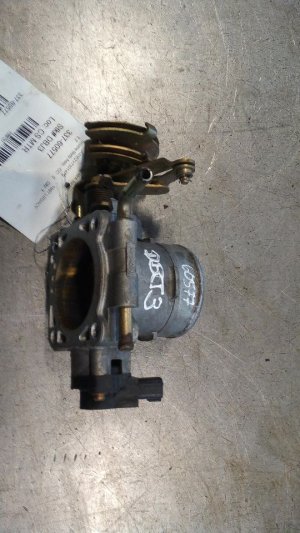
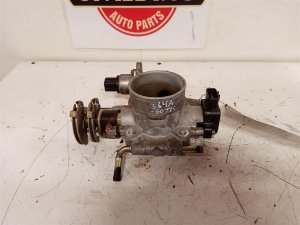
When a used part is the smart pick: A used OEM throttle body assembly from a low-mileage donor can be a good value if it includes a known-good original TPS. However, buying a used TPS sensor by itself is not recommended as it is a wear item with a finite lifespan.
Donor-vehicle mileage cap: roughly under 75000 miles for the part to have meaningful remaining life.
What to inspect on the donor part:
- Check for a clean connector with no corrosion or broken plastic tabs.
- Ensure the throttle body it's attached to is relatively free of heavy carbon buildup.
- Ask for the VIN of the donor car to verify mileage and compatibility.
OEM-only on this vehicle (don't cheap out):
- While not strictly 'OEM-only', the consensus among Subaru enthusiasts is that engine sensors, especially the TPS, should be either Genuine Subaru or from the original equipment manufacturer (OEM), which is often Hitachi.
Aftermarket brands forum-validated for this vehicle:
- Hitachi (OEM)
- Denso
- NTK / NGK
- Standard Motor Products (SMP)
Brands owners have reported issues with on this vehicle:
- Unnamed, low-cost sensors from online marketplaces (e.g., Amazon, eBay) are frequently reported by forum users to fail quickly, sometimes within months, or be dead-on-arrival.
Real Owner Stories
Aggregated from forums and TSBs cited above. Mileages and costs reflect what owners reported in those sources.
2001 Forester
Symptoms: Severe hesitation, terrible fuel economy, a hard bang when shifting gears, loss of power, and the engine shutting off. After initial repair, the car had 'dancing rpms'.
What fixed it: Installed a new TPS sensor and planned an idle relearn procedure.
Source hint: The Subaru Forums report for 2001 Forester
1997 Legacy (EJ25)
Symptoms: Code P0122 present; community advice suggested checking for gunk on the throttle body plate and bad electrical connections.
What fixed it: Cleaning the throttle body plate and checking electrical connections before sensor replacement.
Source hint: LegacyGT.com - 'CEL P0122 - Any Tips?'
Related OBD-II Codes
Frequently Asked Questions
Can I just bolt on a new TPS to my Forester, or is there a specific adjustment needed?
Which brand of replacement sensor should I use for my EJ25 engine?
Is there a recall for the front oxygen sensor on the 1998-2004 Forester?
My Forester is stalling at stops; could this be related to the head gasket issues common on EJ25 engines?
What voltage should I see at the TPS signal wire when the throttle is closed?
Are there any other common mechanical issues I should look out for on this specific Forester generation?
Helpful Videos
Used OEM Parts in Stock
New Aftermarket Parts Available

The information in this article is provided for general reference and educational purposes only. Vehicle specifications, procedures, and part compatibility can vary by production date, trim level, and region. Always consult your vehicle's factory service manual and verify part numbers before purchasing or performing repairs. Safety-critical components such as airbags, seat belts, and braking systems should be installed by a qualified professional.
- Subaru Forester:
- 🧭 Diagnostic Flowchart
- 🎬 Helpful Videos
- 🛍️ Shop This Part
- What's Unique About the 1998-2004 Subaru Forester
- Symptoms You May Notice
- Most Likely Causes
- Rare But Worth Checking
- Diagnosis Steps
- Parts You'll Likely Need
- Related Codes That Often Appear With This One
- Platform-Specific Known Issues
- Mechanic-Grade Diagnostic Values
- Scan Tool Commands That Help
- Wiring & Ground Locations
- Real Owner Repair Stories
- OEM Part Supersession History
- Model Year Variations Within This Range
- Other Known Issues on This Vehicle
- Used vs. New Parts: Buying Guide for This Vehicle
- Real Owner Stories
- 2001 Forester
- 1997 Legacy (EJ25)
- Related OBD-II Codes
- Frequently Asked Questions
- 🎟️ Get 5% Off