

P0122 on 2004-2005 Toyota RAV4 2.4L: Throttle Position Sensor Low Input Causes and Fixes
P0122 on a 2004-2005 RAV4 almost always points to a failing Throttle Position Sensor (TPS) located on the throttle body. A replacement sensor is the most common fix. Expect to pay around $60-$120 for an OEM sensor and under $50 for an aftermarket one. It's a DIY-friendly repair.
- P0122 on a 2004-2005 RAV4 means the Throttle Position Sensor's voltage is too low.
- The most likely cause is a failed sensor, which is a relatively inexpensive part and simple to replace.
- Symptoms include poor acceleration, rough idle, and the engine entering a low-power 'limp mode'.
- Diagnosis involves checking the sensor's voltage output with a multimeter; it should sweep smoothly from ~0.7V to ~4.5V.
- While you're working on the 2AZ-FE engine, be aware of its two major known issues: excessive oil consumption and stripped cylinder head bolts.
What's Unique About the 2000-2005 Toyota RAV4
The 2004-2005 RAV4 with the 2AZ-FE engine uses a non-contact, Hall-effect type Throttle Position Sensor, which is part of an Electronic Throttle Control System (ETCS) — there is no physical throttle cable. This system uses two sensors (VTA1 and VTA2) for redundancy and to detect faults. A failure in the primary 'A' circuit (VTA1) triggers P0122. While these sensors are designed for reliability, internal failure or issues with the wiring are the primary cause for this code, rather than the carbon buildup issues that can plague the throttle body motor on other Toyota models with the same engine family.
Generation note: The specified vehicle range (2000-2005) covers the entire second generation (XA20) of the RAV4. However, the 2AZ-FE 2.4L engine was only available in the 2004-2005 model years in North America. The 2000-2003 models used a different engine (1AZ-FE 2.0L). This guide is specific to the 2004-2005 models with the 2.4L engine.
Symptoms You May Notice
- Check Engine Light is on
- Hesitation or stumbling when accelerating
- Reduced engine power or 'limp mode'
- Rough or unstable idle
- Engine may stall, especially at idle
- Poor fuel economy
- Difficulty shifting gears or improper transmission shift points
- Hard starting engine
- Replacing the entire throttle body assembly. For a P0122 code, the issue is almost always the sensor itself, which is sold separately, not the throttle body motor or the physical throttle plate.
Most Likely Causes
- Faulty Throttle Position Sensor (TPS) 🔴 High Probability → Shop Fuel Injection Throttle Body The sensor is an electronic component that can fail internally over time due to heat and vibration in the engine bay. Even non-contact Hall-effect sensors can fail electronically, leading to a loss of signal.
How to confirm: With the key on and engine off, use a multimeter to back-probe the sensor's signal wire (VTA1). The voltage should be around 0.5-0.9V at closed throttle and sweep smoothly up to ~4.5V at wide-open throttle. A reading below 0.2V or an erratic/jumpy signal indicates a bad sensor. A user on LS1Tech.com confirms these typical voltage ranges.
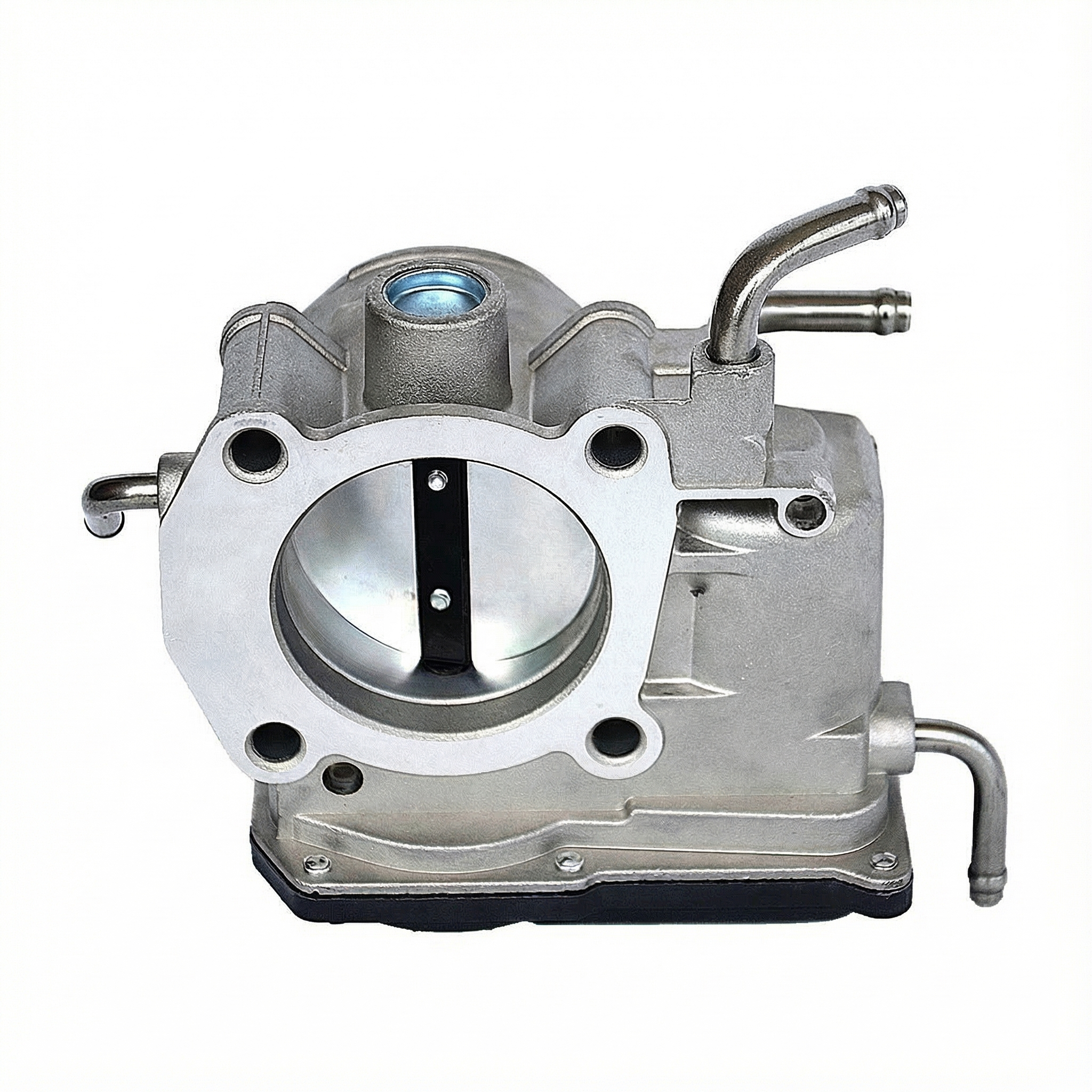
Typical fix: Replace the throttle position sensor. It is mounted to the side of the throttle body with two screws.
Est. part cost: $25-$120 - Wiring or Connector Issue 🟡 Medium Probability Engine bay heat can make wiring insulation brittle and connectors fragile over time. Corrosion on the connector pins is a common cause, creating high resistance that drops the signal voltage.
How to confirm: Visually inspect the wiring harness leading to the TPS for any signs of damage, fraying, or melting. Unplug the connector and check for corrosion (green crust), moisture, or bent pins. Check for a stable 5V reference voltage and a good ground at the connector with a multimeter.
Typical fix: Repair the damaged section of wiring or clean the connector pins thoroughly. If the connector is damaged, replace the pigtail.
Est. part cost: $5-$30
Rare But Worth Checking
- Faulty Powertrain Control Module (PCM/ECM): This is very rare and should only be considered after all other possibilities have been ruled out. A faulty PCM might not provide the correct 5V reference voltage to the sensor or may fail to interpret the signal correctly. A forum user on ScannerDanner describes a scenario where a junkyard PCM was considered after extensive wiring checks.
Diagnosis Steps
- Read the code with an OBD-II scanner to confirm P0122 is present and note any other codes.
- Visually inspect the Throttle Position Sensor connector and its wiring for any obvious damage, corrosion, or loose connections.
- With the ignition ON (engine OFF), use a multimeter to test the TPS connector. Verify you have a steady 5V reference wire and a good ground wire (near 0V).
- Back-probe the signal wire (VTA1) while it is connected. At closed throttle, the voltage should be low (approx. 0.5-0.9V). A reading near zero or below 0.2V confirms the 'Low Input' condition.
- Slowly open the throttle by hand. The voltage should increase smoothly and linearly towards ~4.5V. Any drops, spikes, or dead spots indicate a failed sensor.
- If the wiring and voltages at the connector are good, but the signal from the sensor is incorrect, the Throttle Position Sensor is faulty and needs to be replaced.
- If the sensor and its direct wiring test good, check for continuity on the signal wire back to the ECM and check for a short to ground. If wiring is confirmed good, the problem may lie with the ECM, though this is rare.
- After repair, clear the code using a scanner. An idle relearn procedure may be necessary. A common method is to disconnect the negative battery terminal for 10-15 minutes, then reconnect and let the engine idle for 5-10 minutes to relearn idle values.
Parts You'll Likely Need
- Throttle Position Sensor
(OEM #89452-20130)— This is the electronic sensor that fails and sends the low voltage signal, directly causing the P0122 code.
Trusted brands: Denso (OEM Supplier), Aisan, Standard Motor Products (SMP), NGK/NTK
OEM price range: $60-$120
Aftermarket price range: $25-$50
Related Codes That Often Appear With This One
- P0120 — This is a general 'Throttle/Pedal Position Sensor/Switch 'A' Circuit' malfunction code that can appear alongside the more specific P0122.
- P0123 — This code for 'Circuit High Input' could appear intermittently if the sensor is failing erratically, sending signals that are both too high and too low at different times.
- P2135 — This code indicates a 'Voltage Correlation' error between the two throttle position sensors (VTA1 and VTA2). If one sensor fails and sends a low signal (P0122), it will not correlate with the other sensor's reading, triggering P2135.
Mechanic-Grade Diagnostic Values
- TPS Signal Voltage (VTA1) at ECM — expected: 0.6 - 1.0 V at closed throttle (Ignition ON, engine off).. Failure: Voltage below 0.5V or near 0V.
- TPS Signal Voltage (VTA1) at ECM — expected: 3.3 - 4.9 V at wide-open throttle (Ignition ON, engine off).. Failure: Voltage does not increase smoothly or fails to reach the upper range.
- TPS Redundancy Check Signal Voltage (VTA2) at ECM — expected: 2.1 - 3.1 V at closed throttle (Ignition ON, engine off).. Failure: Voltage is outside this range, which can trigger a correlation code (P2135).
- Sensor Power Supply Voltage (VC) at TPS connector — expected: 4.5 - 5.5 V (Ignition ON, engine off).. Failure: Voltage is significantly lower than 4.5V or absent, indicating a wiring or ECM issue.
Scan Tool Commands That Help
- Toyota Techstream: Data List > Powertrain / Engine and ECT > Throttle Position & Throttle Position No. 2 — Use this function to view the live voltage readings from both VTA1 and VTA2 simultaneously. This is crucial for diagnosing intermittent issues or confirming if the sensor signal is smooth throughout its range of motion, which is more effective than a multimeter for catching glitches.
Wiring & Ground Locations
- E2 (Sensor Ground) — This is the sensor ground circuit provided by the ECM. For the 2AZ-FE, the main ECM ground points are crucial.. A poor ground connection at the ECM can cause a floating ground, leading to incorrect voltage readings from the TPS and triggering a P0122. If the 5V reference is good but the signal is low, verifying the ground circuit back to the ECM is a critical step.
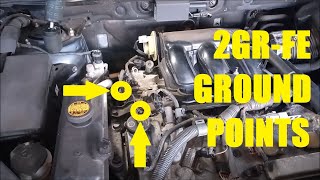
- Eb / Ec (Engine Grounds) — On the 2AZ-FE, ground point 'Eb' is located at the left rear of the cylinder block, and 'Ec' is on the left front side of the cylinder head. Another key ground strap is often found on the valve cover.. The ECM case and its primary ground connections rely on clean engine and chassis grounds. Corrosion or looseness at these main grounding points can introduce electrical noise and voltage drops throughout the engine management system, potentially affecting the TPS signal.
- ECM Pin B30-115 (VTA1) — This is the specific pin at the Engine Control Module (ECM) for the primary TPS signal.. When diagnosing a persistent P0122 after replacing the sensor, a technician must test for continuity and check for a short-to-ground on the wire running from the TPS connector to this specific ECM pin.
- ECM Pin B30-114 (VTA2) — The specific pin at the ECM for the secondary (redundancy check) TPS signal.. This pin's reading should correlate with VTA1. Comparing the live voltage at both pins on a scan tool can quickly identify a failing sensor versus a wiring issue specific to the VTA1 circuit.
- ECM Pin B30-91 (E2) — The specific pin at the ECM that provides the ground for the throttle position sensor.. If there is no or high resistance on the ground wire between the TPS connector and this pin, the sensor's signal voltage will be skewed low, directly causing a P0122 code.
Real Owner Repair Stories
- YouTube channel 'Beat The Tech' (2006 Toyota RAV4 with 2GR-FE (similar ETCS logic to 2AZ-FE), 130,000 miles) — Intermittent Check Engine Light with code P0121 (Range/Performance), which often accompanies or precedes P0122/P0123.
❌ Tried (didn't work) Replaced the entire throttle body assembly (which includes the TPS)., Replaced the accelerator pedal position sensor.
✅ What actually fixed it The problem was finally traced to damaged wiring in the engine harness. The insulation on wires leading to the throttle body had rubbed through, causing an intermittent short. The fix involved repairing the damaged sections of the wires, adding new protective sheathing, and properly securing the harness.
OEM Part Supersession History
89452-20130→89452-02020— Standard part number consolidation and revision by Toyota.
Heads up: 89452-02020 is the direct, backward-compatible replacement for 89452-20130. Other compatible numbers include 89452-10040.
Diagnostic Flowchart
Other Known Issues on This Vehicle
Issues unrelated to this code that are worth knowing about as an owner of this generation:
- Excessive Oil Consumption 🔴 High — Common on 2006-2008 RAV4 models, but affects the 2AZ-FE engine family broadly, often appearing after 60,000 miles. Caused by a piston ring design flaw. (Ref: T-SB-0094-11 describes the repair (piston replacement), while T-SB-0158-14 details the oil consumption test procedure. Toyota also issued a warranty enhancement (ZE7) for this issue.)
- Stripped Cylinder Head Bolt Threads 🔴 High — Affects earlier 2AZ-FE blocks (approx. 2002-2006). Overheating can cause the aluminum block threads for the head bolts to strip, leading to head gasket failure. The failure is often at the rear three bolts. (Ref: Toyota TSB EG015-07 recommends a short block replacement. The block design was updated around 2006-2007 to mitigate this. Repair often involves installing thread inserts like Time-Serts or a dedicated kit from Huhn Solutions.)
- Water Pump Failure 🟠 Medium — While generally reliable, water pumps can fail, typically after 100,000 miles. Some owners report premature failures. Symptoms include coolant leaks from the pump weep hole or overheating.
Used vs. New Parts: Buying Guide for This Vehicle
When a used part is the smart pick: A used throttle position sensor is generally not recommended because it is a wear-prone electronic part. However, if sourcing a complete used throttle body assembly from a low-mileage (under 80,000 miles) donor vehicle, using the sensor that comes with it can be a cost-effective option, provided it is a genuine OEM part (Denso/Aisan).
Donor-vehicle mileage cap: roughly under 80000 miles for the part to have meaningful remaining life.
What to inspect on the donor part:
- Verify the donor vehicle's mileage.
- Inspect the connector pins on the sensor for any signs of corrosion, moisture, or damage.
- Ensure the part is from a vehicle that was not in a front-end collision.
- Confirm the part is a genuine Toyota/Denso/Aisan component, not a previously installed aftermarket part.
OEM-only on this vehicle (don't cheap out):
- For critical sensors like the TPS, using an OEM (Toyota) or OEM-supplier (Denso, Aisan) part is highly recommended to ensure correct voltage signals and longevity.
Aftermarket brands forum-validated for this vehicle:
- Denso (OEM supplier)
- Aisan (OEM supplier)
- NGK/NTK
- Standard Motor Products (SMP)
Brands owners have reported issues with on this vehicle:
- Unbranded, 'white-box' parts from online marketplaces are frequently cited in forums as being dead-on-arrival or failing prematurely, causing the code to return.
Real Owner Stories
Aggregated from forums and TSBs cited above. Mileages and costs reflect what owners reported in those sources.
2004 Toyota RAV4 2AZ-FE
Symptoms: The vehicle experienced hesitation or stumbling when accelerating and the Check Engine Light was on. Diagnostic steps confirmed a 'Low Input' condition on the signal wire.
What fixed it: Replacement of the throttle position sensor mounted to the side of the throttle body.
Source hint: Charm.li Service Manual for 2004 Toyota RAV4
2005 Chevrolet Cavalier (Diagnostic Reference)
Symptoms: Recurring P0122 code. The diagnostic process required checking for shared 5V reference circuits and considering the PCM as a final possibility.
What fixed it: Advanced diagnostic process checking the 5V reference circuit and PCM logic.
Source hint: ScannerDanner Forum - '2005 Cavalier recurring P0122'
Related OBD-II Codes
Frequently Asked Questions
My 2004 RAV4 is showing P0122; what voltage should I see when testing the sensor?
Is there a specific TSB for the P0122 code on my 2AZ-FE engine?
Can I use a used TPS from a salvage yard for my 2005 RAV4?
I replaced the sensor on my 2.4L RAV4 but the idle is still rough. What should I do?
Could the P0122 code be related to the 5V reference circuit mentioned in technical forums?
Helpful Videos

Used OEM Parts in Stock
New Aftermarket Parts Available


The information in this article is provided for general reference and educational purposes only. Vehicle specifications, procedures, and part compatibility can vary by production date, trim level, and region. Always consult your vehicle's factory service manual and verify part numbers before purchasing or performing repairs. Safety-critical components such as airbags, seat belts, and braking systems should be installed by a qualified professional.
- Toyota RAV4:
- 🧭 Diagnostic Flowchart
- 🎬 Helpful Videos
- 🛍️ Shop This Part
- What's Unique About the 2000-2005 Toyota RAV4
- Symptoms You May Notice
- Most Likely Causes
- Rare But Worth Checking
- Diagnosis Steps
- Parts You'll Likely Need
- Related Codes That Often Appear With This One
- Mechanic-Grade Diagnostic Values
- Scan Tool Commands That Help
- Wiring & Ground Locations
- Real Owner Repair Stories
- OEM Part Supersession History
- Other Known Issues on This Vehicle
- Used vs. New Parts: Buying Guide for This Vehicle
- Real Owner Stories
- 2004 Toyota RAV4 2AZ-FE
- 2005 Chevrolet Cavalier (Diagnostic Reference)
- Related OBD-II Codes
- Frequently Asked Questions
- 🎟️ Get 5% Off