

P0123 on 2003-2004 Cadillac CTS 3.2L: Throttle Position Sensor Circuit High Causes and Fixes
This code on a 2003-2004 Cadillac CTS with the 3.2L V6 almost always points to a failed throttle position sensor (TPS), which is integrated into the throttle body. The fix is typically replacing the entire throttle body assembly with a part like GM/ACDelco #9128412. After replacement, a specific throttle relearn procedure is required. Expect to pay between $150 and $400 for the part.
- P0123 on a 2003-2004 CTS 3.2L means the throttle position sensor is sending a high voltage signal.
- The most likely cause is a failed sensor, which is part of the complete throttle body assembly (GM part #9128412).
- The fix is to replace the entire throttle body and then perform a mandatory idle relearn procedure.
- Checking the wiring and connector for damage or corrosion is a critical secondary diagnostic step.
- This issue is common across other vehicles that use the same Opel-designed 3.2L V6 engine.
What's Unique About the 2003-2007 Cadillac CTS
This guide specifically covers the first-generation Cadillac CTS with the 3.2L V6 (LA3) engine, an Opel-designed 54-degree V6 offered only in the 2003 and 2004 model years. Unlike some vehicles where the throttle position sensor (TPS) is a separate, easily replaceable component, on the 3.2L LA3 engine, the dual TPS units are integrated directly into the electronic throttle body assembly. This means that a failure of either sensor typically requires the replacement of the entire throttle body, making the repair more involved and costly than a simple sensor swap.
Symptoms You May Notice
- Check Engine Light is on
- Vehicle enters 'limp mode' (reduced engine power message on dash)
- Hesitation or stumbling during acceleration
- Rough or unstable idle, sometimes dangerously high
- Poor fuel economy
- Engine may stall, especially when returning to idle
- Delayed or non-responsive throttle pedal
- Engine cranks but will not start (in some failure cases)
- Replacing the accelerator pedal position (APP) sensor. While the APP sensor also relates to throttle control, P0123 specifically points to the sensor at the throttle body on the engine, not the pedal inside the car.
- Assuming a transmission problem due to harsh shifting or lack of power, which are symptoms of the engine being in 'limp mode' caused by the TPS fault.
Most Likely Causes
- Failed Throttle Body Assembly (Integrated TPS) 🔴 High Probability → Shop Fuel Injection Throttle Body The internal electronic components of the dual throttle position sensors wear out over time. Since they are sealed within the throttle body assembly on the Opel-designed LA3 engine, the entire unit must be replaced when a sensor fails.
How to confirm: Using an OBD-II scanner, observe the live data for 'Throttle Position'. If the reading is stuck at a high percentage (e.g., 90-100%) even with the pedal at rest, or if the voltage is stuck above 4.5V, the sensor has failed. A multimeter can also be used to back-probe the signal wire, which will show voltage exceeding the normal operating range.
Typical fix: Replace the entire throttle body assembly (GM Part #9128412). After installation, a throttle body relearn procedure is mandatory.
Est. part cost: $200-$400 - Wiring Harness or Connector Issue 🟡 Medium Probability Engine vibration, heat, and age can cause wires to fray or break. More specifically, GM vehicles from this era are known for 'fretting corrosion' on electrical terminals, where micro-vibrations create oxidized debris that interrupts the signal. The pigtail connector itself can also become brittle and fail.
How to confirm: Visually inspect the wiring harness leading to the throttle body for any signs of damage, chafing, or melting. Unplug the connector and check for greenish or white corrosion, bent pins, or loose terminals. Wiggle the connector with the engine running to see if it affects idle. Use a multimeter to perform a continuity test on the signal, 5V reference, and ground wires between the connector and the ECM.
Typical fix: Repair the damaged section of wiring or replace the pigtail connector. Clean corroded terminals carefully with an electrical contact cleaner and apply dielectric grease to prevent future corrosion.
Est. part cost: $20-$60
Rare But Worth Checking
- Faulty Powertrain Control Module (ECM): → Shop Engine Control Module (ECM) This is very rare. The ECM should only be considered after all other possibilities, including the throttle body and wiring, have been definitively ruled out. An ECM failure will typically cause multiple other codes and more severe drivability issues.
- Bad Ground Connection: A corroded or loose engine or chassis ground can cause floating voltages and trigger a high input code. This is uncommon but should be checked by inspecting and cleaning main ground straps if other diagnostics lead nowhere.
Diagnosis Steps
- Connect an OBD-II scanner and confirm the presence of the P0123 code. Note any other codes, especially P0223, P0121, or P1516.
- View the live data stream on the scanner. Look for the 'Throttle Position Sensor A' PID. At idle with your foot off the pedal, the voltage should be around 0.5V. A P0123 code will typically show a voltage stuck high (above 4.5V) regardless of throttle position.
- Turn the ignition off and locate the throttle body on the top of the engine.
- Inspect the electrical connector and wiring harness going to the throttle body. Look for obvious damage, corrosion (fretting), or loose connections. Wiggle the harness to check for intermittent faults.
- As a quick test, try disconnecting the TPS sensor and starting the engine. If the engine starts (it may run poorly), it strongly suggests the sensor itself has failed, as the PCM is now using default values. If it still doesn't start, the problem might be more complex.
- If the wiring looks good, and you have a multimeter, back-probe the connector to test the circuit. You should find a 5-volt reference wire, a ground wire, and a signal wire. The signal wire is the one that will show the erroneous high voltage.
- If the 5V reference and ground are good, and the wiring is intact, the fault is confirmed to be internal to the throttle body assembly.
- The most common and reliable fix is to replace the entire throttle body assembly (GM part #9128412).
- After replacement, clear the codes and perform a throttle relearn procedure. This is critical for proper idle and throttle response.
Parts You'll Likely Need
- Throttle Body Assembly
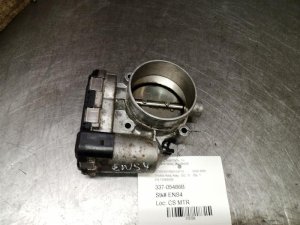
(OEM #9128412)— The throttle position sensors (TPS) are integrated into the throttle body on this engine. A P0123 code is most often caused by the failure of one of these internal sensors, requiring the replacement of the complete assembly. This part number is the correct GM/ACDelco replacement.
Trusted brands: ACDelco (GM Original Equipment), Bosch
OEM price range: $350-$450
Aftermarket price range: $150-$300
Related Codes That Often Appear With This One
- P0223 — This code indicates a high voltage fault in the second throttle position sensor ('B' circuit). Since the 3.2L engine uses two sensors for comparison, a failure often affects both, or a wiring/power issue could be common to both circuits.
- P0121 — This code indicates 'Throttle/Pedal Position Sensor/Switch 'A' Circuit Performance'. It can be set along with P0123 if the ECM sees that the sensor's signal is not correlating correctly with the other sensor or with expected values.
- P1516 — This is a GM-specific code for 'Throttle Actuator Control (TAC) Module Throttle Actuator Position Performance'. It indicates a discrepancy between the commanded throttle position and the actual position reported by the sensors, which is a direct consequence of a P0123 fault.
Technical Service Bulletins (TSBs) & Recalls
- Special Coverage #14582: While this TSB applies to slightly later models (2008-2011 CTS), it is highly relevant as it covers the exact same condition: throttle position sensor failure causing reduced engine power. It instructs dealers to replace the throttle body assembly, showing a pattern of GM acknowledging this specific part failure on the CTS platform.
- General GM Bulletins on Fretting Corrosion: Various GM service bulletins (e.g., for BCM connectors) from this era identify 'fretting corrosion' as a common cause for sensor and module communication errors due to vibration. This is a key diagnostic consideration for the throttle body connector.
Platform-Specific Known Issues
- The 3.2L LA3 V6 is an Opel-designed engine shared with European models like the Vectra and Signum. These platforms share the same integrated throttle body design and are known to exhibit the same P0123 failure mode, confirming it as a platform-wide weakness rather than a Cadillac-only issue.
Mechanic-Grade Diagnostic Values
- TPS 'A' (Poti 1) Signal Voltage — expected: Approx. 0.5V at idle to 4.5V at wide-open throttle.. Failure: Voltage is stuck above 4.6289V.
- TPS 'B' (Poti 2) Signal Voltage — expected: Near 5.0V at idle, decreasing as throttle opens.. Failure: Voltage is stuck above 4.8828V (for code P0223).
- TPS 1 vs. TPS 2 Plausibility Check — expected: The signals from both sensors should correlate.. Failure: The ECM detects a difference of more than 6.275% between the two sensors, which can set a P0121 performance code.
- 5-Volt Reference at Throttle Body Connector — expected: Steady 5.0V with key on, engine off.. Failure: Voltage is significantly lower or higher than 5.0V, or is absent, indicating a wiring or ECM issue.
Scan Tool Commands That Help
- GM Tech2: Idle Learn Reset / Throttle Learn — This function is mandatory after replacing the throttle body assembly to allow the ECM to learn the new sensor's idle and wide-open positions. Failure to perform this can result in incorrect idle speed and poor throttle response.
- GM Tech2: Data Display > TP Sensor 1 and 2 Agree/Disagree — During diagnosis, this parameter should be monitored while pressing the accelerator pedal. It should always display 'Agree'. If it displays 'Disagree' at any point, it confirms a fault within the throttle body assembly or its circuits.
- GM Tech2: Special Functions > Engine Output Controls — While not a direct throttle test, this menu allows a technician to activate other components to rule out system-wide electrical issues. For this code, its primary use is to confirm the Tech2 is communicating properly before proceeding with more specific tests.
Wiring & Ground Locations
- G102 — On the engine block, near the starter motor on the 3.2L V6 engine.. This is a primary engine ground. A poor connection here can cause unstable voltages for various engine sensors, including the 5V reference circuit shared by the throttle position sensors, potentially leading to a high input code.
- G101 — In the engine compartment, near the left front strut tower.. This ground point serves the Engine Control Module (ECM). A compromised G101 can lead to erratic ECM behavior and incorrect sensor readings, including P0123.
- G100 — On the left rear side of the 3.2L engine.. Another critical engine ground point. All major engine grounds should be inspected, cleaned, and tightened when diagnosing intermittent or voltage-related fault codes.
- ECM Connector C1 (Pins 1 & 17) — The ECM is located on the front of the passenger-side (right) valve cover.. Pin 1 (Yellow wire) and Pin 17 (Brown wire) are the two Throttle Actuator Control (TAC) motor control circuits. While not the sensor signal wires, damage to these wires can indicate a harness problem near the throttle body that could also affect the sensor circuits.
Real Owner Repair Stories
- YouTube user 'LegitStreetCars' (Cadillac SRX (contemporary to CTS, demonstrates common GM issue)) — Vehicle went into limp mode with multiple warning lights on the dashboard, including traction control and check engine.
❌ Tried (didn't work) N/A - this was the first step taken.
✅ What actually fixed it Temporarily fixed the issue by disconnecting the negative battery terminal for a few minutes to reset the vehicle's computers. This cleared the limp mode condition, suggesting the fault was intermittent or a one-time sensor glitch. This is a valid first diagnostic step before replacing parts, but if the code returns, the underlying hardware fault (likely the throttle body) still needs to be addressed.
OEM Part Supersession History
9128412 (GM)→217-2295 (ACDelco)— Standard part number update and branding change from GM to its ACDelco parts division.
Heads up: While 217-2295 is the commonly referenced ACDelco replacement, always verify fitment with the vehicle's VIN before purchasing. No incompatibilities are widely noted, but using a VIN checker is best practice.
Model Year Variations Within This Range
- 2003-2004 only: The 3.2L LA3 V6 engine and its associated Bosch electronic throttle body were only used on the Cadillac CTS for these two model years. Later first-generation models (2005-2007) used the 2.8L and 3.6L engines, which feature different throttle body designs and part numbers.
Diagnostic Flowchart
Used vs. New Parts: Buying Guide for This Vehicle
When a used part is the smart pick: For this specific repair, a used throttle body is a significant gamble and generally not recommended. The failure is electronic wear inside a sealed unit. A used part from a junkyard has unknown remaining life and could fail shortly after installation. It should only be considered as a last resort for budget reasons or to temporarily diagnose the issue.
Donor-vehicle mileage cap: roughly under 50000 miles for the part to have meaningful remaining life.
What to inspect on the donor part:
- Verify the part number on the donor unit matches the original exactly.
- Inspect the electrical connector pins for any signs of corrosion, bending, or damage.
- Check the throttle bore for excessive carbon buildup, which might indicate a poorly maintained engine.
- Ensure the throttle plate moves smoothly by hand (with ignition off) and is not physically damaged or bent.
OEM-only on this vehicle (don't cheap out):
- Throttle Body Assembly
Aftermarket brands forum-validated for this vehicle:
- Bosch (Often the original equipment manufacturer for GM)
Brands owners have reported issues with on this vehicle:
- Unbranded, 'white-box' parts from online marketplaces should be avoided. The calibration and sensor quality are critical for drive-by-wire systems, and cheap alternatives are known to cause erratic behavior, fail prematurely, or not calibrate correctly during the relearn procedure.
Real Owner Stories
Aggregated from forums and TSBs cited above. Mileages and costs reflect what owners reported in those sources.
2004 Cadillac CTS 3.2L V6
Symptoms: Owner replaced the throttle body to resolve an issue but found the car was still not running correctly afterwards.
What fixed it: Performing the correct throttle body idle relearn procedure, which is a required final step after this repair.
Source hint: 2CarPros.com: A 2019 thread titled 'I Have Replaced the Throttle Body and It Says It Is Not...'
Opel Vectra C 3.2L V6
Symptoms: Experiencing a laggy throttle pedal and engine revs climbing uncontrollably.
What fixed it: The owner confirmed the TPS is an integral part of the throttle body, indicating the fix is to replace the entire assembly.
Source hint: boards.ie (Ireland): A 2015 thread on a platform-mate, the Opel Vectra C 3.2L
Related OBD-II Codes
Frequently Asked Questions
Is the throttle position sensor (TPS) a separate part I can replace on my 2003-2007 CTS 3.2L?
I just replaced the throttle body on my CTS, but it's idling high. What did I miss?
My Cadillac cranks but won't start and is showing a P0123 code. Is this related?
Are there any official GM service bulletins for this throttle body problem?
Is it safe to buy a used throttle body from a junkyard to fix this?
My Opel Vectra has the same 3.2L engine and similar symptoms. Is it the same part?
Helpful Videos
We Have This Part in Stock

The information in this article is provided for general reference and educational purposes only. Vehicle specifications, procedures, and part compatibility can vary by production date, trim level, and region. Always consult your vehicle's factory service manual and verify part numbers before purchasing or performing repairs. Safety-critical components such as airbags, seat belts, and braking systems should be installed by a qualified professional.
- Cadillac CTS:
- 🧭 Diagnostic Flowchart
- 🎬 Helpful Videos
- 🛍️ Shop This Part
- What's Unique About the 2003-2007 Cadillac CTS
- Symptoms You May Notice
- Most Likely Causes
- Rare But Worth Checking
- Diagnosis Steps
- Parts You'll Likely Need
- Related Codes That Often Appear With This One
- Technical Service Bulletins (TSBs) & Recalls
- Platform-Specific Known Issues
- Mechanic-Grade Diagnostic Values
- Scan Tool Commands That Help
- Wiring & Ground Locations
- Real Owner Repair Stories
- OEM Part Supersession History
- Model Year Variations Within This Range
- Used vs. New Parts: Buying Guide for This Vehicle
- Real Owner Stories
- 2004 Cadillac CTS 3.2L V6
- Opel Vectra C 3.2L V6
- Related OBD-II Codes
- Frequently Asked Questions
- 🎟️ Get 5% Off