

P0123 on 2013-2016 Dodge Challenger: Throttle Position Sensor Circuit High Causes and Fixes
P0123 on a 2013-2016 Dodge Challenger most often means the throttle body has failed, as the sensor is integrated into it. Before replacing it, check for crucial PCM software updates, as multiple TSBs indicate this can resolve the code and the accompanying 'lightning bolt' ETC light. A new throttle body costs around $170-$480, while a dealer software flash can range from $150-$300.
- P0123 indicates a 'Circuit High' fault from the Throttle Position Sensor, which is part of the throttle body on your Challenger.
- The most common fix is replacing the entire electronic throttle body assembly.
- Crucially, check with a dealer if your vehicle needs a PCM software update first, as multiple TSBs show this can be the actual cause, saving you money on parts.
- Symptoms are serious and include the car going into a low-power 'limp mode', making it unsafe to drive in many situations.
- This is a DIY-friendly repair for many, requiring basic tools and potentially a throttle relearn procedure after installation.
What's Unique About the 2013-2016 Dodge CHALLENGER
On this generation of Dodge Challenger, and its platform mates like the Charger and Chrysler 300, the throttle position sensor is not a separate, replaceable part. Instead, it is integrated into the electronic throttle body assembly. This means that a sensor failure requires replacing the entire throttle body. Additionally, Chrysler issued several Technical Service Bulletins (TSBs) for these vehicles, indicating that the PCM's software can be overly sensitive and set this code erroneously. A software update at a dealership might fix the problem without any parts being replaced, making it a critical first diagnostic step before hardware replacement.
Diagnostic Flowchart
Tap your situation to follow the diagnostic path that matches what you're seeing on this vehicle.
Generation note: The 2013-2016 range covers the Dodge Challenger's third generation (LC), including the 2013-2014 models and the 2015-2016 facelifted models. The underlying electronic architecture and common causes for this code are similar across these years, as evidenced by TSBs that cover the entire period. The issue is common to all engines offered: 3.6L V6, 5.7L Hemi V8, and 6.4L Hemi V8.
Symptoms You May Notice
- Check Engine Light is on
- Electronic Throttle Control (ETC) or 'lightning bolt' warning light is illuminated
- Vehicle enters 'limp mode' with severely limited power and acceleration
- Hesitation or bucking during acceleration
- Rough or high idle speed
- Hard starting
- Engine stalling, especially when coming to a stop
- Replacing the accelerator pedal position (APP) sensor. The APP sensor is on the gas pedal assembly and reports the driver's intention, while the TPS is on the throttle body and reports the throttle blade's actual position. P0123 specifically points to the throttle body circuit, not the pedal.
Most Likely Causes
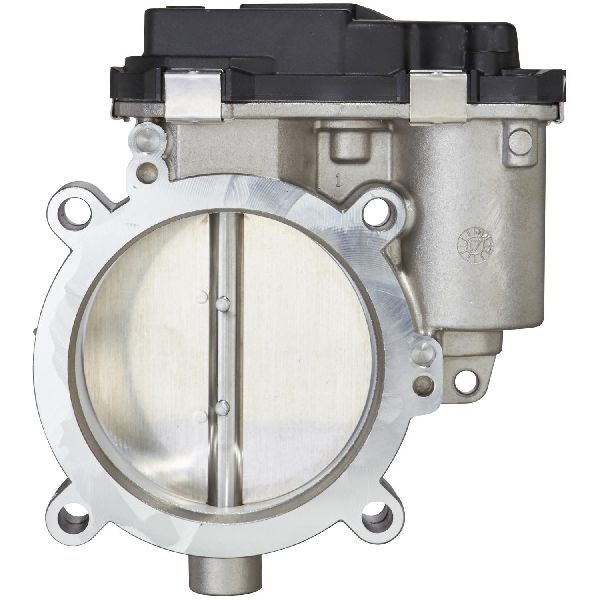
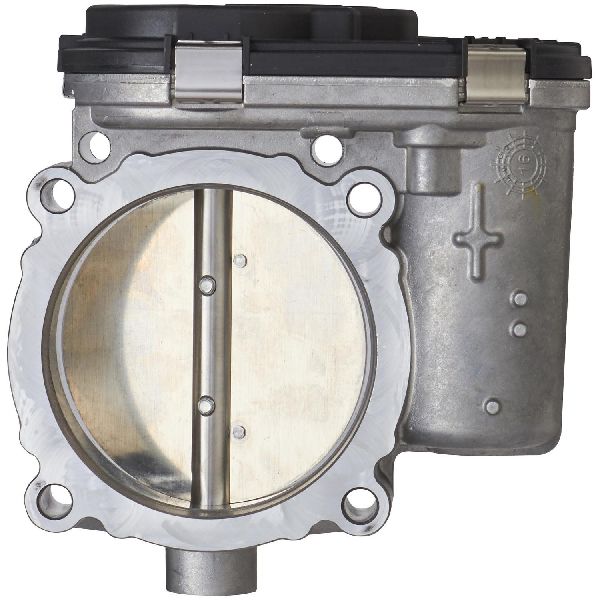
- Faulty Electronic Throttle Body Assembly 🔴 High Probability → Shop Fuel Injection Throttle Body The throttle position sensor (TPS) is integrated into the throttle body assembly and cannot be replaced separately. Wear and tear on the internal electronic components or carbon buildup interfering with the sensor's movement are common failure points.
How to confirm: After confirming wiring is intact, use a scan tool to monitor live data for 'TPS 1 Voltage'. If the voltage is stuck high (near 5V) regardless of pedal position, the throttle body has failed. 🎬 Watch: How to diagnose these specific codes on your Challenger Visually inspect for a dirty throttle plate that may be sticking.
Typical fix: Replace the entire electronic throttle body assembly. A throttle relearn procedure is required after installation.
Est. part cost: $170-$486 - Outdated Powertrain Control Module (PCM) Software 🟡 Medium Probability → Shop Engine Control Module (ECM) Dodge released multiple Technical Service Bulletins (TSBs) to correct software that was too sensitive and could falsely trigger P0123 and related codes, often after certain driving conditions.
How to confirm: A Dodge dealership or a qualified shop with access to OEM software (wiTECH) can check your vehicle's VIN against TSBs to see if a software update is available.
Typical fix: Flash the PCM with the latest software version. This must be done by a dealer or a properly equipped independent shop. The process takes about 20-30 minutes but dealers often charge for a full hour of labor.
Est. part cost: $150-$350 - Wiring or Connector Issue ⚪ Low Probability The wiring harness leading to the throttle body is subject to engine heat and vibration, which can cause wires to fray, short to power, or the connector pins to become loose, spread, or corroded over time.
How to confirm: Visually inspect the wiring harness and the connector at the throttle body for any signs of damage, melting, or corrosion. Check for a secure connection and ensure the red locking tab is engaged. Perform a 'wiggle test' on the connector while monitoring TPS voltage to see if the reading fluctuates.
Typical fix: Repair the damaged section of wiring or replace the connector pigtail.
Est. part cost: $15-$50
Rare But Worth Checking
- Failing Powertrain Control Module (PCM): → Shop Engine Control Module (ECM) This is rare, but if the throttle body and wiring have been confirmed to be good and a software update has been performed, the PCM's internal driver for the TPS circuit could be at fault. This should be the last item to consider after all other possibilities are exhausted.
- Faulty Alternator: In rare cases, a failing alternator can produce excessive voltage across the entire electrical system, causing the TPS to send a signal higher than the 4.5-volt maximum and triggering a P0123 code. This would typically be accompanied by other voltage-related trouble codes.
Diagnosis Steps
- Scan the PCM for any and all stored trouble codes. Note if P0122, P0222, P0223, or other codes are present.
- Check for applicable TSBs for your vehicle's VIN. A dealership can confirm if a PCM software update is required. This should be a primary step due to the numerous TSBs for this issue.
- Thoroughly inspect the throttle body electrical connector and wiring harness. Check for pushed-out pins, corrosion, or damaged wires. Ensure the red locking tab on the connector is fully seated.
- Using a scan tool with live data capabilities, observe the voltage for 'TPS Sensor 1'. With the key on and engine off, the voltage should be around 0.5V at closed throttle and sweep smoothly up to ~4.5V at wide-open throttle.
- If the voltage for TPS 1 is stuck at a high value (e.g., 4.8V or higher) and does not change with the throttle plate, and the wiring is confirmed to be good, the throttle body assembly is faulty.
- If a new throttle body is installed, perform a throttle relearn procedure. This can often be done without a scan tool by turning the ignition to 'ON' (not start), slowly pressing the accelerator pedal to the floor, slowly releasing it, and then turning the ignition 'OFF'.
- If the wiring and sensor test good, and a PCM update has been performed, the final and least likely possibility is a faulty PCM.
Parts You'll Likely Need
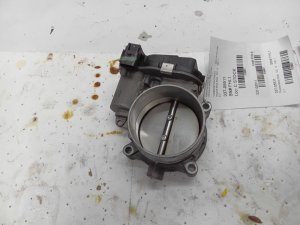
- Electronic Throttle Body
(OEM #04891735AC (For 5.7L/6.4L Hemi), 05184349AF (For 3.6L V6))— This is the most common fix because the faulty Throttle Position Sensor (TPS) is integrated into this assembly and cannot be replaced separately on this vehicle. Be sure to verify the correct part number for your specific engine.
Trusted brands: Mopar, Standard Motor Products, Bosch, Hitachi
OEM price range: $370-$486
Aftermarket price range: $170-$250
Related Codes That Often Appear With This One
- P0122 — This is for 'TPS 1 Circuit Low'. It's common to see both high and low circuit codes when a sensor is failing erratically. This is mentioned in TSBs #18-062-17, #18-045-16 REV. A, #1809416, and #18-074-15 REV A.
- P0222 — This is for 'TPS 2 Circuit Low'. The throttle body uses two redundant sensors for safety. A failure in the primary sensor (TPS1) often causes the PCM to flag the secondary sensor (TPS2) as well. This is mentioned in the same TSBs.
- P0223 — This is for 'TPS 2 Circuit High'. Similar to P0222, this indicates a fault in the secondary sensor circuit that often accompanies a P0123 code.
- P2172 — This code for 'High Airflow/Vacuum Leak Detected' can appear alongside TPS codes if the throttle body is not functioning correctly, as noted in TSB #18-045-16 REV. A.
- P2111 — Stands for 'Throttle Actuator Control System - Stuck Open'. This code can be set along with P0123 if the PCM detects that the throttle plate is physically stuck in a position that doesn't match the commands, a common result of a failing throttle body.
Technical Service Bulletins (TSBs) & Recalls
- 18-062-17: Addresses multiple DTCs including P0123, recommends PCM software update for 2016 models.
- 18-045-16 REV. A: Addresses multiple DTCs including P0123, recommends PCM software update for 2015 models.
Platform-Specific Known Issues
- A significant number of TSBs were issued by Dodge for the 2013-2016 Challenger concerning false TPS codes. Bulletins like #18-062-17, #18-045-16 REV. A, #1809416, and #18-074-15 REV A all call for a PCM software update to fix issues where codes P0123, P0122, P0222, and P0223 are set. This strongly suggests that a software check should be performed before replacing hardware.
- Owner Experience: Sudden Limp Mode: Many owners report experiencing a sudden and jarring transition into 'limp mode' while driving, often accompanied by the check engine light and the ETC 'lightning bolt' light. One user on ChallengerTalk described being on the highway when the car suddenly lost all acceleration, forcing a dangerous maneuver to the shoulder. The dealer ultimately replaced the throttle body to fix the issue.
Mechanic-Grade Diagnostic Values
- Throttle Position Sensor 1 (TPS1) Voltage — expected: Approx. 0.5V - 1.0V at closed throttle (idle), sweeping smoothly to ~4.5V at Wide-Open Throttle (WOT).. Failure: Voltage is stuck at or near 5.0V regardless of throttle plate angle, or does not sweep smoothly.
- Throttle Position Sensor 2 (TPS2) Voltage — expected: Inverse of TPS1. Approx. 4.5V at closed throttle, sweeping smoothly down to ~0.5V at Wide-Open Throttle (WOT).. Failure: Voltage does not track inversely with TPS1, is stuck at a specific value, or does not sweep smoothly.
- Voltage Drop on Sensor Ground Circuit — expected: Less than 0.1V (100mV) between the throttle body connector's ground pin and the negative battery terminal.. Failure: Voltage greater than 0.1V indicates high resistance in the ground circuit, which can cause a floating signal voltage and trigger a high circuit code.
Scan Tool Commands That Help
- Mopar wiTECH: ETC Relearn (Electronic Throttle Control Relearn) — This function is used after replacing the throttle body or cleaning it. It forces the PCM to learn the new closed, partial, and wide-open throttle positions. It can also be used to verify if a relearn solves an intermittent issue before parts replacement.
- Mopar wiTECH: Throttle Follower Test — This is a bidirectional test where the scan tool commands the throttle plate to open to specific percentages (e.g., 10%, 25%, 50%). The technician can then watch the live data from TPS1 and TPS2 to confirm if the sensors are accurately reporting the commanded position, which is excellent for verifying sensor function independently of the accelerator pedal.
Wiring & Ground Locations
- Throttle Body Connector (6-Pin) — Directly on the electronic throttle body, located at the front of the intake manifold.. This is the primary connection point for all power, ground, and signal wires for the integrated TPS. P0123 specifically relates to the signal from Pin 6. The pinout is typically: Pin 1: ETC Motor (+), Pin 2: ETC Motor (-), Pin 3: Sensor Ground, Pin 4: TPS Signal 2, Pin 5: 5V Reference, Pin 6: TPS Signal 1. A short between Pin 5 (5V Reference) and Pin 6 (TPS Signal 1) is a direct cause of P0123.
- G35a — On the right front corner of the engine compartment.. This is a major ground point for several engine components. While not the direct sensor ground, a poor connection here can introduce electrical noise and voltage offsets into the system, potentially causing the PCM to misinterpret sensor readings. Verifying this ground is clean and tight is a wise step in diagnosing persistent, hard-to-trace electronic codes.
- Powertrain Control Module (PCM) Connector C2 — The PCM is located in the right rear of the engine compartment. C2 is one of its main connectors.. The TPS signal, reference, and ground circuits all terminate here. When diagnosing a wiring issue, technicians perform continuity and voltage drop tests between the throttle body connector and the pins on this connector to isolate a break or high resistance in the harness.
Real Owner Repair Stories
- ChallengerTalk Forum Member (2013 Dodge Challenger R/T (5.7L Hemi)) — Check engine light, ETC 'lightning bolt' light, and car went into limp mode on the highway. Codes P0123 and P0222 were present.
❌ Tried (didn't work) Replaced the electronic throttle body with a new Mopar unit., Performed the throttle relearn procedure multiple times.
✅ What actually fixed it The dealership diagnosed a faulty wire in the engine harness between the PCM and the throttle body connector. They repaired the single wire, which resolved all codes and symptoms. The owner noted the repair cost more in labor than the throttle body part itself. - Reddit user in /r/MechanicAdvice (2016 Dodge Challenger SXT (3.6L V6)) — Intermittent P0123, rough idle, and occasional hesitation on acceleration.
❌ Tried (didn't work) Cleaning the throttle body (worked for a few days, then the code returned)., Checking for software updates (none were available for the VIN).
✅ What actually fixed it Replacing the entire throttle body assembly with an aftermarket unit and performing the manual relearn procedure fixed the issue permanently. The user noted the manual relearn (key on, slow pedal press/release, key off) had to be done twice before the idle smoothed out correctly.
OEM Part Supersession History
04891735AC→04891735AD— Likely an internal revision for improved reliability of the electronic components to address common failures.5184349AB, 5184349AC, 5184349AD, 5184349AE→05184349AF— Multiple revisions over the years for the 3.6L V6 engine, with the 'AF' version noted for improved NVH (Noise, Vibration, and Harshness) performance and a new purge valve design.
Heads up: While older versions may fit, it is always recommended to use the latest superseded part number (05184349AF) for the best performance and reliability.
Model Year Variations Within This Range
- 2015-2016: The 2015 model year marked a significant refresh, including a new interior, updated Uconnect systems, and the 8-speed automatic transmission becoming standard on Hemi models. This also involved changes to the PCM and its software. While the throttle body part may be the same, the software logic and the specific TSB flash files required to fix erroneous codes can be different from the 2013-2014 models. Always verify TSBs against the specific model year.
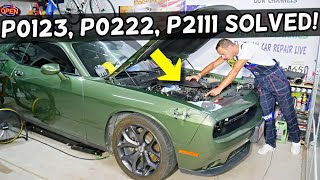
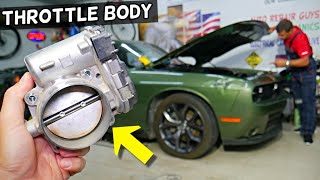
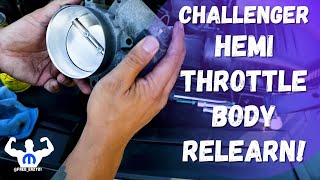
Helpful Videos
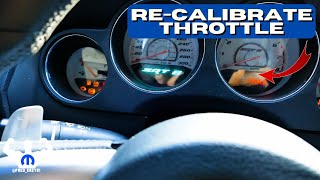

Used OEM Parts in Stock
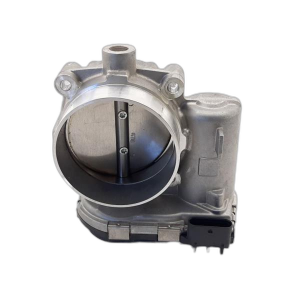
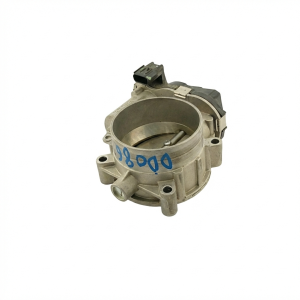
New Aftermarket Parts Available


The information in this article is provided for general reference and educational purposes only. Vehicle specifications, procedures, and part compatibility can vary by production date, trim level, and region. Always consult your vehicle's factory service manual and verify part numbers before purchasing or performing repairs. Safety-critical components such as airbags, seat belts, and braking systems should be installed by a qualified professional.
- Dodge CHALLENGER:
- 🧭 Diagnostic Flowchart
- 🎬 Helpful Videos
- 🛍️ Shop This Part
- What's Unique About the 2013-2016 Dodge CHALLENGER
- Symptoms You May Notice
- Most Likely Causes
- Rare But Worth Checking
- Diagnosis Steps
- Parts You'll Likely Need
- Related Codes That Often Appear With This One
- Technical Service Bulletins (TSBs) & Recalls
- Platform-Specific Known Issues
- Mechanic-Grade Diagnostic Values
- Scan Tool Commands That Help
- Wiring & Ground Locations
- Real Owner Repair Stories
- OEM Part Supersession History
- Model Year Variations Within This Range
- 🎟️ Get 5% Off