

P0123 on 2004-2009 Lexus RX: Throttle Position Sensor Circuit High Causes and Fixes
On a 2004-2009 Lexus RX, code P0123 is most often caused by a failed throttle position sensor, which is integrated into the throttle body assembly. The second most likely cause is a faulty accelerator pedal sensor. Expect to replace the entire throttle body assembly, as the sensor is not sold separately for this model. Cleaning the throttle body is a valid first step but rarely solves a persistent P0123 code.
- P0123 on a 2004-2009 RX means the throttle system has a high voltage fault.
- The most likely fix is replacing the entire throttle body assembly, not just a sensor.
- The second most likely fix is replacing the accelerator pedal assembly.
- Use an OBD-II scanner's live data function to determine which part has failed before buying anything.
- Do not buy a separate TPS sensor with part number 89452-33030; it is for the wrong vehicle generation.
What's Unique About the 2004-2009 Lexus RX
The 2004-2009 Lexus RX (second generation, XU30) uses a fully electronic throttle body where the Throttle Position Sensor (TPS) is an integrated, non-serviceable part of the assembly. A common point of confusion is that a separate TPS (part no. 89452-33030) is available, but this part fits the previous generation RX300 (1999-2003), not this vehicle. Owners or shops attempting to buy just the sensor will find it doesn't fit, leading to the realization that the entire throttle body assembly must be replaced. This is a frequent topic of discussion in owner forums.
Generation note: This guide covers the second generation (XU30) Lexus RX. This includes the RX330 (2004-2006) with the 3.3L 3MZ-FE V6 and the RX350 (2007-2009) with the 3.5L 2GR-FE V6. The causes and fixes are broadly similar as they both use a non-serviceable throttle position sensor integrated into the throttle body. The RX400h hybrid model also shares many of these components.
Symptoms You May Notice
- Check Engine Light is on
- VSC (Vehicle Stability Control) and/or TRAC (Traction Control) warning lights are on
- Engine enters 'limp mode' with severely reduced power
- Hesitation, stumbling, or surging on acceleration
- Rough or abnormally high idle
- Engine may stall unexpectedly
- Little to no throttle response, RPMs won't rise when pressing the accelerator
- Unintended or sudden acceleration
- Purchasing a standalone Throttle Position Sensor (e.g., part number 89452-33030). This sensor is for the older 1999-2003 RX300 and will not fit the 2004-2009 RX models, which require a complete throttle body assembly.
- Replacing a faulty gas cap. While a loose gas cap can trigger a Check Engine Light and VSC light, it typically sets an evaporative emissions system code (e.g., P044x) and will not cause a P0123.
Most Likely Causes
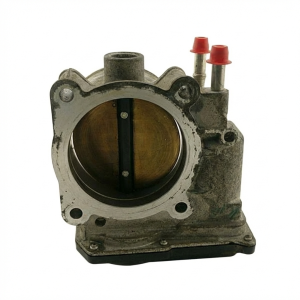
- Failed Throttle Body Assembly (Internal TPS Failure) 🔴 High Probability → Shop Fuel Injection Throttle Body The Throttle Position Sensor (TPS) is an electronic component that wears out over time. On the 3MZ-FE and 2GR-FE engines in this generation, it is integrated into the throttle body and cannot be replaced separately. This is the most common failure point for a P0123 code on this platform.
How to confirm: Use an OBD-II scanner to monitor live data for the 'Throttle Position' percentage or voltage. If the reading is stuck at a high value (e.g., over 80% or near 5 volts) even when the gas pedal is not pressed, the TPS has failed. A ClubLexus forum member noted that clearing the code might temporarily restore function, but the issue will return if the sensor is failing.
Typical fix: Replace the entire throttle body assembly. A relearn procedure is not typically required after replacement, though some owners report that letting the car idle for a few minutes with the A/C on can help the ECU adjust. Alternatively, a manual relearn can be done by disconnecting the battery for over a minute, reconnecting, and then letting the engine idle to operating temperature.
Est. part cost: $150-$450 - Failed Accelerator Pedal Position (APP) Sensor 🟡 Medium Probability This is another electronic sensor that can fail with age and use. It is a complete assembly with the gas pedal and contains two sensors for redundancy.
How to confirm: Use an OBD-II scanner to monitor live data for the 'Accelerator Pedal Position' sensors (usually two, D and E). If either sensor shows a voltage stuck high and does not change when you press the pedal, the APP sensor assembly is faulty.
Typical fix: Replace the entire accelerator pedal assembly. It is typically held on by two nuts in the driver's footwell.
Est. part cost: $70-$200 - Wiring Harness Issue ⚪ Low Probability
How to confirm: Visually inspect the wiring and connectors going to the throttle body and the accelerator pedal for any signs of damage, corrosion, or chafing. Use a multimeter to check for a stable 5V reference and good ground at the sensor connector with the key on, engine off. Check the signal wire for a short to a power source, as this is a primary cause of a 'Circuit High' code.
Typical fix: Repair the damaged section of the wiring harness or clean/replace the corroded connector.
Est. part cost: $10-$50 - Dirty Throttle Body ⚪ Low Probability → Shop Fuel Injection Throttle Body While carbon buildup can cause the throttle plate to stick, it is less likely to cause a 'Circuit High' fault compared to an internal electronic failure. It's more often associated with idle issues or other TPS performance codes.
How to confirm: Visually inspect the throttle bore and plate for heavy carbon deposits. A sticking plate could theoretically hold the sensor at a high reading, but it's not the typical failure mode for P0123.
Typical fix: Clean the throttle body with a dedicated throttle body cleaner and a soft brush. This is good maintenance but unlikely to fix a persistent P0123. 🎬 See this step-by-step throttle body cleaning guide
Est. part cost: $5-$15
Rare But Worth Checking
- Faulty Engine Control Module (ECM): → Shop Engine Control Module (ECM) This is very rare. The ECM should only be considered after all other possibilities, including sensors and wiring, have been definitively ruled out. An ECM input circuit failure can cause it to misinterpret the sensor's signal.
- Blown ETCS Fuse: A blown 10A ETCS (Electronic Throttle Control System) fuse can cause a complete loss of throttle response and may trigger related throttle actuator codes like P2118. This is often a primary check before suspecting the throttle body itself. The fuse is typically located in the under-hood fuse box. 🎬 Watch: How to check the ETCS fuse for no pedal response
Diagnosis Steps
- Connect an OBD-II scanner and confirm P0123 is the primary code. Note any other codes present, such as those for the 'B' circuit (P0223) or APP sensor.
- Access the live data stream on the scanner.
- Observe the voltage/percentage readings for both the 'Throttle Position Sensor' and the 'Accelerator Pedal Position Sensor(s)' with the key on, engine off.
- If the TPS reading is stuck high (near 5V or >80%) and does not change, the throttle body assembly is the likely fault.
- If the APP sensor reading is stuck high and does not change as you press the gas pedal, the accelerator pedal assembly is the likely fault.
- If both sensors appear to read correctly, the issue may be intermittent. Wiggle the wiring harnesses for the throttle body and accelerator pedal while watching the live data for any voltage spikes or dropouts. A short to power on the signal wire is a key possibility.
- If no sensor fault is obvious, perform a visual inspection of the wiring and connectors for both components, looking for damage, corrosion, or loose pins.
- Check the 10A ETCS fuse located in the engine compartment fuse box. A blown fuse will cause a no-throttle condition.
- As a preliminary step, you can clean the throttle body, but this is unlikely to resolve a persistent 'Circuit High' code.
- If wiring and fuses are intact, the most probable cause based on the code is the component (TPS or APP) that showed the abnormal reading, even if intermittent.
Parts You'll Likely Need
- Throttle Body Assembly
(OEM #22030-20060, 22030-0A030)— This is the most common failure for code P0123, as the internal, non-serviceable Throttle Position Sensor (TPS) fails. Part number 22030-20060 is listed for the 3.3L 3MZ-FE.
Trusted brands: Lexus/Toyota (OEM), Aisin (OEM supplier, part TBT-006), Hitachi, Dorman (Part No. 977-068)
OEM price range: $380-$600
Aftermarket price range: $150-$450 - Accelerator Pedal Sensor Assembly
(OEM #78120-08021)— This is the second most likely cause. The entire pedal assembly is replaced as a single unit.
Trusted brands: Lexus (OEM), Dorman
OEM price range: $150-$250
Aftermarket price range: $70-$120
Related Codes That Often Appear With This One
- P0121 — This code indicates a performance/range issue with the TPS. It can appear alongside P0123 if the sensor's signal is erratic before failing high.
- P0122 — This is for 'TPS Circuit Low Input'. Seeing them together intermittently could point to a severe wiring problem or internal sensor failure causing erratic readings.
- P0222 / P0223 — These codes relate to the 'B' circuit of the throttle/pedal position sensor. Since these systems use dual sensors for redundancy, a fault in one can sometimes trigger codes for the other.
Platform-Specific Known Issues
- VSC and TRAC Lights Accompany CEL: On this platform, almost any fault that triggers the Check Engine Light will also disable the Vehicle Stability Control (VSC) and Traction Control (TRAC) systems, illuminating their respective warning lights on the dashboard. This is normal behavior and does not necessarily indicate a separate problem with the VSC/TRAC system itself. Resolving the P0123 code will clear these additional lights.
Mechanic-Grade Diagnostic Values
- Throttle Position Sensor (TPS) 'A' Signal Voltage (VTA1) — expected: Approx. 0.5V - 0.95V at idle (throttle closed), smoothly increasing to approx. 4.5V at Wide Open Throttle (WOT).. Failure: Voltage is stuck high (e.g., > 4.65V) regardless of throttle pedal position.
- Accelerator Pedal Position (APP) Sensor 'A' Signal Voltage — expected: Varies by specific sensor, but should show a low voltage (e.g., ~0.7V) with pedal released, and smoothly increase to a high voltage (e.g., ~4.2V) when fully depressed.. Failure: Voltage is stuck high and does not change when the pedal is pressed, or shows erratic jumps.
- Sensor 5V Reference Voltage — expected: A steady ~5.0V at both the TPS and APP sensor connectors with the key on, engine off.. Failure: Voltage is significantly higher, lower, or absent, indicating a wiring or ECM issue.
- Sensor Ground Circuit — expected: Near 0V when testing between the ground pin at the sensor connector and a known good chassis ground.. Failure: Voltage present on the ground wire, indicating a bad ground connection.
Scan Tool Commands That Help
- Toyota Techstream: Data List > VTA1, VTA2, VPA, VPA2 — This is the primary screen for diagnosing P0123. It allows you to monitor the real-time voltage signals from both throttle position sensors (VTA1, VTA2) and both accelerator pedal position sensors (VPA, VPA2) simultaneously to see which one is reporting the high, out-of-range value.
- Toyota Techstream: Active Test > Control the Throttle Opening Angle — This bidirectional command lets you command the throttle motor to open and close directly from the scan tool. It's used to determine if the throttle plate is physically stuck or if the motor itself has failed, which helps differentiate a mechanical jam from an electrical sensor fault.
- Toyota Techstream: Utility > ETCS > Reset Memory — This function should be used after replacing the throttle body assembly. It clears the ECM's learned values for the old sensor and forces an immediate relearn of the new sensor's closed and open positions.
Wiring & Ground Locations
- Engine Control Module (ECM) — Located behind the right side of the dashboard, typically behind the glove box assembly.. The ECM is the termination point for all signals from the TPS and APP sensors. Verifying pin integrity and checking for voltage/ground at the ECM connector is the final step in diagnosing a persistent wiring fault.
- ETCS 10A Fuse — Located in the engine room R/B (Relay Block), which is the main fuse box in the engine compartment, typically on the driver's side.. This fuse provides power to the Electronic Throttle Control System. While a blown fuse usually causes a 'no response' condition or actuator codes, a surge or intermittent short that damages the fuse could potentially be related to a P0123 fault.
- Ground Point E4 — Located in the engine harness, at the top rear of the engine.. This is a critical engine harness ground point. A loose or corroded connection here can cause erratic behavior and incorrect voltage readings from various engine sensors, including the throttle position sensor.
- DLC3 (OBD-II Port) — Under the driver's side of the dashboard.. Pin 7 (SIL) and Pins 6 (CANH) & 14 (CANL) are the communication lines used by scan tools to read codes and live data. A wiring issue at this connector can prevent proper diagnosis.
Real Owner Repair Stories
- YouTube video by 'carfix' (2005 Lexus RX330 3.3L 3MZ-FE) — Check engine light on, no throttle response, engine will not rev up when accelerator pedal is pressed.
❌ Tried (didn't work) Initially suspected the throttle body motor itself based on symptoms.
✅ What actually fixed it The 10A ETCS (Electronic Throttle Control System) fuse in the under-hood fuse box was blown. Replacing the fuse restored throttle functionality and cleared the associated fault codes.
Model Year Variations Within This Range
- 2004-2006 (RX330) vs 2007-2009 (RX350): While both use an integrated, non-serviceable throttle body, the engine is different (3.3L 3MZ-FE vs 3.5L 2GR-FE). The fundamental cause and repair (replacing the entire throttle body) remain the same, but the specific part numbers for the throttle body assembly may differ. The 3MZ-FE uses part number 22030-20060. The 2GR-FE uses a different part.
Diagnostic Flowchart
Other Known Issues on This Vehicle
Issues unrelated to this code that are worth knowing about as an owner of this generation:
- Cracked/Melting Dashboard 🟠 Medium — Very common, especially in regions with high heat and humidity. Can start appearing around 70,000-90,000 miles. (Ref: Lexus issued a Warranty Enhancement Program (TSB L-SB-0011-15) to replace affected dashboards, though this program has since expired.)
- Power Steering Rack and/or High-Pressure Hose Leaks 🔴 High — Common issue. Leaks often develop at the passenger-side inner tie-rod boot seal on the rack or from the crimped sections of the high-pressure line that runs behind the intake manifold.
- Transmission Hesitation and Harsh Shifting 🟠 Medium — Frequently reported by owners, especially on early 2004-2005 models. Symptoms include a lag or 'clunk' when shifting at low speeds (1-2, 2-3 gears) or when re-accelerating. Some owners report improvement after an ECU reflash or fluid change, while for others the issue persists. (Ref: An early ECU software update was available, but many owners report it did not fully resolve the issue.)
- Timing Belt Replacement Interval 🔴 High — This is a critical maintenance item, not a failure. The 3MZ-FE is an interference engine, and a snapped timing belt will cause catastrophic engine damage. The recommended replacement interval is every 90,000 miles or 9 years.
Used vs. New Parts: Buying Guide for This Vehicle
When a used part is the smart pick: A used throttle body from a low-mileage donor vehicle can be a cost-effective option, as the part is a simple bolt-on replacement with no complex coding required. Given the high cost of a new OEM unit, a used part from a reputable salvage yard with a short warranty is a reasonable gamble for a DIY repair or a budget-conscious customer.
Donor-vehicle mileage cap: roughly under 80000 miles for the part to have meaningful remaining life.
What to inspect on the donor part:
- Verify the donor vehicle's mileage if possible. Lower is always better.
- Inspect the throttle bore for excessive carbon buildup or scoring. A relatively clean bore suggests better engine health.
- Ensure the electrical connector is not cracked, corroded, or damaged.
- Manually move the throttle plate (if possible); it should move smoothly without binding or sticking.
- Ask for a 30-day or 60-day warranty to protect against an immediate electronic failure of the integrated sensor.
OEM-only on this vehicle (don't cheap out):
- For maximum reliability and to avoid potential compatibility issues, using a new OEM (Toyota/Lexus) or OEM-supplier (Aisin) throttle body is the most recommended path. The ECM is calibrated for the precise response of the original sensor.
Aftermarket brands forum-validated for this vehicle:
- Aisin: As the OEM supplier for many Toyota/Lexus parts, Aisin is considered equivalent to genuine OEM quality. Their TBT-006 is listed for this application.
- Dorman: A widely available aftermarket option that often re-engineers parts to fix common failures. Quality can be variable but is generally a trusted name.
Brands owners have reported issues with on this vehicle:
- Unbranded, no-name parts from online marketplaces. While tempting due to very low cost, these often have high failure rates, poor sensor calibration leading to other codes, and are a common source of frustration documented in forums.
Real Owner Stories
Aggregated from forums and TSBs cited above. Mileages and costs reflect what owners reported in those sources.
2004-2009 Lexus RX 3MZ-FE
Symptoms: The Check Engine Light came on and the car entered 'limp mode' with severely reduced power. Clearing the code temporarily restored function, but the issue eventually returned.
What fixed it: Replacement of the entire throttle body assembly, as the internal TPS had failed.
Source hint: ClubLexus
2004-2006 Toyota Sienna 3.3L 3MZ-FE
Symptoms: The vehicle experienced throttle-related issues consistent with the 3MZ-FE powertrain failure patterns.
What fixed it: Replacement of the integrated throttle body assembly.
Source hint: Toyota Sienna (3.3L 3MZ-FE V6) platform mate context
Related OBD-II Codes
Frequently Asked Questions
Why are my VSC and TRAC lights on along with the Check Engine Light on my Lexus RX?
Can I just replace the Throttle Position Sensor (TPS) on my 3MZ-FE engine?
Is there a specific fuse I should check for throttle issues on the RX?
Does my 2004-2009 Lexus RX require a special relearn procedure after replacing the throttle body?
Is the P0123 code related to the dashboard cracking issue on my Lexus RX?
Helpful Videos



We Have This Part in Stock

The information in this article is provided for general reference and educational purposes only. Vehicle specifications, procedures, and part compatibility can vary by production date, trim level, and region. Always consult your vehicle's factory service manual and verify part numbers before purchasing or performing repairs. Safety-critical components such as airbags, seat belts, and braking systems should be installed by a qualified professional.
- Lexus RX:
- 🧭 Diagnostic Flowchart
- 🎬 Helpful Videos
- 🛍️ Shop This Part
- What's Unique About the 2004-2009 Lexus RX
- Symptoms You May Notice
- Most Likely Causes
- Rare But Worth Checking
- Diagnosis Steps
- Parts You'll Likely Need
- Related Codes That Often Appear With This One
- Platform-Specific Known Issues
- Mechanic-Grade Diagnostic Values
- Scan Tool Commands That Help
- Wiring & Ground Locations
- Real Owner Repair Stories
- Model Year Variations Within This Range
- Other Known Issues on This Vehicle
- Used vs. New Parts: Buying Guide for This Vehicle
- Real Owner Stories
- 2004-2009 Lexus RX 3MZ-FE
- 2004-2006 Toyota Sienna 3.3L 3MZ-FE
- Related OBD-II Codes
- Frequently Asked Questions
- 🎟️ Get 5% Off