

P0126 on 2004-2024 Ford F-150: Insufficient Coolant Temperature Causes and Fixes
On a Ford F-150, code P0126 almost always means the engine thermostat is stuck open and needs to be replaced. This prevents the engine from warming up properly. Expect to pay $25-$75 for a new thermostat and gasket, with DIY difficulty rated at 2/5 for most engines. A notable exception is the 2018-2020 2.7L EcoBoost, which has a known wiring issue addressed by TSB 21-2168.
- P0126 on a Ford F-150 is overwhelmingly caused by a thermostat that is stuck open.
- Symptoms include a check engine light, a low-reading temperature gauge, and poor heater performance.
- Diagnosis is best done with a scan tool by monitoring the engine coolant temperature during warm-up.
- The repair is DIY-friendly for most home mechanics and involves replacing the thermostat and refilling the coolant.
- Always use the correct Ford-specified coolant for your truck's model year to avoid cooling system problems.
What's Unique About the 2004-2024 Ford F-150
Across the 2004-2024 F-150 model years, which span four distinct generations and numerous engine options (V6, V8, and EcoBoost), the primary cause for P0126 remains remarkably consistent: a failed thermostat stuck in the open position. While the part's location and replacement procedure vary between engines like the 5.4L Triton, 5.0L Coyote, and 3.5L EcoBoost, the diagnostic logic is the same. A notable exception exists for some 2018-2020 2.7L EcoBoost engines, where a Technical Service Bulletin (TSB 21-2168) points to an issue with the engine coolant temperature (ECT) sensor wiring, requiring a revised heater hose and jumper harness to relocate the sensor.
Generation note: This guide covers the 11th (2004-2008), 12th (2009-2014), 13th (2015-2020), and 14th (2021-2024) generations of the Ford F-150. While the most common cause (thermostat) is universal, the location of cooling system components and specific part numbers vary significantly by engine and year. A TSB for the 2.7L EcoBoost (2018-2020) highlights a known sensor wiring issue specific to that powertrain. A major change occurred around 2019 when Ford began phasing out Motorcraft Orange coolant in favor of Motorcraft Yellow coolant.
Symptoms You May Notice
- Check Engine Light is on
- Temperature gauge on the dashboard reads lower than normal or takes a very long time to move
- Heater blows lukewarm air or takes much longer than usual to get hot
- Noticeable decrease in fuel economy
- Engine may seem to run rough or hesitate when cold.
- Replacing the coolant temperature sensor (ECT) when the thermostat is the actual problem. Always diagnose by watching the live temperature data first to see if the engine is actually warming up or not. If the temperature climbs slowly and steadily but just doesn't get hot enough, the thermostat is the issue.
Most Likely Causes
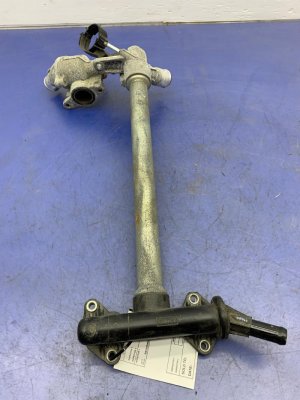
- Engine Thermostat Stuck Open 🔴 High Probability → Shop Integrated Thermostat Housing Assembly Thermostats are wear-and-tear items. The internal wax pellet or spring mechanism can fail over time, causing the valve to remain open. This is the cause for P0126 in over 80% of cases.
How to confirm: Use an OBD-II scanner to monitor live coolant temperature data. Start the engine from cold. If the temperature rises extremely slowly, especially during light driving, and struggles to reach the normal operating range (approx. 195°F), the thermostat is almost certainly stuck open. 🎬 Watch: How to diagnose and fix P0126 and P0128 codes You can also feel the upper radiator hose; it should remain cool for the first few minutes of operation and then get hot suddenly. If it warms up gradually right from the start, the thermostat is open.
Typical fix: Replace the engine thermostat and the corresponding gasket or O-ring. It's also best practice to drain and refill the engine coolant at the same time.
Est. part cost: $25-$90 - Low Engine Coolant Level 🟡 Medium Probability Coolant leaks can develop from various places like radiator hoses, the water pump, the radiator itself, or the degas bottle (coolant reservoir), which is a common failure point on many F-150s. A low level can create air pockets, preventing hot coolant from reaching the sensor.
How to confirm: Visually inspect the coolant reservoir (degas bottle) when the engine is cold. The level should be between the 'MIN' and 'MAX' lines. If it's low, look for signs of leaks (puddles under the truck, crusty residue around hoses, or a sweet smell of coolant).
Typical fix: Find and repair the source of the leak, then top off or refill the cooling system with the correct type of Ford-specified coolant (e.g., Motorcraft Orange VC-3-D for 2011-2018 or Motorcraft Yellow VC-13-G for 2019+). Bleed any air from the system.
Est. part cost: $10-$500+ depending on the source of the leak - Faulty Engine Coolant Temperature (ECT) Sensor ⚪ Low Probability → Shop Engine Coolant Temperature Sensor Sensors can fail electrically over time, providing inaccurate readings to the PCM. This is a more common issue on 2.7L EcoBoost engines as noted in TSB 21-2168.
How to confirm: Compare the ECT sensor reading on a scan tool with the ambient air temperature sensor reading on a completely cold engine; they should be very close. If the ECT reads an illogical temperature (e.g., -40°F or 250°F) when the engine is cold, the sensor is bad. You can also use an infrared thermometer to measure the temperature at the thermostat housing and compare it to the live data from the sensor; a large discrepancy points to a faulty sensor. A multimeter can be used to check resistance; a good sensor should read approximately 2,200-3,000 Ohms at 20°C (68°F) and drop to 250-350 Ohms at 80°C (176°F).
Typical fix: Replace the ECT sensor. On many Ford engines, it's a simple, threaded sensor that is easy to access. For affected 2.7L models, the TSB repair is required.
Est. part cost: $20-$50
Rare But Worth Checking
- Cooling Fan Stuck On: → Shop Engine Cooling Fan Blade If the electric cooling fan runs at high speed as soon as the engine is started (even when cold), it can prevent the engine from warming up. This is usually caused by a failed fan control module, a stuck relay, or a short in the wiring.
- ECT Sensor Wiring Issue (2.7L EcoBoost): → Shop Engine Coolant Temperature Sensor As per TSB 21-2168, some 2018-2020 F-150s with the 2.7L engine may have an issue with the ECT sensor wiring that causes intermittent voltage drops. The official fix involves replacing the heater hose assembly (Part No. ML3Z-14A411-H) to relocate the sensor and installing a jumper harness. 🎬 Watch: 2.7L EcoBoost ECT relocation kit and TSB repair guide
Diagnosis Steps
- Check for other stored DTCs. Address any other codes first, especially those related to the cooling fan or other sensors.
- Inspect the engine coolant level. With the engine cold, check the level in the coolant reservoir. If low, top it off with the Ford-specified coolant and check for visible leaks.
- Monitor live data with a scan tool. Watch the Engine Coolant Temperature (ECT) reading as the engine warms up from a cold start. It should climb steadily to about 195-210°F and stabilize within 15 minutes of combined idling and driving.
- Analyze the warm-up pattern. If the temperature climbs very slowly and never reaches the target, the thermostat is the most likely cause. If the temperature reading is erratic, jumps around, or is clearly incorrect (e.g., reads -40°F), the ECT sensor or its wiring is the likely culprit.
- Check cooling fan operation. Ensure the electric cooling fan is not running at high speed when the engine is cold. It should only activate when the A/C is on or when the engine reaches a high temperature.
- If the thermostat is suspected, replace it. This is the most common fix for this code.
- If the ECT sensor is suspected (especially on a 2.7L EcoBoost), test its resistance or replace it. For 2018-2020 2.7L models, check for applicability of TSB 21-2168.
- After repairs, clear the code and perform a drive cycle to ensure the temperature now reaches and maintains the correct range.
Parts You'll Likely Need
- Engine Thermostat and Gasket/Seal
(OEM #Motorcraft RT-1251 (for 5.0L V8 & 2.7L V6) 🎬 See this 5.0 Coyote thermostat and coolant exchange walkthrough or RT-1252 (for 3.5L EcoBoost). Part numbers vary by year and engine, always verify with VIN.)— This is the most frequent cause of P0126, as the thermostat fails in the open position, preventing the engine from reaching operating temperature.
Trusted brands: Motorcraft, Stant, Gates
OEM price range: $40-$90
Aftermarket price range: $25-$60 - Engine Coolant Temperature (ECT) Sensor
(OEM #Motorcraft DY-1145 (Varies by engine, confirm with VIN))— A less common but possible cause, a faulty sensor can send incorrect temperature data to the computer. It is the primary suspect for certain 2.7L EcoBoost engines per TSB 21-2168.
Trusted brands: Motorcraft, Bosch, NTK
OEM price range: $30-$60
Aftermarket price range: $20-$40 - Engine Coolant / Antifreeze
(OEM #Motorcraft VC-3-D (Orange) or VC-13-G (Yellow))— The system will need to be drained and refilled when replacing the thermostat. It's critical to use the correct Ford-specified coolant type (e.g., Motorcraft Orange for pre-2019 models, Motorcraft Yellow for 2019+ models) to prevent system damage. Mixing coolant types is not recommended.
Trusted brands: Motorcraft, PEAK, Prestone
OEM price range: $20-$30 per gallon
Aftermarket price range: $15-$25 per gallon
Related Codes That Often Appear With This One
- P0128 — P0128 (Coolant Temperature Below Thermostat Regulating Temperature) is a very similar code. Both are triggered by the engine warming up too slowly, and they share the same common causes, most notably a stuck-open thermostat. It is very common to see both codes appear together.
Technical Service Bulletins (TSBs) & Recalls
- TSB 21-2168: For 2018-2020 2.7L EcoBoost F-150s, addresses intermittent ECT voltage drops that can cause various temperature-related codes.
Platform-Specific Known Issues
- TSB 21-2168: Some 2018-2020 F-150s with the 2.7L EcoBoost engine may set this code (along with others) due to an intermittent voltage drop from the ECT sensor. The fix is to install a new heater hose assembly (Part No. ML3Z-14A411-H) which relocates the sensor, and a jumper harness.
Mechanic-Grade Diagnostic Values
- Engine Coolant Temperature (ECT) Sensor Resistance — expected: Approximately 2,200 - 3,000 Ω at 20°C (68°F), dropping to 250 - 350 Ω at 80°C (176°F).. Failure: Readings are significantly outside this range, or do not change smoothly as the engine warms up.
- Engine Coolant Temperature (ECT) Sensor Voltage (at sensor connector, key on, engine off) — expected: Approximately 3.0V - 3.5V on a cold engine (~20°C/68°F), dropping to around 0.5V - 1.3V at full operating temperature (~90°C/194°F).. Failure: Voltage is stuck high (e.g., 5V) or low, or does not decrease as the engine warms up. This test is performed on the signal wire with the sensor connected.
- ECT Sensor Reference Voltage (at sensor connector, unplugged, key on) — expected: Approximately 5.0V on one of the two pins.. Failure: Voltage is significantly lower than 5.0V (e.g., 0.6V) or absent, indicating a problem with the PCM or wiring, not the sensor itself.
Scan Tool Commands That Help
- Ford IDS (Integrated Diagnostic System): Datalogger / Live Data Monitoring — This is the primary function used for this code. A technician would use IDS to graph the ECT, Intake Air Temperature (IAT), and calculated engine run time on one screen to verify if the temperature is rising at the rate expected by the PCM. While there isn't a specific 'thermostat test,' this data comparison is the diagnostic procedure.
- Ford IDS (Integrated Diagnostic System): Bi-Directional Controls (Cooling Fan) — To rule out a cooling fan that is stuck on, a technician can use IDS to command the cooling fan(s) on and off. This verifies if the fan control module and fan itself are responding correctly and are not the cause of the over-cooling.
Wiring & Ground Locations
- ECT Sensor Connector — A 2-wire weatherproof connector plugged directly into the ECT sensor. The sensor is typically located near the thermostat housing or on a coolant crossover pipe/manifold.. This is the primary connection to check for corrosion, damage, or looseness. The two wires are typically a signal return and a ground. On 2.7L EcoBoost models, the location of this sensor and its wiring is the subject of TSB 21-2168.
- G103 / G104 / G105 — These are common engine bay ground points. Locations vary by generation, but are typically found on the firewall, inner fender aprons, or on the engine block itself. For example, on later models, key PCM grounds are on the firewall.. The ECT sensor circuit relies on a clean ground reference. A corroded or loose engine or PCM ground can cause a voltage drop, leading to an incorrect temperature reading by the PCM, potentially triggering P0126.
Real Owner Repair Stories
- Go-Parts Article citing forum research (2019 Ford F-150 2.7L EcoBoost at 25k miles) — Recurring limp mode, temperature gauge pegging to Hot then dropping to Cold, codes P1026 and P1299 (P0126 is often related).
❌ Tried (didn't work) Dealer replaced the Cylinder Head Temperature (CHT) sensor under warranty., Owner replaced the CHT sensor again, assuming the new part was faulty.
✅ What actually fixed it The owner discovered TSB 21-2168 and had the dealership perform the repair, which involves relocating the ECT sensor with a new harness and hose assembly. This resolved the issue permanently. The problem was the ECT circuit, not the CHT sensor.
OEM Part Supersession History
br3z8575c, br3z8575e, br3z8575f, rt1217, rt1227→Motorcraft RT-1251— Part consolidation and potential minor revisions for reliability over the years.
Model Year Variations Within This Range
- 2018-2020: F-150s with the 2.7L EcoBoost engine may have a faulty ECT sensor wiring design, addressed by TSB 21-2168. This is not an issue on other engines or years.
- 2011-2018 vs 2019-2024: The specified factory engine coolant changed. Models up to ~2018 used Motorcraft Orange Coolant (OAT). Models from ~2019 and newer use Motorcraft Yellow Coolant (P-OAT). While Ford has stated the new Yellow coolant is backward compatible and can be used to top-off Orange systems, a full flush to the new type is recommended for best performance.
Diagnostic Flowchart
Other Known Issues on This Vehicle
Issues unrelated to this code that are worth knowing about as an owner of this generation:
- Ford 5.4L 3-Valve Triton Cam Phaser Failure 🔴 High — Extremely common on 2004-2010 models. Often presents as a diesel-like ticking or knocking sound at idle. Can lead to catastrophic engine failure if ignored. (Ref: Multiple TSBs exist, including #06-19-8, addressing the VVT system.)
- 10R80 10-Speed Transmission Harsh/Erratic Shifting 🟠 Medium — Widespread on 2017-2023 models. Symptoms include hard shifts, delayed engagement, and jerking. Often caused by software or internal valve body/CDF drum issues. (Ref: Numerous TSBs have been released, including TSB 23-2250 and others, which supersede older versions and provide updated diagnostic and repair procedures.)
- Frozen Door Latches in Cold Weather 🟠 Medium — Common on 2015-2019 models. Doors may fail to open or, more dangerously, fail to latch closed in freezing temperatures. (Ref: Ford issued recall 17S33 and Customer Satisfaction Program 19N06 to address the issue by installing water shields and lubricating components.)
- Warping Dashboards (XL/XLT Trims) 🟡 Low — Prevalent on 2015-2020 XL and XLT trim levels. The dashboard material lifts and deforms around the defrost vents. (Ref: TSB 19-2041 was issued to authorize dashboard replacement, though some owners report the replacement part has the same issue.)
- 2.7L EcoBoost Leaking Plastic Oil Pan 🟠 Medium — A known issue on 2015-2019 2.7L EcoBoost engines where the original RTV sealant for the composite oil pan fails, causing oil leaks. (Ref: TSBs 19-2189 (for 2018-2019) and 23-2083 (for 2015-2017) detail the fix, which involves replacing the pan with an updated version that uses a press-in-place gasket.)
- 5.4L 3-Valve Spark Plug Breakage During Removal 🔴 High — A notorious problem on 2004-2008 F-150s with the 5.4L 3V engine. The two-piece spark plug design can cause the lower section to seize in the cylinder head and break off during routine maintenance, requiring a special extraction tool.
Used vs. New Parts: Buying Guide for This Vehicle
When a used part is the smart pick: For this specific trouble code, using used parts is generally not recommended. The primary failure items (thermostat, ECT sensor) are inexpensive wear-and-tear components that should always be replaced with new parts to ensure a lasting repair.
Donor-vehicle mileage cap: roughly under 15000 miles for the part to have meaningful remaining life.
What to inspect on the donor part:
- If sourcing a wiring pigtail for a connector repair, inspect for any signs of brittleness, cracking, or previous repairs.
- Ensure the donor vehicle is from the same generation and has the same engine to guarantee harness compatibility.
- Avoid parts from vehicles with signs of front-end collision or engine fires.
OEM-only on this vehicle (don't cheap out):
- Engine Thermostat: While some aftermarket brands are reliable, many owners report issues with incorrect temperature ratings or premature failure. Using an OEM Motorcraft thermostat is a cheap insurance policy against having to do the job twice.
Aftermarket brands forum-validated for this vehicle:
- Stant (Thermostats)
- Gates (Thermostats)
- Bosch (Sensors)
- NTK (Sensors)
Brands owners have reported issues with on this vehicle:
- Generic, unbranded 'white box' thermostats and sensors from online marketplaces are frequently cited as failing quickly or being out-of-spec from the factory.
Real Owner Stories
Aggregated from forums and TSBs cited above. Mileages and costs reflect what owners reported in those sources.
2017 3.5L EcoBoost
Symptoms: The owner received code P0126.
What fixed it: The owner replaced the stuck-open thermostat to fix the issue.
Source hint: f150forum.com thread titled 'p0126-code-491959/'
2011 5.0L
Symptoms: The owner described a slow-to-warm engine and poor heater performance.
What fixed it: The confirmed fix was a new Motorcraft thermostat.
Source hint: f150forum.com thread titled 'p0126-code-need-help-339249/'
2018 5.0L
Symptoms: The truck had both P0126 and P0128 codes, and the check engine light was on.
What fixed it: The repair was replacing the thermostat, which resolved the check engine light.
Source hint: Reddit r/f150 thread titled 'p0126_and_p0128/'
2011 5.0L
Symptoms: The truck was showing both P0126 and P0128 codes.
What fixed it: A thermostat replacement fixed the problem and restored normal temperature gauge readings.
Source hint: ford-trucks.com thread titled 'p0126-and-p0128-on-my-2011-f150-5-0-a.html'
Documented NHTSA Reports
Ford Manufacturer Reference
Symptoms: An owner reported a "Coolant Thermostat Temperature Below Thermostat Regulating" condition occurring multiple times.
Findings: NHTSA ODI #10899284 describes a scenario where this code appeared alongside other powertrain control module malfunctions, with some suggestions pointing toward circuit issues or even unrelated bulb failures, though the primary code remained P0126.
Related OBD-II Codes
Frequently Asked Questions
I have a 2019 F-150 with the 2.7L EcoBoost and code P0126. Does the TSB for the ECT sensor apply to my truck?
What is the most common reason for a P0126 code on my Ford F-150?
My heater is blowing lukewarm air and the check engine light is on. Are these related?
My temperature gauge on the dash barely moves. Is a bad thermostat or a bad sensor more likely?
I need to top off my coolant to fix a low level. What kind should I use for my 2020 F-150?
Can a low coolant level cause the P0126 code on my F-150?
Helpful Videos
We Have This Part in Stock

The information in this article is provided for general reference and educational purposes only. Vehicle specifications, procedures, and part compatibility can vary by production date, trim level, and region. Always consult your vehicle's factory service manual and verify part numbers before purchasing or performing repairs. Safety-critical components such as airbags, seat belts, and braking systems should be installed by a qualified professional.
- Ford F-150:
- 🧭 Diagnostic Flowchart
- 🎬 Helpful Videos
- 🛍️ Shop This Part
- What's Unique About the 2004-2024 Ford F-150
- Symptoms You May Notice
- Most Likely Causes
- Rare But Worth Checking
- Diagnosis Steps
- Parts You'll Likely Need
- Related Codes That Often Appear With This One
- Technical Service Bulletins (TSBs) & Recalls
- Platform-Specific Known Issues
- Mechanic-Grade Diagnostic Values
- Scan Tool Commands That Help
- Wiring & Ground Locations
- Real Owner Repair Stories
- OEM Part Supersession History
- Model Year Variations Within This Range
- Other Known Issues on This Vehicle
- Used vs. New Parts: Buying Guide for This Vehicle
- Real Owner Stories
- 2017 3.5L EcoBoost
- 2011 5.0L
- 2018 5.0L
- 2011 5.0L
- Documented NHTSA Reports
- Ford Manufacturer Reference
- Related OBD-II Codes
- Frequently Asked Questions
- 🎟️ Get 5% Off