

P0126 on 2019-2025 Mazda CX-5 2.5L Turbo: Why It's Different and What to Check
IMPORTANT: On the 2.5L Turbo CX-5, code P0126 is NOT the common, well-known issue covered by Mazda's warranty extension (SSPD8). For the turbo engine, this code points to general cooling system problems like a stuck conventional thermostat or a bad sensor, not the specific Coolant Control Valve failure seen on non-turbo models.
- Crucially, the common P0126 issue covered by Mazda's TSBs and warranty extension (SSPD8) does NOT apply to your 2.5L Turbo CX-5.
- For the turbo engine, diagnosis should focus on traditional cooling system components.
- The most likely cause is a conventional thermostat that is stuck in the open position.
- Other potential causes include a faulty coolant temperature sensor or a low coolant level due to a leak.
- Do not expect a free repair under the special warranty program, as your vehicle is not included.
What's Unique About the 2019-2025 Mazda CX-5
It is critical to understand that the widespread, well-documented P0126 issue on many 2018+ Mazdas, caused by a faulty failsafe thermostat within the Coolant Control Valve (CCV), does NOT apply to the 2.5L Turbo engine. Mazda's Technical Service Bulletins (TSBs) and the associated 15-year/150,000-mile warranty extension (SSPD8) explicitly exclude the turbo models. The 2.5L Turbo engine uses a more conventional cooling system and a simple mechanical thermostat design, so the causes and diagnostic procedures are different.
Symptoms You May Notice
- Check Engine Light is on
- Engine takes an unusually long time to warm up
- Temperature gauge stays low or fluctuates, especially at highway speeds
- Poor heater performance, blowing lukewarm air, especially at idle
- Blue low coolant temperature light stays on longer than usual or turns on while driving
- Noticeable decrease in fuel economy
- Assuming the issue is the same as the non-turbo CX-5 and requesting the warranty extension (SSPD8) from the dealer, which does not apply.
- Replacing the entire Coolant Control Valve assembly, which is the common failure on non-turbo models but is not the likely cause on the turbo engine.
Most Likely Causes
- Stuck-Open Conventional Thermostat 🔴 High Probability → Shop Integrated Thermostat Housing Assembly This is the most common cause for P0126 on any engine not affected by the specific CCV issue. The thermostat is a mechanical valve that can fail over time. Some owners of 2.5T engines have noted that the plastic thermostat housing can also develop coolant leaks.
How to confirm: Monitor the engine coolant temperature with a scan tool. If the temperature is slow to rise, stays below ~180°F, or drops at highway speeds, the thermostat is likely stuck open. A visual inspection may also reveal coolant leaks around the plastic thermostat housing.
Typical fix: Replace the engine coolant thermostat and gasket. 🎬 Watch: Step-by-step thermostat replacement walkthrough A coolant flush is recommended at the same time. If the housing is cracked, it must also be replaced.
Est. part cost: $25-$75 - Faulty Engine Coolant Temperature (ECT) Sensor 🟡 Medium Probability → Shop Engine Coolant Temperature Sensor
How to confirm: Compare the ECT sensor reading on a scan tool with the ambient air temperature sensor reading on a cold engine; they should be very close. If the ECT reading is irrational (e.g., stuck at -40°F) or doesn't change as the engine warms up, it's likely faulty.
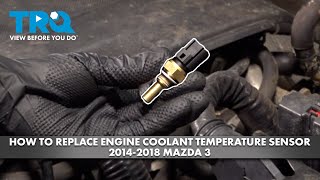
Typical fix: Replace the engine coolant temperature sensor. 🎬 See: How to replace the coolant temperature sensor
Est. part cost: $20-$60 - Low Engine Coolant Level ⚪ Low Probability While not specific to P0126, some early 2.5T engines are known to develop coolant leaks from a cracked cylinder head near the exhaust manifold, which could lead to low coolant levels. 🎬 Watch: Understanding the Mazda 2.5T cracked head issue
How to confirm: Visually inspect the coolant reservoir. If the level is below the 'MIN' line when the engine is cold, it is low. This indicates a leak that must be found and repaired. Check for white or pink crusty residue around the engine, particularly on the back side near the exhaust manifold.
Typical fix: Top off the coolant with Mazda FL22 coolant and pressure test the cooling system to find and repair the source of the leak (e.g., a cracked hose, radiator, thermostat housing, or in rare cases, the cylinder head).
Est. part cost: $5-$5000+ depending on the source of the leak
Rare But Worth Checking
- Cooling Fan Running Constantly: → Shop Engine Cooling Fan Blade If the electric cooling fan is stuck on, it can over-cool the engine, especially in cold weather or at highway speeds. This could be caused by a faulty fan relay or a short in the wiring.
Diagnosis Steps
- Verify the code with an OBD-II scanner.
- IMPORTANT: Confirm your vehicle has the 2.5L Turbo engine. If it is not the turbo model, refer to Mazda TSB 01-005/24 and warranty extension SSPD8.
- Check the engine coolant level in the reservoir when the engine is cold. Top up if necessary and inspect for visible leaks, paying close attention to the thermostat housing and the area around the exhaust manifold.
- Use a scan tool to monitor the Engine Coolant Temperature (ECT) data. Watch the temperature as the engine warms up from a cold start.
- If the temperature rises very slowly, fails to reach ~195°F, or drops significantly while driving at speed, a stuck-open thermostat is the most likely cause.
- If the temperature reading is erratic or does not match the ambient temperature on a cold engine, suspect a faulty ECT sensor.
- If coolant levels and sensor readings appear normal, investigate the cooling fan operation to ensure it is not running continuously from a cold start.
Parts You'll Likely Need
- Engine Coolant Thermostat
(OEM #PY8V-15-171)— This is the most probable cause of the engine failing to reach operating temperature on a vehicle with a conventional cooling system.
Trusted brands: Mazda OE, Motorad, Stant, Vernet
OEM price range: $50-$100
Aftermarket price range: $25-$75 - Engine Coolant Temperature Sensor — If the thermostat is working correctly, an inaccurate sensor can falsely report a low temperature to the PCM, triggering the code.
Trusted brands: Mazda OE, Bosch, Denso
OEM price range: $40-$80
Aftermarket price range: $20-$60
Technical Service Bulletins (TSBs) & Recalls
- TSB 01-003/25 & 01-005/24: These bulletins describe the P0126 issue on non-turbo models and explicitly state that vehicles with the SKYACTIV-G 2.5T engine are not applicable.
Platform-Specific Known Issues
- Owner Experience on Reddit: A Reddit user with a 2018 CX-9 (same 2.5T engine) reported a P0126 code at 50k miles. The community correctly identified that the turbo engines use a simple mechanical thermostat and that the issue is a classic stuck-open failure, distinct from the non-turbo CCV problem.
Mechanic-Grade Diagnostic Values
- Engine Coolant Temperature (ECT) Sensor Resistance — expected: ~2,200 - 3,000 Ω at 20°C (68°F); ~250 - 350 Ω at 80°C (176°F). Failure: Readings significantly outside the expected range for a given temperature, or an open/short circuit reading.
- Engine Coolant Temperature (ECT) Sensor Signal Voltage (Key On, Engine Off) — expected: ~2.0V - 3.5V on a cold engine (~20°C / 68°F). Failure: Voltage near 5V (open circuit) or near 0V (short circuit) when the sensor is connected.
- Engine Coolant Temperature (ECT) Sensor Signal Voltage (Engine at Operating Temp) — expected: ~0.5V - 1.3V at ~80-90°C (176-194°F). Failure: Voltage fails to drop into this range as the engine warms up, suggesting the engine isn't getting hot (stuck thermostat) or the sensor is faulty.
- P0126 Code Set Condition (from Freeze Frame Data) — expected: Normal operating temperature should be >180°F (82°C).. Failure: The PCM will set the code if the ECT does not exceed ~160-176°F (71-80°C) within a specified time (e.g., 8-20 minutes) after a cold start, depending on ambient temperature.
Wiring & Ground Locations
- ECT Sensor Location — On the 2.5L engine, the primary ECT sensor is typically located on or near the thermostat housing, at the rear of the engine on the driver's side.. This is the sensor providing the primary temperature reading to the PCM. A poor connection or damaged wiring at this location will cause incorrect readings and can trigger P0126 or other ECT-related codes.
- Engine Ground G07 — A common engine ground point shown in wiring diagrams for the first-generation CX-5 is on the left rear of the engine. While the exact location for the Gen 2 Turbo may vary slightly, ensuring the main engine-to-chassis grounds are clean and tight is critical.. The ECT sensor relies on a clean ground path to provide an accurate signal. A corroded or loose engine ground can introduce resistance and skew the sensor's voltage reading, potentially tricking the PCM into thinking the engine is colder than it is.
OEM Part Supersession History
PY8V-15-171→PY8V-15-171— No supersession found. The original part number appears to be current.
Model Year Variations Within This Range
- 2022-2025: For the 2022 model year refresh, the 2.5L Turbo engine received a minor power increase to 256 hp (from 250 hp) when using 93-octane fuel. This change is related to PCM tuning and does not affect the fundamental design of the conventional cooling system or the causes of P0126.
Diagnostic Flowchart
Other Known Issues on This Vehicle
Issues unrelated to this code that are worth knowing about as an owner of this generation:
- Cracked Cylinder Head (Coolant Leak) 🔴 High — Affects some earlier models (primarily 2019-2020) with VINs lower than JM3KF******830243. Can cause external coolant leaks near the exhaust manifold or internal leaks. (Ref: TSB 01-002/23 (previously 01-013/21))
- Excessive Oil Consumption (Valve Stem Seals) 🟠 Medium — Primarily affects certain 2021 models. Caused by faulty valve stem seals allowing oil into the combustion chamber. (Ref: Subject of a class-action settlement and TSB 01-003/23, leading to an extended powertrain warranty for affected vehicles.)
- Poor PCV Design (Early Models) 🟡 Low — On 2016 to early 2019 models, the PCV valve design integrated into the valve cover could lead to excessive oil consumption and fouled spark plugs.
Used vs. New Parts: Buying Guide for This Vehicle
When a used part is the smart pick: A used thermostat housing (OEM Part No. PY8W-15-17Z) could be a sensible choice if the original is cracked and a new OEM part is unavailable or cost-prohibitive. The housing itself is not a wear item.
Donor-vehicle mileage cap: roughly under 100000 miles for the part to have meaningful remaining life.
What to inspect on the donor part:
- Inspect thoroughly for hairline cracks, especially around bolt holes and hose connections.
- Ensure all mounting surfaces are flat and not warped.
- Verify it is the correct part for the 2.5T engine, as it differs from the non-turbo Coolant Control Valve assembly.
OEM-only on this vehicle (don't cheap out):
- Engine Coolant Thermostat: While aftermarket thermostats are available, the price difference is often minimal. Using an OEM thermostat (PY8V-15-171) ensures the correct opening temperature and flow characteristics specified by Mazda, which is critical for avoiding this specific trouble code.
Aftermarket brands forum-validated for this vehicle:
- Stant
- Motorad
- Gates
Brands owners have reported issues with on this vehicle:
- No-name, unbranded parts from online marketplaces should be avoided, as their quality control and temperature calibration can be inconsistent.
Real Owner Stories
Aggregated from forums and TSBs cited above. Mileages and costs reflect what owners reported in those sources.
2018 Mazda CX-9 2.5T — 50000 miles
Symptoms: Check engine light illuminated with code P0126. The community noted this engine uses a simple mechanical thermostat unlike the non-turbo models.
What fixed it: Replacement of the conventional stuck-open mechanical thermostat.
Source hint: r/mazda - '2018 CX-9 check engine light ( P0126 error code)': https://www.reddit.com/r/mazda/comments/1eouy1g/2018_cx9_check_engine_light_p0126_error_code/
Related OBD-II Codes
Frequently Asked Questions
Does TSB 01-005/24 regarding the Coolant Control Valve (CCV) apply to my 2.5L Turbo CX-5?
Is the P0126 code on my 2019 CX-5 Turbo covered under the SSPD8 warranty extension?
Could a coolant leak near the exhaust manifold cause a P0126 code on my 2019-2020 CX-5?
What specific thermostat part number should I use for the 2.5L Turbo engine?
Can I reuse my thermostat housing if I find a leak while fixing P0126?
Why is my blue low coolant temperature light staying on longer than usual?
Helpful Videos

We Have This Part in Stock


The information in this article is provided for general reference and educational purposes only. Vehicle specifications, procedures, and part compatibility can vary by production date, trim level, and region. Always consult your vehicle's factory service manual and verify part numbers before purchasing or performing repairs. Safety-critical components such as airbags, seat belts, and braking systems should be installed by a qualified professional.
- Mazda CX-5:
- 🧭 Diagnostic Flowchart
- 🎬 Helpful Videos
- 🛍️ Shop This Part
- What's Unique About the 2019-2025 Mazda CX-5
- Symptoms You May Notice
- Most Likely Causes
- Rare But Worth Checking
- Diagnosis Steps
- Parts You'll Likely Need
- Technical Service Bulletins (TSBs) & Recalls
- Platform-Specific Known Issues
- Mechanic-Grade Diagnostic Values
- Wiring & Ground Locations
- OEM Part Supersession History
- Model Year Variations Within This Range
- Other Known Issues on This Vehicle
- Used vs. New Parts: Buying Guide for This Vehicle
- Real Owner Stories
- 2018 Mazda CX-9 2.5T — 50000 miles
- Related OBD-II Codes
- Frequently Asked Questions
- 🎟️ Get 5% Off