

P0128 on 2003-2008 Audi A4: Coolant Temperature Below Thermostat Regulating Temperature Causes and Fixes
For a 2003-2008 Audi A4, code P0128 almost always means the engine thermostat is stuck open and needs to be replaced. This is a common failure item. The ECU triggers this code when the engine fails to reach its target temperature (typically ~87-90°C) in a set time. Expect to pay between $30-$80 for an aftermarket part or $100-$150 for an OEM part.
- P0128 on a 2003-2008 Audi A4 means the engine is running too cool.
- The most likely cause, by a wide margin, is a thermostat that is stuck in the open position.
- Symptoms include a low reading on the temperature gauge, poor cabin heat, and reduced fuel economy.
- Diagnosis is best confirmed by watching the live coolant temperature on a scan tool; if it's slow to warm up or cools down at highway speeds, replace the thermostat.
- When replacing the thermostat, it's essential to also replace the coolant with the correct G12 or G13 specification.
What's Unique About the 2003-2008 Audi A4
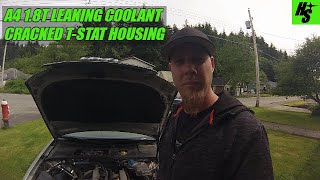
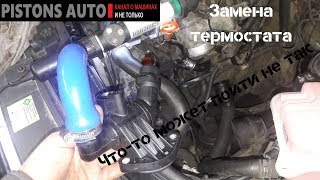
On the B6 (2002-2005) and B7 (2005.5-2008) generations of the Audi A4, the cooling systems are generally reliable, but the thermostat is a known wear item. The plastic housings used for thermostats and other cooling components like the rear coolant flange can become brittle over time, but for the P0128 code specifically, the issue is almost always the thermostat's internal mechanism failing and sticking open. While the ECT sensor can also fail, it's a much less frequent cause for this particular code on this platform. The location of the thermostat varies significantly by engine, impacting repair difficulty; on the 1.8T, it's behind the alternator, while on the 3.0L V6, it's behind the timing belt covers, 🎬 See this walkthrough for replacing the 3.0L V6 thermostat. making replacement much more labor-intensive.
Generation note: This guide covers the B6 (2003-2005) and B7 (2005.5-2008) generations of the Audi A4. The causes and fixes for P0128 are largely identical across these two generations and their common engines (1.8T, 2.0T, 3.0L, 3.2L), though specific part numbers and the labor involved in replacing the thermostat vary significantly by engine.
Symptoms You May Notice
- Check Engine Light is on
- Temperature gauge on the dashboard reads lower than normal (e.g., below the center 90°C/192°F mark)
- Temperature gauge drops at highway speeds
- Heater does not blow hot air or is only lukewarm
- Noticeable decrease in fuel economy
- Engine takes a very long time to warm up
- Replacing the Engine Coolant Temperature (ECT) sensor when the thermostat is actually the problem. Because the sensor is often cheaper and easier to access, it's sometimes replaced first. However, the symptoms of a slow warm-up or temperature dropping at speed strongly point to the thermostat.
Most Likely Causes
- Engine thermostat stuck open 🔴 High Probability → Shop Integrated Thermostat Housing Assembly The thermostat is a mechanical wear-and-tear item. Over time, the internal wax motor can weaken or the spring mechanism can fail, causing it to remain in the open position, allowing constant coolant circulation.
How to confirm: Use an OBD-II scanner to monitor live coolant temperature data. Start the car from cold. The temperature should rise steadily to around 90°C (192°F) and stabilize. If it warms up very slowly, never reaches full temperature, or drops significantly when driving at speed, the thermostat is almost certainly stuck open. Another test is to feel the upper radiator hose; if it gets warm gradually with the rest of the engine instead of getting hot suddenly when the engine reaches operating temp, the thermostat is open.
Typical fix: Replace the engine thermostat and its integrated housing and gasket/seal. It is also recommended to replace the coolant at the same time.
Est. part cost: $30-$150 - Faulty Engine Coolant Temperature (ECT) Sensor 🟡 Medium Probability → Shop Engine Coolant Temperature Sensor The ECT sensor can fail electrically, sending inaccurate (typically low or erratic) temperature readings to the ECU. While less common than thermostat failure for this code, it's a known issue on many VW/Audi products of this era.
How to confirm: With a cold engine (after sitting overnight), compare the ECT sensor reading and the Intake Air Temperature (IAT) sensor reading on a scan tool; they should be nearly identical (within 2-3°C). If the ECT reads significantly lower or shows an illogical value (e.g., -40°F), it's likely faulty. You can also test the sensor's resistance with a multimeter at various temperatures and compare it to manufacturer specifications.
Typical fix: Replace the Engine Coolant Temperature sensor and its O-ring. It is often green or black and held in by a plastic clip, making for a relatively easy replacement. 🎬 Watch: How to replace the coolant temperature sensor on a 2.0T.
Est. part cost: $15-$50 - Low engine coolant level ⚪ Low Probability Leaks can develop at several common points on the B6/B7 A4, such as the plastic coolant flange at the rear of the cylinder head, radiator end tanks, or water pump. Low coolant can create air pockets near the ECT sensor, leading to incorrect readings that can trigger P0128.
How to confirm: Visually inspect the coolant expansion tank when the engine is cold. The level should be between the MIN and MAX marks. If low, inspect the system for leaks from hoses, the radiator, water pump, or thermostat housing. A cooling system pressure test is the most effective way to find a leak.
Typical fix: Top off the coolant with the correct type (G12 or G12+ for this vehicle) and find and repair the source of the leak.
Est. part cost: $20-$40 for coolant
Rare But Worth Checking
- Cooling fan stuck on: → Shop Engine Cooling Fan Blade If the electric cooling fan runs continuously from the moment the car is started (even when cold), it can over-cool the engine, especially in cold weather or at low speeds. This is usually caused by a failed fan control module or a short in the wiring, and is not a common cause of P0128.
Diagnosis Steps
- Read the code with an OBD-II scanner and confirm P0128 is present. Note any other codes, especially P2181 or 17701.
- With the engine cold, check the coolant level in the expansion tank. Ensure it is between the MIN and MAX lines.
- Start the engine from cold and use the live data function on your scanner to monitor the Engine Coolant Temperature.
- Observe the temperature rise. It should climb steadily to approximately 87-92°C (188-198°F) within 5-15 minutes of driving, depending on ambient temperature.
- If the temperature is very slow to rise, struggles to reach its target, or drops when you drive at highway speeds, the thermostat is stuck open and is the most likely culprit.
- If the temperature seems to behave normally but the code returns, investigate the ECT sensor. Compare its reading to the intake air temp sensor on a cold engine; they should be within a few degrees of each other. If the ECT reading is illogical (e.g., -40°F), the sensor or its wiring is faulty.
- Check that the electric cooling fans are not running constantly when the engine is cold.
- If coolant level is low, perform a cooling system pressure test to identify and locate any leaks.
Parts You'll Likely Need
- Engine Coolant Thermostat
(OEM #06B121111K (1.8T), 06D121111G (2.0T), 06C121111E (3.0L), 06E121111G (3.2L) - Verify by VIN)— This is the most common cause of P0128, as the internal mechanism fails and sticks open, preventing the engine from reaching operating temperature.
Trusted brands: Mahle, Behr, Wahler, Genuine Audi
OEM price range: $100-$180
Aftermarket price range: $30-$90 - Engine Coolant Temperature (ECT) Sensor
(OEM #059919501A (common, verify by VIN))— This sensor provides the temperature reading to the ECU. If it fails and reads incorrectly low, it can trigger P0128. It's the second most likely cause.
Trusted brands: Bosch, Febi Bilstein, VEMO
OEM price range: $30-$50
Aftermarket price range: $15-$30 - Engine Coolant / Antifreeze
(OEM #G012A8G1G (G12+ Spec))— The cooling system must be drained to replace the thermostat, so you will need to refill it with the correct specification coolant (G12 or G12+). G13 is backwards compatible but not required for this generation.
Trusted brands: Pentosin (Pentofrost SF), HEPU, Genuine Audi/VW
OEM price range: $30-$40 per gallon
Aftermarket price range: $20-$30 per gallon
Related Codes That Often Appear With This One
- P2181 — This code is for "Cooling System Performance" and is often set alongside P0128 on Volkswagen and Audi vehicles, as both relate to the engine not reaching operating temperature correctly.
- 17701 — This is a VAG-specific fault code for "Map Controlled Engine Cooling Thermostat (F265): Open Circuit". It points directly to an electrical fault with the thermostat's heater element, which is common on these vehicles.
- 00522 — This is a VAG-specific fault code for the Engine Coolant Temperature Sensor (G62), indicating an open or short circuit. It points directly to a sensor or wiring fault rather than a mechanical thermostat issue.
Platform-Specific Known Issues
- 3.0L (AVK) V6 Thermostat Location: → Shop Integrated Thermostat Housing Assembly On the 3.0L V6 engine, the thermostat is located behind the timing belt covers. This means that a thermostat replacement job requires the same labor as a full timing belt service, including putting the front lock carrier into the service position. It is highly recommended to replace the timing belt, water pump, and all related tensioners and idlers at the same time as the thermostat, even if they are not due for replacement.
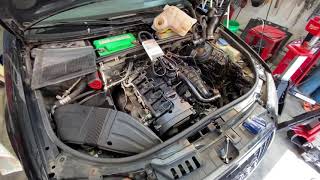
- 1.8T (AMB) Thermostat Location: → Shop Integrated Thermostat Housing Assembly On the 1.8T engine, the thermostat is located on the front of the engine block, but it is tucked behind and below the alternator. Access requires removing the serpentine belt and unbolting the alternator to move it out of the way. While not as intensive as the 3.0L V6, it is still a moderately difficult job due to the tight space.
- 2.0T (BGB, BPG, BWT) & 3.2L (BKH) Thermostat Location: → Shop Integrated Thermostat Housing Assembly On the B7 generation's 2.0T and 3.2L engines, the thermostat is located on the front of the engine, typically bolted to the engine block and connected to the lower radiator hose. While more accessible than the 3.0L V6, it can still be tight to work on, sometimes requiring removal of other accessories for clearance.
Mechanic-Grade Diagnostic Values
- Engine Coolant Temperature (ECT/G62) Sensor Resistance — expected: Approx. 2000-3000 Ω at 20°C (68°F); Approx. 250-375 Ω at 80-90°C (176-194°F).. Failure: Infinite resistance (open circuit), near-zero resistance (short circuit), or values significantly outside the expected range for a given temperature.
- Map-Controlled Thermostat (F265) Heater Element Resistance — expected: 14 - 16 Ω at room temperature (~25°C).. Failure: A reading far outside this range indicates a faulty internal heater, which can trigger fault code 17701 and contribute to improper temperature regulation.
- ECT (G62) Sensor Signal Voltage — expected: Key on, engine off: Approx. 2.0V - 3.0V on a cold engine. Drops to approx. 0.5V when the engine is fully warmed up.. Failure: Voltage near 0V suggests a short to ground. Voltage near 5V suggests an open circuit. Readings that do not change as the engine warms up indicate a faulty sensor.
- Map-Controlled Thermostat (F265) Bench Test — expected: When submerged in boiling water with 12V applied to the heater element, the thermostat must open at least 7mm within 10 minutes.. Failure: Failure to achieve the minimum 7mm travel indicates a faulty thermostat that should be replaced.
Scan Tool Commands That Help
- VCDS (VAG-COM): Engine -> Measuring Blocks (MVB) -> Group 001 (or similar) — This is the primary diagnostic method for P0128. A technician will monitor the coolant temperature value (from sensor G62) in real-time from a cold start. This allows them to see exactly how fast the engine is warming up and if the temperature stabilizes correctly or drops at speed, confirming a stuck-open thermostat. Comparing the G62 reading to the radiator outlet temp sensor (G83) can also show if the thermostat is opening prematurely.
Wiring & Ground Locations
- G62 Sensor Connector — On the plastic coolant flange at the rear of the cylinder head (most engines). It is a 2, 3, or 4-pin connector depending on the specific engine and year.. This is the primary connection to test for sensor signal voltage and resistance. A corroded or loose connector can cause incorrect readings and trigger P0128.
- F265 Thermostat Connector — Directly on the thermostat housing. It is a 2-pin connector for the internal heater element.. A loose or damaged connector here will cause an open circuit fault (code 17701) and prevent the ECU from using the map-controlled heating function, affecting warm-up behavior.
- Engine Block Ground — A primary engine-to-chassis ground strap is often found on the driver's side of the engine compartment. A key ground point on some 2.0L engines is designated 'G18' at the left rear of the engine.. A poor engine ground can cause floating or incorrect readings from various sensors, including the ECT sensor, leading to false codes.
Real Owner Repair Stories
- Audi-Sport.net forum user (2008 Audi A4 Cabriolet 2.0 TFSI) — Temperature gauge on dash and coolant temp in VCDS were both reading low, maxing out around 70°C.
❌ Tried (didn't work) Initial diagnosis and monitoring.
✅ What actually fixed it Replacing the engine thermostat fully resolved the low temperature reading. - Ross-Tech forum user (2008 Audi A4 1.8T (BFB engine)) — Engine does not reach or maintain operating temperature in winter, leading to poor cabin heat and P0128.
❌ Tried (didn't work) Replaced map-controlled thermostat 3 times with genuine parts., Replaced G62 (coolant temp) sensor 3 times., Replaced G83 (radiator outlet) sensor 3 times.
✅ What actually fixed it The issue remained unresolved after replacing all common components, leading the owner to suspect a rare fault in the ECU's control signal to the map-controlled thermostat. This highlights an edge case where the standard fixes are not sufficient. - North American Motoring forum user (2009 MINI Clubman S (different vehicle, same code)) — P0128 code appeared three months after replacing the thermostat housing.
❌ Tried (didn't work) Assuming the new thermostat was faulty.
✅ What actually fixed it The electrical connector on the new thermostat housing was not fully seated. After pushing it on until it clicked, the code was resolved. This serves as a critical reminder to check all connections after a repair.
When the Usual Fixes Don't Work
- While P0128 is overwhelmingly caused by a stuck-open thermostat, there are documented cases in owner forums where replacing the thermostat and ECT sensor does not solve the problem. In one such case involving a 2008 A4 1.8T, the owner replaced the thermostat and both relevant temperature sensors three times with genuine parts, yet the engine still failed to reach operating temperature in cold weather. The final suspicion fell on the Engine Control Unit (ECU) itself failing to send the correct control signal to the map-controlled thermostat's heater, a rare and difficult-to-diagnose fault that requires oscilloscope analysis. This demonstrates that while the thermostat is the 95% answer, a small fraction of cases may involve complex control system or wiring faults.
OEM Part Supersession History
06B121111D, 06B121111G, 06B121111H→06B121111K— Component revision and consolidation by the manufacturer for the 1.8T engine thermostat.
Heads up: The newest part number (06B121111K) is the correct replacement for all previous versions on the specified 1.8T engines.
Model Year Variations Within This Range
- 2003-2008: All engines in this range (1.8T, 2.0T, 3.0L, 3.2L) use a map-controlled thermostat (designated F265). This design includes an internal electric heater that allows the ECU to force the thermostat open earlier under high load conditions for better performance and component protection. This adds an electrical point of failure (the heater element or its wiring) in addition to the traditional mechanical failure of being stuck open.
Diagnostic Flowchart
Other Known Issues on This Vehicle
Issues unrelated to this code that are worth knowing about as an owner of this generation:
- 2.0T FSI (EA113) Cam Follower Failure 🔴 High — Very common. Recommended preventative replacement every 20,000-40,000 miles. Failure can occur from 40,000 miles onward. (Ref: TSB 2013147 / TPI 2017356 address this issue.)
- 1.8T Engine Oil Sludge 🔴 High — Common on engines with extended oil change intervals or use of non-synthetic oil. Can lead to a blocked oil pickup tube and catastrophic engine failure.
- Power Window Regulator Failure 🟠 Medium — Common across all years. The plastic clips that hold the window glass to the regulator cable break, causing the window to drop into the door.
- Ignition Coil Pack Failure 🟡 Low — Widespread issue, often leading to engine misfires. Relatively inexpensive and easy to replace. Many vehicles were covered under a recall or service campaign. (Ref: Recalls and service campaigns existed, check with dealer.)
- PCV Valve Failure 🟠 Medium — The diaphragm in the Positive Crankcase Ventilation valve tears, causing vacuum leaks, high oil consumption, and a rough idle.
- 3.0L V6 (AVK) Timing Belt Service Complexity 🟠 Medium — Not a failure, but a maintenance issue. The timing belt, water pump, and thermostat are all major jobs requiring significant labor, often done together around 75,000-90,000 miles.
Used vs. New Parts: Buying Guide for This Vehicle
When a used part is the smart pick: For this specific repair, using a used part is strongly discouraged. The primary failure components—the thermostat and ECT sensor—are wear items made with plastic that becomes brittle and electronics that degrade over time. The labor cost to access and replace these parts is significant, making the risk of premature failure from a used part a poor economic choice.
What to inspect on the donor part:
- Not applicable, as used parts are not recommended for the core components of this repair.
OEM-only on this vehicle (don't cheap out):
- Engine Coolant Thermostat
Aftermarket brands forum-validated for this vehicle:
- Mahle
- Behr
- Wahler
- Bosch (for sensors)
- Pentosin (for coolant)
Brands owners have reported issues with on this vehicle:
- Unbranded or 'white-box' parts from online marketplaces. The thermostat and related coolant flanges are known failure points on this platform, and low-quality aftermarket parts have a high failure rate, often leading to repeat repairs.
Real Owner Stories
Aggregated from forums and TSBs cited above. Mileages and costs reflect what owners reported in those sources.
2002-2005 Audi A4 (B6 platform)
Symptoms: The owner noticed the temperature gauge was dropping while driving at highway speeds and the Check Engine Light was on for P0128.
What fixed it: Replacing the thermostat resolved the issue after the owner initially suspected the sensor.
Source hint: https://www.audiworld.com/forums/a4-b6-platform-discussion-34/p0128-cel-code-2842131/
2002-2005 Audi A4 (B6 platform)
Symptoms: The vehicle displayed a P0128 code (Coolant Thermometer Below Control Limit). The owner was debating between a sensor or thermostat failure.
What fixed it: Replacing the thermostat.
Source hint: https://www.audizine.com/forum/showthread.php/465133-P0128-Coolant-Thermometer-Below-Control-Limit
Related OBD-II Codes
Frequently Asked Questions
I have a 2003-2005 Audi A4 with the 3.0L V6 (AVK); why is the thermostat repair so expensive?
My 1.8T A4 is throwing P0128; is the thermostat easy to reach?
Can a faulty Engine Coolant Temperature (ECT) sensor cause P0128 on my B6/B7 Audi?
What type of coolant should I use to top off my 2003-2008 Audi A4?
Is there a TSB for the cam follower issue on my B7 A4 2.0T?
My temperature gauge drops when I'm driving on the highway. Is this related to P0128?
Helpful Videos
We Have This Part in Stock


The information in this article is provided for general reference and educational purposes only. Vehicle specifications, procedures, and part compatibility can vary by production date, trim level, and region. Always consult your vehicle's factory service manual and verify part numbers before purchasing or performing repairs. Safety-critical components such as airbags, seat belts, and braking systems should be installed by a qualified professional.
- Audi A4:
- 🧭 Diagnostic Flowchart
- 🎬 Helpful Videos
- 🛍️ Shop This Part
- What's Unique About the 2003-2008 Audi A4
- Symptoms You May Notice
- Most Likely Causes
- Rare But Worth Checking
- Diagnosis Steps
- Parts You'll Likely Need
- Related Codes That Often Appear With This One
- Platform-Specific Known Issues
- Mechanic-Grade Diagnostic Values
- Scan Tool Commands That Help
- Wiring & Ground Locations
- Real Owner Repair Stories
- When the Usual Fixes Don't Work
- OEM Part Supersession History
- Model Year Variations Within This Range
- Other Known Issues on This Vehicle
- Used vs. New Parts: Buying Guide for This Vehicle
- Real Owner Stories
- 2002-2005 Audi A4 (B6 platform)
- 2002-2005 Audi A4 (B6 platform)
- Related OBD-II Codes
- Frequently Asked Questions
- 🎟️ Get 5% Off