

P0128 on 2005-2008 Audi A4 2.0T: Causes and Fixes for Low Coolant Temperature
On a B7 Audi A4 with the 2.0T engine, code P0128 is almost always caused by a thermostat that is stuck open. The fix is to replace the entire thermostat and housing assembly, which costs around $40-$100 for an aftermarket part or $150-$250 for an OEM part. The repair is labor-intensive as it requires removing the alternator for access.
- P0128 on a B7 Audi A4 2.0T almost certainly means you need a new thermostat.
- You must replace the entire plastic thermostat housing assembly, not just the thermostat itself. The housing is the primary point of failure.
- While driving is possible, you will get poor gas mileage and no heat from your vents until it's fixed.
- Always use the correct G12 or G13 specification coolant when refilling the system to prevent damage.
- If you have a DSG (S-Tronic) transmission and a new thermostat doesn't fix the code, investigate the secondary in-line thermostat for the transmission cooler.
What's Unique About the 2005-2008 Audi A4
On the 2.0L TFSI (EA113) engine in the B7 A4, the thermostat is not just a simple metal valve; it's integrated into a large plastic housing located on the side of the engine block, behind the alternator. This plastic is a known weak point that becomes brittle from thousands of heat cycles, leading to cracks, leaks, and the thermostat itself getting stuck open. Because of this design and the difficult access, the only reliable repair involves replacing the entire housing assembly, not just the thermostat insert.
Symptoms You May Notice
- Check Engine Light is illuminated.
- Temperature gauge on the dashboard stays low, never reaches the middle (90°C) position, or drops towards cold when driving at highway speeds.
- Heater blows lukewarm or cool air, even when the engine has been running for a while.
- Engine takes noticeably longer than usual to warm up (e.g., more than 10-15 minutes).
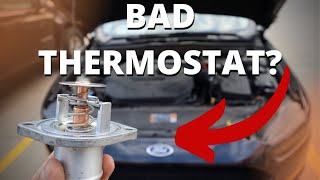
- A decrease in fuel economy. 🎬 Watch: A quick guide to common symptoms of a bad thermostat.
- Visible coolant leaks (pink/white crusty residue) or drips under the front of the engine, near the alternator, originating from the thermostat housing.
- Replacing only the Engine Coolant Temperature (ECT) sensor without first verifying its reading against another sensor. While the sensor can fail, a stuck thermostat is far more common for this code on this specific vehicle.
- Replacing only the thermostat insert instead of the entire housing assembly. The plastic housing itself is a common failure point, and a new insert in a failing housing will not be a durable repair.
- Assuming an incorrect coolant mixture is the cause. While running pure, undiluted antifreeze can affect cooling performance, it is unlikely to be the primary cause of a P0128 code compared to a mechanical thermostat failure.
Most Likely Causes
- Thermostat Stuck Open 🔴 High Probability → Shop Integrated Thermostat Housing Assembly The thermostat is integrated into a plastic housing that is known to fail from heat cycle fatigue, causing the thermostat valve to stick in the open position. This allows coolant to circulate through the radiator constantly, preventing the engine from reaching operating temperature.
How to confirm: After starting a cold engine, feel the upper radiator hose. It should remain cool for several minutes. If it starts to get warm almost immediately, the thermostat is likely stuck open, allowing coolant to flow to the radiator prematurely. You can also monitor the coolant temperature via an OBD-II scanner; if it fails to reach ~90°C (194°F) after 10-15 minutes of mixed driving, the thermostat is the prime suspect.
Typical fix: Replace the entire thermostat and housing assembly. It is not recommended to replace only the thermostat insert due to the high failure rate of the plastic housing itself. The job requires draining the coolant and removing the alternator for access. 🎬 See this step-by-step walkthrough for replacing the thermostat housing assembly.
Est. part cost: $40-$100 - Low Engine Coolant 🟡 Medium Probability The plastic thermostat housing is prone to cracking and leaking, as are other plastic components in the cooling system like the J-plug. A low coolant level can cause air pockets and prevent the coolant temperature sensor from getting an accurate reading.
How to confirm: Visually inspect the coolant expansion tank. When the engine is cold, the level should be between the 'MIN' and 'MAX' marks. If it is low, inspect the thermostat housing, water pump, and radiator hoses for signs of pink/white crusty residue, indicating a leak.
Typical fix: Top off the coolant with the correct G12/G13 specification fluid and bleed the system. If a leak is present, replace the failed component (often the thermostat housing or water pump).
Est. part cost: $20-$40 - Faulty Engine Coolant Temperature (ECT) Sensor ⚪ Low Probability → Shop Engine Coolant Temperature Sensor The ECT sensor is located on the back of the cylinder head and can fail, though it's much less common than thermostat failure for a P0128 code.
How to confirm: Use an OBD-II scanner to compare the ECT sensor reading to the Intake Air Temperature (IAT) sensor reading on a cold engine after it has sat overnight. The readings should be within a few degrees of each other. If the ECT reading is significantly different (e.g., reading -40°F or 250°F on a cold engine), the sensor is likely faulty.
Typical fix: Replace the engine coolant temperature sensor (Part number example: 059919501A) and its o-ring.
Est. part cost: $15-$50
Rare But Worth Checking
- Secondary In-line Thermostat Failure (DSG Models): → Shop Integrated Thermostat Housing Assembly On models equipped with a DSG (S-Tronic) transmission, there is a small, secondary thermostat in a coolant hose for the transmission oil cooler. This small thermostat can also fail in the open position, preventing the engine from reaching temperature, even after the main thermostat has been replaced.
Diagnosis Steps
- Check for other stored trouble codes. Address any other codes first, especially those related to the ECT sensor circuit (e.g., P0116).
- With the engine cold, check the coolant level in the expansion tank. Ensure it is between the MIN and MAX marks. If low, top it off with the correct G12/G13 coolant and inspect for visible leaks.
- If the coolant level is correct, start the engine from cold. Feel the upper radiator hose. It should remain cool to the touch for at least 5-10 minutes of idling. If it gets warm right away, the thermostat is stuck open and must be replaced.
- If the hose test is inconclusive, use an OBD-II scan tool to monitor the live coolant temperature data. Drive the vehicle and observe if the temperature reaches and holds steady at the operating temperature (approx. 87-95°C or 188-203°F). If it stays low or drops significantly at highway speeds, the thermostat is the most likely culprit.
- As a final check, use the scan tool on a cold engine (after sitting overnight) to compare the Engine Coolant Temperature and Intake Air Temperature readings. They should be within 2-3 degrees of each other. If the coolant sensor reads drastically different, it may be faulty.
Parts You'll Likely Need
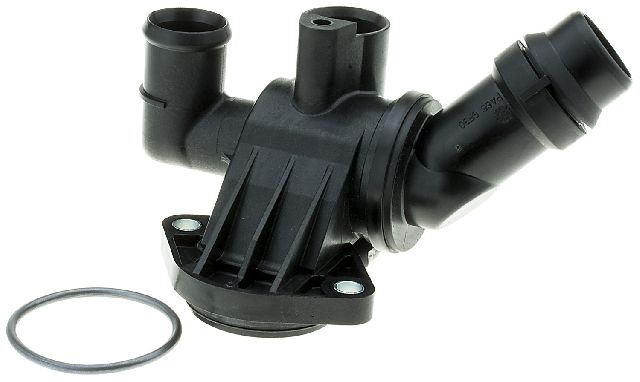
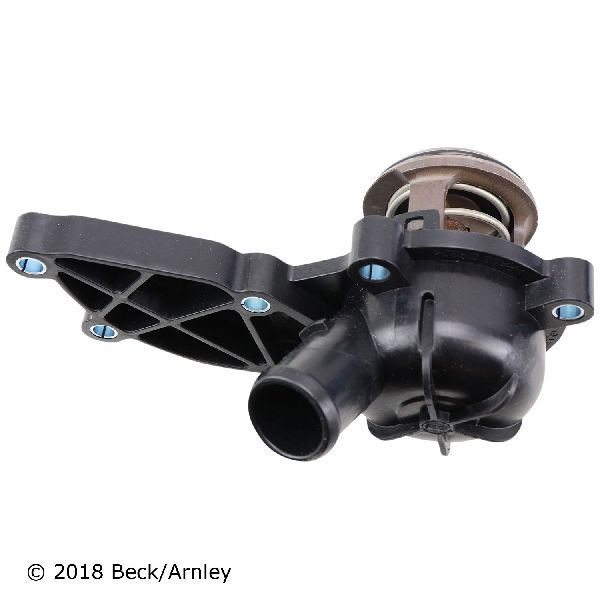
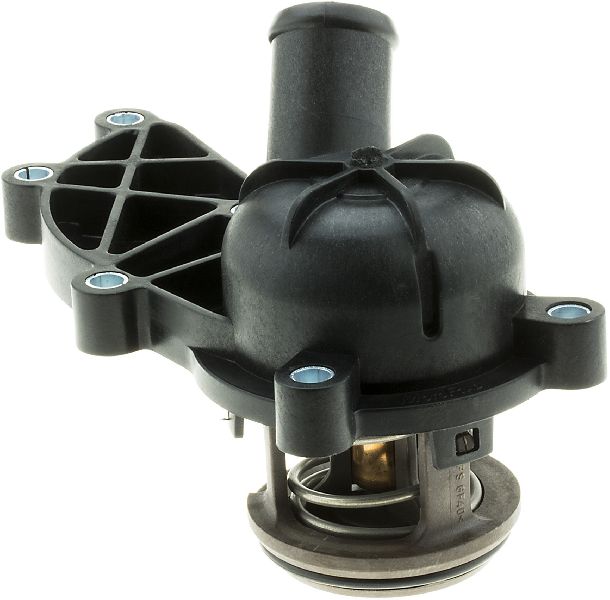
- Coolant Thermostat Housing Assembly
(OEM #06D121111G)— This is the most common failure point for code P0128 on this engine. The original plastic becomes brittle and fails, causing the thermostat to stick open. The entire assembly, which includes the thermostat, housing, and seal, should be replaced.
Trusted brands: Genuine Audi/VW, Mahle, Calorstat by Vernet, Rein
OEM price range: $150-$250
Aftermarket price range: $40-$100 - Engine Coolant / Antifreeze (G12/G13) — The cooling system will need to be drained to replace the thermostat, requiring a refill with approximately 4.5 liters of the correct specification coolant, mixed 50/50 with distilled water.
Trusted brands: Pentofrost E, Febi G13, Vaico
OEM price range: $30-$50
Aftermarket price range: $20-$40
Related Codes That Often Appear With This One
- P2181 — This code means 'Cooling System Performance' and is a more general code that is often set alongside P0128 when the ECU detects a problem with the engine's ability to reach or maintain operating temperature.
Technical Service Bulletins (TSBs) & Recalls
- Audi TSB 2014910/11: Titled 'Coolant Temperature below specification, DTC P0128 stored in ECM'. This TSB directly addresses the P0128 code and confirms the likely cause is a faulty thermostat, instructing technicians to check and replace the thermostat assembly.
Platform-Specific Known Issues
- The plastic thermostat housing is a well-documented weak point on the 2.0T TFSI engine, known for cracking and causing leaks or thermostat failure.
- Access to the thermostat is difficult, requiring the removal of the serpentine belt and alternator, which increases labor time and complexity 🎬 Watch: How to replace the thermostat and fix coolant leaks. compared to many other vehicles.
Mechanic-Grade Diagnostic Values
- Engine Coolant Temperature (ECT) Sensor G62 Resistance — expected: 2000-3000 Ω at 20°C (68°F); 200-300 Ω at 90°C (194°F).. Failure: A reading that is infinite (open circuit), near zero (short circuit), or does not change smoothly as the engine warms indicates a faulty sensor.
- Engine Coolant Temperature (ECT) Sensor G62 Signal Voltage — expected: On a 5V reference circuit, the signal wire should read approximately 2.0V - 3.5V on a cold engine (~20°C / 68°F) and drop to around 0.5V when the engine is at full operating temperature.. Failure: A voltage reading that is stuck near 5V or 0V, or a reading that does not decrease as the engine warms up, points to a sensor or wiring fault.
Scan Tool Commands That Help
- VCDS (VAG-COM) / ODIS: Engine -> Output Tests -> "Fan 1 Control Circuit" or "Coolant Fan" — This command allows you to manually activate the radiator cooling fans to verify their operation. It is useful for diagnosing an edge-case cause of P0128 where a faulty fan control module causes the fans to run constantly, over-cooling the engine.
- VCDS (VAG-COM) / ODIS: Engine -> Meas. Blocks -> Group 001 (and others) — Use this to monitor live data. Field 1 of Group 001 typically shows the coolant temperature as read by the G62 sensor. Comparing this value to the radiator outlet sensor (G83) and intake air temp can help diagnose if the sensor is reading logically.
Wiring & Ground Locations
- G62 Engine Coolant Temperature Sensor — Located on a coolant pipe at the rear of the engine, behind the right cylinder head (when facing the engine). Access is tight.. This is the primary sensor the ECU uses to determine coolant temperature. A fault in the sensor or its wiring directly impacts the P0128 calculation. The two wires are typically a signal wire and a ground wire, both running to the Engine Control Module (ECM).
- G26 Cooling Fan Control Module Ground — Located under the power steering reservoir in the engine bay.. A poor ground at the fan control module could potentially cause erratic behavior, such as the fans running when not commanded. This could lead to over-cooling and trigger a P0128 code.
- Main Engine Block Ground Strap — There is a primary ground strap connecting the engine block to the chassis, often located near the passenger side engine mount, right beside the alternator.. A corroded or loose main engine ground can cause a variety of electrical issues, including incorrect readings from engine sensors that rely on a stable ground reference provided through the ECU.
Real Owner Repair Stories
- AudiWorld Forums User (2006 Audi A4 2.0T Quattro, 209k miles) — Leaking O-ring at the thermostat housing, causing a slight coolant drip.
❌ Tried (didn't work) The user was replacing a previously installed thermostat where the O-ring was seated improperly, causing a leak.
✅ What actually fixed it Replacing the thermostat housing assembly and ensuring the large O-ring was seated squarely before tightening fixed the leak. The user also noted that not draining the radiator properly introduced an air bubble, which caused the radiator fans to run constantly until the bubble worked its way out after a day of driving. - North American Motoring Forum User (MINI, but same code logic) (MINI Cooper S (demonstrates a non-vehicle-specific issue)) — P0128 code returned immediately after installing a brand new thermostat.
❌ Tried (didn't work) Replacing the thermostat housing assembly.
✅ What actually fixed it The electrical connector for the temperature sensor on the new thermostat housing was not fully clipped in. Although it looked connected, it came off with a slight tug. The retaining clip was loose and had to be manually secured to ensure a proper connection, which resolved the code. - AudiForums User (Audi A4 B7 2.0T) — P2181 code (Cooling System Performance), which is closely related to P0128. Temperature gauge not reaching the midpoint.
❌ Tried (didn't work) The user first replaced the Coolant Temperature Sensor (CTS) based on the code.
✅ What actually fixed it When replacing the CTS did not fix the P2181 code, the user then replaced the entire thermostat housing assembly. This ultimately resolved the issue, confirming the thermostat was the root cause, not the sensor.
OEM Part Supersession History
06D121111G→06D121111G— This part number has remained stable for the B7 2.0T application. No major supersessions noted.
Heads up: Be aware of different thermostat housings for other Audi engines (e.g., 1.8T or the later EA888 2.0T in the B8 chassis) which may look similar but are not compatible. Part quality is a major factor; OEM (Mahle, Behr) or high-quality aftermarket brands are strongly recommended over cheaper alternatives which have a high rate of out-of-box failure.
Model Year Variations Within This Range
- 2005-2008: The 2.0T TFSI engine in the B7 A4 had several engine codes (e.g., BPG, BWT, BWE). However, for the purposes of diagnosing and repairing a P0128 code, the cooling system components like the thermostat housing (06D121111G), ECT sensor, and their locations are functionally identical across these engine codes within the B7 platform.
Diagnostic Flowchart
Other Known Issues on This Vehicle
Issues unrelated to this code that are worth knowing about as an owner of this generation:
- HPFP Cam Follower Wear 🔴 High — A very common wear item. Recommended inspection/replacement every 30,000-40,000 miles. Failure can destroy the high-pressure fuel pump and intake camshaft. (Ref: Audi TSB 2013147/4 describes the failure mode of excessive cam lobe and follower wear.)
- PCV Valve Failure 🟠 Medium — Common failure item. Symptoms include rough/oscillating idle, whistling/squealing noises from the engine bay, and high vacuum when removing the oil cap. (Ref: Audi issued a TSB for this part, leading to several part number revisions (e.g., 06F129101R).)
- Excessive Oil Consumption 🟠 Medium — Widespread issue on 2.0T FSI engines, often attributed to stuck/clogged piston rings. Consumption of 1 quart per 1,000-1,500 miles is not uncommon. (Ref: While more prominent in later engine versions, the B7 can also suffer. A class-action lawsuit addressed this for later models, but the B7 is known for it anecdotally.)
- Diverter Valve (DV) Failure 🟡 Low — The original diaphragm-style DV is prone to tearing, causing a loss of boost pressure (reduced power). It's a common and relatively easy upgrade/repair.
- Intake Manifold Runner Flap Failure 🟠 Medium → Shop Engine Intake Manifold — The plastic runner flaps inside the intake manifold or their actuating motor can fail, causing fault codes (like P2015) and performance issues.
Used vs. New Parts: Buying Guide for This Vehicle
When a used part is the smart pick: For this specific repair, using a used part is NEVER recommended. The primary failure mode of the thermostat housing is plastic fatigue and brittleness from heat cycles. A used part from a junkyard has already been subjected to thousands of heat cycles and is likely near the end of its service life, if not already failed.
What to inspect on the donor part:
- Do not use a salvaged thermostat housing for this repair.
OEM-only on this vehicle (don't cheap out):
- Coolant Thermostat Housing Assembly
Aftermarket brands forum-validated for this vehicle:
- Mahle (often the OEM supplier)
- Behr
- Wahler
- Rein
Brands owners have reported issues with on this vehicle:
- Unbranded, low-cost parts from online marketplaces (e.g., eBay, Amazon). Forum users report a high incidence of these parts being defective on arrival or failing within a few months.
Real Owner Stories
Aggregated from forums and TSBs cited above. Mileages and costs reflect what owners reported in those sources.
2006 Audi A4 2.0T
Symptoms: The temperature gauge on the dashboard stayed low and never reached the middle 90°C position. The heater was also blowing lukewarm air even after driving for a while.
What fixed it: Replacement of the thermostat assembly fixed the P0128 code and restored proper engine temperature and heater function.
Source hint: Audizine - B7 A4 P0128, Thermostat or sensor?
2007 Audi A4 2.0T
Symptoms: Owner questioned if an incorrect coolant mixture from a recent flush caused the P0128 code.
What fixed it: Thermostat replacement. The community noted that the thermostat is the overwhelmingly likely culprit regardless of recent maintenance due to the difficulty of the DIY job and the failure-prone plastic housing.
Source hint: AudiForums - P0128 one month after coolant flush
Related OBD-II Codes
Frequently Asked Questions
Is there an official Audi TSB for the P0128 code on my B7 A4?
Can I just replace the thermostat insert to save money on my 2.0T TFSI?
Why is the labor for a thermostat replacement so high on this specific Audi model?
What specific coolant should I use when topping off my 2005-2008 A4?
Could a faulty sensor be causing my P0128 instead of the thermostat?
I see pink crusty residue near my alternator; is this related to P0128?
Helpful Videos


We Have This Part in Stock


The information in this article is provided for general reference and educational purposes only. Vehicle specifications, procedures, and part compatibility can vary by production date, trim level, and region. Always consult your vehicle's factory service manual and verify part numbers before purchasing or performing repairs. Safety-critical components such as airbags, seat belts, and braking systems should be installed by a qualified professional.
- Audi A4:
- 🧭 Diagnostic Flowchart
- 🎬 Helpful Videos
- 🛍️ Shop This Part
- What's Unique About the 2005-2008 Audi A4
- Symptoms You May Notice
- Most Likely Causes
- Rare But Worth Checking
- Diagnosis Steps
- Parts You'll Likely Need
- Related Codes That Often Appear With This One
- Technical Service Bulletins (TSBs) & Recalls
- Platform-Specific Known Issues
- Mechanic-Grade Diagnostic Values
- Scan Tool Commands That Help
- Wiring & Ground Locations
- Real Owner Repair Stories
- OEM Part Supersession History
- Model Year Variations Within This Range
- Other Known Issues on This Vehicle
- Used vs. New Parts: Buying Guide for This Vehicle
- Real Owner Stories
- 2006 Audi A4 2.0T
- 2007 Audi A4 2.0T
- Related OBD-II Codes
- Frequently Asked Questions
- 🎟️ Get 5% Off