

P0128 on 2007-2013 Chevrolet Silverado 1500: Causes, Fixes, and Parts
Code P0128 on a 2007-2013 Silverado almost always means the thermostat is stuck open. This is a very common and straightforward DIY fix. Expect to pay $30-$70 for an OEM ACDelco thermostat and gasket. A key symptom is the cooling fans running constantly and the A/C not working.
- P0128 on your Silverado almost certainly means you need a new thermostat (ACDelco 131-160).
- A key symptom on this truck is the ECM entering a failsafe mode: cooling fans run constantly, the A/C is disabled, and the temp gauge goes dead.
- This is a DIY-friendly repair that can be done in about an hour with basic tools like a 10mm socket and pliers.
- Always check your coolant level first, as a leak can cause this code, but it's less common than thermostat failure.
- Use a quality OEM thermostat to ensure correct 190°F operation and avoid a repeat failure. Aftermarket parts are not recommended for this component.
What's Unique About the 2007-2013 Chevrolet Silverado 1500
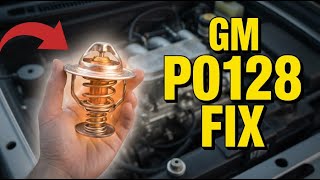
On the GMT900 generation of Silverado and its platform mates (2007-2013), this code triggers a specific and noticeable failsafe mode. The ECM, unable to trust the coolant temperature reading, defaults to a protective strategy: it commands the electric cooling fans to run constantly at high speed, disables the A/C compressor clutch, and makes the dashboard temperature gauge go dead (stuck at the 160°F minimum). Many owners first notice the loud fans running constantly or continuing to run for minutes after the engine is shut off, which is a direct and unmistakable symptom of an active P0128 code 🎬 Watch: See how loud fans and P0128 symptoms look in action. on this truck.
Symptoms You May Notice
- Check Engine Light is on
- Engine temperature gauge reads lower than normal, or is completely inoperative (stuck on 160°F)
- Electric cooling fans run constantly at high speed, even when the engine is cold or after it's turned off
- A/C system is disabled; the compressor will not engage.
- Heater blows lukewarm or cool air, especially on cold days.
- Slightly reduced fuel economy because the engine stays in 'open-loop' mode longer.
- A 'Permanent' P0128 code may be stored that cannot be cleared with a basic scanner until the ECM completes a drive cycle and verifies the fix.
- Replacing the ECT sensor when the thermostat is actually the problem. The thermostat is the most frequent failure. The symptom of the temperature gauge dropping at highway speeds is a classic sign of a stuck-open thermostat, not a bad sensor.
Most Likely Causes
- Thermostat Stuck Open 🔴 High Probability → Shop Integrated Thermostat Housing Assembly The internal spring mechanism or wax element of the original thermostat can weaken or break over time, causing it to fail in a partially or fully open position. This is the most common failure point for this code on GMT900 trucks by a wide margin.
How to confirm: Monitor the coolant temperature on a scan tool or the dashboard gauge (if it works before the code sets). If the temperature rises normally at idle but then drops significantly while driving at highway speeds, the thermostat is stuck open, allowing constant coolant flow to the radiator. Another sign is the upper radiator hose getting warm almost immediately after a cold start, when it should remain cool until the engine reaches operating temp.
Typical fix: Replace the engine coolant thermostat and its gasket/seal. It is highly recommended to use an OEM ACDelco part (190°F rating) to ensure correct temperature regulation and prevent a recurrence.
Est. part cost: $30-$70 - Faulty Engine Coolant Temperature (ECT) Sensor 🟡 Medium Probability → Shop Engine Coolant Temperature Sensor The sensor can degrade over time, sending inaccurate (but still plausible) low-temperature readings to the ECM. Instead of failing completely (which might set a P0117/P0118 code), it might read consistently colder than the actual temperature, tricking the ECM into thinking the engine isn't warming up.
How to confirm: With a cold engine, compare the ECT sensor reading on a scan tool to the Intake Air Temperature (IAT) sensor reading. They should be within a few degrees of each other. If the ECT reads significantly colder, it's likely faulty. The sensor is located on the front of the driver's side cylinder head and can be replaced with a 19mm deep socket.
Typical fix: Replace the ECT sensor. Many owners replace it as a preventative measure when replacing the thermostat due to its low cost and accessibility.
Est. part cost: $15-$40 - Low Engine Coolant Level ⚪ Low Probability While not a specific weakness, these trucks can develop coolant leaks over time. Common spots include the plastic heater hose quick-connect fittings at the firewall, the water pump weep hole, and the radiator end tanks. A low coolant level can create an air pocket around the ECT sensor, causing it to read air temperature instead of coolant temperature, leading to a P0128 code.
How to confirm: Visually inspect the coolant reservoir and radiator (when the engine is cold). If the level is low, the system has a leak. Top off the coolant and perform a cooling system pressure test to find the source of the leak.
Typical fix: Find and repair the source of the coolant leak, then properly refill and bleed the cooling system.
Est. part cost: $10-$500+, depending on the source of the leak (e.g., hose vs. radiator).
Rare But Worth Checking
- Cooling Fan Relay Stuck On: → Shop Engine Cooling Fan Blade While the ECM commands the fans on with a P0128, a failed (stuck closed) fan relay could be the root cause. This would force the fans to run constantly, over-cooling the engine and preventing it from reaching operating temperature, which then triggers the P0128 code. This is much less common than a bad thermostat.
- Incorrect Radiator Installed: A GM Technical Service Bulletin (TSB) for some related models notes that if an aftermarket radiator is installed, it may be missing a required orifice/restrictor in the small hose nipple that runs to the coolant surge tank. This allows too much coolant to bypass the thermostat, slowing engine warmup and potentially triggering a P0128 code. This is a rare cause, typically only seen after a recent radiator replacement.
Diagnosis Steps
- Verify the code P0128 is present using an OBD-II scanner. Note if it is 'Current', 'Pending', or 'Permanent'.
- With the engine cold, check the coolant level in the coolant reservoir. It should be at the 'Full Cold' line. Also, remove the radiator cap (only when cold!) to ensure the radiator is full.
- Start the engine and monitor the cooling fans. If they turn on at high speed within a minute or two of a cold start, this confirms the ECM is in failsafe mode due to the P0128 code.
- Check for A/C operation. If the A/C compressor does not engage, this is another confirmation of the failsafe mode.
- Use a scan tool to monitor live data for Engine Coolant Temperature (ECT). Drive the vehicle to get it up to operating temperature. Then, drive at a steady highway speed for several minutes. If the ECT value drops significantly (e.g., from 190°F down to 170°F or lower), the thermostat is stuck open and must be replaced.
- If the ECT reading on the scan tool is erratic or seems stuck at an impossibly low temperature from the start, the ECT sensor or its wiring is the more likely culprit.
- After replacing the faulty part(s), clear the codes with a scanner. Note that a 'Permanent' code may not clear until the vehicle is driven through a full drive cycle, allowing the ECM to verify the repair is successful.
Parts You'll Likely Need
- Engine Coolant Thermostat
(OEM #ACDelco 131-160 (GM #19339133))— This is the most common cause of P0128. The original 190°F thermostat fails in the open position, preventing the engine from maintaining temperature. This is the correct part for most V8 engines in this truck.
Trusted brands: ACDelco (GM Original Equipment)
OEM price range: $30-$70
Aftermarket price range: $20-$50 - Engine Coolant Temperature (ECT) Sensor
(OEM #ACDelco 213-4514 (GM #19236568))— The second most likely cause. It can send false low-temperature readings to the ECM. It's often replaced along with the thermostat due to its low cost and accessibility.
Trusted brands: ACDelco, Delphi
OEM price range: $20-$40
Aftermarket price range: $15-$30
Technical Service Bulletins (TSBs) & Recalls
- While several GM Technical Service Bulletins (TSBs) exist for code P0128 (e.g., PIP5685, 22-NA-054), they typically apply to newer models (2021+) or address rare conditions like software calibration errors or incorrect aftermarket radiators being installed. For the 2007-2013 GMT900 platform, the overwhelming cause is a mechanical failure of the thermostat, not a software issue requiring a dealer reflash.
- Manufacturer TSB Bulletin #PIP5685 notes that for some vehicles with a customer concern of P0128, engineering is aware of the issue and working on a repair; at that time, the recommendation was to clear the codes and not replace the thermostat.
- Bulletin #17-NA-171 also lists P0128 as a potential code that may set alongside symptoms like engine vibration, buzzing, or humming from the steering wheel.
Mechanic-Grade Diagnostic Values
- Engine Coolant Temperature (ECT) Sensor Resistance — expected: Approximately 2,830 Ω at 77°F (25°C), 332 Ω at 176°F (80°C), and 177 Ω at 212°F (100°C).. Failure: Readings that are significantly outside of the expected resistance for a known temperature indicate a faulty sensor. A common failure is reading a much higher resistance (indicating colder temperature) than actual.
- ECT Sensor Voltage (at sensor connector, key on, engine off) — expected: Approximately 3.0V - 3.5V on the signal wire with a cold engine (e.g., 70°F). The reference wire should have a steady 5V.. Failure: A voltage reading near 0V or 5V on the signal wire suggests a short or open circuit. A reading that doesn't correspond to the expected temperature/resistance curve points to a faulty sensor.
Scan Tool Commands That Help
- Tech2 / GDS2: Cooling Fan Relay Command (On/Off) — This bidirectional control is used to verify the functionality of the cooling fan control circuit (relays, wiring, and fan motors) independently of the ECM's automatic commands. If the fans can be turned on and off manually with the scan tool but do not operate correctly during normal driving (before a P0128 sets), it points towards a sensor or ECM logic issue rather than a fan circuit failure.
- Tech2 / GDS2: Reset Functions / Clear DTCs — Used after a repair to clear current and pending codes. However, for a 'Permanent DTC' like P0128, a simple clear command will not remove it. The code is only cleared after the ECM successfully runs and passes the internal diagnostic monitor for the coolant thermostat, which requires a specific drive cycle.
Wiring & Ground Locations
- G103 / G104 — On the left rear of the engine block (driver's side). These are primary engine-to-chassis grounds.. The Engine Control Module (ECM) and its sensors, including the ECT sensor, rely on a clean ground path. A corroded or loose G103/G104 can introduce voltage offsets, causing the ECM to misinterpret the ECT sensor's resistance reading, potentially leading to a false P0128 code.
- G105 — On the right front of the engine, serving as the main battery ground connection to the engine block.. While less direct than the ECM-specific grounds, a poor main engine ground can cause widespread electrical issues and erratic behavior from various sensors as the system seeks alternative ground paths.
- ECT Sensor Connector — On the front of the driver's side cylinder head, connecting to the ECT sensor.. The two pins are for the 5V reference from the ECM and the signal return. Corrosion or damage to this connector or its wiring is a potential point of failure that can mimic a bad sensor, causing an open or high-resistance condition.
Real Owner Repair Stories
- Chevrolet Forum user (2007-2013 Silverado (exact year not specified)) — P0128 code returned one week after replacing both the OEM thermostat and ECT sensor. Temperature gauge would not go above the mark between 160 and 210.
❌ Tried (didn't work) Replaced thermostat with OEM part, Replaced ECT sensor with OEM part
✅ What actually fixed it The user noted the truck had been in a front-end accident and had a new, likely aftermarket, radiator installed. The discussion pointed towards a rare TSB issue where some aftermarket radiators lack a necessary restrictor in the surge tank hose nipple, allowing too much coolant to bypass the thermostat and causing the engine to warm up too slowly. The implication is that correcting the radiator or adding the restrictor was the final fix. - NHTSA ODI #10320960 — An owner reported that their vehicle throws code P0128, causing the fans to run on high, a loss of power, and the check engine light to illuminate at random.
OEM Part Supersession History
GM 89018168→ACDelco 131-160 (GM #19339133)— Standard part number evolution and potential minor design updates.
Heads up: The ACDelco 131-160 is specified with a 190°F (87.5°C) opening temperature. Some sources may list the start-to-open temp as 187°F. Using a thermostat with a lower rating (e.g., 180°F) can cause the P0128 code to set, as the ECM's calibration expects the temperature to be maintained near 190°F.
Diagnostic Flowchart
Real Owner Stories
Aggregated from forums and TSBs cited above. Mileages and costs reflect what owners reported in those sources.
Chevrolet Silverado SS (Year/Engine not specified)
Symptoms: Check engine light (P0128) comes on with aggressive driving on the interstate. If driven normally, not giving it much gas, it's fine.
What fixed it: Replacing the aftermarket 'hypertech' thermostat that the previous owner had installed.
Source hint: SilveradoSS.com
2014 Chevrolet Silverado
Symptoms: Cooling fans running after shutoff, no temperature gauge reading, and the P0128 code present.
What fixed it: Replacing the thermostat and ECT sensor, and then properly clearing the 'Permanent' code.
Source hint: Chevrolet Forum - 'Fan Runs after shutoff; P0128'
Chevrolet Silverado (Year/Engine not specified)
Symptoms: Intermittent problem where the temperature gauge drops to baseline and the cooling fans run after engine shutoff.
What fixed it: Replacing the thermostat with an OEM part and replacing the temperature sensor.
Source hint: Reddit r/Silverado - 'P0128 and replacing thermostat'
Related OBD-II Codes
Frequently Asked Questions
Why are my cooling fans running constantly on high speed and my A/C is disabled on my 2007-2013 Silverado?
Should I use an aftermarket thermostat to fix P0128 on my GMT900 Silverado?
Do TSBs PIP5685 or 22-NA-054 apply to my 2007-2013 Silverado 1500 for code P0128?
I replaced the thermostat, but my scanner says P0128 is a 'Permanent' code. How do I clear it?
Where is the Engine Coolant Temperature (ECT) sensor located on this truck?
Could a coolant leak cause the P0128 code on my 5.3L Silverado?
Helpful Videos
We Have This Part in Stock


The information in this article is provided for general reference and educational purposes only. Vehicle specifications, procedures, and part compatibility can vary by production date, trim level, and region. Always consult your vehicle's factory service manual and verify part numbers before purchasing or performing repairs. Safety-critical components such as airbags, seat belts, and braking systems should be installed by a qualified professional.
- Chevrolet Silverado 1500:
- 🧭 Diagnostic Flowchart
- 🎬 Helpful Videos
- 🛍️ Shop This Part
- What's Unique About the 2007-2013 Chevrolet Silverado 1500
- Symptoms You May Notice
- Most Likely Causes
- Rare But Worth Checking
- Diagnosis Steps
- Parts You'll Likely Need
- Technical Service Bulletins (TSBs) & Recalls
- Mechanic-Grade Diagnostic Values
- Scan Tool Commands That Help
- Wiring & Ground Locations
- Real Owner Repair Stories
- OEM Part Supersession History
- Real Owner Stories
- Chevrolet Silverado SS (Year/Engine not specified)
- 2014 Chevrolet Silverado
- Chevrolet Silverado (Year/Engine not specified)
- Related OBD-II Codes
- Frequently Asked Questions
- 🎟️ Get 5% Off