

P0128 on 2011-2014 Chrysler 200 2.4L: Causes and Fixes for Coolant Temperature Fault
On a 2011-2014 Chrysler 200 with the 2.4L engine, code P0128 is almost always caused by a faulty thermostat that is stuck open. The recommended fix is to replace the entire thermostat housing assembly, which includes two internal thermostats and often a new sensor. An aftermarket assembly costs around $60-$110. This is a moderately difficult DIY job due to tight access behind the engine.
- P0128 on this car almost always means you need a new thermostat.
- The correct fix is to replace the entire thermostat housing assembly, not just an internal part.
- This is a common failure on the 2.4L World Engine, affecting many Chrysler, Dodge, and Jeep models.
- The job is DIY-possible but requires patience due to tight access to the bolts.
- Always use the correct OAT coolant and properly bleed the system after the repair.
What's Unique About the 2011-2014 Chrysler 200
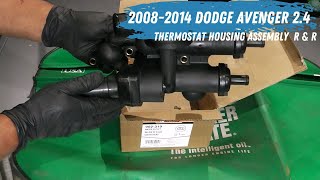
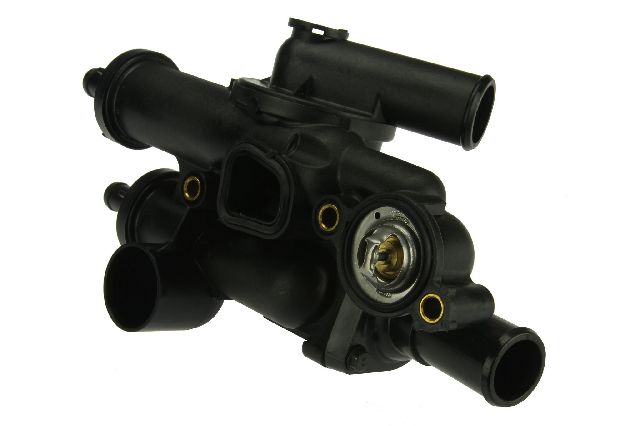
The 2.4L World engine in this Chrysler 200 uses a unique cooling system design that incorporates two separate thermostats within a single plastic housing assembly. When code P0128 appears, this entire assembly is the common failure point, with one of the thermostats getting stuck open. It is strongly recommended to replace the entire housing as a unit 🎬 Watch: Step-by-step guide to replacing the full thermostat housing assembly. rather than attempting to service the individual thermostats, as the plastic can become brittle and the kit includes all necessary new seals. Some aftermarket aluminum housings are available which owners report offer better longevity.
Symptoms You May Notice
- Check Engine Light is on
- Engine takes a very long time to warm up
- Temperature gauge on the dashboard reads lower than normal or drops at highway speeds
- Poor or no heat coming from the cabin vents, especially in cold weather.
- Reduced fuel economy
- Failing a state emissions test
- Replacing only the Engine Coolant Temperature (ECT) sensor. While the sensor can fail, it is far more common for the thermostat to be the root cause of P0128. Many owners replace the sensor first, only to find the code returns, requiring them to then replace the thermostat assembly.
- A shop incorrectly diagnosing a bad head gasket or faulty ECM when P0128 is the primary code. While those are serious issues, they are not typical causes for this specific code, which almost always points to a simple thermostat problem.
Most Likely Causes
- Faulty Thermostat Assembly (Stuck Open) 🔴 High Probability → Shop Integrated Thermostat Housing Assembly The plastic thermostat housing and the internal thermostats are a very common failure point on this engine, frequently getting stuck in a partially or fully open position. This allows coolant to circulate through the radiator constantly, preventing the engine from warming up properly.
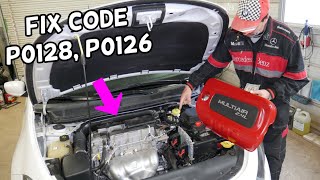
How to confirm: Use a scan tool to monitor the Engine Coolant Temperature (ECT) data. 🎬 See how to diagnose P0128 and P0126 codes using a scanner. Start the car cold and watch the temperature rise. If it rises extremely slowly, fails to reach normal operating temperature (approx. 195-210°F), or if the temperature drops significantly while driving at highway speeds, the thermostat is almost certainly stuck open. You can also feel the upper radiator hose; it should remain cool for several minutes after a cold start and then get hot quickly. If it warms up gradually from the start, the thermostat is open.
Typical fix: Replace the entire thermostat and housing assembly. It is recommended to replace the complete unit which includes both internal thermostats, new gaskets, and often a new ECT sensor. After replacement, the cooling system must be properly bled of air.
Est. part cost: $60-$150 - Low Engine Coolant Level ⚪ Low Probability
How to confirm: Visually inspect the coolant reservoir and radiator (when the engine is cold) to ensure the coolant is at the proper level. If low, check for visible leaks from hoses, the radiator, water pump, or the thermostat housing itself.
Typical fix: Top off the coolant with the correct type (Mopar OAT 10 Year/150,000 Mile coolant is specified, part #68163848AB) and bleed any air from the system. If a leak is present, the leaking component must be repaired or replaced.
Est. part cost: $20-$40 - Faulty Engine Coolant Temperature (ECT) Sensor ⚪ Low Probability → Shop Engine Coolant Temperature Sensor
How to confirm: Using a scan tool, check if the ECT sensor reading is rational. When the engine is cold, the ECT reading should be very close to the Intake Air Temperature (IAT) sensor reading. If the reading is stuck at an extreme value (e.g., -40°F) or doesn't change as the engine warms up, the sensor or its wiring is likely faulty.
Typical fix: Replace the ECT sensor. On the 2.4L engine, the sensor is located on the thermostat housing. Since it is often included with new thermostat housing assemblies, it is frequently replaced during the thermostat job anyway.
Est. part cost: $25-$50
Rare But Worth Checking
- Powertrain Control Module (PCM) Software Glitch: → Shop Engine Control Module (ECM) While no specific TSB for P0128 exists for this exact model, other Chrysler vehicles with the 2.4L engine have had TSBs issued (e.g., TSB #18-016-13 for PT Cruiser, TSB #18-022-17 REV. A for later models) where overly sensitive software could falsely trigger this code in cold weather. If the thermostat and sensor are confirmed to be good, checking with a dealer for any available PCM updates is a worthwhile final step.
- Cooling Fan Stuck On: → Shop Engine Cooling Fan Blade If the electric radiator fan runs constantly, even when the engine is cold, it can over-cool the engine and prevent it from reaching operating temperature, triggering a P0128. This is usually caused by a faulty fan relay, a wiring issue, or a command from the PCM due to another failed sensor.
Diagnosis Steps
- Check for other DTCs. Address any other codes, especially those related to the ECT sensor circuit (P0117, P0118) or cooling fan circuits, before proceeding.
- Inspect Coolant Level and Condition. With the engine cold, check the coolant level in the reservoir. Ensure it is at the 'Full' mark. Low coolant can cause this code.
- Monitor Coolant Temperature with a Scan Tool. Connect a scan tool and view the live data for the Engine Coolant Temperature (ECT) sensor.
- Perform a Warm-Up Test. Start the engine from cold and let it idle. The temperature should climb steadily to around 195-210°F and then stabilize as the thermostat opens and closes.
- Analyze Test Results. If the temperature rises very slowly, never reaches the target range, or drops significantly when driving at speed, the thermostat is stuck open and must be replaced.
- Test the ECT Sensor (if needed). If the thermostat appears to be working but the temperature readings are erratic or illogical, the ECT sensor itself may be the problem. Compare its cold reading to the Intake Air Temp sensor; they should be nearly identical.
- Check for PCM Updates. If hardware tests pass, contact a dealer with your VIN to see if any software updates related to TSBs like 18-022-17 or similar are applicable to your vehicle.
Parts You'll Likely Need
- Engine Coolant Thermostat Housing Assembly
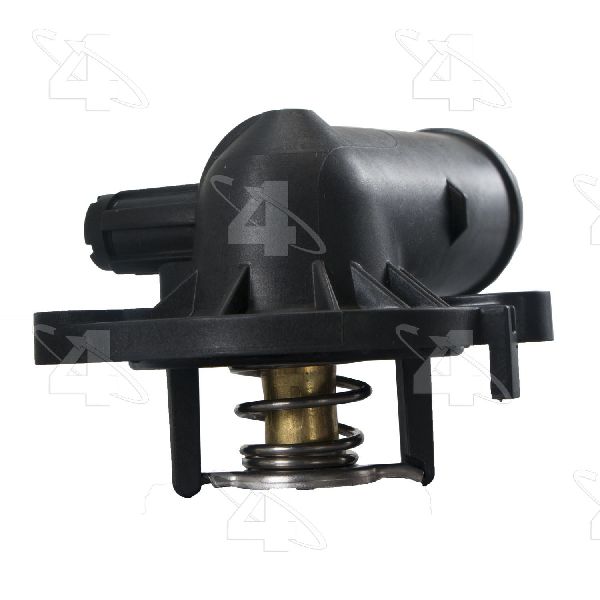
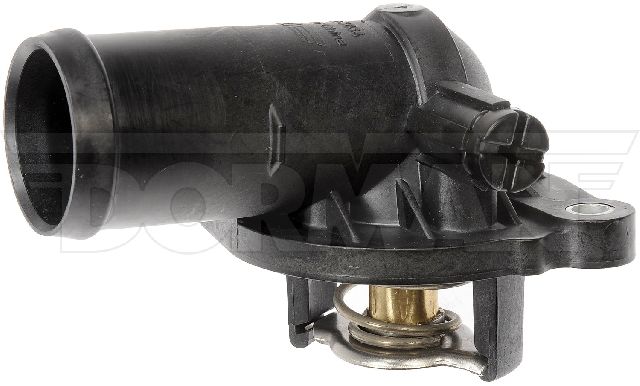
(OEM #4884571AB)— This is the most common cause of code P0128 on the 2.4L engine. The assembly includes the plastic housing, both internal thermostats (a primary rated for ~180°F and a secondary for ~203°F), and necessary seals, providing a complete fix for the common failure of a stuck-open thermostat. The original part number 4884571AB has been superseded by Mopar part number 68676479AA.
Trusted brands: Mopar, Dorman, Gates, Crown Automotive, Stant
OEM price range: $100-$160
Aftermarket price range: $60-$110
Related Codes That Often Appear With This One
- P2181 — P2181 is 'Cooling System Performance,' which is a closely related code that is often set alongside P0128 when the engine is not reaching operating temperature as expected.
- P0125 — P0125 is 'Insufficient Coolant Temperature for Closed Loop Fuel Control.' It indicates the engine hasn't warmed up enough for the PCM to enter closed-loop fuel management, a direct consequence of the condition causing P0128.
Technical Service Bulletins (TSBs) & Recalls
- While not for the 200 directly, TSB #18-022-17 REV. A for other 2.4L models lists P0128 as a code that could be resolved with a PCM software update, indicating a potential for software sensitivity.
- TSB #18-016-13 for the 2.4L PT Cruiser notes that P0128 can be falsely triggered in cold weather and fixed with a PCM update, a pattern that could potentially apply here.
Platform-Specific Known Issues
- The 2.4L engine uses a dual-thermostat system integrated into a single housing; it is highly recommended to replace the entire assembly rather than attempting to service the individual thermostats.
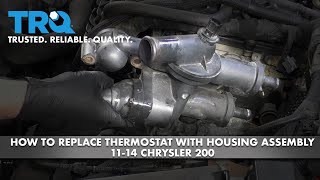
- Access to the thermostat housing is tight, located on the back of the engine. The repair often requires removing the airbox assembly for better access. 🎬 Watch this walkthrough for tips on accessing those hard-to-reach bolts. One mounting bolt, in particular, is difficult to reach.
Mechanic-Grade Diagnostic Values
- Engine Coolant Temperature (ECT) Sensor Resistance — expected: ~2000-3000 Ω at 20°C (68°F), decreasing to ~200-300 Ω at 90°C (194°F).. Failure: An infinite reading (open circuit), near-zero reading (short circuit), or values that do not decrease smoothly as temperature rises.
- Engine Coolant Temperature (ECT) Sensor Signal Voltage (Key On, Engine Off) — expected: Approximately 2.0V - 3.5V on a cold-soaked engine.. Failure: A reading stuck near 5.0V indicates an open circuit; a reading near 0V indicates a short to ground.
- Engine Coolant Temperature (ECT) Sensor Signal Voltage (Engine at Operating Temperature) — expected: Drops smoothly to around 0.5V - 1.3V.. Failure: Voltage does not drop into the expected range, or drops erratically.
Scan Tool Commands That Help
- wiTECH (or equivalent high-level scanner): Live Data Graphing (ECT vs. IAT) — On a cold-soaked engine, graphing the Engine Coolant Temp and Intake Air Temp sensors should show them reading within a few degrees of each other. This is the primary data the PCM uses to run the rationality check and is the first step in ruling out a bad sensor vs. a bad thermostat.
- wiTECH (or equivalent high-level scanner): Cooling Fan Actuation Test — To rule out the rare possibility that the code is being caused by a cooling fan that is stuck on. This command allows the technician to manually turn the fan on and off to verify the control circuit and relay are working correctly.
Wiring & Ground Locations
- ECT Sensor Connector — On the thermostat housing, located on the passenger side of the engine, towards the back.. This 2-pin connector provides the 5V reference and signal return for the ECT sensor. Corrosion, damage, or not being fully seated after a thermostat replacement can cause an incorrect signal and trigger P0128 even with a good sensor and thermostat.
- G21a — An engine compartment ground point located on the left rear of the engine compartment.. A poor engine ground can cause floating or incorrect readings from various sensors, including the ECT sensor. While not a primary cause, checking the integrity of major engine grounds is a valid step if direct sensor testing is inconclusive.
Real Owner Repair Stories
- North American Motoring forum user (2009 Mini Clubman S (different vehicle, but identical P0128 symptom/cause pattern)) — Check Engine Light with code P0128 returned three months after replacing the thermostat housing.
❌ Tried (didn't work) Replacing the thermostat housing assembly.
✅ What actually fixed it The ECT sensor connector was not fully clipped in after the thermostat replacement. Although it looked connected, it came off with a slight tug. Pushing it on until the clip securely locked solved the problem. - Reddit /r/MechanicAdvice user (Vehicle with P0128) — Check Engine Light with P0128 returned two months after replacing the thermostat.
❌ Tried (didn't work) Replacing the thermostat with an aftermarket part from an auto parts store., Performing a coolant flush.
✅ What actually fixed it The thread concluded with the strong suggestion from multiple mechanics that either the new aftermarket thermostat was faulty out of the box (a common issue) or the cooling system was not properly bled, trapping an air pocket. The final fix was not posted, but the clear advice was to re-do the job with an OEM thermostat and ensure a proper air bleeding procedure.
When the Usual Fixes Don't Work
- In several documented cases, replacing the thermostat assembly did not immediately fix the P0128 code. The most common follow-up causes were not a different underlying vehicle problem, but rather issues with the repair itself. These include using a low-quality aftermarket thermostat that was faulty out of the box, failing to properly bleed the cooling system of all air after the replacement, or inadvertently damaging or failing to fully seat the Engine Coolant Temperature (ECT) sensor's electrical connector during the job. Before suspecting a more complex issue like the PCM, it is critical to verify the quality of the replacement part and the correctness of the repair procedure.
OEM Part Supersession History
4884571AB→68676479AA— Standard part revision by the manufacturer. The new part is a direct replacement.
Heads up: None. 68676479AA is the correct and current Mopar part number to order for this application.
Diagnostic Flowchart
Other Known Issues on This Vehicle
Issues unrelated to this code that are worth knowing about as an owner of this generation:
- Engine Stalling While Driving 🔴 High — Reported to occur, sometimes at low speeds, after the vehicle passes 50,000 miles. Can be caused by a faulty Powertrain Control Module (PCM). (Ref: NHTSA opened a preliminary investigation in 2012 for 2011-2013 models due to stalling.)
- Faulty Totally Integrated Power Module (TIPM) 🔴 High — Can cause a wide range of electrical problems, including fuel pump failure or random airbag deployment. This was a widespread issue across many Chrysler products of this era. (Ref: No specific recall for the 200, but other FCA models were recalled for TIPM-related fuel pump issues.)
- Transmission Shifting Issues (62TE 6-Speed) 🟠 Medium — Owners report rough shifting, jolting, or hesitation, which can sometimes be attributed to failing transmission solenoid packs.
- Excessive Oil Consumption (2.4L Tigershark) 🟠 Medium — More prevalent in the next-generation (2015-2016) 2.4L 'Tigershark' engine, but the underlying World Engine architecture can also consume oil. The issue is often linked to piston ring design.
Used vs. New Parts: Buying Guide for This Vehicle
When a used part is the smart pick: For this specific repair, using a used thermostat housing assembly from a salvage yard is strongly discouraged. The failure mode is typically age and heat-cycle related (brittle plastic, worn internal thermostats), so a used part has a very high likelihood of failing soon after installation.
What to inspect on the donor part:
- Not applicable as used parts are not recommended for this repair.
OEM-only on this vehicle (don't cheap out):
- Engine Coolant Thermostat Housing Assembly
Aftermarket brands forum-validated for this vehicle:
- Dorman (e.g., part #902-3022)
- Gates
- Stant
Brands owners have reported issues with on this vehicle:
- Unbranded, 'white-box' parts from online marketplaces should be avoided. Forum discussions frequently feature owners who tried to save money with a cheap part, only to have the P0128 code return within weeks or months, forcing them to do the job a second time.
Real Owner Stories
Aggregated from forums and TSBs cited above. Mileages and costs reflect what owners reported in those sources.
2012 Dodge Journey 2.4L
Symptoms: The vehicle triggered a P0128 code. A shop incorrectly diagnosed the issue as a bad head gasket and ECM.
What fixed it: The community consensus identified it as a thermostat issue, which is a common DIY fix for this engine platform.
Source hint: Reddit /r/MechanicAdvice - Corroborated that P0128 is a very common issue on the 2.4L engine
2011-2014 Chrysler 200 2.4L
Symptoms: Check engine light on, no heat coming from the cabin vents, and a low reading on the dashboard temperature gauge.
What fixed it: Replacing the entire thermostat housing assembly.
Source hint: 200forums.com - Numerous threads confirm P0128 is almost always the thermostat housing.
2011 Chrysler 200 2.4L — ~50000 miles
Symptoms: Engine stalling while driving, sometimes at low speeds.
What fixed it: Potentially a faulty Powertrain Control Module (PCM), as noted in reports of stalling after 50,000 miles.
Source hint: vehicle_specific_issues - Engine Stalling While Driving
Related OBD-II Codes
Frequently Asked Questions
Does TSB #18-022-17 apply to my 2011-2014 Chrysler 200 2.4L?
Can I just replace the individual thermostats in my 2.4L Chrysler 200?
What specific coolant should I use when topping off my Chrysler 200 after a thermostat repair?
Why does my temperature gauge drop when I'm driving on the highway?
Is the P0128 code related to the engine stalling issues reported on 2011-2013 models?
Where is the ECT sensor located on the 2.4L World Engine?
Helpful Videos
We Have This Part in Stock


The information in this article is provided for general reference and educational purposes only. Vehicle specifications, procedures, and part compatibility can vary by production date, trim level, and region. Always consult your vehicle's factory service manual and verify part numbers before purchasing or performing repairs. Safety-critical components such as airbags, seat belts, and braking systems should be installed by a qualified professional.
- Chrysler 200:
- 🧭 Diagnostic Flowchart
- 🎬 Helpful Videos
- 🛍️ Shop This Part
- What's Unique About the 2011-2014 Chrysler 200
- Symptoms You May Notice
- Most Likely Causes
- Rare But Worth Checking
- Diagnosis Steps
- Parts You'll Likely Need
- Related Codes That Often Appear With This One
- Technical Service Bulletins (TSBs) & Recalls
- Platform-Specific Known Issues
- Mechanic-Grade Diagnostic Values
- Scan Tool Commands That Help
- Wiring & Ground Locations
- Real Owner Repair Stories
- When the Usual Fixes Don't Work
- OEM Part Supersession History
- Other Known Issues on This Vehicle
- Used vs. New Parts: Buying Guide for This Vehicle
- Real Owner Stories
- 2012 Dodge Journey 2.4L
- 2011-2014 Chrysler 200 2.4L
- 2011 Chrysler 200 2.4L — ~50000 miles
- Related OBD-II Codes
- Frequently Asked Questions
- 🎟️ Get 5% Off