

P0128 on 2019-2024 Ford Ranger 2.3L EcoBoost: Causes and Fixes for Low Coolant Temperature
On a 2019-2024 Ford Ranger with the 2.3L EcoBoost, code P0128 is almost always caused by a faulty thermostat that is stuck open. Replacing the thermostat assembly is the most common fix. Expect to pay around $40-$60 for an OEM part, with a DIY difficulty of 2/5.
- P0128 on your Ranger means the engine is running too cool, not too hot.
- The most likely cause is a thermostat that is stuck open. Don't replace the temperature sensor first unless you have other codes.
- The fix is to replace the thermostat and housing assembly. The current OEM part is LB5Z-8575-C, which supersedes FR3Z-8575-A.
- This is a DIY-friendly job for those with basic tools, taking about 1-2 hours. You'll need an 8mm socket with extensions.
- While you're at it, check your coolant level and inspect for leaks, as low coolant can also cause this code. Specifically check for the block heater recall (24S03/25SA4).
What's Unique About the 2019-2024 Ford Ranger
The 2.3L EcoBoost engine in this Ford Ranger generation uses a Cylinder Head Temperature (CHT) sensor that measures the engine's metal temperature directly, rather than a traditional sensor that only measures coolant temperature. While this provides a more robust way to detect overheating, the P0128 code is still most commonly triggered by a simple mechanical failure: the thermostat sticking open. This is heavily corroborated in owner forums for the Ranger and its platform mates like the Ford Bronco and Mustang, where replacing the thermostat is the go-to fix for this code.
Symptoms You May Notice
- Check Engine Light is on
- Temperature gauge on the dashboard reads lower than normal or takes a very long time to reach the middle
- Heater blows lukewarm or cool air, especially when driving at highway speeds
- A noticeable decrease in fuel economy (MPG)
- Engine temperature gauge drops when cruising at highway speeds and may rise again in stop-and-go traffic.
- Replacing the Cylinder Head Temperature (CHT) sensor first. While it's part of the system, the thermostat is a much more frequent point of failure for this specific code. Unless other codes pointing to the sensor are present, assume the thermostat is the culprit.
Most Likely Causes
- Thermostat Stuck Open 🔴 High Probability → Shop Integrated Thermostat Housing Assembly This is the most common failure mode for thermostats on most modern vehicles, including the Ranger and its platform mates with the 2.3L EcoBoost. Forum members have confirmed this is the primary fix for P0128. One user on the Mustang6G forum experienced the failure at just 11,000 miles, highlighting that it can happen early in the vehicle's life.
How to confirm: Monitor the live coolant temperature data with an OBD-II scanner. If the engine temperature struggles to get above 80-85°C (176-185°F) during normal driving, or if it drops significantly at highway speeds, the thermostat is almost certainly stuck open. You can also feel the upper radiator hose after a few minutes of cold starting; if it gets warm quickly, coolant is circulating prematurely, confirming an open thermostat.
Typical fix: Replace the entire thermostat and housing assembly. It is sold as a single, integrated unit. The job is accessible from the top of the engine and requires basic tools.
Est. part cost: $40-$70 - Low Engine Coolant 🟡 Medium Probability Any leak in the cooling system can lead to low coolant levels. A notable issue is recall 24S03 / 25SA4 for the engine block heater on some Rangers, which can crack and cause a coolant leak. A manufacturer service bulletin for other Ford models, TSB 20-2234, also notes that vehicles may exhibit an illuminated MIL with P0128 alongside low coolant levels. A significant coolant loss can introduce air into the system, potentially causing the P0128 code before more serious overheating occurs.
How to confirm: Visually inspect the coolant level in the degas bottle (coolant reservoir) when the engine is cold. The level should be between the 'MIN' and 'MAX' lines. Also, inspect for any visible signs of coolant leaks (yellow residue) around hoses, the radiator, water pump, and especially near the engine block heater if equipped.
Typical fix: Find and repair the source of the leak. For the block heater recall, a dealer will replace the part free of charge. Then, top off and bleed the cooling system with the correct Motorcraft VC-13-G Yellow coolant.
Est. part cost: $20-$40 for coolant - Faulty Cylinder Head Temperature (CHT) Sensor ⚪ Low Probability While sensor failure is possible, it is not the common cause for a P0128 code specifically. A faulty CHT sensor is more likely to cause other codes related to circuit faults (P0116, P017C) or overheating (like P1299). However, corrosion on the sensor or its connector can cause incorrect readings. Manufacturer bulletin TSB 21-2168 indicates that an incorrectly illuminated MIL with P0128 may be caused by an intermittent drop in sensor voltage.
How to confirm: With the engine cold after sitting overnight, use a scan tool to compare the CHT reading with the ambient air temperature and intake air temperature readings. They should all be within a few degrees of each other. If the CHT reading is skewed significantly (e.g., reading -40°F), the sensor or its wiring is faulty.
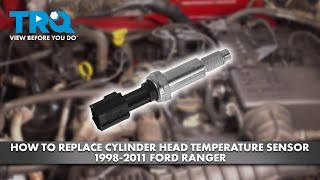
Typical fix: Replace the CHT sensor. 🎬 Watch: How to replace the CHT sensor on older models It is located on the back of the cylinder head on the driver's side and may require accessing it from the top.
Est. part cost: $30-$50
Rare But Worth Checking
- Cooling Fan Stuck On: → Shop Engine Cooling Fan Blade
- PCM Software Glitch: Manufacturer service bulletins TSB 25-2348 and TSB 25-2486 for other Ford models suggest that an incorrectly illuminated MIL with DTC P0128 may be due to software in the Powertrain Control Module (PCM).
Diagnosis Steps
- Check for other Diagnostic Trouble Codes (DTCs). If codes for the CHT sensor (like P0116) or cooling fan are present, investigate those first.
- Visually inspect the engine coolant level in the reservoir when the engine is cold. If it is low, top it off with Ford-specified Motorcraft VC-13-G coolant and inspect for leaks. Pay close attention to the block heater area if equipped (Recall 24S03/25SA4).
- Use an OBD-II scanner to monitor the Cylinder Head Temperature (PID: CHT) while driving. Start the engine from cold. The temperature should rise steadily and stabilize between 90-100°C (195-212°F).
- If the temperature fails to reach this range, or if it reaches it but then drops significantly at highway speeds, the thermostat is almost certainly stuck open and needs replacement.
- If the temperature reading is erratic, reads an impossible value from a cold start (e.g., -40°F or 250°F), or doesn't change at all, test the CHT sensor and its wiring harness for damage or corrosion.
- If coolant is full and the sensor reads correctly, proceed with replacing the thermostat assembly. This is the fix in over 90% of cases for this code.
Parts You'll Likely Need
- Engine Coolant Thermostat Assembly
(OEM #LB5Z-8575-C (Supersedes FR3Z-8575-A))— This is the most common failure part that causes code P0128. It fails by sticking in the open position. The original part FR3Z-8575-A was superseded by LB5Z-8575-C, which is the current recommended OEM replacement.
Trusted brands: Motorcraft (RT1233 or RT-1262), Gates, Motorad
OEM price range: $40-$70
Aftermarket price range: $30-$60 - Motorcraft Yellow Concentrated Antifreeze/Coolant
(OEM #VC-13-G)— The cooling system must be partially drained to replace the thermostat, so you will need to replenish it with the correct type of coolant. Using the wrong coolant can cause damage.
Trusted brands: Motorcraft, PEAK OET Yellow, Valvoline ZEREX Yellow
OEM price range: $20-$30 per gallon
Aftermarket price range: $15-$25 per gallon
Technical Service Bulletins (TSBs) & Recalls
- TSB 23-2011: Water Intrusion into Spark Plug Wells (Related to general engine issues, not P0128 directly).
- TSB 23-2251: Shudder/Vibration When Accelerating From A Stop (Unrelated platform issue).
- TSB 24-2101: 10R80 Transmission Harsh/Delayed Shift (Unrelated platform issue).
- TSB 21-2168: Describes an incorrectly illuminated MIL with P0128 caused by an intermittent drop in coolant temperature voltage.
- TSB 20-2234: Notes that vehicles may exhibit P0128 stored in the PCM along with low coolant levels.
- TSB 25-2348 / TSB 25-2486: Manufacturer bulletins indicating that P0128 may be incorrectly triggered due to PCM software.
Platform-Specific Known Issues
- Recall 24S03 / 25SA4: The engine block heater on some 2019-2024 Rangers can crack and develop a coolant leak. This can cause a short circuit and fire risk when plugged in, but the resulting coolant loss can also trigger a P0128 code if the level becomes too low. Owners are advised not to use the block heater until the recall repair is performed.
Mechanic-Grade Diagnostic Values
- Cylinder Head Temperature (CHT) Sensor Resistance — expected: Approximately 2000-3000 Ω at 20°C (68°F) and 200-300 Ω at 90°C (194°F).. Failure: An open circuit (infinite resistance), a short circuit (near zero resistance), or a reading significantly outside the expected range for a given temperature.
- Cylinder Head Temperature (CHT) Sensor Signal Voltage (Key On, Engine Off) — expected: Approximately 2.0V - 3.0V on a cold engine, decreasing to around 0.5V as the engine warms up.. Failure: Voltage is stuck near 5.0V (open circuit/bad ground) or near 0V (short to ground).
- CHT Sensor Reference Voltage (at harness connector, sensor unplugged) — expected: Approximately 5 volts on the signal wire side with the key on.. Failure: No voltage indicates an open wire or a PCM issue.
Scan Tool Commands That Help
- ForScan / Ford IDS: Live Data PID Monitoring (CHT, IAT) — This is the primary diagnostic function for P0128. It should be used from a cold start to verify if the CHT fails to reach the target temperature (195-212°F) or drops at highway speed, which confirms a stuck-open thermostat. It's also used to compare CHT and IAT on a cold-soaked engine to check for a skewed sensor.
- ForScan / Ford IDS: Clear PCM DTCs — After replacing the thermostat, the P0128 code may not clear on its own for many drive cycles. Use a scan tool to manually clear the code immediately after the repair to turn off the Check Engine Light and confirm the fix.
Wiring & Ground Locations
- Cylinder Head Temperature (CHT) Sensor — Located on the back of the cylinder head on the driver's side. It may be partially obscured by a heat shield or intake components.. This is the primary sensor the PCM uses to determine if the engine is warming up correctly. A bad sensor, corroded connector, or damaged wiring can send a false low-temperature signal, triggering P0128 even with a good thermostat.
- G105 — A common engine block ground point for various sensors.. A poor connection at this ground can affect the CHT sensor's reading by creating a voltage offset, leading the PCM to misinterpret the temperature and potentially set a P0128 code.
Real Owner Repair Stories
- Ranger-Forums user 'Scotthartmann0321' (2009 Ford Ranger 4.0L SOHC (Note: Older model, but the diagnostic principle is identical)) — Check Engine Light on, temperature gauge only rising to 1/4 of the way at most.
❌ Tried (didn't work) Waiting for the code to clear on its own after replacing the thermostat.
✅ What actually fixed it The user correctly diagnosed and replaced the stuck-open thermostat, which fixed the low temperature reading. However, the Check Engine Light remained on for a week. The final step was to manually clear the stored P0128 code with an OBD-II scanner, which resolved the issue completely. - NHTSA ODI #11640247 — An owner reported receiving a repair estimate that included a coolant flush and code P0128 after waiting for recall plans and assistance regarding other engine components.
OEM Part Supersession History
FR3Z-8575-A→LB5Z-8575-C— Standard part revision by the manufacturer. While the specific reason isn't publicly documented, supersessions typically address material improvements, minor design tweaks for durability, or supplier changes.
Heads up: The parts are interchangeable. FR3Z-8575-A is still sold and referenced by its Motorcraft part number RT1233, but LB5Z-8575-C is the latest revision and the preferred replacement part.
Model Year Variations Within This Range
- 2024+: For the 2024 model year, Ford introduced an optional twin-turbo 2.7L V6 engine. The standard engine remains the 2.3L EcoBoost I4. This guidance for P0128 applies specifically to the 2.3L engine.
Diagnostic Flowchart
Other Known Issues on This Vehicle
Issues unrelated to this code that are worth knowing about as an owner of this generation:
- 10R80 Transmission Harsh/Delayed Shifting 🟠 Medium — Common complaint across multiple model years. Can occur at various mileages. (Ref: TSB 24-2101 (superseded), TSB 25-2024. Addresses issues like harsh engagements, delayed shifts, and various transmission-related DTCs due to valve body or clutch component issues.)
- Driveshaft Shudder/Vibration on Acceleration 🟡 Low — Affects some vehicles, typically noticed when accelerating from a stop. (Ref: TSB 23-2251 (supersedes TSB 22-2051). The fix involves adjusting the rear axle pinion angle by installing shims.)
- APIM Failures & SYNC 3 Glitches 🟡 Low — Sporadic reports of black screens, unresponsiveness, or features failing. Often software-related. (Ref: TSB 20-2255. Many owners report issues like the screen going black, GPS failing, or audio alerts changing pitch. Sometimes caused by a low battery, but can also be a software glitch or a failing APIM module.)
- Engine Misfires due to Water Intrusion 🟠 Medium — Primarily on 2019-2022 models, often occurs after heavy rain or a car wash. (Ref: TSB 23-2011. Water can leak from the cowl area onto the engine, pooling in the spark plug wells and shorting out the ignition coils, causing misfire codes (P0300-P0304).)
- Internal Coolant Leak ('Cracked Block/Head') 🔴 High — Less common than other issues but a known catastrophic failure mode for this engine family. Subject of a class-action lawsuit. (Ref: No specific TSB, but a known issue. A design flaw can allegedly allow coolant to leak into the cylinders, leading to coolant consumption, white smoke, and eventual engine failure.)
Used vs. New Parts: Buying Guide for This Vehicle
When a used part is the smart pick: Almost never for this repair. The primary failure part, the thermostat assembly, is a wear-and-tear item made of plastic and contains a mechanical wax-and-spring valve. A used part has unknown remaining life and is highly likely to fail in the same manner as the original part. The low cost of a new OEM or quality aftermarket part makes buying used illogical.
Donor-vehicle mileage cap: roughly under 10000 miles for the part to have meaningful remaining life.
What to inspect on the donor part:
- Not applicable, as a used thermostat is not recommended.
OEM-only on this vehicle (don't cheap out):
- Engine Coolant Thermostat Assembly: While not strictly 'OEM-only', using the Motorcraft (Ford's OEM brand) part is very strongly recommended. Forum consensus and mechanic experience show that the precise temperature rating and reliability of the OEM thermostat are critical. Some aftermarket brands have been reported to have higher failure rates or incorrect temperature specifications, which can cause the P0128 code to return.
Aftermarket brands forum-validated for this vehicle:
- Gates: Generally considered a reliable and budget-friendly alternative to OEM, though some anecdotal reports suggest a shorter lifespan than Motorcraft.
Brands owners have reported issues with on this vehicle:
- Motorad: Experiences are mixed, with some mechanics and owners reporting premature failures.
- Unbranded 'white-box' parts: Thermostats and sensors from generic online marketplaces should be avoided due to questionable quality control, materials, and incorrect temperature calibration, which can fail to fix the code or cause other issues.
Real Owner Stories
Aggregated from forums and TSBs cited above. Mileages and costs reflect what owners reported in those sources.
2019 Ford Ranger 2.3L EcoBoost
Symptoms: The Check Engine Light came on with code P0128. Initially, the owner found the coolant was low and topped it off, which temporarily resolved the light. However, the code returned even though the coolant reservoir remained full.
What fixed it: Replacing the thermostat, as identified by community members when topping off coolant failed to provide a permanent fix.
Source hint: Ranger5G.com - 2019 Ford Ranger P0128 Engine Light
2015-2024 Ford Mustang 2.3L EcoBoost — 11000 miles
Symptoms: Check engine light with code P0128 at very low mileage.
What fixed it: Replacement of the entire thermostat and the housing assembly.
Source hint: Mustang6G.com - Check engine light - code P0128
Related OBD-II Codes
Frequently Asked Questions
Does the engine block heater recall (24S03 / 25SA4) affect my P0128 code on the Ford Ranger?
What specific coolant should I use to top off my 2.3L EcoBoost Ranger?
Can I just replace the thermostat bulb, or do I need the whole assembly?
My heater still works; could the thermostat still be the cause of my P0128?
Is the P0128 code related to the 10R80 transmission shifting issues mentioned in TSB 24-2101?
Where is the Cylinder Head Temperature (CHT) sensor located on my Ranger?
Helpful Videos

The information in this article is provided for general reference and educational purposes only. Vehicle specifications, procedures, and part compatibility can vary by production date, trim level, and region. Always consult your vehicle's factory service manual and verify part numbers before purchasing or performing repairs. Safety-critical components such as airbags, seat belts, and braking systems should be installed by a qualified professional.
- Ford Ranger:
- 🧭 Diagnostic Flowchart
- 🎬 Helpful Videos
- What's Unique About the 2019-2024 Ford Ranger
- Symptoms You May Notice
- Most Likely Causes
- Rare But Worth Checking
- Diagnosis Steps
- Parts You'll Likely Need
- Technical Service Bulletins (TSBs) & Recalls
- Platform-Specific Known Issues
- Mechanic-Grade Diagnostic Values
- Scan Tool Commands That Help
- Wiring & Ground Locations
- Real Owner Repair Stories
- OEM Part Supersession History
- Model Year Variations Within This Range
- Other Known Issues on This Vehicle
- Used vs. New Parts: Buying Guide for This Vehicle
- Real Owner Stories
- 2019 Ford Ranger 2.3L EcoBoost
- 2015-2024 Ford Mustang 2.3L EcoBoost — 11000 miles
- Related OBD-II Codes
- Frequently Asked Questions
- 🎟️ Get 5% Off