

P0128 on 2019 Hyundai Veloster: Software Update, Thermostat, or Sensor?
On a 2019 Hyundai Veloster, code P0128 is frequently caused by outdated engine control module (ECM) software, a fix covered by a Hyundai service campaign. A dealer software update should be the first step. If the code persists, the next most likely cause is a stuck-open thermostat, a relatively affordable part to replace.
- For a 2019 Hyundai Veloster, your first action for a P0128 code should be to contact a dealer and check if the ECM software update from Service Campaign T3T Dea has been performed.
- If the software is up-to-date, the most likely mechanical culprit is a thermostat that is stuck open.
- This code does not indicate a severe or dangerous fault, but fixing it will restore proper fuel economy and heater function.
- Replacing the thermostat is a manageable DIY job for those with some experience, but the ECM software update must be done by a dealer or properly equipped shop.
What's Unique About the 2019-2019 Hyundai VELOSTER
What's unique for the 2019 Veloster (specifically models with the 1.6L Turbo engine) is that Hyundai specifically identified an overly sensitive software logic issue that could falsely trigger the P0128 code. The manufacturer released Technical Service Bulletins (TSBs), including a service campaign (Campaign T3T), to update the ECM software and correct this problem. This means that, unlike on many other cars where P0128 almost always points to a mechanical part, the very first diagnostic step for this specific vehicle should be to check if this crucial software update has been performed. Some owners have reported clearing the code themselves and having it not return, while others required the dealer update.
Diagnostic Flowchart
Tap your situation to follow the diagnostic path that matches what you're seeing on this vehicle.
Symptoms You May Notice
- Check Engine Light is on
- Engine temperature gauge reads lower than normal or takes a very long time to reach the middle
- Heater may not blow hot air or takes a very long time to warm up
- Slightly decreased fuel economy
- In some cases with the software issue, there are no noticeable drivability symptoms at all.
- Replacing the thermostat or ECT sensor before checking if the vehicle needs the critical ECM software update from Hyundai. This can lead to unnecessary expense and the code returning.
Most Likely Causes
- Outdated Engine Control Module (ECM) Software 🔴 High Probability → Shop Engine Control Module (ECM) Hyundai issued TSB #19-01-016H-1 and Service Campaign T3T specifically to address a logic flaw in the ECM for the 1.6L Turbo engine that caused it to be too sensitive and trigger P0128 incorrectly.
How to confirm: Contact a Hyundai dealership with your vehicle's VIN. They can verify if Service Campaign T3T applies to your car and if the update has been performed. This can be checked in their WebDCS system.
Typical fix: A Hyundai dealer or a qualified shop with a Hyundai GDS tool must reprogram (or 'flash') the ECM with the updated software (Event #569 or later). The campaign states this should be performed whenever the vehicle is in the shop for any maintenance or repair. Some owners report dealers charging for this if the vehicle is out of warranty.
Est. part cost: $0 - Stuck-Open Engine Thermostat 🟡 Medium Probability → Shop Integrated Thermostat Housing Assembly This is the most common mechanical failure for P0128 on any vehicle. Thermostats are designed to fail in the open position as a failsafe to prevent overheating. This can happen even after the software update is performed if the mechanical part fails.
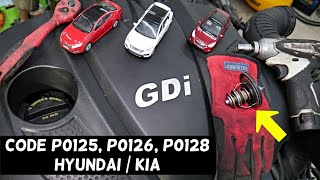
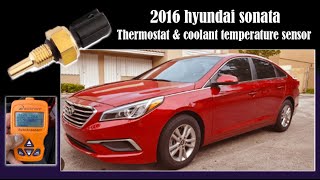
How to confirm: With a cold engine, start the car and feel the upper radiator hose. It should remain cool for several minutes. If it starts to warm up almost immediately, the thermostat is likely stuck open, allowing coolant to circulate prematurely. Alternatively, an OBD-II scanner can show live data; if the temperature rises very slowly on the highway or drops significantly while driving at speed, it points to a stuck-open thermostat. 🎬 Watch: Step-by-step thermostat and sensor replacement guide
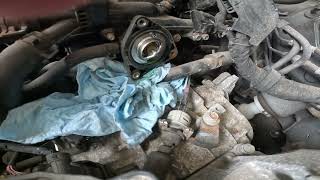
Typical fix: Replace the engine thermostat and gasket/housing assembly. It's also recommended to drain and refill the engine coolant at the same time, ensuring all air is bled from the system. 🎬 See this universal walkthrough for fixing the P0128 code
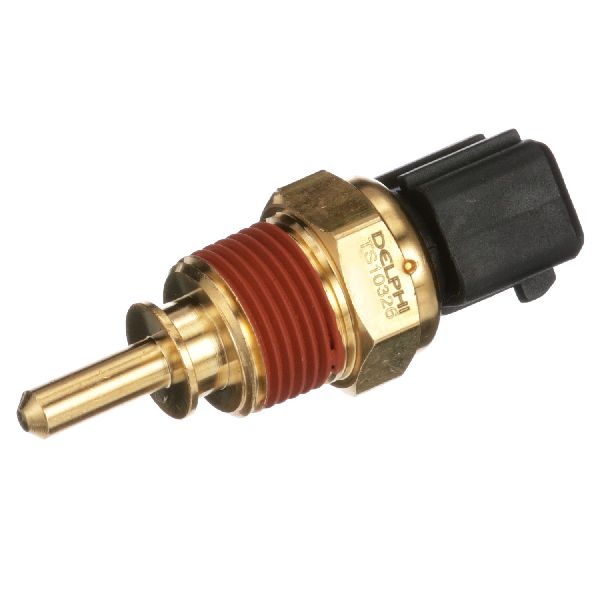
Est. part cost: $30-$245 - Faulty Engine Coolant Temperature (ECT) Sensor ⚪ Low Probability → Shop Engine Coolant Temperature Sensor
How to confirm: Use an OBD-II scanner to monitor the live ECT data. If the reading is erratic, nonsensical (e.g., shows -40°F on a warm day), or never changes, the sensor is likely faulty. You can also test the sensor's resistance with a multimeter and compare it to specifications at a known temperature. For example, at 68°F (20°C), the resistance should be around 3520 ohms.
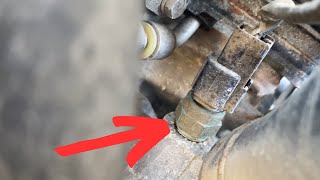
Typical fix: Replace the ECT sensor. This is typically a small, inexpensive sensor that screws into the engine block or thermostat housing. 🎬 Watch: How to locate and replace the ECT sensor
Est. part cost: $27-$45
Rare But Worth Checking
- Low Engine Coolant Level: While low coolant usually leads to overheating, a significant air pocket near the ECT sensor can cause it to send an inaccurate, low reading to the ECM. Always check the coolant level in the reservoir and radiator (when the engine is cold) as a first step.
- Cooling Fan Stuck On: → Shop Engine Cooling Fan Blade If the electric cooling fan runs constantly, even when the engine is cold, it can over-cool the engine and prevent it from reaching operating temperature, triggering a P0128 code.
- Incorrect Coolant Mixture: Some technicians have noted that a coolant-to-water ratio significantly different from 50/50 can confuse the ECU's logic and potentially trigger a P0128 code on some Hyundai/Kia vehicles.
Diagnosis Steps
- Check for Service Campaigns: Contact a Hyundai dealer with your VIN to determine if TSB #19-01-016H-1 or Service Campaign T3T is open for your vehicle. If so, have the ECM update performed first. This is the most critical first step for a 2019 Veloster 1.6T.
- Inspect Coolant Level and Condition: Ensure the engine is completely cool. Check the coolant level in the overflow reservoir and the radiator. The coolant should be at the 'FULL' line and be clean. A non-standard or improper coolant mix could also be a factor.
- Monitor Coolant Temperature: Use an OBD-II scanner to view live data from the Engine Coolant Temperature (ECT) sensor. Start the cold engine and watch the temperature reading.
- Analyze Temperature Rise: The temperature should rise steadily to around 180-195°F (82-90°C) and then stabilize as the thermostat opens and closes to regulate it. If the temperature rises extremely slowly, struggles to reach this range, or drops significantly at highway speeds, the thermostat is likely stuck open.
- Test the ECT Sensor: → Shop Engine Coolant Temperature Sensor If the temperature reading on the scanner is erratic, jumps around, or stays at a fixed, illogical value (like -40°F), the ECT sensor or its wiring is the likely problem. Resistance can be checked with a multimeter against a detailed temperature/resistance chart.
- Inspect Radiator Hoses: If you suspect a stuck thermostat, feel the upper radiator hose after starting the engine from cold. It should stay cool for several minutes. If it gets warm right away, it confirms coolant is flowing to the radiator prematurely.
- Check Cooling Fans: → Shop Engine Cooling Fan Blade Observe the engine cooling fans. They should not be running continuously when the engine is cold.
Parts You'll Likely Need
- Engine Coolant Thermostat Assembly
(OEM #25500-2E085)— This is the most common hardware failure for P0128. The thermostat gets stuck in the open position, preventing the engine from warming up properly. This part number fits the 2.0L engine in the Veloster, Kona, and Elantra.
Trusted brands: Genuine Hyundai, Dorman, Aisin, Beck/Arnley
OEM price range: $130-$190
Aftermarket price range: $30-$150 - Engine Coolant Temperature Sensor
(OEM #39220-38030)— A less common but possible cause, this sensor can fail and send incorrect temperature data to the computer. This part number is widely used across many Hyundai and Kia models and years.
Trusted brands: Genuine Hyundai, NTK, Standard Motor Products
OEM price range: $35-$50
Aftermarket price range: $25-$45
Technical Service Bulletins (TSBs) & Recalls
- 19-01-016H-1: A revised TSB related to Campaign T3T, providing the specific GDS information (Event #569 for the Veloster JS) for the ECM software update to revise the logic for DTC P0128.
- 20-01-036H: Details an ECM software update to revise the logic for DTC P0128, noting there are no drivability symptoms.
- Campaign T3T Dea: A service campaign launched by Hyundai to perform the ECM software update for P0128 logic improvement on certain 2018 Elantra GT and 2019 Veloster vehicles with the 1.6L Turbo engine.
Platform-Specific Known Issues
- ECM Software Logic Flaw: Hyundai issued Technical Service Bulletin #19-01-016H-1 and Service Campaign T3T to update the engine control module software for the 1.6L Turbo engine. The original software was too sensitive in its monitoring, leading to false P0128 codes even when no mechanical fault was present. Owners on forums confirm that getting this update is the correct first step, though some have had to pay for it out of warranty.
Mechanic-Grade Diagnostic Values
- ECT Sensor Resistance vs. Temperature — expected: 100°C (212°F) = 177 Ω; 80°C (176°F) = 332 Ω; 60°C (140°F) = 667 Ω; 40°C (104°F) = 1459 Ω; 20°C (68°F) = 3520 Ω; 0°C (32°F) = 9420 Ω. Failure: Resistance readings that deviate significantly from the chart at a measured temperature.
- ECT Sensor Signal Voltage (at sensor connector) — expected: Approximately 2.0V - 3.0V on a cold engine, decreasing to around 0.5V at full operating temperature.. Failure: Voltage that is stuck high (near 5V), stuck low (near 0V), or does not change as the engine warms up.
- ECT Sensor Reference Voltage (at sensor connector, ignition on, engine off) — expected: Approximately 5.0V on one of the pins (typically Pink wire).. Failure: No voltage indicates a problem with the ECM or the wiring from the ECM.
Scan Tool Commands That Help
- Hyundai GDS (Global Diagnostic System): ECM Update - Event #569 — This is the specific software update event number required to fix the P0128 logic flaw on the 2019 Veloster 1.6L Turbo, as per TSB #19-01-016H-1.
- Hyundai GDS (Global Diagnostic System): DTC Erase - All Menus — After successfully performing the ECM software update, Hyundai specifies that the technician must erase any stored DTCs from all vehicle system menus, not just the engine module.
- Hyundai GDS (Global Diagnostic System): Erase DTC in BlueLink system — As a final step in the TSB procedure, any related fault codes stored in the BlueLink telematics system must also be cleared per TSB 12-BE-005-2.
Wiring & Ground Locations
- ECT Sensor Connector — On the thermostat housing, which is located at the end of the upper radiator hose on the engine block.. This is the primary connection point for testing. On similar Hyundai engines, the wires are Pink (5V reference) and Gray (signal return). A poor connection here will cause faulty readings and trigger P0128.
- Engine Room Fuse #7 — In the main fuse box in the engine compartment.. This 15A fuse provides power to the ECM/PCM. If this fuse is blown, the ECM will not power on, and no sensor data will be processed, which could lead to multiple codes including P0128 or a no-start condition.
- Engine Room Fuse #9 — In the main fuse box in the engine compartment.. This 10A fuse also provides power to the ECM/PCM. A failure of this fuse would impact ECM operation and sensor readings.
Real Owner Repair Stories
- Reddit user on r/veloster (2019 Hyundai Veloster Turbo R-Spec) — P0128 code appeared with no noticeable drivability issues or symptoms.
❌ Tried (didn't work) The owner first suspected a mechanical issue, but diagnostics were recommended before parts replacement.
✅ What actually fixed it The issue was identified as the known TSB for an ECM software update. A local mechanic quoted $656 for the diagnostic and update. The owner noted Hyundai would not cover the TSB work outside of the warranty period. In the same thread, another user with the same code simply cleared it with a scanner and it did not return after 150+ miles, suggesting it can sometimes be an intermittent, one-time glitch.
OEM Part Supersession History
25500-2B400→25500-2B000— Part revision or manufacturer change for the thermostat assembly for the 1.6L Turbo engine.39220-38020, 39230-26700→39220-38030— Part revision or manufacturer change for the Engine Coolant Temperature (ECT) sensor.
Helpful Videos
We Have This Part in Stock



The information in this article is provided for general reference and educational purposes only. Vehicle specifications, procedures, and part compatibility can vary by production date, trim level, and region. Always consult your vehicle's factory service manual and verify part numbers before purchasing or performing repairs. Safety-critical components such as airbags, seat belts, and braking systems should be installed by a qualified professional.
- Hyundai VELOSTER:
- 🧭 Diagnostic Flowchart
- 🎬 Helpful Videos
- 🛍️ Shop This Part
- What's Unique About the 2019-2019 Hyundai VELOSTER
- Symptoms You May Notice
- Most Likely Causes
- Rare But Worth Checking
- Diagnosis Steps
- Parts You'll Likely Need
- Technical Service Bulletins (TSBs) & Recalls
- Platform-Specific Known Issues
- Mechanic-Grade Diagnostic Values
- Scan Tool Commands That Help
- Wiring & Ground Locations
- Real Owner Repair Stories
- OEM Part Supersession History
- 🎟️ Get 5% Off