

P0128 on 2007-2017 Jeep Compass 2.4L: Causes, Fixes, and Thermostat Replacement
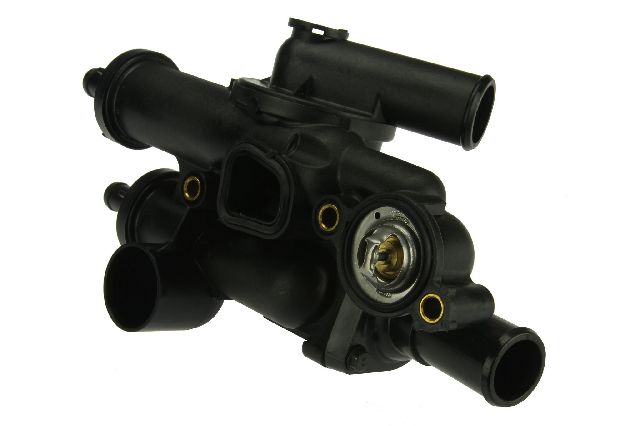
On a 2007-2017 Jeep Compass with the 2.4L World engine, the P0128 code is almost always caused by a faulty thermostat that is stuck open. The fix is to replace the thermostat housing assembly, which typically includes a new thermostat and coolant temperature sensor. The updated OEM part is 68003582AC. Expect to pay around $40-$80 for an aftermarket part, though OEM is often recommended for better reliability.
- P0128 on your Jeep Compass almost certainly means you need a new thermostat.
- The most common cause is the thermostat being stuck in the open position, preventing the engine from warming up correctly.
- For a lasting repair, replace the entire thermostat housing assembly, which includes a new thermostat and sensor.
- While you can continue to drive the vehicle, you will experience poor fuel economy and no heat until it is fixed.
- This is a DIY-possible job for someone with moderate experience, but be prepared for tight access to bolts.
What's Unique About the 2007-2017 Jeep Compass

The 2.4L World engine, shared with the Dodge Caliber and Jeep Patriot, is known for this specific issue. The primary culprit is the thermostat failing in the open position. While the thermostat itself is a common failure item on many cars, the job on this specific engine can be more labor-intensive than on other vehicles due to the location of the thermostat housing and the components that must be removed to access it, such as the PCM. Many owners and mechanics report that replacing the entire thermostat housing assembly, which includes a new sensor, is the most effective and long-lasting repair.
Generation note: The 2007-2017 year range covers the entire first generation (MK) of the Jeep Compass. The 2.4L World engine was the primary engine for this generation. A '2017' model could be either the first generation (MK) or the new second generation (MP), which uses a different 'Tigershark' engine. This guide specifically applies to the first-generation Compass with the 2.4L World engine.
Symptoms You May Notice

- Check Engine Light is on
- Engine temperature gauge reads lower than normal, or drops at highway speeds
- Heater blows lukewarm or cool air, especially in cold weather
- Slightly reduced fuel economy
- Engine takes a very long time to warm up
- Gurgling sound from the dashboard area (can indicate air in the system from a related coolant leak)
- Replacing only the ECT sensor without checking the thermostat. While the sensor can fail, the thermostat is the much more common cause for P0128.
- Using a low-quality aftermarket thermostat. Many owners report that the P0128 code returned shortly after installing a non-OEM part, requiring a second repair with a Mopar-branded assembly.
Most Likely Causes

- Thermostat Stuck Open 🔴 High Probability → Shop Integrated Thermostat Housing Assembly The original equipment thermostat has a high failure rate where it gets stuck in the open position, allowing coolant to circulate to the radiator constantly instead of letting the engine warm up first.
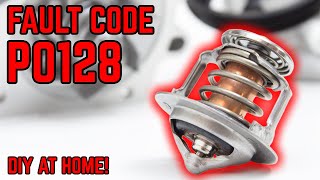
How to confirm: Monitor the coolant temperature with a scan tool. If the temperature rises very slowly, drops at highway speeds, or never reaches the target of ~195-205°F, the thermostat is likely stuck open. 🎬 See this breakdown of P0128 causes and common fixes. You can also feel the upper radiator hose; it should remain cool until the engine is warm, then get hot suddenly. If it warms up gradually with the engine, the thermostat is open.
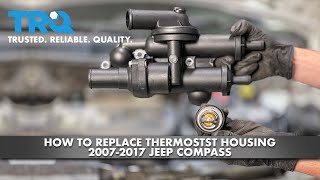
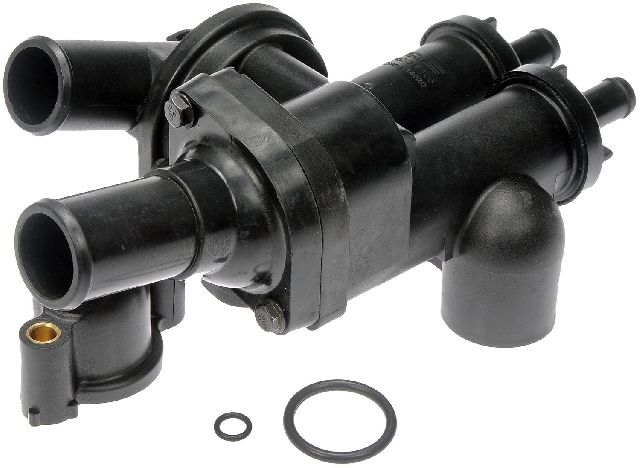
Typical fix: Replace the entire thermostat housing assembly. This part usually includes the thermostat, the housing, and a new coolant temperature sensor. It is highly recommended to use the OEM Mopar part for best fit and longevity.
Est. part cost: $40-$120 - Low Engine Coolant 🟡 Medium Probability The plastic thermostat housing itself can become brittle, crack, and leak coolant, leading to a low coolant level which can also trigger P0128.
How to confirm: Visually inspect the coolant reservoir and the radiator (when the engine is cold) to see if the level is low. Check for signs of pink or orange crusty residue (dried coolant) around the thermostat housing, hoses, and radiator.
Typical fix: Find and repair the source of the leak, then top off and bleed the cooling system. If the thermostat housing is cracked, it will need to be replaced.
Est. part cost: $20-$40 for coolant - Faulty Engine Coolant Temperature (ECT) Sensor ⚪ Low Probability → Shop Engine Coolant Temperature Sensor
How to confirm: Compare the ECT sensor reading on a scan tool to a reading from an infrared thermometer pointed at the thermostat housing. If the readings are significantly different, the sensor may be faulty. However, this is much less common than a bad thermostat.
Typical fix: Replace the ECT sensor. Since most replacement thermostat assemblies for this vehicle include a new sensor, this is often replaced along with the thermostat as a single unit.
Est. part cost: $20-$50
Rare But Worth Checking
- PCM Software Calibration: In some cases, particularly if the thermostat has been replaced and the code returns, a PCM software update may be available to 'desensitize' the trigger for the P0128 code. While Chrysler has issued TSBs for other models with this issue, no specific TSB for the 2007-2017 Compass 2.4L was found in research. It remains a rare possibility worth checking with a dealer if other fixes fail.
Diagnosis Steps
- Check the Check Engine Light with an OBD-II scanner to confirm P0128 is the active code.
- With the engine cold, check the coolant level in the reservoir and radiator. A low level can cause this code. Top off if necessary.
- Inspect for coolant leaks, paying close attention to the plastic thermostat housing for cracks or residue.
- Use a scan tool to monitor the live data for the Engine Coolant Temperature (ECT).
- Start the cold engine and watch the ECT reading. It should climb steadily to around 195-205°F and then stabilize.
- If the temperature climbs very slowly, never reaches the target, or drops significantly when driving at highway speeds, the thermostat is almost certainly stuck open and needs to be replaced.
- If replacing, be aware the job requires removing the PCM for access. 🎬 Watch: Step-by-step guide to replacing the thermostat housing assembly. There is a notoriously difficult bolt to reach underneath the housing; mechanics often recommend taping the 10mm socket to the extension to avoid dropping it.
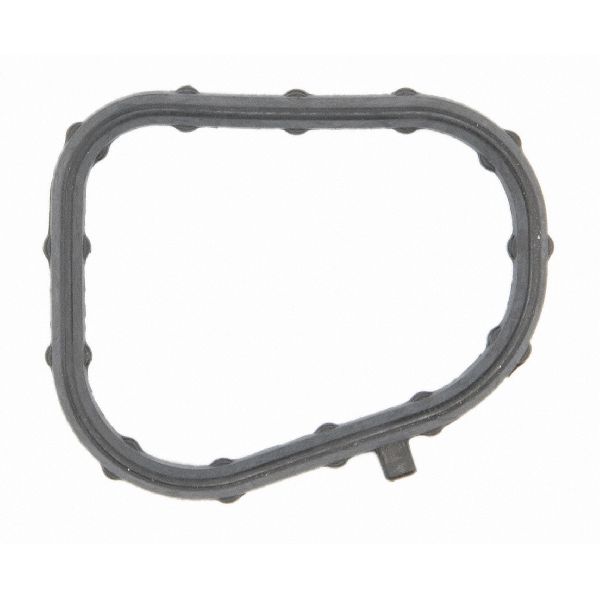
- After removing the old housing, ensure the old rubber O-ring/gasket is not stuck to the engine block surface before installing the new part.
- After installation, properly refill and bleed the cooling system to remove any air pockets. A spill-free funnel kit is highly recommended for this process.
Parts You'll Likely Need

- Thermostat Housing Assembly
(OEM #68003582AC (supersedes 68003582AB))— This is the most common failure point. The original thermostat fails by sticking open, and the plastic housing can become brittle and crack. The assembly typically includes a new thermostat, housing, and ECT sensor, addressing all likely failure points at once. The OEM Mopar part is strongly recommended for fit and longevity.
Trusted brands: Mopar (OEM), Dorman (Aftermarket, P/N 902-319), Gates, SKP
OEM price range: $80-$130
Aftermarket price range: $40-$80 - Engine Coolant/Antifreeze
(OEM #Mopar 68163848AB (OAT 10 Year/150,000 Mile))— You will lose coolant when replacing the thermostat and will need to refill and bleed the system. Use the correct type specified for your vehicle (typically a Mopar OAT or HOAT coolant, check owner's manual for spec).
Trusted brands: Mopar, Peak, Prestone
OEM price range: $25-$40 per gallon
Aftermarket price range: $20-$30 per gallon
Platform-Specific Known Issues
- The plastic thermostat housing on the 2.4L World engine is a known weak point, prone to cracking and leaking over time. Some aftermarket companies offer upgraded aluminum housings to address this.
- Accessing the thermostat housing is difficult due to its location. The job requires removing the Powertrain Control Module (PCM) and working in a tight space.
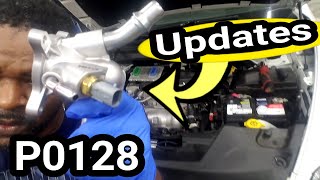
- A specific bolt located under the housing is very difficult to access and is often referred to as the 'bolt in the blind'. Many DIYers and mechanics recommend taping the socket to the extension 🎬 Watch: Pro tips for replacing the 2.4L Jeep thermostat. to prevent it from falling into the engine bay.
Mechanic-Grade Diagnostic Values
- Engine Coolant Temperature (ECT) Sensor Resistance — expected: Approximately 2,000 to 3,000 Ohms at 68°F (20°C).. Failure: A reading significantly outside this range, or an open/short circuit, indicates a faulty sensor.
- Normal Engine Operating Temperature — expected: 195°F - 220°F (90°C - 104°C) on a scan tool after warm-up.. Failure: Temperature fails to reach this range, rises very slowly, or drops at highway speeds.
- Thermostat Housing Bolt Torque — expected: 9 ft-lbs (12 Nm). Failure: Over-torquing can crack the plastic housing; under-torquing can cause leaks.
Scan Tool Commands That Help
- Dealer Scan Tool (Witech): PCM Flash/Software Update — As a last resort when the P0128 code returns after replacing the thermostat (especially with an OEM part) and verifying the rest of the cooling system is functional. A software update may exist to widen the acceptable parameters for warm-up time.
Wiring & Ground Locations
- ECT Sensor Signal Pin — Pin 12 of the Powertrain Control Module (PCM) C2 connector. The wire is typically Violet/Orange.. This is the specific pin where the PCM receives the temperature data from the sensor. A continuity or voltage test at this pin can confirm if the signal is reaching the PCM correctly, helping to diagnose a wiring fault between the sensor and the module.
- Sensor Ground Pin — Pin 66 of the Powertrain Control Module (PCM) C2 connector. The wire is typically Dark Blue/Dark Green.. This is the shared ground reference used by the ECT sensor. A poor connection at this pin or a break in the wire can cause an incorrect temperature reading, potentially triggering a P0128 code.
- G111 — Upper left front of the engine compartment.. This is a primary ground point for the engine controls system on early models. A corroded or loose connection at G111 can cause erratic behavior in various sensors, including the ECT, leading to false codes.
Real Owner Repair Stories
- Reddit user on r/Jeep (Jeep (model unspecified, but P0128 issue is common to the platform)) — Persistent P0128 code.
❌ Tried (didn't work) Replaced the thermostat., Cleared the code, but it returned.
✅ What actually fixed it The dealership diagnosed a 'seeping' radiator. Even though it passed a pressure test, the minor leak was enough to cause the code. A different user in the same thread confirmed their P0128 was only resolved after replacing the radiator due to a known issue with cracking plastic end tanks, even after a Mopar thermostat had failed to fix it.
When the Usual Fixes Don't Work
- While replacing the thermostat assembly with an OEM Mopar part fixes P0128 in the vast majority of cases, it is not a guaranteed solution. In a documented instance, a vehicle owner replaced the thermostat, but the code returned. The final fix was a new radiator to resolve a very slow, 'seeping' leak from a cracked plastic end tank. This suggests that any issue preventing the cooling system from sealing and pressurizing correctly, even a minor one, can interfere with the warm-up cycle and trigger P0128. Therefore, if a new OEM thermostat doesn't solve the code, a thorough inspection of the entire cooling system for subtle leaks is warranted before suspecting the PCM or other rare causes.
OEM Part Supersession History
68003582AB→68003582AC— Standard revision by the manufacturer, likely for improved reliability or minor design change to address the high failure rate of the original thermostat.
Model Year Variations Within This Range
- 2007: Wiring diagrams for the 2007 model year show a distinction between 'early production' and 'late production' for the cooling fan control system. While not directly causing P0128, it indicates that mid-year changes occurred and technicians should verify the correct diagram if diagnosing a related fan issue.
- 2011-2017: The Jeep Compass received a major facelift for the 2011 model year, updating its appearance to be more like the Grand Cherokee. However, the 2.4L World engine and its cooling system components relevant to P0128 remained largely unchanged from the earlier 2007-2010 models.
Diagnostic Flowchart
Real Owner Stories
Aggregated from forums and TSBs cited above. Mileages and costs reflect what owners reported in those sources.
2019 Jeep Compass
Symptoms: Service Engine light with code P0128 (thermostat rationality) and a 'Service stop/start system: auxiliary battery is weak' message.
What fixed it: Owner was quoted for a repair under warranty, implying thermostat replacement.
Cost: $200
Source hint: Reddit r/JeepCompass
2016 Jeep Renegade
Symptoms: Check engine light on, temperature would drop to nothing, and the radiator fan would run continuously.
What fixed it: Determined the thermostat needed replacement.
Source hint: Reddit r/JeepRenegade
Jeep Compass 2.4L World
Symptoms: Thermostat stuck in the open position causing a P0128 code.
What fixed it: Replaced the thermostat housing assembly, which required removing the PCM and navigating a difficult lower bolt.
Source hint: YouTube 'Online Mechanic Tips' (https://www.youtube.com/watch?v=hYsea6JqQOM)
Related OBD-II Codes
Frequently Asked Questions
Why is replacing the thermostat on my 2.4L Jeep Compass so difficult?
Should I buy an OEM or aftermarket thermostat housing for my Compass?
My Compass heater is blowing lukewarm air and I have a P0128 code. Are they related?
Do I need to buy a separate Engine Coolant Temperature (ECT) sensor to fix P0128?
I hear a gurgling sound from the dashboard of my Compass. What does this mean with a P0128 code?
Is the P0128 code common on other Jeeps or Dodges?
Helpful Videos
We Have This Part in Stock


The information in this article is provided for general reference and educational purposes only. Vehicle specifications, procedures, and part compatibility can vary by production date, trim level, and region. Always consult your vehicle's factory service manual and verify part numbers before purchasing or performing repairs. Safety-critical components such as airbags, seat belts, and braking systems should be installed by a qualified professional.
- Jeep Compass:
- 🧭 Diagnostic Flowchart
- 🎬 Helpful Videos
- 🛍️ Shop This Part
- What's Unique About the 2007-2017 Jeep Compass
- Symptoms You May Notice
- Most Likely Causes
- Rare But Worth Checking
- Diagnosis Steps
- Parts You'll Likely Need
- Platform-Specific Known Issues
- Mechanic-Grade Diagnostic Values
- Scan Tool Commands That Help
- Wiring & Ground Locations
- Real Owner Repair Stories
- When the Usual Fixes Don't Work
- OEM Part Supersession History
- Model Year Variations Within This Range
- Real Owner Stories
- 2019 Jeep Compass
- 2016 Jeep Renegade
- Jeep Compass 2.4L World
- Related OBD-II Codes
- Frequently Asked Questions
- 🎟️ Get 5% Off