

P0128 on 2015-2017 Jeep Renegade: Causes and Fixes for Thermostat Rationality
This code means your Renegade's engine isn't warming up as fast as the computer expects. The most common cause is a faulty thermostat that is stuck open, requiring replacement of the thermostat assembly. This is a very common issue on the 2.4L Tigershark engine. Expect to pay $110-$180 for an OEM part and between $600-$1000 for a professional repair due to the difficult labor involved.
- P0128 on a 2015-2017 Renegade almost always points to a faulty thermostat that is stuck open.
- The most effective and common repair is to replace the entire thermostat housing assembly, which includes a new thermostat and ECT sensor.
- While the part is not excessively expensive, the labor can be, as access to the thermostat on the 2.4L engine is difficult. This makes it a challenging but achievable DIY job for an experienced person.
- Always use the correct OAT (Organic Acid Technology) coolant when refilling the system to prevent damage.
- Before performing a mechanical repair, it's worth checking with a dealer if your vehicle needs a PCM software update, as this can sometimes be the root cause.
What's Unique About the 2015-2017 Jeep RENEGADE
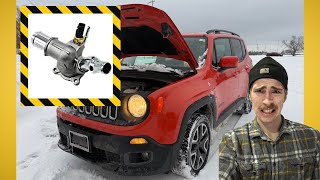
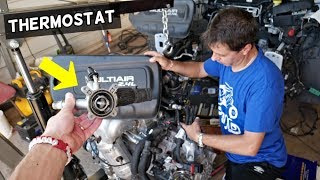
On the 2015-2017 Jeep Renegade, particularly those with the 2.4L Tigershark engine, the P0128 code is a very frequent complaint. The issue is so common that multiple Technical Service Bulletins (TSBs) have been issued that include this code, often suggesting a PCM software update may be required to 'desensitize' the trigger for this code. Owners almost universally find that replacing the entire thermostat housing, which includes a new thermostat and a new coolant temperature sensor, is the most effective fix. The repair is notoriously difficult for DIYers due to the tight spacing and one particularly hard-to-reach 10mm bolt 🎬 Watch: This walkthrough shows how to reach those difficult bolts. located under the housing, which often requires special tools or taping the socket to an extension to access.
Symptoms You May Notice
- Check Engine Light is on
- Engine temperature gauge reads lower than normal or takes a very long time to reach the middle
- Cabin heater blows cool or lukewarm air, even after the engine has run for a while
- Decreased fuel economy
- In some cases, the remote start feature may be disabled while the Check Engine Light is active.
- Cooling fans may run continuously at high speed, even when the engine is not hot, as a fail-safe measure.
- Replacing only the ECT sensor when the thermostat is the actual problem. Since new thermostat assemblies for the Renegade often include a new sensor, it's often more efficient to replace the whole unit.
- Replacing the thermostat with a cheap aftermarket part that fails prematurely. Some owners have reported the P0128 code returning within months of using a non-OEM thermostat assembly.
Most Likely Causes
- Faulty Thermostat (Stuck Open) 🔴 High Probability → Shop Integrated Thermostat Housing Assembly The thermostat can fail and remain in the open position, allowing coolant to circulate through the radiator continuously and preventing the engine from warming up properly. This is the most frequent cause for P0128 on the 2.4L engine.
How to confirm: After a cold start, feel the upper radiator hose. It should remain cool until the engine reaches operating temperature (around 195-205°F). If the hose gets warm almost immediately, the thermostat is stuck open. A scan tool showing the temperature failing to reach ~200°F after 10-15 minutes of driving also confirms this.
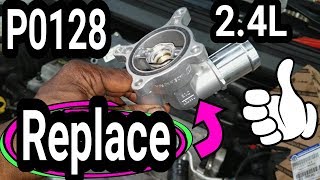
Typical fix: Replace the entire thermostat housing assembly. This assembly typically includes a new thermostat, housing, and a new engine coolant temperature sensor, addressing all likely failure points at once. 🎬 See this step-by-step thermostat replacement for the 2.4L engine.
Est. part cost: $70-$185 - Faulty Engine Coolant Temperature (ECT) Sensor 🟡 Medium Probability → Shop Engine Coolant Temperature Sensor The ECT sensor can send inaccurate readings to the PCM, making it think the engine is colder than it is. While less common than a failed thermostat, a faulty sensor can trigger this code. Some owners report that aftermarket thermostat assemblies can come with a faulty sensor out of the box, leading to the code returning shortly after a repair.
How to confirm: Use a scan tool to monitor the live ECT sensor data. Compare this reading to a reading from an infrared thermometer aimed at the thermostat housing. The readings should be very close. A significant discrepancy or an erratic reading points to a bad sensor.
Typical fix: Replace the ECT sensor. On the 2.4L engine, the sensor is located in the thermostat housing. Since the labor is intensive, most owners and shops choose to replace the whole housing assembly which includes a new sensor.
Est. part cost: $20-$50 - Low Engine Coolant Level ⚪ Low Probability If the coolant level is too low, the ECT sensor may be exposed to an air pocket instead of coolant, leading to inaccurate readings. This can be caused by leaks, which may be visible around the thermostat housing itself or other cooling system components.
How to confirm: Visually inspect the coolant reservoir to ensure the level is between the 'MIN' and 'MAX' lines when the engine is cold. Check for any visible signs of coolant leaks (often pink or orange residue) around the engine bay, particularly around hoses and the thermostat housing.
Typical fix: Top off the coolant with the correct type (Mopar OAT coolant meeting MS-12106 spec) and inspect the system for leaks. If a leak is found, the leaking component must be repaired or replaced.
Est. part cost: $20-$40 for coolant - PCM Software Update Needed ⚪ Low Probability Several TSBs for the Jeep Renegade (e.g., #18-061-16 Rev. C) list P0128 along with a group of other codes that are resolved with a PCM software update. This suggests the original factory software may be too sensitive in its monitoring, and a flash can 'desensitize' the P0128 trigger.
How to confirm: A Jeep dealership or a qualified repair shop with access to OEM software (like wiTECH) can check if your vehicle's PCM has any pending updates by referencing its VIN.
Typical fix: Have a dealership or qualified shop perform a PCM software update. This is often recommended even after replacing the thermostat to prevent a recurrence.
Est. part cost: $0-$200 (may be covered under warranty or TSB)
Rare But Worth Checking
- Cooling Fan Stuck On: → Shop Engine Cooling Fan Blade If the electric cooling fan runs continuously, even when the engine is cold, it can over-cool the engine and prevent it from reaching operating temperature, triggering a P0128 code. This can be a fail-safe response from the PCM due to a bad sensor reading.
- Incorrect Coolant Mixture: Using the wrong type of coolant or mixing different types (e.g., OAT and HOAT) can lead to gelling or clogging within the cooling system, which can affect thermostat operation and overall system performance.
Diagnosis Steps
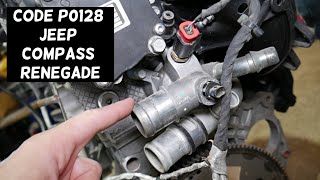
- Verify the Check Engine Light is on and code P0128 is present using an OBD-II scanner. 🎬 Watch: How to diagnose and fix the P0128 rationality code.
- Check the engine coolant level in the reservoir. Ensure it is at the proper level when the engine is cold.
- Inspect for any visible coolant leaks, paying close attention to the thermostat housing and connected hoses.
- Start the engine from cold and feel the upper radiator hose. If it becomes warm within the first 1-2 minutes, the thermostat is stuck open and must be replaced.
- If the hose remains cold, use a scan tool to monitor the Engine Coolant Temperature (ECT) reading in real-time. Watch for a slow, steady rise. The engine should reach operating temperature (approx. 195-205°F or 90-96°C) within 10-15 minutes of driving. If it fails to reach this temperature, the thermostat is the likely culprit.
- If the temperature reading on the scan tool seems erratic, jumps to extremes, or never changes, suspect a faulty ECT sensor or wiring.
- If the mechanical parts seem to be working correctly, contact a dealership to check if your vehicle's VIN has an available PCM software update related to TSBs like #18-061-16 Rev. C.
Parts You'll Likely Need
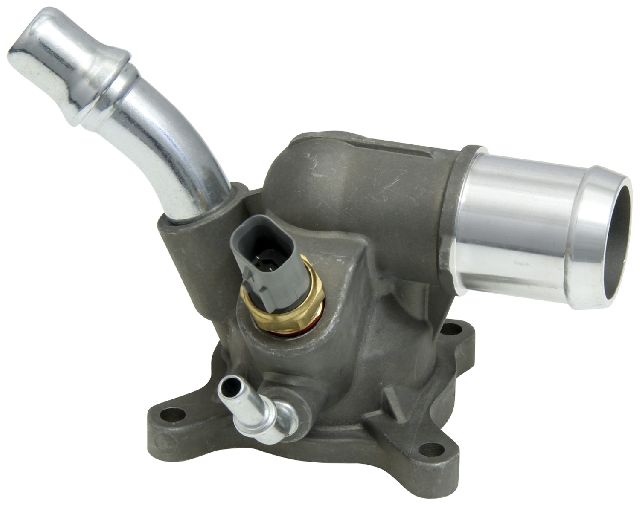
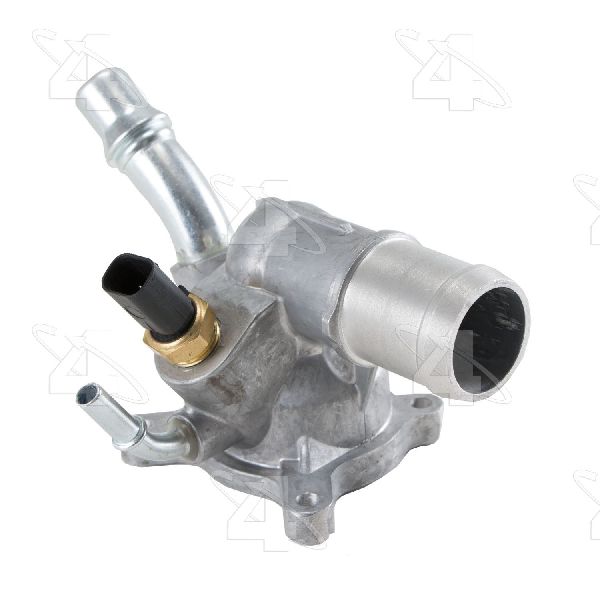
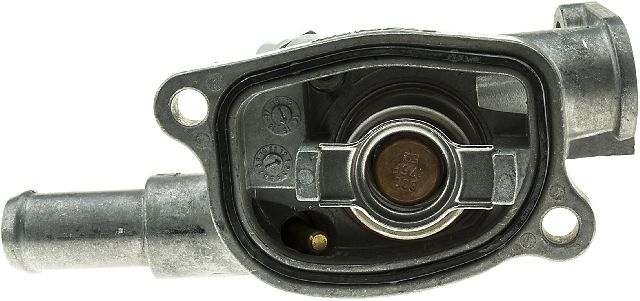
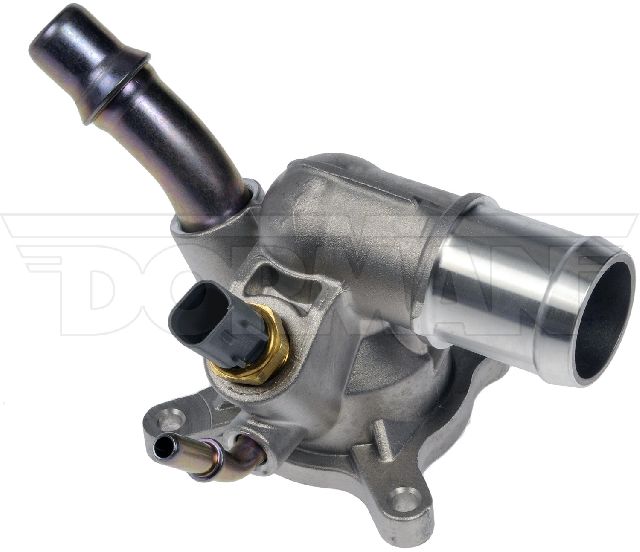
- Thermostat Housing Assembly
(OEM #68211424AA)— This is the most common failure item for code P0128. Replacing the entire assembly is recommended as it includes the thermostat, housing, and a new ECT sensor, addressing all likely failure points at once.
Trusted brands: Mopar, Dorman
OEM price range: $110-$150
Aftermarket price range: $70-$120 - Engine Coolant (OAT)
(OEM #Mopar 68163848AB (10 Year/150,000 Mile))— The cooling system will need to be partially drained and refilled during the thermostat replacement. It is critical to use the specified Organic Acid Technology (OAT) coolant meeting Chrysler specification MS-12106 to prevent system damage.
Trusted brands: Mopar, Valvoline Zerex
OEM price range: $25-$40 per gallon
Aftermarket price range: $20-$30 per gallon
Related Codes That Often Appear With This One
- U1504 — This code for 'Implausible Message Data Length Received' is frequently mentioned alongside P0128 in manufacturer TSBs, suggesting a PCM software update may resolve both.
- P0101 — Mentioned in TSB #1805520 and #18-061-16, indicating a potential software issue that affects multiple sensor rationality checks.
- P1185 — Also listed in TSBs with P0128, pointing towards a group of codes that can be addressed by a PCM flash.
Technical Service Bulletins (TSBs) & Recalls
- 1805520: Mentions P0128 - Thermostat Rationality along with other codes.
- 18-061-16 REV. C: Notes that MIL illumination may be caused by P0128 - Thermostat Rationality, among other codes.
- 18-063-16: Lists P0128 as a potential DTC.
- 1801617: Includes P0128 in a list of DTCs.
- 18-061-16: Lists P0128 as a potential DTC.
Platform-Specific Known Issues
- The replacement process on the 2.4L engine is considered difficult due to poor access. One of the thermostat housing bolts (a 10mm) is notoriously hard to reach, located underneath the housing and obscured by other components.
- Owner Experience: A user on Reddit's r/JeepRenegade mentioned paying a dealer $650 for the first replacement and then doing the second one themselves. Another user noted they gave up on the DIY attempt due to the difficulty and paid a shop $600.
Mechanic-Grade Diagnostic Values
- Engine Coolant Temperature (ECT) Sensor Resistance — expected: Approximately 2,000-3,000 Ohms at 68°F (20°C). Resistance decreases as temperature increases.. Failure: A reading that is infinite (open circuit) or significantly outside the expected range for a given temperature indicates a faulty sensor.
- ECT Sensor Voltage (Live Data) — expected: The PCM sends a 5V reference. The return signal voltage should be high when cold (e.g., ~3.5-4.5V) and drop as the engine warms up (e.g., ~0.5-1.0V at operating temp).. Failure: Voltage that is stuck high, stuck low, or does not change smoothly as the engine warms indicates a sensor or wiring issue.
- Mode $06 Thermostat Monitor (Test ID $86) — expected: A scan tool capable of reading Mode $06 data will show a test value compared against a minimum and maximum threshold set by the manufacturer.. Failure: If the test value falls outside the min/max thresholds, it indicates the thermostat rationality test is failing, even if the Check Engine Light hasn't illuminated yet.
Scan Tool Commands That Help
- wiTECH (or equivalent professional scanner): Cooling Fan Actuator Test — This bidirectional command allows the technician to manually turn the cooling fans on at different speeds. It is used to verify if the fan control module and the fans themselves are working correctly, helping to rule out a 'fan stuck on' condition as the cause of P0128.
- wiTECH: Restore Configuration and Align Proxi — This procedure is required after performing a PCM software update (flash) as described in TSBs. It ensures all vehicle modules are communicating correctly with the newly updated software.
Wiring & Ground Locations
- ECT Sensor Connector — Plugged into the Engine Coolant Temperature sensor, which is located on the thermostat housing assembly on the passenger side of the 2.4L engine.. The two-wire connector provides the 5V reference and sensor ground. Corrosion or damage to the connector or its pigtail can cause incorrect readings, triggering P0128. The wires are typically Pin 1: 5V Supply (e.g., Violet/White) and Pin 2: Sensor Ground (e.g., Black/Light Blue).
- G102 — A primary engine ground point located on the left side of the engine block.. A loose or corroded main engine ground can cause floating or incorrect readings for multiple sensors that reference it, including the ECT sensor, leading to rationality codes like P0128.
Real Owner Repair Stories
- Reddit user in r/JeepRenegade (2016 Jeep Renegade 2.4L) — Check Engine Light with code P0128.
❌ Tried (didn't work) Using a cheap aftermarket thermostat assembly, which failed in less than a year.
✅ What actually fixed it Replacing the thermostat a second time using an OEM Mopar thermostat assembly resolved the issue permanently. The user also noted the extreme difficulty of reaching the bottom bolt, recommending a 10mm swivel socket and long extensions. - jeeprenegadeforum.com user (2015 Jeep Renegade 2.4L) — P0128 code.
❌ Tried (didn't work) The dealership first performed a PCM software flash according to a TSB.
✅ What actually fixed it When the software update did not fix the code, the dealership then replaced the thermostat housing assembly, which permanently resolved the problem.
When the Usual Fixes Don't Work
- While the vast majority of P0128 codes on this platform are fixed by replacing the thermostat assembly, a small number of owners have found the issue persists. In these cases, the root cause was often traced back to using a low-quality aftermarket part that was faulty out of the box. One owner on a forum reported the code returning twice; the first time was due to a failed aftermarket thermostat, and the second was due to an air pocket that was not properly bled from the system after the second repair. Ensuring an OEM part is used and the system is properly bled is critical to avoiding a comeback.
OEM Part Supersession History
68211424AA→68395227AA— Standard part revision and potential design improvement by the manufacturer.
Helpful Videos
We Have This Part in Stock


The information in this article is provided for general reference and educational purposes only. Vehicle specifications, procedures, and part compatibility can vary by production date, trim level, and region. Always consult your vehicle's factory service manual and verify part numbers before purchasing or performing repairs. Safety-critical components such as airbags, seat belts, and braking systems should be installed by a qualified professional.
- Jeep RENEGADE:
- 🎬 Helpful Videos
- 🛍️ Shop This Part
- What's Unique About the 2015-2017 Jeep RENEGADE
- Symptoms You May Notice
- Most Likely Causes
- Rare But Worth Checking
- Diagnosis Steps
- Parts You'll Likely Need
- Related Codes That Often Appear With This One
- Technical Service Bulletins (TSBs) & Recalls
- Platform-Specific Known Issues
- Mechanic-Grade Diagnostic Values
- Scan Tool Commands That Help
- Wiring & Ground Locations
- Real Owner Repair Stories
- When the Usual Fixes Don't Work
- OEM Part Supersession History
- 🎟️ Get 5% Off