

P0128 on 2010-2017 Kia Forte: Causes and Fixes for Engine Running Too Cool
On a 2010-2017 Kia Forte, code P0128 almost always means the engine thermostat is stuck open and needs to be replaced. The part design differs by generation, with 2010-2013 models using a more expensive integrated housing. Expect to pay $40-$150 for the part and plan for 1-2 hours of DIY labor. Before replacing parts, check for any applicable ECU software updates from a dealer.
- P0128 on a Kia Forte almost always points to a failed thermostat that is stuck open.
- Verify your vehicle's generation (2010-2013 vs. 2014-2017) before buying a thermostat, as the parts are different and not interchangeable.
- When replacing the thermostat, pay close attention to the gasket and thermostat orientation to prevent repeat failures, as warned in TSB PS267.
- Before replacing any parts, check the coolant level and use a scan tool to watch the live coolant temperature data to confirm the diagnosis.
- While not a critical emergency, fixing this code will improve fuel economy, restore proper heater function, and ensure the long-term health of your engine.
What's Unique About the 2010-2017 Kia FORTE
The 2010-2017 Kia Forte spans two distinct generations with different cooling system parts. First-generation (2010-2013) models use a larger, integrated thermostat and housing assembly that is more expensive to replace. Second-generation models (2014-2017) use a more conventional and affordable standalone thermostat. Kia has issued Technical Service Bulletins (TSBs) for this code, including one for repeat failures after thermostat replacement due to incorrect installation (PS267) and another for specific 2017 2.0L models (TSBENG176), highlighting known issues on this platform. This issue is also common on platform mates like the Hyundai Elantra and Kia Soul.
Diagnostic Flowchart
Tap your situation to follow the diagnostic path that matches what you're seeing on this vehicle.
Generation note: The 2010-2017 range covers two Forte generations: - First Generation (TD, 2010-2013): Uses a larger, integrated thermostat and housing assembly with the 2.0L and 2.4L Theta II engines. The housing itself is part number 25620-2G010 for many of these models. - Second Generation (YD, 2014-2017): Uses a smaller, separate thermostat with the 1.8L and 2.0L Nu engines. The thermostat itself is often replaced, while the housing is reused unless damaged.
Symptoms You May Notice
- Check Engine Light is on
- Engine temperature gauge reads lower than normal or takes a very long time to warm up
- Cabin heater blows lukewarm or cool air, especially in cold weather
- Noticeable decrease in fuel economy
- Engine temperature may drop at highway speeds
- Replacing the ECT sensor when the thermostat is the actual problem. Always diagnose by watching the live temperature data before replacing parts.
- Failing to properly bleed the cooling system after a repair, which can trap air and cause incorrect temperature readings or a repeat P0128 code.
Most Likely Causes
- Thermostat Stuck Open 🔴 High Probability → Shop Integrated Thermostat Housing Assembly This is the most common failure mode for modern thermostats and is the primary cause of P0128 on most vehicles, including the Forte. TSBs TSBENG176 and PS267 directly address 🎬 Watch this step-by-step guide to replacing a Forte thermostat. thermostat-related issues on this platform. Forum users widely confirm this is the usual fix.
How to confirm: Use an OBD-II scanner with live data to monitor the Engine Coolant Temperature (ECT). After a cold start, the temperature should rise steadily to ~195°F. If it gets stuck at a lower temperature (e.g., 140-160°F), rises very slowly, or drops significantly at highway speed, the thermostat is stuck open.
Typical fix: Replace the engine thermostat. For 2010-2013 models, this involves replacing the entire thermostat and housing assembly. For 2014-2017 models, the thermostat itself is replaced. Always use a new gasket and ensure correct installation orientation (jiggle pin/bleeder valve at the 12 o'clock position) to avoid repeat failures, as noted in TSB PS267 and DIY videos.
Est. part cost: $40-$150, depending on generation - Low Engine Coolant 🟡 Medium Probability Low coolant can create air pockets near the ECT sensor, causing it to send an inaccurate low reading to the ECU. While not specific to the Forte, it's a universal cause for this code.
How to confirm: Visually inspect the coolant reservoir and the radiator (when the engine is completely cool). If the level is below the 'MIN' or 'LOW' mark, it needs to be topped off. Check for visible leaks in the cooling system (hoses, radiator, water pump).
Typical fix: Top off the cooling system with the correct type of coolant (Kia-specific green or blue-green, phosphate-based Asian vehicle coolant). If a leak is present, the leaking component must be repaired or replaced. Ensure the system is properly bled of air after refilling.
Est. part cost: $20-$40 for coolant - Faulty Engine Coolant Temperature (ECT) Sensor ⚪ Low Probability → Shop Engine Coolant Temperature Sensor
How to confirm: Using a scan tool, compare the ECT sensor reading to the Intake Air Temperature (IAT) sensor reading on a cold engine; they should be within a few degrees of each other. If the ECT reading is erratic, nonsensical, or stuck at a very low/high value, the sensor is likely bad. A more definitive test involves checking the sensor's resistance at various temperatures and comparing it to a chart.
Typical fix: Replace the ECT sensor and its O-ring/gasket. The sensor is typically located on or near the thermostat housing.
Est. part cost: $25-$60
Rare But Worth Checking
- ECU Software Logic: On some Hyundai/Kia models, the parameters for triggering P0128 have been found to be too sensitive. The fix is a dealer-performed ECU software update. While no specific Forte campaign was found, it's a known issue in the family and TSB TSBENG176 for the 2017 Forte involves an ECU logic update.
- Cooling Fan Stuck On: → Shop Engine Cooling Fan Blade If the electric radiator fan runs constantly, even when the engine is cold, it can prevent the engine from warming up properly. This is usually caused by a failed fan relay or fan control module.
- Incorrect Coolant Mixture: A forum user noted a TSB for other Kia/Hyundai vehicles suggesting that a coolant mixture with too much antifreeze (significantly more than 50/50) can confuse the ECU's temperature logic and trigger a P0128 code.
Diagnosis Steps
- Check for TSBs: Contact a Kia dealer with your VIN to see if any software updates or service campaigns apply to your vehicle for code P0128, especially for 2017 models per TSBENG176.
- Inspect Coolant Level & Condition: With the engine cold, check the coolant level in the overflow reservoir and radiator. Top off if low and inspect for leaks. Ensure the coolant is the correct type and mixture (50/50).
- Analyze Live Data: Use an OBD-II scanner to monitor the Engine Coolant Temperature (ECT) sensor reading from a cold start. The temperature should climb steadily to ~195°F and stabilize. If it flatlines at a lower temperature (160-170°F) or drops while driving at highway speeds, the thermostat is the primary suspect.
- Verify ECT Sensor: If the live data is erratic or doesn't change, check the ECT sensor and its wiring. Compare its reading to the Intake Air Temp sensor on a cold engine; they should be nearly identical. For a more precise test, measure the sensor's resistance at known temperatures.
- Inspect Cooling Fan: Ensure the radiator fan is not running constantly when the engine is cold and the A/C is off.
- Replace the Thermostat: If all other checks pass, the thermostat is almost certainly the cause. Replace it, ensuring you have the correct part for your vehicle's generation and that the new part is installed in the correct orientation. 🎬 See this walkthrough for replacing the thermostat on Kia models.
Parts You'll Likely Need
- Engine Coolant Thermostat (or Assembly)
(OEM #25500-2G000 (or 25500-2GGA0 for 2.4L, fits 2010-2013 models), 25500-2E080QQK (for 2017-2018 2.0L models), 25500-2E000 (for 1.8L/2.0L 2014-2016 models))— This is the most common failure part for code P0128, as it gets stuck in the open position.
Trusted brands: Genuine Kia, Gates, Dorman, MotoRad
OEM price range: $80-$150
Aftermarket price range: $40-$100 - Engine Coolant Temperature Sensor
(OEM #39220-2B000 (example, verify by VIN))— A less common but possible cause, this sensor provides the temperature reading to the ECU. If it fails, it can send false information.
Trusted brands: Genuine Kia, Bosch, NTK
OEM price range: $40-$70
Aftermarket price range: $25-$50 - Engine Coolant / Antifreeze — Required to refill the system after replacing the thermostat or correcting a low coolant condition. Using the correct Kia-specified coolant is critical.
Trusted brands: Genuine Kia Long Life Coolant, Pentofrost A3 (Green), Zerex Asian Vehicle (Green or Blue)
OEM price range: $30-$45 per gallon
Aftermarket price range: $20-$35 per gallon
Technical Service Bulletins (TSBs) & Recalls
- TSBENG176: MIL ON with DTC P0128 on specific 2017 Forte 2.0L MPI vehicles.
- PS267: Pitstop procedure for repeat P0128 code after thermostat replacement, pointing to incorrect installation.
Platform-Specific Known Issues
- TSB #TSBENG176: Notes that 2017 Forte models with the 2.0L MPI engine, produced between May 23, 2016, and March 15, 2017, may exhibit a MIL on with DTC P0128. The fix involves an ECU update and, if necessary, thermostat replacement.
- TSB #PS267: Warns of repeat P0128 codes after a thermostat replacement. It advises technicians to verify correct installation within the housing, indicating that improper seating of the thermostat can cause a persistent problem.
- Owner Repair Story: Improper Gasket Placement: A user on BobIsTheOilGuy.com shared their experience of getting a P0128 code immediately after replacing the thermostat on their 2.4L Forte. The cause was installing the thermostat housing gasket incorrectly, which led to a small leak and improper system pressure. After reinstalling the gasket in the correct groove on the engine block, the issue was resolved. This highlights the importance of careful reassembly.
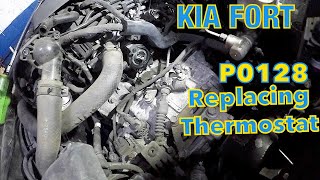
- DIY Repair Video Walkthrough: A YouTube video by 'RB The Mechanic' provides a detailed, step-by-step guide for replacing the thermostat on a Kia Forte. The video highlights the location of the three bolts securing the thermostat housing and the process of removing the air duct and computer to gain access.
Mechanic-Grade Diagnostic Values
- ECT Sensor Resistance vs. Temperature — expected: At 0°C (32°F): 5.0-6.5 kΩ. At 20°C (68°F): 2.0-3.0 kΩ. At 90°C (194°F): 225-300 Ω.. Failure: Readings outside of these ranges indicate a faulty sensor.
- ECT Sensor Voltage (Signal Wire to Ground) — expected: Approximately 2.0V-3.0V on a cold engine (e.g., 20°C / 68°F). Decreasing to approximately 0.5V on a fully warmed-up engine (e.g., 90°C / 194°F).. Failure: Voltage that is stuck, erratic, or does not decrease smoothly as the engine warms up.
Scan Tool Commands That Help
- Kia Diagnostic System (KDS): ECU Upgrade — This function is used to apply software updates to the Engine Control Unit (ECU). For the P0128 code, this is specifically called for in TSB TSBENG176 for certain 2017 Forte models to correct overly sensitive diagnostic logic. It may also be applicable to other years if the dealer identifies a relevant update.
- Kia Diagnostic System (KDS): In Use Performance Ratio Data Extraction — While not a direct diagnostic command for P0128, this function (detailed in TSB ENG178) is used by dealers to pull emissions-related performance data from the ECU for CARB. It demonstrates the dealer-level capability to access deep system data that is not available on standard OBD-II scanners.
Wiring & Ground Locations
- Engine Ground Cable — Commonly found bolted from the engine block or cylinder head to the chassis frame rail or firewall. Specific part numbers like 91860-B0130 (for 2017-18 models) and 91860-A7220 (for 2014-16 models) exist.. A poor engine ground can cause erratic behavior in various sensors, including the ECT sensor, leading to incorrect readings and false trouble codes. While not a primary cause for P0128, it's a foundational check for any electrical issue.
- ECU/PCM Ground Pins — On the main Engine Control Module connector. For example, on a 2020 Forte with the 2.0L Nu engine, pins 3, 18, and 21 on connector 'A' are grounds.. These are the specific ground references for the computer. A fault here would cause major, widespread issues, but checking for voltage drop between these pins and the battery negative post can rule out ECU grounding problems.
- Fuse Panel Ground Bolt — Often located near the interior fuse panel, under the driver's side dashboard. It serves as a common grounding point for multiple interior circuits.. While less likely to be directly related to the ECT sensor circuit, a loose main body ground can cause a variety of unpredictable electrical problems throughout the vehicle.
Real Owner Repair Stories
- BobIsTheOilGuy.com forum user '1 SX' (Kia Forte 2.4L (First Generation)) — Check Engine Light with code P0128 appeared shortly after replacing the original thermostat with a new, genuine OEM part as preventative maintenance.
❌ Tried (didn't work) Initially, the user had to redo the job because they installed the gasket incorrectly on the housing instead of the engine block, causing a leak. After fixing the leak and properly bleeding the system, the code still appeared.
✅ What actually fixed it The user diagnosed the problem by monitoring live data. The new OEM thermostat was defective and not allowing the engine to warm up past ~143°F at highway speeds, even though it would reach 191°F at idle. The final fix was to replace the brand-new, but faulty, OEM thermostat with another one.
OEM Part Supersession History
25500-2E000→25500-2E000 (current)— This part number is used across a wide range of model years (2012-2024) and models including the Forte, Soul, and Seltos with 1.8L and 2.0L Nu engines. While the number itself has not been superseded, there may be internal revisions from the manufacturer over its long production life.
Helpful Videos

The information in this article is provided for general reference and educational purposes only. Vehicle specifications, procedures, and part compatibility can vary by production date, trim level, and region. Always consult your vehicle's factory service manual and verify part numbers before purchasing or performing repairs. Safety-critical components such as airbags, seat belts, and braking systems should be installed by a qualified professional.
- Kia FORTE:
- 🧭 Diagnostic Flowchart
- 🎬 Helpful Videos
- What's Unique About the 2010-2017 Kia FORTE
- Symptoms You May Notice
- Most Likely Causes
- Rare But Worth Checking
- Diagnosis Steps
- Parts You'll Likely Need
- Technical Service Bulletins (TSBs) & Recalls
- Platform-Specific Known Issues
- Mechanic-Grade Diagnostic Values
- Scan Tool Commands That Help
- Wiring & Ground Locations
- Real Owner Repair Stories
- OEM Part Supersession History
- 🎟️ Get 5% Off