

P0128 on 2012-2019 Kia Rio: Coolant Temperature Below Normal Causes and Fixes
On a 2012-2019 Kia Rio, code P0128 is most often caused by a faulty thermostat stuck in the open position or an outdated Engine Control Unit (ECU) software. A thermostat replacement is an inexpensive DIY fix (~$15-$30 part, OEM P/N: 25500-2B000), while the software update must be performed by a Kia dealer and may be covered by a service campaign (e.g., TSBENG202). Always check for TSBs before replacing parts.
- For a 2012-2019 Kia Rio, always check for an applicable ECU software update TSB before replacing any parts for code P0128.
- The most common mechanical failure is a thermostat that is stuck open, which is an affordable part and a manageable DIY repair.
- Symptoms to watch for include a low reading on the temperature gauge, poor heater performance, and a drop in fuel economy.
- Driving with this code is not immediately dangerous, but it should be addressed to prevent long-term engine wear and poor performance.
- Always bleed the air from the cooling system after replacing the thermostat or adding coolant to prevent overheating issues.
What's Unique About the 2012-2019 Kia RIO
What makes the Kia Rio unique regarding code P0128 is the well-documented history of the code being triggered by software glitches in the Engine Control Unit (ECU). Kia has issued multiple Technical Service Bulletins (TSBs) for both the third and fourth-generation Rio, calling for a dealership to perform an 'ECU Logic Improvement' to fix the problem. This means that unlike many other vehicles where P0128 is almost exclusively a mechanical fault, on a Rio, it could very well be a software issue that requires no parts replacement. This is a critical first check before spending money on a thermostat.
Diagnostic Flowchart
Tap your situation to follow the diagnostic path that matches what you're seeing on this vehicle.
Generation note: The 2012-2019 range covers two generations of the Kia Rio: the third generation (2012-2017, code UB) and the fourth generation (2018-2019, code SC). Technical Service Bulletins related to code P0128 have been issued for models in both generations, indicating the causes and fixes are similar across this year range.
Symptoms You May Notice
- Check Engine Light is illuminated
- Engine temperature gauge reads lower than normal or fluctuates, especially dropping at highway speeds
- Heater blows lukewarm or cool air, taking a long time to warm up the cabin
- Noticeable decrease in fuel economy
- Vehicle takes longer than usual to warm up after a cold start
- Replacing the thermostat when the actual problem is the ECU software. It is critical to check for applicable TSBs for your Kia Rio's VIN before spending money on parts.
- Replacing the ECT sensor when the thermostat is the actual cause. A stuck-open thermostat will cause the ECT sensor to report a low temperature, but the sensor itself is working correctly.
Most Likely Causes
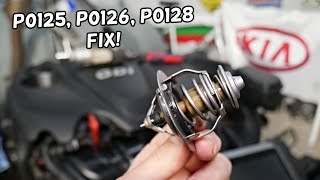
- Faulty Engine Thermostat 🔴 High Probability → Shop Integrated Thermostat Housing Assembly Thermostats are wear items designed to fail in the 'open' position as a failsafe against overheating. This is the most common mechanical cause for P0128 on almost all vehicles, including the Rio.
How to confirm: Use a scan tool to monitor live coolant temperature data. After a cold start, the temperature should climb steadily to ~180-200°F and stabilize. If it warms up very slowly, 🎬 See how a professional mechanic diagnoses a P0128 code. never reaches 180°F, or if the temperature drops significantly while driving at highway speeds, the thermostat is almost certainly stuck open.
Typical fix: Replace the engine thermostat and gasket. The thermostat is located on the driver's side of the engine, below the alternator, where the lower radiator hose connects. The cooling system must be partially drained, the thermostat replaced, and then the system refilled 🎬 Watch: Step-by-step guide to replacing the thermostat on your Rio. and bled of air.
Est. part cost: $15-$30 - Engine Control Unit (ECU) Software Update Needed 🔴 High Probability Kia has officially recognized that the factory ECU logic can be too sensitive and may incorrectly trigger P0128, especially in certain production runs. This is confirmed by multiple TSBs issued specifically for the Rio.
How to confirm: A Kia dealership can check your vehicle's VIN against their database for open service campaigns or applicable TSBs (like TSBENG202, TSBENG146R1, TSB-ENG118R2). This should be the first step before replacing parts. TSBENG202, for example, applies to 2019 Rios built between August 27, 2018, and March 4, 2019.
Typical fix: The Kia dealer will perform an 'ECU Upgrade' using their proprietary KDS diagnostic system to install improved software logic. This is often covered under warranty or as a service action. Out of warranty, owners may face a diagnostic fee or labor charge for the update.
Est. part cost: $0 - $150 - Low Engine Coolant Level 🟡 Medium Probability Leaks can develop over time in any cooling system. If the level drops, air pockets can form near the coolant temperature sensor, causing it to send inaccurate readings to the ECU.
How to confirm: Visually inspect the coolant reservoir and the radiator (when the engine is cold). If the level is below the 'MIN' line, it needs to be topped off. Also, look for signs of coolant leaks (green, pink, or blue puddles) under the car.
Typical fix: Top off the coolant with the correct type (Kia-specified coolant, typically green or blue) and inspect the system for leaks. After refilling, bleed the system to remove air.
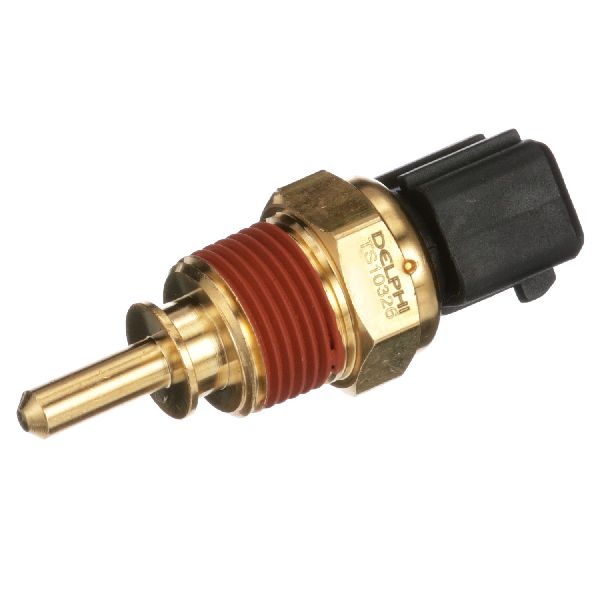
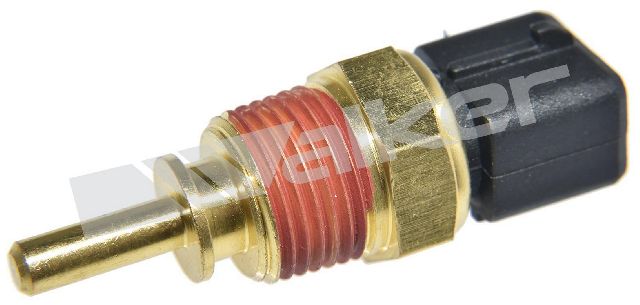
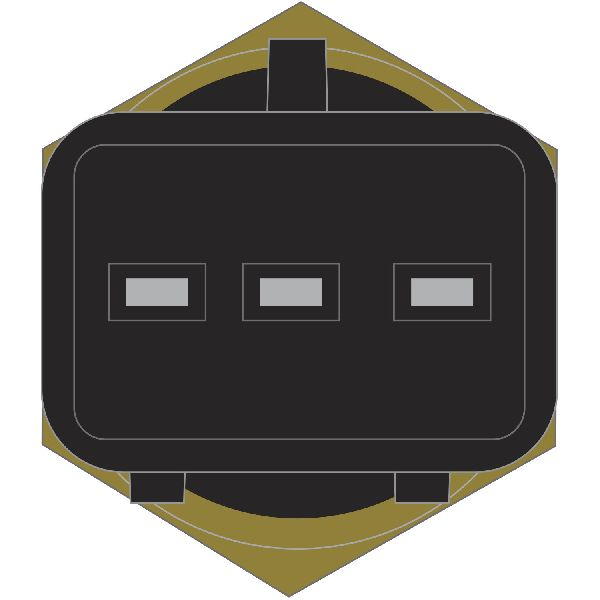
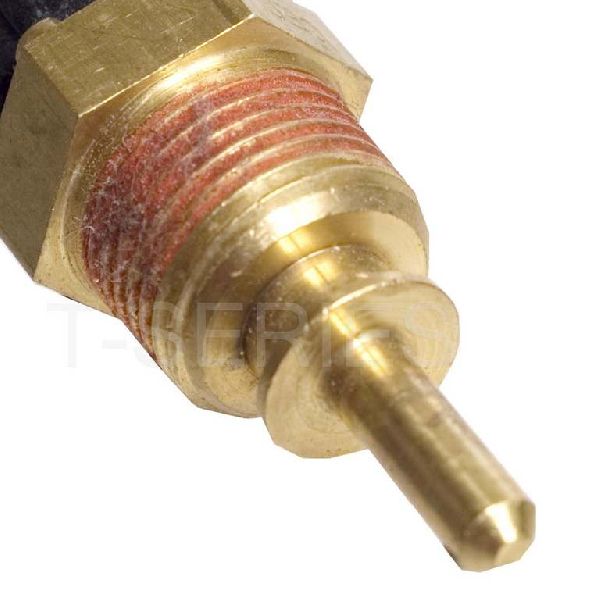
Est. part cost: $20-$40 - Faulty Engine Coolant Temperature (ECT) Sensor ⚪ Low Probability → Shop Engine Coolant Temperature Sensor While sensors can fail, it's much less common for this code than the thermostat or ECU logic. A faulty ECT sensor will often trigger other codes (like P0116-P0119) in addition to or instead of P0128.
How to confirm: Using a scan tool, observe the live data from the ECT sensor. If the reading is erratic, jumps to extreme highs or lows (e.g., -40°F), or doesn't change at all as the engine warms up, the sensor or its wiring is likely faulty. You can also test the sensor's resistance; at an ambient temperature of 20°C (68°F), it should be between 2000-3000Ω, and at 90°C (194°F), it should be between 200-300Ω.
Typical fix: Replace the ECT sensor. This is typically a small, inexpensive sensor that screws into the engine or thermostat housing. 🎬 Watch: How to locate and replace the ECT sensor.
Est. part cost: $20-$50
Rare But Worth Checking
- Cooling Fan Stuck On: → Shop Engine Cooling Fan Blade If the electric radiator fan runs constantly, even when the engine is cold, it can prevent the engine from warming up properly. This is usually caused by a failed fan relay or control module and is a very rare cause for this code.
Diagnosis Steps
- Check for Service Bulletins: The first and most important step for this specific vehicle. Contact a Kia dealer or use an online TSB database to see if your VIN is affected by TSBENG202, TSBENG146R1, or TSB-ENG118R2. If so, an ECU update is the prescribed fix.
- Check Coolant Level and Condition: With the engine cold, check the coolant level in the overflow reservoir and radiator. Ensure it is full and the coolant is clean and of the correct type.
- Scan and Monitor Temperature: Connect an OBD-II scanner and view the live data for the Engine Coolant Temperature (ECT). Start the cold engine and watch the temperature rise. It should climb steadily to around 180-200°F (82-93°C) and stabilize.
- Analyze Temperature Behavior: If the temperature rises very slowly, never reaches 180°F, or drops significantly when you drive at highway speeds, a stuck-open thermostat is the most likely mechanical fault.
- Test the ECT Sensor: If the temperature reading on the scanner is erratic, nonsensical (e.g., -40°F), or doesn't change at all, the ECT sensor or its wiring is suspect. Compare the cold ECT reading to the Intake Air Temp (IAT) sensor reading; they should be very close. Test the sensor's resistance with a multimeter: expect ~2.0-3.0 kΩ at 68°F (20°C) and ~0.2-0.3 kΩ at 194°F (90°C).
- Inspect Cooling Fan: Check if the radiator fan is running constantly, even immediately after a cold start. If it is, diagnose the fan control circuit.
- Perform Repairs: Based on the diagnosis, either take the vehicle for an ECU update, replace the thermostat (OEM P/N: 25500-2B000), replace the ECT sensor, or repair the fan circuit. Always bleed the cooling system properly after any repairs that involve draining coolant.
Parts You'll Likely Need
- Engine Coolant Thermostat
(OEM #25500-2B000)— This is the most common mechanical failure that causes code P0128. It gets stuck open, over-cooling the engine. This part number is widely used across the 1.6L Gamma engine family.
Trusted brands: Genuine Kia/Hyundai, Mahle, Gates, Beck Arnley
OEM price range: $40-$60
Aftermarket price range: $15-$30 - Engine Coolant Temperature Sensor
(OEM #39220-38030)— A less common but possible cause, a faulty sensor can send incorrect temperature data to the ECU, triggering the code. Part number 39220-38030 is a common sensor for this application.
Trusted brands: Bosch, Delphi, NTK
OEM price range: $40-$70
Aftermarket price range: $20-$50
Technical Service Bulletins (TSBs) & Recalls
- TSBENG202: SERVICE ACTION: ECU LOGIC IMPROVEMENT FOR DTC P0128 (SA374) for 2019 Rio (SC) models produced from August 27, 2018 through March 4, 2019.
- TSBENG146R1: ECM UPGRADE – RIO, SOUL MIL ON WITH DTC(S) ... P0128 for 2012-2014 Rio (UB) models.
- TSB-ENG118R2: COMBINED TSB/SERVICE ACTION ... MIL ON WITH DTCS ... P0128 (SA152) for 2012-2013 Rio (UB) models.
Platform-Specific Known Issues
- Certain 2012-2014 and 2019 Kia Rio models are subject to Technical Service Bulletins (TSBs) where the official fix for a P0128 code is a software update to the Engine Control Unit (ECU). This is not a mechanical repair and should be investigated before replacing any parts.
Mechanic-Grade Diagnostic Values
- Engine Coolant Temperature (ECT) Sensor Resistance — expected: 2000-3000 Ω (2.0-3.0 kΩ) at 20°C (68°F); 200-300 Ω (0.2-0.3 kΩ) at 90°C (194°F). Failure: Readings significantly outside these ranges indicate a faulty sensor.
- Engine Coolant Temperature (ECT) Sensor Signal Voltage (Key On, Engine Off) — expected: Approximately 2V to 3V on a cold engine, dropping to around 0.5V when the engine is fully warmed up.. Failure: Voltage that is stuck, does not change with temperature, or is significantly different (e.g., 1.5V on a cold engine) points to a sensor or wiring issue.
Scan Tool Commands That Help
- Kia Diagnostic System (KDS): ECU Upgrade - Manual Mode - Upgrade Event #411 — This specific function is used by Kia technicians to apply the improved ECU logic to fix a false P0128 code on affected 2019 Rio models, as detailed in TSB SA374.
Wiring & Ground Locations
- Engine Ground Strap (UB Generation) — A black cable connecting the negative battery terminal to the vehicle's chassis and then to the engine block. The main engine ground wiring assembly for the 2012-2017 Rio is part number 91861-1W210.. A poor or corroded engine ground can cause erratic behavior from various sensors, including the ECT sensor, leading to incorrect readings and potentially triggering fault codes. While not a primary cause for P0128, it's a foundational check for any electrical diagnosis.
Real Owner Repair Stories
- Reddit user on r/MechanicAdvice (Vehicle with recurring P0128) — Check Engine Light with code P0128 came on. After replacing the thermostat and flushing the coolant, the light went away but returned two months later with the same code.
❌ Tried (didn't work) Replacing the thermostat with an OEM-equivalent part from an auto parts store.
✅ What actually fixed it The user was advised to investigate other causes, as the code returned. This highlights that either the replacement (aftermarket) thermostat failed prematurely, or the root cause was something else, like the ECT sensor or an ECU logic issue, which is a known problem on these vehicles. The final fix was not posted, but the story serves as a caution against assuming the first repair is always the final one.
OEM Part Supersession History
25500-2B400, 25500-2B001→25500-2B000— Part consolidation and potential design updates by the manufacturer.
Heads up: The newer part number 25500-2B000 is the correct direct replacement for the older numbers on the 2012-2019 Kia Rio.
Model Year Variations Within This Range
- 2012-2017 vs 2018-2019: The 2012-2017 models are the 'UB' generation, while the 2018-2019 models are the 'SC' generation. While they share the 1.6L Gamma engine and similar P0128 causes, Kia issued separate TSBs for the ECU logic update for each generation, indicating different software fixes are required (e.g., TSBENG146R1 for UB vs. TSBENG202 for SC).
Helpful Videos
We Have This Part in Stock


The information in this article is provided for general reference and educational purposes only. Vehicle specifications, procedures, and part compatibility can vary by production date, trim level, and region. Always consult your vehicle's factory service manual and verify part numbers before purchasing or performing repairs. Safety-critical components such as airbags, seat belts, and braking systems should be installed by a qualified professional.
- Kia RIO:
- 🧭 Diagnostic Flowchart
- 🎬 Helpful Videos
- 🛍️ Shop This Part
- What's Unique About the 2012-2019 Kia RIO
- Symptoms You May Notice
- Most Likely Causes
- Rare But Worth Checking
- Diagnosis Steps
- Parts You'll Likely Need
- Technical Service Bulletins (TSBs) & Recalls
- Platform-Specific Known Issues
- Mechanic-Grade Diagnostic Values
- Scan Tool Commands That Help
- Wiring & Ground Locations
- Real Owner Repair Stories
- OEM Part Supersession History
- Model Year Variations Within This Range
- 🎟️ Get 5% Off