

P0128 on 2004-2009 Mazda 3: Causes and Fixes for Coolant Temperature Issues
On a first-generation Mazda 3, the P0128 code almost always means the thermostat is stuck open. It's a common failure on this platform. Replacing the thermostat and housing assembly is the typical fix, costing around $30-$60 for an aftermarket part and is a DIY-friendly job (2/5 difficulty). For early 2004-2005 models, a PCM reflash per TSB 01-041/07 may be required if a new thermostat doesn't solve the issue.
- P0128 on your 2004-2009 Mazda 3 almost certainly means you need a new thermostat.
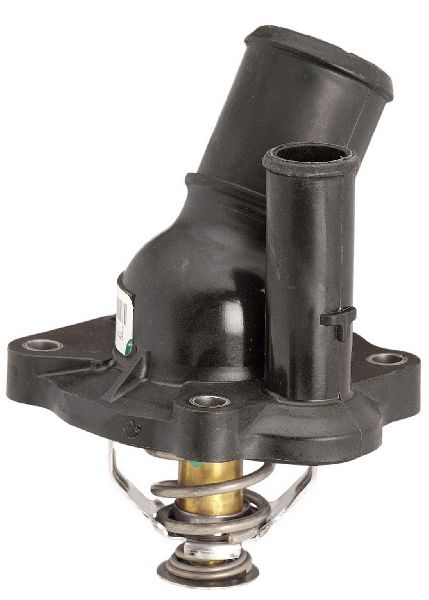
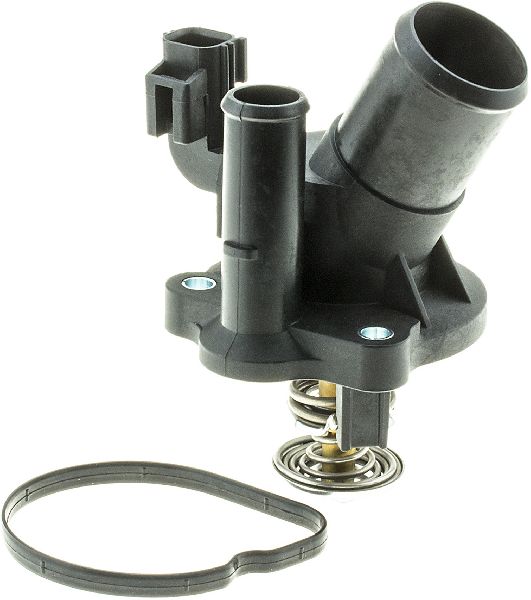
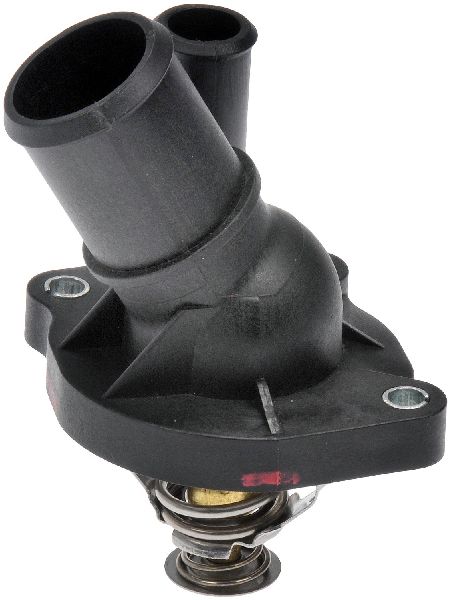
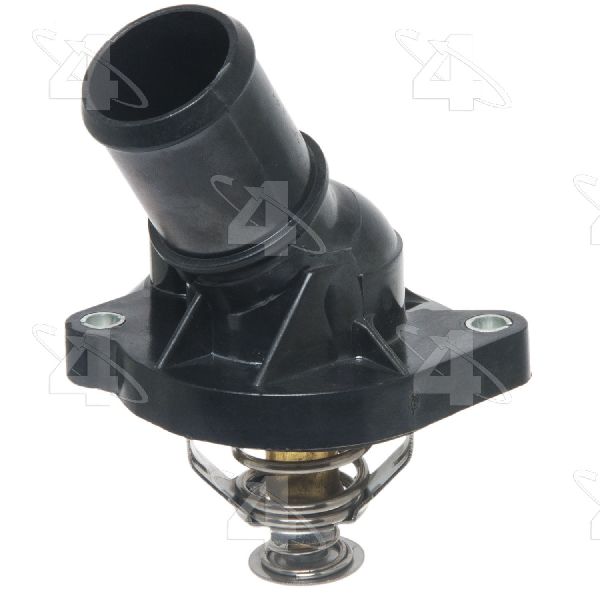
- The thermostat is sold as a complete assembly with the plastic housing; you cannot buy just the inner valve.
- While driving is possible, fixing it will restore proper fuel economy and heater function.
- This is a manageable DIY repair for those with basic tools, typically taking 1-2 hours. A key tip is accessing the bottom bolt from under the car.
- Always check your coolant level first, as a significant leak could also cause this code.
- For 2004-2005 models, be aware of TSB 01-041/07 regarding a sensitive PCM, which may require a dealer reflash if a new thermostat doesn't clear the code.
What's Unique About the 2004-2009 Mazda 3
The first-generation Mazda 3 (2004-2009) is well-known for this specific issue. The original thermostat, housed in a plastic assembly, is a common failure point that tends to get stuck in the open position. While other causes are possible, a faulty thermostat is so prevalent on these 2.0L and 2.3L engines that it is the primary suspect by a wide margin. Some early models (2004-2005) were also subject to a Technical Service Bulletin (TSB 01-041/07) for a PCM calibration that was too sensitive, especially in cold weather. However, on a vehicle of this age, a physical part failure is the most likely cause.
Symptoms You May Notice
- Check Engine Light is on
- Engine temperature gauge on the dashboard reads lower than normal, takes a very long time to reach the middle, or drops towards 'C' during highway driving.
- Heater may not blow as hot as it should, especially in cold weather or at idle.
- Noticeable decrease in fuel economy.
- In some cases, rough idling or erratic shifting as the engine computer struggles with an incorrect temperature reading.
- Replacing the Engine Coolant Temperature (ECT) sensor first. While the sensor can fail, the thermostat is a far more common cause for this specific code on this vehicle.
- Assuming an aftermarket thermostat is good. Some owners have reported receiving the same P0128 code shortly after replacing the thermostat with a faulty or incorrect temperature aftermarket part.
Most Likely Causes
- Thermostat Stuck Open 🔴 High Probability → Shop Integrated Thermostat Housing Assembly The original thermostat and plastic housing assembly is a known weak point on the LF-DE and L3-VE engines, frequently failing and sticking in the open position. This prevents the engine from warming up at a normal rate.
How to confirm: After a cold start, feel the upper radiator hose. If it starts to get warm almost immediately (within 1-2 minutes), the thermostat is likely stuck open, allowing coolant to flow to the radiator prematurely. A properly functioning thermostat would keep the hose cold until the engine reaches operating temperature (around 180-195°F). A more definitive test involves removing the thermostat and placing it in hot water to see if it opens, and then in cold water to see if it fails to close completely.
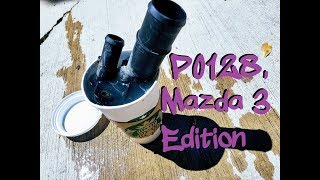
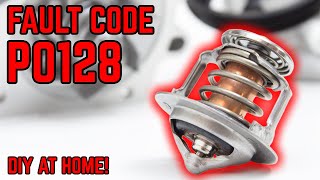
Typical fix: Replace the entire thermostat and housing assembly. 🎬 Watch this video to see how a stuck thermostat causes P0128. On this vehicle, the thermostat is integrated into the housing and is not sold separately. The job requires draining some coolant and removing three 8mm bolts. 🎬 See this step-by-step walkthrough for replacing the thermostat assembly.
Est. part cost: $30-$60 - Low Engine Coolant 🟡 Medium Probability The plastic thermostat housing can become brittle, crack, and leak, leading to low coolant levels. Other common leak points include the radiator, hoses, and water pump.
How to confirm: Visually inspect the coolant level in the overflow reservoir when the engine is cold. Check for puddles of green or blue coolant under the car and look for white or colored crusty residue around the thermostat housing, radiator, and hoses, which indicates a slow leak.
Typical fix: Find and repair the source of the leak, then top off and bleed the cooling system to remove any air pockets.
Est. part cost: $10-$200+ - Faulty Engine Coolant Temperature (ECT) Sensor ⚪ Low Probability → Shop Engine Coolant Temperature Sensor
How to confirm: Use an OBD-II scanner to monitor the live data from the ECT sensor. When the engine is cold (after sitting overnight), the ECT reading should be very close to the Intake Air Temperature (IAT) sensor reading. If it's significantly different, the sensor may be faulty. However, this is a much rarer failure than the thermostat for this code.
Typical fix: Replace the ECT sensor. It is located on the thermostat housing.
Est. part cost: $20-$50
Rare But Worth Checking
- Cooling Fan Running Constantly: → Shop Engine Cooling Fan Blade If the radiator fan is stuck on (due to a faulty fan relay or control module), it can over-cool the engine, especially at idle or low speeds, preventing it from reaching operating temperature. Manufacturer Bulletin #01-005-20-3704 notes that incorrect cylinder head temperature readings can also affect cooling fan operation.
- PCM Calibration Issue: Mazda Technical Service Bulletin TSB 01-041/07 was issued for 2004-2005 Mazda 3 models where the PCM's parameters for triggering P0128 were too sensitive, especially in cold climates during short trips with the heater on full. The fix is a PCM re-flash at a dealership. While possible, it's less likely than a mechanical failure on a vehicle of this age, but should be considered if a new thermostat doesn't fix the code.
Diagnosis Steps
- Check for other DTCs: Use an OBD-II scanner to confirm P0128 is the primary code. Note if P0126 is also present, which strengthens the diagnosis of a thermostat issue. Manufacturer Bulletin #01-005-20-3704 indicates that P0128 may also appear alongside P1285 and P1299, where the engine temperature may be cold but report as hot, or vice versa.
- Inspect Coolant Level: With the engine cold, check the coolant level in the overflow tank. A low level can cause this code. If low, top it off with a compatible FL22 coolant and inspect for leaks.
- Monitor Coolant Temperature: Use a scanner to view live data. Start the cold engine and watch the ECT sensor reading. Note how long it takes to warm up. If the temperature stalls or drops on the highway, the thermostat is likely stuck open.
- Check Radiator Hose: While the engine is warming up from a cold start, carefully feel the upper radiator hose. If it gets warm within the first couple of minutes, the thermostat is stuck open. It should remain cool until the engine reaches about 180-195°F.
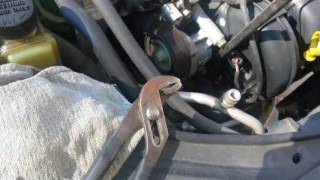
- Confirm ECT Sensor Accuracy: Before the first start of the day, compare the ECT and IAT sensor readings on a scan tool. They should be within a few degrees of each other. If not, the ECT sensor may be skewed. 🎬 Watch this helpful guide on diagnosing and fixing the P0128 code.
- If all other checks pass, the thermostat is the most likely culprit. Given the high failure rate, many technicians will replace it preventatively for this code.
Parts You'll Likely Need
- Thermostat and Housing Assembly
(OEM #LF70-15-170)— This is the most common failure point for code P0128 on this vehicle. The thermostat sticks open and is sold as a complete assembly with the housing.
Trusted brands: Motorad, Dayco, Gates, Duralast, WOLFIGO
OEM price range: $50-$80
Aftermarket price range: $30-$60 - Engine Coolant / Antifreeze — The system must be partially drained to replace the thermostat. Use a P-OAT type coolant compatible with Mazda, often labeled as 'Asian Vehicle' green or blue coolant. Mazda's specified coolant is FL22.
Trusted brands: Zerex Asian Vehicle, Peak Asian, Genuine Mazda FL22
OEM price range: $25-$35 per gallon
Aftermarket price range: $18-$25 per gallon
Related Codes That Often Appear With This One
- P0126: 'Insufficient Coolant Temperature for Stable Operation' - This code is very similar and often appears alongside P0128, pointing directly to the same root cause of the engine running too cool.
Technical Service Bulletins (TSBs) & Recalls
- TSB 01-041/07 (supersedes 01-008/04): Affects 2004-2005 Mazda 3 models. Addresses an improper PCM calibration that could falsely trigger P0128 in cold weather. The fix is to reprogram the PCM. For vehicles built before Feb 1, 2004, the TSB also advises replacing the thermostat if the code persists after the reflash.
- TSB 01-007/11: Mentioned in forums for a similar issue where stop-and-go driving in the cold with the heater on high could trigger the code due to an overly sensitive PCM threshold. The procedure involves inspecting the thermostat and, if it's okay, reprogramming the PCM.
- Bulletin #01-021-13-2817B: Notes that some vehicles may experience a MIL on with DTC P0128:00 (thermostat stuck open) caused by improper control logic of the PCM, which requires a logic update to correct.
- Bulletin #01-005-20-3704: Describes a concern where the engine temperature may be cold and report as hot or be hot and report as cold, potentially exhibiting DTC P0128.
Platform-Specific Known Issues
- The plastic thermostat housing is a known weak point that can become brittle and crack over time, leading to coolant leaks in addition to the P0128 code.
- The thermostat is not replaceable by itself; it is integrated into the housing and must be purchased as a single assembly.
- Accessing the bottom bolt of the three 8mm bolts holding the housing can be tricky from above. Some DIYers find it easier to reach from underneath the car.
- Bleeding air from the cooling system after the repair is critical to prevent overheating. Using a spill-proof funnel kit is highly recommended to properly 'burp' the system.
Mechanic-Grade Diagnostic Values
- ECT Sensor Resistance (cold) — expected: 2,000 - 3,000 Ω (2.0 - 3.0 kΩ) at 20°C (68°F). Failure: Significantly higher or lower resistance indicates a faulty sensor. An open circuit (infinite resistance) or short circuit (near zero resistance) is a definitive failure.
- ECT Sensor Resistance (hot) — expected: 200 - 350 Ω at 80°C-90°C (176°F-194°F). Failure: Resistance that does not drop to this range when the engine is at operating temperature suggests the sensor is not reading correctly.
- ECT Sensor Signal Voltage (Key On, Engine Off, Cold) — expected: ~2.0V - 3.5V, depending on ambient temperature.. Failure: A reading of 5V indicates an open circuit or disconnected sensor. A reading near 0V indicates a short to ground.
- ECT Sensor Signal Voltage (Engine at Operating Temp) — expected: ~0.5V - 1.3V. Failure: Voltage that remains high (e.g., over 1.5V) when the engine is fully warmed up indicates the sensor is faulty or the engine is not reaching temperature (confirming the P0128 condition).
Scan Tool Commands That Help
- Mazda IDS/MDARS: PCM Reprogramming / Module Reprogramming — This is a dealer-level function used to apply an updated software calibration to the Powertrain Control Module (PCM). It is the specific fix for the issue described in TSB 01-041/07 for 2004-2005 models where the original PCM logic was too sensitive and could falsely trigger a P0128 code, especially in cold weather. This should be considered if a new thermostat does not resolve the code on an affected model year vehicle.
Wiring & Ground Locations
- ECT Sensor Connector — On the thermostat housing assembly, which is located on the driver's side of the engine block, below the intake manifold.. This is the primary point for testing the sensor's resistance and the voltage signal from the PCM. The connector has two wires, reported to be white and brown. A poor connection, corrosion, or damaged wires here will cause incorrect temperature readings, potentially triggering P0128.
- G06 — Left rear of the engine.. This is an engine ground point. A poor ground here can affect the reference for various engine sensors, including the ECT sensor, leading to erratic or incorrect readings that could contribute to a P0128 code.
- G09 — Under the left side of the dashboard.. This is a major chassis ground point for components inside the cabin. While less direct, a compromised ground here can cause unpredictable electrical issues for the PCM, which interprets the ECT sensor data.
Real Owner Repair Stories
- YouTube channel 'pistonsandpixiedust' (2006 Mazda 3 2.0L) — Check Engine Light with code P0128.
❌ Tried (didn't work) The mechanic noted that the temp sensor is a possibility, but the thermostat is the most common failure.
✅ What actually fixed it Replacing the thermostat and housing assembly. The mechanic definitively proved the old part was faulty by submerging it in hot water to watch it open, and then in cold water where it failed to close, confirming it was stuck open. - Reddit user in /r/Cartalk (2008 Mazda 3 S GT) — P0128 code returned two months after replacing both the thermostat (with an O'Reilly's part) and the coolant temperature sensor.
❌ Tried (didn't work) Replaced thermostat, Replaced coolant temperature sensor
✅ What actually fixed it The user's warm-up times seemed normal, suggesting the parts were working. The accepted solution in the thread was to investigate TSB 01-007/11, which addresses improper PCM calibration causing the code during specific driving conditions (stop-and-go with heater on high). The final fix is a PCM re-flash at a dealership. - Reddit user in /r/MechanicAdvice (Vehicle not specified, but common P0128 scenario) — P0128 code returned 2 months after replacing the thermostat with an 'OEM equivalent' from an auto parts store.
❌ Tried (didn't work) Replacing the thermostat with an aftermarket part.
✅ What actually fixed it The thread did not have a final confirmed fix from the original poster, but the discussion heavily pointed towards the new aftermarket thermostat being faulty out of the box or having the incorrect temperature rating. This represents a common pitfall where the 'fix' doesn't last.
OEM Part Supersession History
L327-15-170, L327-15-170A, L327-15-171, L328-15-170A, L328-15-170B→L336-15-170— Standard part revision and consolidation by the manufacturer.
Heads up: No known incompatibilities. L336-15-170 is the correct current replacement for the earlier numbers on applicable 2.3L engines.
Model Year Variations Within This Range
- 2004-2005: These early model years are subject to TSB 01-041/07, which indicates the PCM logic for detecting a P0128 fault was too sensitive, especially in cold climates. While a mechanical thermostat failure is still the most likely cause due to age, a PCM re-flash is a specific remedy for these years if a new thermostat doesn't solve the code.
Diagnostic Flowchart
Real Owner Stories
Aggregated from forums and TSBs cited above. Mileages and costs reflect what owners reported in those sources.
2004 Mazda 3 2.3L
Symptoms: Check engine light came on at startup after a very cold night (10 degrees). The engine temp gauge reads regularly in the middle after a 5-minute drive.
What fixed it: A commenter advised the owner to replace the thermostat, recommending an OEM part. (Repair was pending at the time of the post).
Source hint: r/Cartalk - 2004 Mazda 3 2.3L Code P0128
2007 Mazda 5 (Platform Mate)
Symptoms: Battled the P0128 code for some time without resolution.
What fixed it: Replacing the thermostat resolved the code permanently.
Source hint: mazda3forums.com thread titled 'Mazda 5 Check engine P0128'
Related OBD-II Codes
Frequently Asked Questions
Does TSB 01-041/07 apply to my Mazda 3?
Can I just replace the thermostat insert on my 2.0L or 2.3L engine?
Why is my 2004-2009 Mazda 3 losing coolant along with the P0128 code?
What kind of coolant should I use if I need to top off my Mazda 3?
Is there a trick to removing the thermostat housing on this car?
I got P0128 after driving in stop-and-go traffic with the heater on high. Is my thermostat broken?
Helpful Videos

We Have This Part in Stock


The information in this article is provided for general reference and educational purposes only. Vehicle specifications, procedures, and part compatibility can vary by production date, trim level, and region. Always consult your vehicle's factory service manual and verify part numbers before purchasing or performing repairs. Safety-critical components such as airbags, seat belts, and braking systems should be installed by a qualified professional.
- Mazda 3:
- 🧭 Diagnostic Flowchart
- 🎬 Helpful Videos
- 🛍️ Shop This Part
- What's Unique About the 2004-2009 Mazda 3
- Symptoms You May Notice
- Most Likely Causes
- Rare But Worth Checking
- Diagnosis Steps
- Parts You'll Likely Need
- Related Codes That Often Appear With This One
- Technical Service Bulletins (TSBs) & Recalls
- Platform-Specific Known Issues
- Mechanic-Grade Diagnostic Values
- Scan Tool Commands That Help
- Wiring & Ground Locations
- Real Owner Repair Stories
- OEM Part Supersession History
- Model Year Variations Within This Range
- Real Owner Stories
- 2004 Mazda 3 2.3L
- 2007 Mazda 5 (Platform Mate)
- Related OBD-II Codes
- Frequently Asked Questions
- 🎟️ Get 5% Off