

P0128 on 2007-2012 Nissan Altima: Coolant Temperature and Thermostat Guide
On a 2007-2012 Nissan Altima, code P0128 almost always means the engine thermostat is stuck open and needs to be replaced. This is a very common failure item. For the 2.5L engine, there are two thermostats to consider. A new thermostat assembly typically costs between $25 and $80 for an aftermarket part.
- P0128 on a 2007-2012 Altima points overwhelmingly to a failed thermostat that is stuck open.
- The primary symptom to watch for is an engine temperature gauge that reads low or drops while driving at highway speeds.
- Before replacing any parts, verify the coolant level is correct.
- When replacing the thermostat, you must drain and refill the coolant. Use Nissan-specific blue long-life coolant to protect the system.
- The 2.5L 4-cylinder and 3.5L V6 engines use different thermostat parts, so ensure you purchase the correct one for your vehicle.
What's Unique About the 2007-2012 Nissan Altima
For the fourth-generation (L32) Altima, this code is an extremely common and well-documented issue. The vast majority of owner and mechanic experiences point directly to a failed thermostat that is stuck in the open position. A key difference is that the 2.5L (QR25DE) engine actually has two thermostats—a main one and a smaller 'water control valve'—and it's often recommended to replace both. The 3.5L (VQ35DE) has a single, more traditional thermostat. While a TSB for a software-related false P0128 code exists for some 2007 models (NTB07-020), a mechanical failure of the thermostat is far more probable and should be investigated first.
Symptoms You May Notice
- Check Engine Light is illuminated.
- Engine temperature gauge reads lower than normal, often staying near 'C' or dropping on the highway.
- Engine takes an unusually long time to warm up.
- Heater may not blow hot air or is only lukewarm, as it relies on hot engine coolant.
- Noticeable decrease in fuel economy because the engine stays in 'open-loop' mode, running a richer fuel mixture.
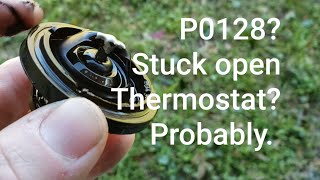
- Replacing the Engine Coolant Temperature (ECT) sensor when the thermostat is the actual problem. Always diagnose the thermostat's function by monitoring live temperature data before replacing sensors. 🎬 Watch: A professional mechanic's guide to diagnosing the P0128 code.
- On the 2.5L engine, replacing only one of the two thermostats. If the main thermostat is replaced but the water control valve is stuck open, the problem may persist.
Most Likely Causes
- Engine Thermostat Stuck Open 🔴 High Probability → Shop Integrated Thermostat Housing Assembly The original thermostat is a mechanical part with a finite lifespan that can fail and stick in the open position, allowing coolant to circulate constantly. This is the number one cause for P0128 on this vehicle.
How to confirm: Use an OBD-II scanner to monitor live coolant temperature data. If the temperature rises very slowly, fails to reach ~180-203°F, or drops significantly when driving at highway speeds, the thermostat is almost certainly stuck open. On a cold engine, the upper radiator hose should remain cool to the touch for several minutes after starting; if it warms up immediately, the thermostat is open.
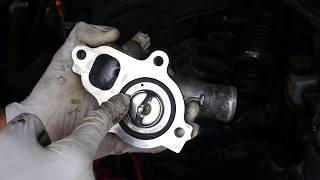
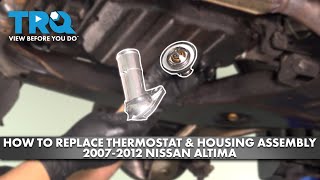
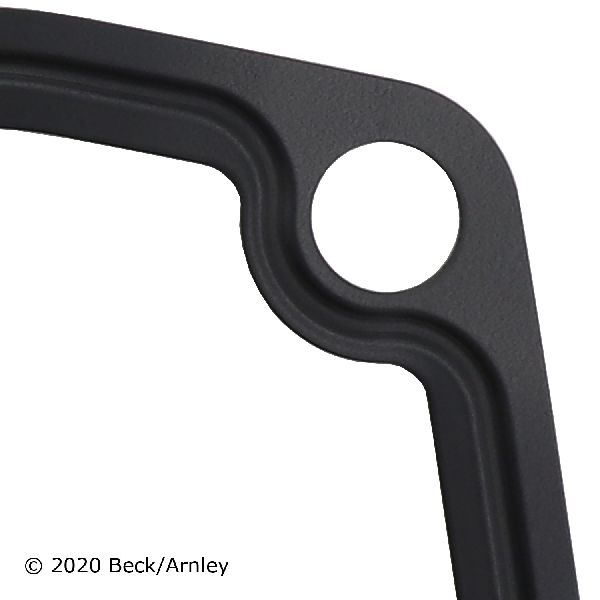
Typical fix: Replace the engine thermostat and gasket. It is sold as a complete housing assembly. 🎬 Watch: How to replace the thermostat and housing assembly. For the 2.5L engine, it is best practice to replace both the main thermostat and the secondary water control valve.
Est. part cost: $25-$80 - Low Engine Coolant Level 🟡 Medium Probability Coolant can be lost over time due to small, undetected leaks from brittle plastic radiator end tanks, hose connections, or the water pump. If the level is low, it can cause air pockets in the system, preventing the coolant temperature sensor from getting an accurate reading.
How to confirm: Visually inspect the coolant level in the reservoir and radiator (only when the engine is completely cool). If low, top it off and inspect the system for leaks. A coolant pressure tester is the most effective tool for finding leaks.
Typical fix: Top off the coolant with Nissan-specific blue long-life coolant and bleed the air from the system. Find and repair any leaks.
Est. part cost: $20-$40 - Faulty Engine Coolant Temperature (ECT) Sensor ⚪ Low Probability → Shop Engine Coolant Temperature Sensor
How to confirm: Compare the ECT sensor reading on a scan tool to the ambient air temperature on a cold engine (they should be very close). If the reading is erratic, nonsensical, or doesn't change as the engine warms up, the sensor is likely bad. Resistance can be tested with a multimeter; at 68°F (20°C), it should be between 2,000-3,000 ohms.
Typical fix: Replace the ECT sensor and ensure the electrical connector is clean and secure. This is often done at the same time as the thermostat as a preventative measure.
Est. part cost: $20-$50
Rare But Worth Checking
- ECM Software Calibration Issue: On some early models (particularly 2007), a TSB (NTB07-020) was issued because the ECM's parameters for triggering P0128 were too sensitive. This would require a dealer visit to reprogram the ECM. This should only be considered after confirming the thermostat and coolant system are functioning correctly, as it is much less common than mechanical failure.
- Cooling Fan Stuck On: → Shop Engine Cooling Fan Blade If the electric cooling fan runs constantly, even when the engine is cold, it can over-cool the engine and prevent it from reaching operating temperature. This could be caused by a faulty fan relay, fan control module, or a short in the wiring. This is an uncommon cause.
Diagnosis Steps
- Check for other stored trouble codes with an OBD-II scanner.
- With the engine cold, check the coolant level in the overflow reservoir and the radiator. Ensure it is full.
- Top off with the correct Nissan blue long-life coolant (or a compatible P-OAT fluid) if low, and inspect for any visible leaks in hoses, the radiator, or around the water pump.
- Connect a scan tool and monitor the Engine Coolant Temperature (ECT). On a cold start, it should be within a few degrees of the Intake Air Temperature (IAT).
- Start the engine and let it idle. Watch the ECT reading. It should climb steadily to around 180-203°F within 10-15 minutes.
- If the temperature climbs very slowly, never reaches 180°F, or if you drive the vehicle and the temperature drops significantly at highway speeds, the thermostat is stuck open and must be replaced.
- If the temperature gauge on the dash and the scan tool reading seem to conflict, or if the reading is erratic, suspect a faulty ECT sensor or wiring.
- After replacing the thermostat, ensure the cooling system is properly bled of all air. A spill-free funnel kit is highly recommended for this process.
- If all mechanical parts check out and the code returns, consult a dealer about potential ECM software updates, especially for 2007 models per TSB NTB07-020.
Parts You'll Likely Need
- Engine Coolant Thermostat Assembly (2.5L)
(OEM #21200-JA00B (supersedes 21200-EA000))— This is the most common failure part for the P0128 code on the 4-cylinder engine. It fails by sticking open. Note that the 2.5L has a second 'water control valve' that is also considered a thermostat.
Trusted brands: Nissan (OEM), Dorman, Gates, Motorad
OEM price range: $40-$70
Aftermarket price range: $25-$50 - Engine Coolant Thermostat Assembly (3.5L)
(OEM #21200-8J10B (supersedes 21200-8J100))— This is the most common failure part for the P0128 code on the V6 engine. It fails by sticking open.
Trusted brands: Nissan (OEM), Beck/Arnley, Gates
OEM price range: $50-$100
Aftermarket price range: $30-$60 - Nissan Long Life Coolant (Blue)
(OEM #999MP-L25500P)— The cooling system must be drained to replace the thermostat and refilled with the correct OEM-specification fluid to prevent corrosion and ensure proper system function.
Trusted brands: Nissan (OEM), Pentofrost A3, Valvoline Zerex Asian Blue
OEM price range: $25-$35 per gallon
Aftermarket price range: $20-$30 per gallon
Technical Service Bulletins (TSBs) & Recalls
- NTB07-020: Mentioned by owners for 2007 models regarding a potential ECM software update for a false P0128 code. This TSB addresses overly sensitive parameters in the original software.
- NTB21-006: A general Nissan TSB that involves reprogramming the ECM for a P0128 code, though not specific to the Altima. This bulletin notes that if the MIL is on with DTC P0128 (Thermostat Function) stored and there are no drivability concerns, specific action is required.
- NTB21-006A: An amended version of the manufacturer's service bulletin regarding the MIL being on with DTC P0128 stored.
Platform-Specific Known Issues
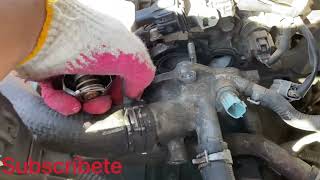
- Repair Location & Difficulty (2.5L QR25DE): The main thermostat is located on the driver's side of the engine, behind the cylinder head, under the intake manifold. It is difficult to access and requires removing the air intake ductwork. The second thermostat (water control valve) is located at the front of the engine and is easier to access. Due to the difficulty of the main thermostat, many owners choose to replace both at the same time. 🎬 See this walkthrough for replacing both 2.5L thermostats.
- Repair Location & Difficulty (3.5L VQ35DE): The thermostat is located on the driver's side of the engine, behind the power steering pump reservoir and fuse box. Access is tight, and these components may need to be unbolted and moved aside to reach the three 10mm bolts holding the thermostat housing.
- Owner Repair Story: 2007 Altima 2.5S: A user on Reddit with a 2007 Altima 2.5S reported code P0128 along with a low temperature gauge reading. The consensus from other mechanics was a faulty thermostat. The user also noted a constantly low coolant reservoir, indicating a potential slow leak contributing to the issue, which is a common secondary check.
Mechanic-Grade Diagnostic Values
- ECT Sensor Resistance (Cold Engine) — expected: 2,000 - 3,000 Ω at 68°F (20°C). Failure: Readings significantly outside this range indicate a faulty sensor.
- ECT Sensor Resistance (Operating Temp) — expected: 250 - 350 Ω at ~176°F (80°C). Failure: Readings significantly outside this range when the engine is warm indicate a faulty sensor.
- ECT Sensor Connector Reference Voltage — expected: 4.9 - 5.1 V (with key on, engine off, sensor disconnected). Failure: Voltage outside this range indicates a wiring or ECM problem, not a sensor fault.
- Thermostat Housing Bolt Torque (2.5L QR25DE) — expected: 16 ft-lbs. Failure: Over-tightening can crack the aluminum housing; under-tightening can cause leaks.
Hidden / Shadow Codes Worth Checking
- None: No specific 'shadow' or 'hidden' codes are commonly associated with P0128 on this platform. Diagnosis relies on the primary P0128 code and observation of live data. However, a complete failure of the ECT sensor or its circuit could independently set codes like P0117 (Circuit Low Input) or P0118 (Circuit High Input). (see via Standard OBD-II scanner.)
Scan Tool Commands That Help
- OBD-II Scan Tool (e.g., CONSULT, Autel, etc.): Live Data Monitoring (ECT vs. IAT) — This is the primary diagnostic method. Instead of a specific bidirectional command, technicians monitor the ECT data stream on a cold start to see if it rises steadily and compare it against the Intake Air Temp (IAT) sensor. A thermostat stuck open will cause the ECT to rise very slowly or drop at highway speeds.
Wiring & Ground Locations
- ECT Sensor (2.5L QR25DE) — On the left (driver's side) rear of the engine, in the water outlet assembly near where the upper radiator hose connects.. This is the primary sensor the ECM uses to monitor coolant temperature. Its reading is critical for the P0128 logic.
- ECT Sensor (3.5L VQ35DE) — On the upper rear of the engine, in the water outlet assembly between the cylinder heads.. This is the primary sensor the ECM uses to monitor coolant temperature. Its reading is critical for the P0128 logic.
- ECM (Engine Control Module) — Located in the engine compartment on the left (driver's) side, near the front.. The ECM receives the signal from the ECT sensor and makes the decision to set code P0128. A critical technician tip is to never use the ECM's own ground terminals for testing circuits, as it can damage the internal transistors; use a chassis ground instead.
Real Owner Repair Stories
- YouTube user 'Amsoil Dealer, Synthetics and more' (2011 Nissan Altima 2.5L) — Fluctuating temperature gauge.
❌ Tried (didn't work) The user went straight for the most likely cause based on symptoms.
✅ What actually fixed it Replacing both the main thermostat and the secondary 'water control valve' cured the problem. The user confirmed with a final test drive that the car was fixed. - Reddit user in r/MechanicAdvice (2007 Nissan Altima 2.5S) — P0128 code, constantly needing to add coolant to the reservoir daily with no visible leaks on the ground.
❌ Tried (didn't work) Just topping off coolant.
✅ What actually fixed it The confirmed fix was not posted by the original user, but the universal advice given by mechanics in the thread was to replace both the thermostat and the water control valve, and to pressure test the system to find the slow leak that was causing the coolant loss.
Documented NHTSA Reports
- NHTSA ODI #10958658: An owner reported receiving error codes P0122, P0128, and P0123 that would come and go. This occurred after having the power steering column fixed and the air intake flow hose replaced.
"I Checked Everything" — The Actual Cause
- The equivalent scenario for this code is 'replaced the thermostat, but the code came back.' On the 2.5L QR25DE engine, this almost always happens because only the main, more difficult-to-access thermostat was replaced. The secondary, easier-to-access 'water control valve' can also stick open and cause P0128. If one has failed, the other is likely near the end of its service life, so replacing only one often leads to a repeat failure.
OEM Part Supersession History
21230-6N200, 21230-EL00A→21230-6N20A— Part revision and consolidation.
Heads up: This part is the secondary 'Water Control Valve' used only on the 2.5L QR25DE engine. It is crucial for a complete repair of P0128 on the 4-cylinder models and is often overlooked.
Model Year Variations Within This Range
- 2007: A Technical Service Bulletin (NTB07-020) exists for some 2007 models where the ECM's logic for setting P0128 was too sensitive. In this rare case, an ECM reprogram by a dealer is the specified fix, but only after all mechanical causes have been ruled out.
Diagnostic Flowchart
Real Owner Stories
Aggregated from forums and TSBs cited above. Mileages and costs reflect what owners reported in those sources.
2007 Nissan Altima 2.5S
Symptoms: Service engine light came on with code P0128. The engine was not overheating, but the coolant reservoir was low and required filling every day despite no visible leaks. The temperature gauge read very low, not even reaching the halfway mark while driving on the freeway.
What fixed it: Advised by mechanics that the thermostat was faulty and needed replacement, along with checking for a slow leak causing the low coolant.
Source hint: r/MechanicAdvice on Reddit: Thread 'P0128 engine code Nissan Altima' (2019)
2007-2012 Nissan Altima (Generation 4)
Symptoms: P0128 coolant temp code wouldn't clear from the system.
What fixed it: Successfully fixed the issue by replacing both the engine coolant temperature (ECT) sensor and the thermostat.
Source hint: NissanClub Forums: Thread 'P0128 coolant Temp Code Wont Clear'
2008 Nissan Altima 2.5L
Symptoms: Cooling system issues requiring thermostat replacement.
What fixed it: Replaced both the main thermostat and the secondary water control valve on the 2.5L engine.
Source hint: YouTube - MauriceD101: '2008 Nissan Altima (4th Gen.): Water Valve & Thermostat Replacement'
Related OBD-II Codes
Frequently Asked Questions
Does TSB NTB07-020 apply to my Altima?
I have the 2.5L QR25DE engine. Do I need to replace both thermostats?
Why is the main thermostat so difficult to replace on the 2.5L Altima?
What type of coolant should I use to top off my 2007-2012 Altima?
My temperature gauge drops when I drive on the highway. Is this normal?
Is there a general Nissan TSB for the P0128 code?
Helpful Videos
We Have This Part in Stock


The information in this article is provided for general reference and educational purposes only. Vehicle specifications, procedures, and part compatibility can vary by production date, trim level, and region. Always consult your vehicle's factory service manual and verify part numbers before purchasing or performing repairs. Safety-critical components such as airbags, seat belts, and braking systems should be installed by a qualified professional.
- Nissan Altima:
- 🧭 Diagnostic Flowchart
- 🎬 Helpful Videos
- 🛍️ Shop This Part
- What's Unique About the 2007-2012 Nissan Altima
- Symptoms You May Notice
- Most Likely Causes
- Rare But Worth Checking
- Diagnosis Steps
- Parts You'll Likely Need
- Technical Service Bulletins (TSBs) & Recalls
- Platform-Specific Known Issues
- Mechanic-Grade Diagnostic Values
- Hidden / Shadow Codes Worth Checking
- Scan Tool Commands That Help
- Wiring & Ground Locations
- Real Owner Repair Stories
- Documented NHTSA Reports
- "I Checked Everything" — The Actual Cause
- OEM Part Supersession History
- Model Year Variations Within This Range
- Real Owner Stories
- 2007 Nissan Altima 2.5S
- 2007-2012 Nissan Altima (Generation 4)
- 2008 Nissan Altima 2.5L
- Related OBD-II Codes
- Frequently Asked Questions
- 🎟️ Get 5% Off