

P0128 on 2007-2009 Saturn Aura: Coolant Temperature and Thermostat Guide
On a 2007-2009 Saturn Aura, code P0128 almost always means the engine thermostat is stuck open and needs to be replaced. This is a common and relatively inexpensive repair, costing about $50-$100 for the part. The thermostat is the most frequent point of failure for this code on these GM engines.
- P0128 on your Saturn Aura means the engine is running too cool.
- The most likely cause, by far, is a thermostat that is stuck open. Replacing it is the most common fix.
- Before buying parts, perform a simple check: make sure your coolant level is full.
- If your heater isn't blowing hot air, it's another strong symptom of a bad thermostat.
- While you can drive with this code, fixing it will restore your fuel economy and prevent potential long-term engine wear.
What's Unique About the 2007-2009 Saturn Aura
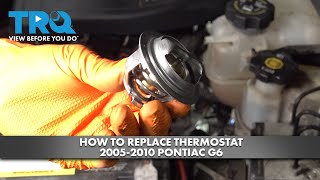
The Saturn Aura uses engines common across the General Motors family (2.4L Ecotec, 3.5L V6, 3.6L V6). For these GM engines, the P0128 code is overwhelmingly caused by a simple mechanical failure: the thermostat sticking open. While electronic sensors can fail, the thermostat is the most frequent point of failure for this specific code. The repair process is straightforward and well-documented on similar GM vehicles like the Chevrolet Malibu and Pontiac G6, making it a common DIY job. The thermostat for the 2.4L Ecotec engine is a known high-failure item, often requiring replacement every few years.
Symptoms You May Notice
- Check Engine Light is on
- Temperature gauge on the dashboard reads lower than normal or doesn't move much
- Heater blows lukewarm or cool air, especially on the highway
- Noticeably worse fuel economy
- Engine cooling fans may run constantly, even when the engine is cold
- Engine takes significantly longer than usual to warm up
- Replacing the radiator cap. While a faulty cap can cause cooling system problems, it's not a typical cause for a P0128 code.
- Replacing the water pump. A failing water pump usually causes overheating (or leaks), not an under-heating condition.
- Immediately replacing the ECT sensor without testing. While the sensor can fail, the thermostat is far more likely to be the culprit for this specific code.
Most Likely Causes
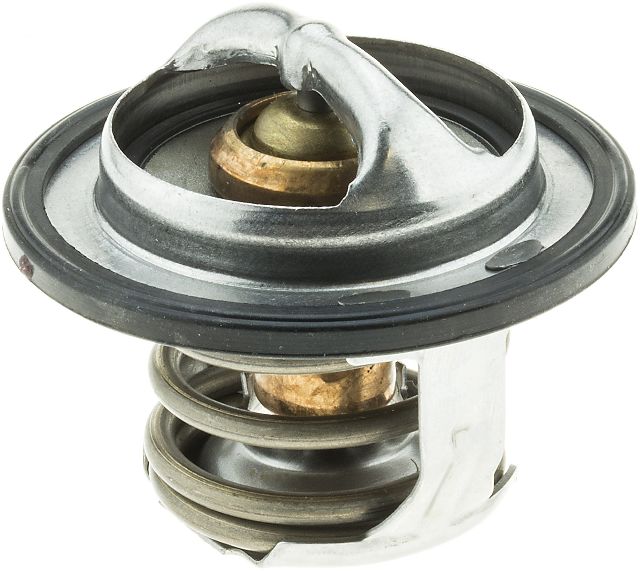
- Engine Thermostat Stuck Open 🔴 High Probability → Shop Integrated Thermostat Housing Assembly Thermostats are wear items designed to fail in the open position as a failsafe to prevent overheating. Over time, the spring mechanism weakens or the seal degrades, causing it to stay open and over-cool the engine. This is a very common failure on GM's Ecotec and V6 engines of this era.
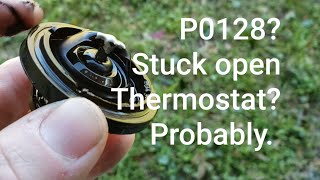
How to confirm: After starting the car cold, feel the upper radiator hose. It should remain cool for several minutes. If it starts warming up almost immediately, the thermostat is likely stuck open, allowing coolant to circulate to the radiator prematurely. A scan tool can also monitor the coolant temperature; if it rises very slowly, struggles to get over 170-180°F, and drops at highway speeds, the thermostat is the prime suspect. 🎬 Watch: A professional mechanic's guide to diagnosing the P0128 code.
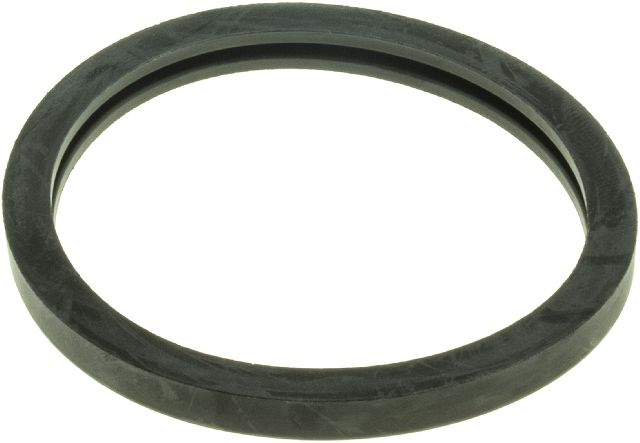
Typical fix: Replace the engine thermostat and gasket/seal. It is often sold as a complete housing assembly, especially for the V6 engines. The cooling system must be properly bled of air after the repair to prevent air pockets.
Est. part cost: $40-$100 - Faulty Engine Coolant Temperature (ECT) Sensor 🟡 Medium Probability → Shop Engine Coolant Temperature Sensor The ECT sensor can degrade over time, sending inaccurate readings to the computer. It might tell the ECM the engine is cold when it's actually at normal operating temperature, triggering a P0128 even if the thermostat is working correctly.
How to confirm: Use a scan tool to compare the ECT sensor reading to the ambient air temperature sensor reading on a cold engine; they should be very close. If the ECT reading is illogical (e.g., -40°F), the sensor is bad. You can also test the sensor's resistance with a multimeter; at 68°F (20°C), it should be between 2,000 and 3,000 ohms.
Typical fix: Replace the ECT sensor. On the 2.4L engine, it's on the engine block. On the 3.5L and 3.6L V6 engines, it is located near the thermostat housing. The repair involves disconnecting the electrical connector and unscrewing the sensor with a deep socket 🎬 See this walkthrough for replacing the coolant temperature sensor. (often 19mm).
Est. part cost: $20-$50 - Low Engine Coolant Level ⚪ Low Probability Leaks in the cooling system can cause the coolant level to drop. If the level is low enough, an air pocket can form around the ECT sensor, preventing it from getting an accurate reading and potentially triggering the code.
How to confirm: Visually inspect the coolant reservoir and the radiator (when the engine is completely cool). If the level is low, there is a leak that must be found and repaired. Pressure testing the system is the most effective way to find a leak.
Typical fix: Find and repair the source of the coolant leak (e.g., a cracked hose, loose clamp, or failing water pump). Then, top off with DEX-COOL coolant and properly bleed the cooling system to remove all air.
Est. part cost: $5-$500 depending on the source of the leak
Rare But Worth Checking
- Cooling Fan Stuck On: → Shop Engine Cooling Fan Blade A faulty fan relay or fan control module could cause the cooling fans to run continuously, preventing the engine from reaching operating temperature, especially in cold weather or during highway driving. This can be a symptom of a bad ECT sensor sending a false overheat signal.
- ECM Software Calibration Issue: On some other manufacturers' vehicles, a Technical Service Bulletin (TSB) was issued because the ECM's diagnostic parameters were too sensitive, causing a false P0128. For example, Hyundai TSB 19-01-016H-1 addresses this for some 1.6L Turbo engines. While no specific TSB for this issue is widely reported for the Aura, it's a remote possibility that could require an ECM reflash at a dealership. GM has issued similar TSBs for other models, indicating it's a known strategy for fixing false P0128 codes.
- Incorrect Thermostat Installed: → Shop Integrated Thermostat Housing Assembly If the thermostat was recently replaced, ensure the correct temperature rating was used. Installing a thermostat that opens at a lower temperature than the OEM specification (typically 180°F for these engines) can cause the P0128 code to set.
Diagnosis Steps
- Check the Check Engine Light: Use an OBD-II scanner to confirm P0128 is the active code and check for any other related codes.
- Inspect Coolant Level: With the engine cold, check the coolant level in the overflow reservoir and radiator. If low, top it off with the correct type of coolant (DEX-COOL) and inspect for leaks.
- Monitor Coolant Temperature: Use a scan tool to view live data. Watch the ECT reading as the engine warms up. The temperature should rise steadily to around 180-210°F and stabilize. If it warms up very slowly, struggles to get over 170°F, or drops significantly when driving at speed, the thermostat is almost certainly stuck open.
- Check ECT Sensor Accuracy: Before starting a cold engine, compare the ECT reading with the Intake Air Temperature (IAT) sensor reading on your scan tool. They should be within a few degrees of each other. If the ECT reading is nonsensical (e.g., -40°F), the sensor is likely bad.
- Inspect Cooling Fans: Ensure the cooling fans are not running constantly as soon as the car is started from cold. They should only activate when the A/C is on or when the coolant reaches a high temperature (typically over 215°F).
- Replace the Thermostat: If all signs point to a slow warm-up, replace the thermostat and gasket/seal. This is the most probable fix.
- Bleed the System: After replacing the thermostat or adding coolant, properly bleed the cooling system to remove any trapped air. This often involves running the engine with the heater on high and the reservoir cap loose, or using a specialized funnel kit to ensure all air is purged. Trapped air can cause temperature reading issues.
- Clear Code and Test Drive: Clear the P0128 code with the scanner and perform a test drive to ensure the temperature gauge reads normally and the code does not return.
Parts You'll Likely Need
- Engine Coolant Thermostat with Housing/Seal
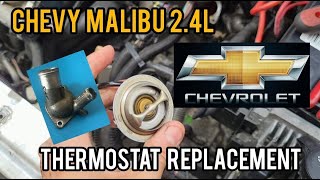
(OEM #ACDelco 131-158 (GM 12622410) for 2.4L Ecotec engine. 🎬 Watch: Step-by-step thermostat replacement for the 2.4L Ecotec engine.)— This is the most common cause of P0128. The thermostat is a mechanical part that wears out and gets stuck in the open position. The 2.4L Ecotec uses a thermostat that fits into the housing, while V6 models often have the thermostat integrated with the housing.
Trusted brands: ACDelco, Motorad, Gates
OEM price range: $70-$120
Aftermarket price range: $40-$80 - Engine Coolant Temperature (ECT) Sensor
(OEM #ACDelco 213-4777 (or 213-4514) is a common replacement for Aura models.)— This is the second most likely part to fail. It provides the temperature reading to the computer, and if it's inaccurate, it can trigger the code.
Trusted brands: ACDelco, Delphi, Standard Motor Products
OEM price range: $30-$60
Aftermarket price range: $15-$40
Related Codes That Often Appear With This One
- P0117 / P0118 — These codes relate to the ECT sensor circuit (low or high input). If you see these alongside P0128, it strongly points to a faulty ECT sensor or its wiring, rather than the thermostat.
Platform-Specific Known Issues
- Thermostat Location and Difficulty: → Shop Integrated Thermostat Housing Assembly On the 2.4L Ecotec engine, the thermostat is located on the driver's side of the engine block, behind the exhaust manifold heat shield, making access somewhat difficult from below. On the 3.5L and 3.6L V6 engines, the thermostat housing is more accessible on the top of the engine, but may require removal of the air intake tube or throttle body for access.
- Owner Experience: Repeat Failures: Some owners on forums report that even after replacing
Mechanic-Grade Diagnostic Values
- Engine Coolant Temperature (ECT) Sensor Resistance — expected: Approximately 2,200 - 3,000 Ω at 68°F (20°C) and 250 - 350 Ω at 176°F (80°C).. Failure: Readings that are infinite (open circuit), near zero (short circuit), or do not decrease smoothly as the sensor is heated indicate a faulty sensor.
- Engine Coolant Temperature (ECT) Sensor Voltage (Key On, Engine Off) — expected: Approximately 3.0 - 3.5V on a cold engine (~20°C).. Failure: A voltage reading near 5.0V suggests an open circuit or bad ground, while a reading near 0V suggests a short to ground. An illogical reading that doesn't match ambient temperature points to a sensor fault.
- Mode 6 Thermostat Monitor Test (TID $82) — expected: The test value should be below the maximum allowable limit set by the manufacturer. This test measures the time it takes for the ECT to reach a target temperature.. Failure: A test value exceeding the maximum limit indicates the engine is warming up too slowly, which will flag P0128. This confirms the thermostat is the likely cause.
Scan Tool Commands That Help
- GM Tech2 / GDS2: Cooling Fan Relay Control — This bidirectional command allows a technician to manually turn the cooling fans on and off. It is used to verify if the fan control circuit, relays, and fan motors are working correctly, helping to rule out a 'fan stuck on' condition as the cause of P0128.
- GM Tech2 / GDS2: ECM Reprogramming (SPS) — If diagnostics do not point to a mechanical fault, checking for an updated ECM calibration is necessary. GM has issued TSBs for other models where overly sensitive diagnostic parameters for P0128 were corrected with a software update. This function is used to flash the new calibration to the ECM.
Wiring & Ground Locations
- ECT Sensor (2.4L Engine) — Located on the right side (passenger side) of the engine, below the exhaust camshaft position sensor.. This is the primary sensor providing temperature data to the ECM. A corroded connector or damaged wiring at this location will cause incorrect readings and can trigger P0128, P0117, or P0118.
- G103 — Located at the left rear of the engine compartment on the cowl, above the brake booster.. This is a major ground point for the Body Control Module (BCM) and Instrument Panel Cluster (IPC). While not a direct engine ground, a poor connection here can cause erratic gauge behavior, including the temperature gauge, potentially confusing the diagnosis.
- G105 / G107 — G105 is at the left front of the engine compartment behind the cooling fan relays. G107 is on the right front of the engine.. These grounds are for the cooling fans and lighting. A poor ground at G105 could potentially cause the fan relay to malfunction, leading to a 'fan stuck on' condition, which is a rare cause of P0128.
- ECM (Engine Control Module) — Located on the left side of the engine compartment, behind the battery.. All sensor data is processed here. Verifying the connectors are clean and secure is a critical step if wiring issues are suspected. The ECM itself receives its ground through its wiring harness, making harness integrity vital.
Real Owner Repair Stories
- SaturnFans.com Forums (2008 Saturn Aura XE 2.4L) — Check Engine Light with code P0128. Temperature gauge would not go past the first tick mark. Heater was not blowing hot air.
❌ Tried (didn't work) Initially suspected the ECT sensor but decided to replace the thermostat first due to commonality.
✅ What actually fixed it Replacing the engine coolant thermostat. After replacement and bleeding the system, the temperature gauge returned to the normal middle position and the heater worked correctly.
OEM Part Supersession History
GM 12622410→ACDelco 131-158— This is a standard part number consolidation where the GM part number is cross-referenced to the ACDelco service part number.
Heads up: While listed for the 2.4L Ecotec, always verify the specific part for V6 models (3.5L LZ4, 3.6L LY7) as they use a different thermostat and housing design.
Model Year Variations Within This Range
- 2007: The initial model year launched with V6 engines only: a 224-hp 3.5L V6 (XE) with a 4-speed automatic and a 252-hp 3.6L V6 (XR) with a 6-speed automatic.
- 2008: A 169-hp 2.4L 4-cylinder engine paired with a 4-speed automatic was introduced for the XE trim. The 3.5L V6 horsepower was revised to 219 hp.
- 2009: The 2.4L 4-cylinder engine was upgraded to a 6-speed automatic transmission. The 3.5L V6 option was dropped, leaving the 2.4L I4 and the 3.6L V6 as the only engine choices.
Diagnostic Flowchart
Real Owner Stories
Aggregated from forums and TSBs cited above. Mileages and costs reflect what owners reported in those sources.
2004 Saturn ION
Symptoms: Experienced a P0128 code.
What fixed it: Suggested the issue could be a kinked O-ring on the thermostat from a previous installation or using a thermostat with the wrong temperature rating (e.g., 180°F instead of 195°F).
Source hint: saturnfans.com
2008 Pontiac G6 GT (3.5L V6)
Symptoms: Triggered a P0128 code.
What fixed it: Confirmed the thermostat is the most common culprit for the code on these GM vehicles, and noted the ECT sensor is located below the throttle body.
Source hint: CarAudio.com
Honda
Symptoms: Experienced a recurring P0128 code two months after replacing the thermostat with an aftermarket part.
What fixed it: Highlighted the possibility of a faulty new aftermarket part or a misdiagnosis where the actual issue might have been the ECT sensor.
Source hint: Reddit r/MechanicAdvice
Related OBD-II Codes
Frequently Asked Questions
Where is the thermostat located on my 2.4L Saturn Aura?
Where is the ECT sensor located on the V6 Saturn Aura?
What type of coolant should I use if my Saturn Aura's coolant level is low?
I just replaced the thermostat on my Aura but the P0128 code came back. What could be wrong?
Are other GM vehicles prone to this same P0128 issue?
Helpful Videos
We Have This Part in Stock


The information in this article is provided for general reference and educational purposes only. Vehicle specifications, procedures, and part compatibility can vary by production date, trim level, and region. Always consult your vehicle's factory service manual and verify part numbers before purchasing or performing repairs. Safety-critical components such as airbags, seat belts, and braking systems should be installed by a qualified professional.
- Saturn Aura:
- 🧭 Diagnostic Flowchart
- 🎬 Helpful Videos
- 🛍️ Shop This Part
- What's Unique About the 2007-2009 Saturn Aura
- Symptoms You May Notice
- Most Likely Causes
- Rare But Worth Checking
- Diagnosis Steps
- Parts You'll Likely Need
- Related Codes That Often Appear With This One
- Platform-Specific Known Issues
- Mechanic-Grade Diagnostic Values
- Scan Tool Commands That Help
- Wiring & Ground Locations
- Real Owner Repair Stories
- OEM Part Supersession History
- Model Year Variations Within This Range
- Real Owner Stories
- 2004 Saturn ION
- 2008 Pontiac G6 GT (3.5L V6)
- Honda
- Related OBD-II Codes
- Frequently Asked Questions
- 🎟️ Get 5% Off