

P0128 on 2012-2017 Toyota Camry 2.5L: Causes and Fixes for Coolant Temperature Issues
On a 2012-2017 Camry with the 2.5L engine, code P0128 almost always means the thermostat is stuck open and needs to be replaced. This is a common and relatively inexpensive fix, with an OEM thermostat costing around $60-$160 and aftermarket options available for less. It is a highly common failure mode for this part.
- P0128 on a 2012-2017 Camry almost always points to a bad thermostat that is stuck open.
- Before buying parts, confirm the diagnosis by checking the coolant level and monitoring the engine temperature from a cold start with a scan tool.
- Replacing the thermostat is a DIY-friendly job with a difficulty of 2 out of 5. The main steps are draining some coolant and removing the airbox for access.
What's Unique About the 2012-2017 Toyota Camry
For the 2AR-FE engine in this generation of Camry, the cooling system is generally very reliable. However, like many vehicles, the thermostat is a mechanical wear item designed to fail in the open position to prevent overheating. The P0128 code is a very common fault as these cars age, and owner experiences overwhelmingly point to the thermostat being stuck open rather than a more complex electronic or sensor issue. The fix is straightforward and doesn't typically require special tools, making it a popular DIY repair.
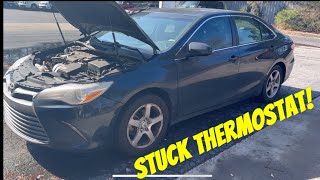
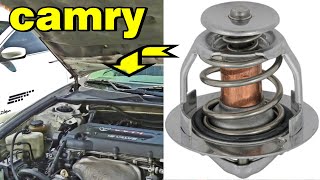
🎬 Watch: Step-by-step guide to replacing your Camry's thermostat.Symptoms You May Notice
- Check Engine Light is illuminated
- Engine temperature gauge reads lower than normal or takes a very long time to reach the middle
- Heater blows lukewarm air or takes a long time to get hot.
- Noticeable decrease in fuel economy
- Engine temperature drops at highway speeds
- Replacing the ECT sensor when the thermostat is actually the problem. Because the thermostat is mechanical, it won't set a specific code for itself; it causes a performance code like P0128. 🎬 See a mechanic explain why the P0128 code triggers. Always diagnose by watching the coolant temperature warm-up curve before replacing parts.
Most Likely Causes
- Stuck-Open Engine Thermostat 🔴 High Probability → Shop Integrated Thermostat Housing Assembly The thermostat is a mechanical part with a wax element that can wear out and fail over time, causing it to stick in the open position. This is the most common failure mode leading to a P0128 code and is a well-documented issue on the 2AR-FE engine.
How to confirm: Use a scan tool to monitor the Engine Coolant Temperature (ECT) sensor data from a cold start. If the temperature rises very slowly and struggles to reach or maintain ~180°F (82°C), especially at highway speeds, the thermostat is almost certainly stuck open. You can also feel the upper radiator hose; if it gets warm almost immediately after starting the cold engine, coolant is flowing prematurely, confirming a stuck-open thermostat.
Typical fix: Replace the engine thermostat and its gasket. It is recommended to drain and refill the coolant at the same time using Toyota Super Long Life Coolant.
Est. part cost: $40-$165 - Faulty Engine Coolant Temperature (ECT) Sensor ⚪ Low Probability → Shop Engine Coolant Temperature Sensor While less common than a thermostat failure, the ECT sensor can fail, sending incorrect temperature readings to the ECU. However, a faulty sensor often triggers other specific sensor-related codes (like P0116-P0119).
How to confirm: Watch the live ECT data on a scan tool. If the reading is erratic, jumps between very high and very low values, or reads a nonsensical temperature (like -40°F) when the engine is at ambient temperature, the sensor is likely bad. You can also test the sensor's resistance with a multimeter and compare it to the factory service manual specifications for a given temperature.
Typical fix: Replace the ECT sensor. This is often a quick replacement 🎬 Watch: How to replace the coolant temperature sensor. with minimal coolant loss.
Est. part cost: $30-$100 - Low Engine Coolant Level ⚪ Low Probability If the coolant is low due to a leak (e.g., from a water pump gasket or radiator cap), an air pocket can form near the ECT sensor, causing it to read incorrectly and trigger the code. This is usually the result of a leak elsewhere in the system.
How to confirm: Visually inspect the coolant level in the overflow reservoir and the radiator (only when the engine is cold). If it is low, top it off and inspect the system for leaks, paying attention to pink, crusty residue which indicates a dried coolant leak.
Typical fix: Top off the coolant and find and repair the source of the leak.
Est. part cost: $20-$40 for coolant
Rare But Worth Checking
- Cooling Fan Running Constantly: → Shop Engine Cooling Fan Blade If a faulty relay or fan control module causes the cooling fans to run at all times, even when the engine is cold, it can over-cool the engine and prevent it from reaching operating temperature, triggering a P0128.
Diagnosis Steps
- Check for other stored trouble codes. Address any other codes first, especially those related to the ECT sensor circuit (P0116-P0119).
- With the engine cold, check the coolant level in the radiator and the overflow tank. Ensure it is full. Look for signs of leaks like pink residue.
- Connect an OBD-II scanner and view live data for the Engine Coolant Temperature (ECT) sensor. The reading should be close to the ambient air temperature.
- Start the engine and monitor the ECT reading. It should rise steadily. The upper radiator hose should remain cool while the lower hose gets warm.
- If the engine warms up very slowly and the upper radiator hose gets warm almost immediately, the thermostat is stuck open, allowing coolant to circulate through the radiator prematurely.
- If the temperature reading on the scan tool is erratic, does not change, or is clearly illogical (e.g., -40°F), the ECT sensor or its wiring is the likely problem.
- If the engine warms up but never reaches the full operating temperature (approx. 180-200°F or 82-93°C), and especially if it cools down on the highway, the thermostat is the primary suspect.
- Confirm the cooling fans are not running continuously from a cold start.
Parts You'll Likely Need
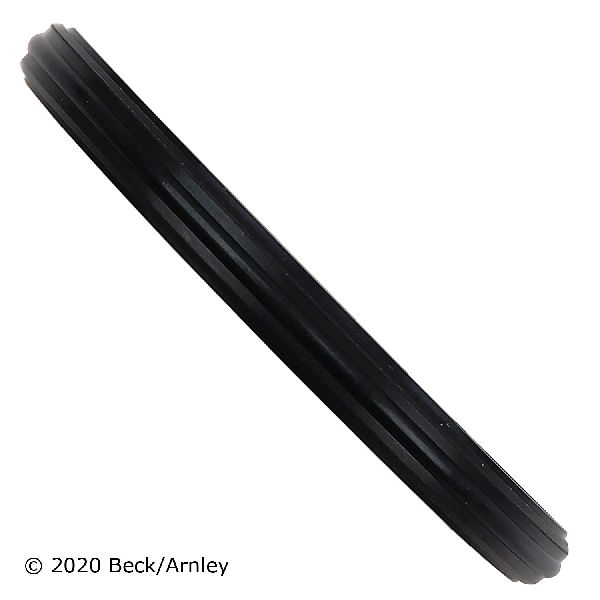
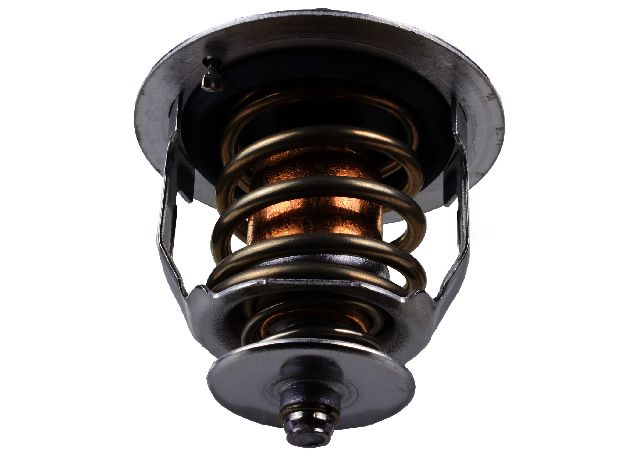
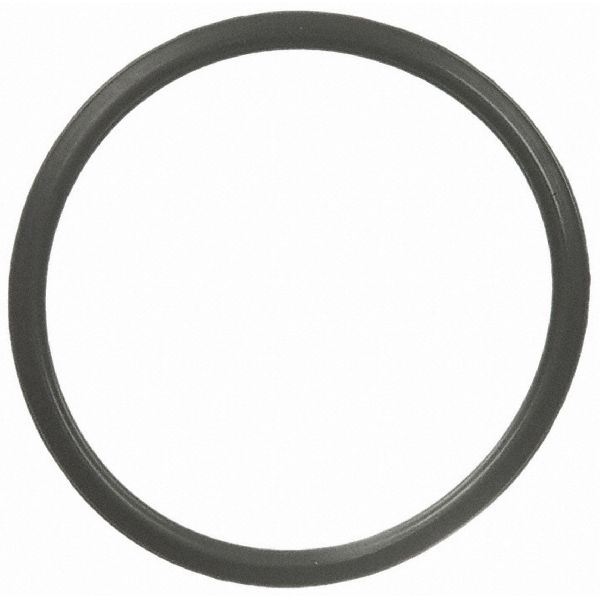
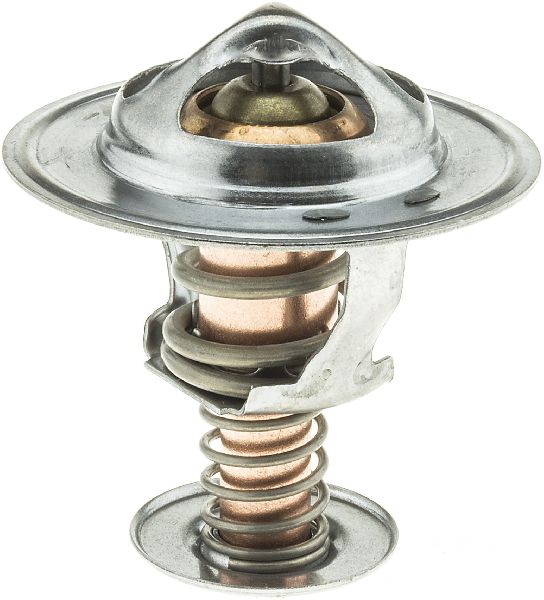
- Engine Coolant Thermostat with Gasket
(OEM #90916-A3003 (82°C / 180°F))— This is the most common cause of P0128. The original part fails by sticking open, preventing the engine from warming up correctly. The OEM part is an 82°C (180°F) thermostat.
Trusted brands: Toyota (OEM), Aisin (OEM supplier), Kuzeh, Gates
OEM price range: $60-$90
Aftermarket price range: $30-$50 - Engine Coolant Temperature (ECT) Sensor
(OEM #89422-33030)— This is the second most likely cause if the thermostat is confirmed to be working correctly or if the temperature readings are erratic.
Trusted brands: Denso (OEM supplier), NGK, Standard Motor Products (SMP)
OEM price range: $60-$100
Aftermarket price range: $25-$50 - Toyota Super Long Life Coolant (Pink)
(OEM #00272-SLLC2)— You will lose coolant when replacing the thermostat and must refill the system with the correct OEM-spec fluid to prevent corrosion and ensure proper performance.
Trusted brands: Toyota (OEM), Pentofrost A4, Zerex Asian Vehicle Formula
OEM price range: $25-$35 per gallon
Aftermarket price range: $20-$30 per gallon (compatible Asian vehicle formula)
Technical Service Bulletins (TSBs) & Recalls
- T-SB-0045-13: A manufacturer service bulletin notes that certain Camry vehicles with the 2AR-FE engine may exhibit a MIL "ON" condition with DTC P0128 because the Engine Control Module (ECM) logic requires updating.
- T-SB-0312-17: Addresses torque converter shudder on 2012-2014 models, recommending torque converter replacement and ECM reprogramming.
- T-SB-0041-13: Pertains to a brief knock/rattle from the camshaft timing gear assembly at cold startup on 2012 models.
Platform-Specific Known Issues
- DIY Repair Experience: Owners on forums frequently report that replacing the thermostat for a P0128 code is a straightforward DIY job. The main challenge is often removing the air filter box assembly to gain access to the thermostat housing, which is located on the driver's side of the engine block. After replacement, properly bleeding the air from the cooling system is crucial to avoid future issues.
Mechanic-Grade Diagnostic Values
- Engine Coolant Temperature (ECT) Sensor Resistance — expected: Approx. 2,000 - 3,000 Ω at 68°F (20°C). Approx. 250 - 350 Ω at 176°F (80°C).. Failure: Resistance is infinite (open circuit), near zero (short circuit), or does not decrease smoothly as the engine warms up.
- Engine Coolant Temperature (ECT) Sensor Signal Voltage — expected: Approx. 2.0V - 3.5V with a cold engine (e.g., 68°F / 20°C). Voltage should drop smoothly to approx. 0.5V - 1.3V as the engine reaches operating temperature (176-194°F / 80-90°C).. Failure: Voltage is stuck at 5V (open circuit), 0V (short to ground), or does not change logically with temperature. A reading that is illogical for the current engine state (e.g., 1.5V on a cold start) indicates a skewed sensor.
Scan Tool Commands That Help
- Techstream or any capable OBD-II Scanner: Live Data / Data Stream Monitoring — This is the primary diagnostic method for P0128. Monitor the 'Engine Coolant Temperature' PID from a cold start. A stuck-open thermostat will be revealed by a very slow temperature rise that may even drop at highway speeds. This is used to confirm the thermostat's failure before replacement.
Wiring & Ground Locations
- ECT Sensor Connector — On the driver's side of the 2AR-FE engine, located in the thermostat housing where the upper radiator hose connects to the engine block.. This is the primary sensor for this code. Checking for corrosion, damage, or a loose connection at this connector is a key diagnostic step if the sensor's readings are erratic or absent.
- Engine Harness Ground — The 2AR-FE engine has several grounds, including points from the valve cover to the chassis near the strut tower and from the main harness to the side of the cylinder head.. While not a common cause for P0128, a poor engine ground can cause floating or incorrect readings on various sensors, including the ECT sensor. If ECT readings are bizarre and the sensor and wiring test good, verifying engine grounds is a valid next step.
Real Owner Repair Stories
- NHTSA ODI #11580781 (Toyota RAV4 with 2AR-FE engine) — An owner reported that electronic control of the engine, throttle, or transmission was detected as faulty, and the dealership confirmed the issue was Code P0128, noting this is a prevalent issue on similar platforms.
- Reddit r/MechanicAdvice (Vehicle year not specified, but user had a P0128 code.) — Check Engine Light with code P0128.
❌ Tried (didn't work) Replaced the thermostat with an 'OEM equivalent from advance auto' and performed a coolant flush. The code went away but returned two months later.
✅ What actually fixed it The thread ends without a final confirmed fix, but the experience strongly suggests that the non-OEM aftermarket thermostat failed prematurely. This serves as a cautionary tale about the quality of some aftermarket parts for this specific component. - YouTube - 'Toyota/Lexus P0128 Thermostat Replacement' (2005 Toyota Highlander (uses the same thermostat part number 90916-A3003 as the Camry)) — Check Engine Light with code P0128.
❌ Tried (didn't work) The user went straight to replacing the thermostat as the primary suspect.
✅ What actually fixed it Replacing the engine thermostat resolved the P0128 code. The user confirmed after 5 days and 177 miles that the code had not returned, and subsequent codes were unrelated EVAP issues.
OEM Part Supersession History
9091603084, 9091603129→90916-A3003— Standard part revision and consolidation by Toyota over the years.
Model Year Variations Within This Range
- 2012-2017: The Camry received a major facelift for the 2015 model year, resulting in different exterior and interior styling and some suspension tuning changes. However, for the purposes of diagnosing a P0128 code, the 2.5L 2AR-FE engine and its cooling system components (thermostat, ECT sensor, water pump) remained fundamentally the same across the entire 2012-2017 generation.
Diagnostic Flowchart
Other Known Issues on This Vehicle
Issues unrelated to this code that are worth knowing about as an owner of this generation:
- Torque Converter Shudder 🟠 Medium — Common between 80,000-120,000 miles. Feels like driving over rumble strips between 25-50 mph under light load. (Ref: T-SB-0312-17, T-SB-0034-14. Toyota also had a Warranty Enhancement Program (ZE5).)
- VVT Cam Gear Rattle on Cold Start 🟡 Low — A brief rattle lasting 1-2 seconds on cold starts. Very common, and many owners live with it for years without issue. (Ref: T-SB-0041-13 addresses this for the 2012 model year.)
- Excessive Oil Consumption 🟠 Medium — Some 2AR-FE engines may consume oil, though less common than the previous 2AZ-FE engine. Often related to piston rings. (Ref: Toyota has had warranty extensions for this issue on various models.)
- Water Pump Gasket Leak 🟡 Low — The water pump itself is reliable, but the gasket can develop slow leaks over time, leaving pink, crusty residue.
- Cracked or Melting Dashboard 🟡 Low — Affects 2007-2011 models most, but some early XV50s can be affected in high-heat climates. The dash becomes sticky or shiny. (Ref: Warranty Enhancement Program (ZE6) covered this for earlier models.)
Used vs. New Parts: Buying Guide for This Vehicle
When a used part is the smart pick: For this repair, using used parts is generally not recommended. The primary failure item, the thermostat, is a low-cost wear-and-tear part that should always be replaced new. A used ECT sensor from a very low mileage vehicle could be considered, but the cost savings are minimal compared to a new, reliable aftermarket part.
Donor-vehicle mileage cap: roughly under 30000 miles for the part to have meaningful remaining life.
What to inspect on the donor part:
- For an ECT sensor, ensure the connector pins are clean, straight, and free of corrosion.
- Verify the donor vehicle was not in a front-end collision that could have damaged engine components.
- Avoid parts from vehicles that show signs of overheating (e.g., burnt plastic, discolored coolant residue).
OEM-only on this vehicle (don't cheap out):
- Engine Coolant Thermostat: While not strictly 'OEM-only', it is highly recommended to use either the genuine Toyota part (90916-A3003) or one from the OEM supplier, Aisin. Low-cost, generic aftermarket thermostats have a higher reported rate of premature failure, potentially causing the P0128 code to return.
Aftermarket brands forum-validated for this vehicle:
- Aisin (for thermostat - OEM supplier)
- Denso (for ECT sensor - OEM supplier)
- Gates (reputable for cooling system components)
Brands owners have reported issues with on this vehicle:
- Unbranded, 'white-box', or store-brand thermostats are a gamble and may have questionable quality control and longevity.
Real Owner Stories
Aggregated from forums and TSBs cited above. Mileages and costs reflect what owners reported in those sources.
2016 Toyota Camry 2.5L
Symptoms: Check engine light with P0128 code and low coolant levels with pink residue around the radiator cap.
What fixed it: Identified a leak and suspected a thermostat issue.
Source hint: Reddit r/Cartalk - '2016 Toyota Camry – P0128 code, low coolant pink residue. Advice?'
2012-2017 Toyota Camry 2AR-FE 2.5L
Symptoms: The engine warms up very slowly and the upper radiator hose gets warm almost immediately after a cold start.
What fixed it: Replaced the engine thermostat and its gasket, followed by a coolant drain and refill.
Source hint: vehicle_specific_issues - DIY Repair Experience
Related OBD-II Codes
Frequently Asked Questions
Does TSB-0312-17 apply to my 2012-2014 Camry if I have a P0128 code?
What type of coolant should I use when replacing the thermostat on my 2AR-FE engine?
I see pink crusty residue near my radiator cap; is this causing my P0128 code?
Is the cold start rattle on my 2012 Camry related to the thermostat failure?
How difficult is it to replace the thermostat on a 2012-2017 Camry 2.5L?
Can a faulty torque converter cause the engine to take a long time to warm up?
Is there a TSB for P0128 on the Camry?
Helpful Videos
We Have This Part in Stock


The information in this article is provided for general reference and educational purposes only. Vehicle specifications, procedures, and part compatibility can vary by production date, trim level, and region. Always consult your vehicle's factory service manual and verify part numbers before purchasing or performing repairs. Safety-critical components such as airbags, seat belts, and braking systems should be installed by a qualified professional.
- Toyota Camry:
- 🧭 Diagnostic Flowchart
- 🎬 Helpful Videos
- 🛍️ Shop This Part
- What's Unique About the 2012-2017 Toyota Camry
- Symptoms You May Notice
- Most Likely Causes
- Rare But Worth Checking
- Diagnosis Steps
- Parts You'll Likely Need
- Technical Service Bulletins (TSBs) & Recalls
- Platform-Specific Known Issues
- Mechanic-Grade Diagnostic Values
- Scan Tool Commands That Help
- Wiring & Ground Locations
- Real Owner Repair Stories
- OEM Part Supersession History
- Model Year Variations Within This Range
- Other Known Issues on This Vehicle
- Used vs. New Parts: Buying Guide for This Vehicle
- Real Owner Stories
- 2016 Toyota Camry 2.5L
- 2012-2017 Toyota Camry 2AR-FE 2.5L
- Related OBD-II Codes
- Frequently Asked Questions
- 🎟️ Get 5% Off