

P0131 on 1998-2007 Daewoo Matiz: O2 Sensor Low Voltage Causes and Fixes
On a Daewoo Matiz, code P0131 almost always points to a failed front oxygen (O2) sensor. It's a common wear item. Replacing the sensor is the most likely fix, costing around $30-$80 for an aftermarket part and is a straightforward DIY job for many owners.
- P0131 on a Daewoo Matiz is most often fixed by replacing the front oxygen sensor.
- Before replacing the sensor, perform a quick visual inspection of the exhaust manifold for leaks and check the sensor's wiring for obvious damage.
- Using a quality replacement sensor from a reputable brand (like NTK, Denso, or an OEM part) is recommended, as these cars can be sensitive to cheap aftermarket parts.
- The Daewoo Matiz is known for several other common issues, such as distributor and IAC valve failures, which can also cause poor engine running.
What's Unique About the 1998-2007 Daewoo Matiz
The Daewoo Matiz, with its small 0.8L or 1.0L inline engine, has a simple exhaust layout with only one "bank," making diagnosis straightforward as there's no confusion about which side of the engine is affected. The most common failure point is simply the front O2 sensor aging and losing its ability to generate a proper voltage signal. While the issue is generic, owners have reported that these cars can be sensitive to the quality of the replacement sensor, with cheap aftermarket parts sometimes failing quickly or not resolving the code correctly. This vehicle was also sold globally as the Chevrolet Spark, so repair experiences often cross over between the nameplates.
Generation note: This guide covers the M100 (1998-2000) and M150 (2000-2007) generations of the Daewoo Matiz. The causes and diagnostic procedures for P0131 are identical for both. While some part numbers may vary slightly, many oxygen sensors are listed as compatible with both generations. The platform continued with minor changes as the Chevrolet Spark (M200), which shares these same issues.
Symptoms You May Notice
- Check Engine Light illuminated
- Reduced fuel economy
- Rough or unstable idle
- Engine hesitation or stalling at low speeds
- Noticeable smell of gasoline or black smoke from the exhaust if the ECM overcompensates by running too rich
- Difficulty accelerating or a feeling of power loss, especially when climbing hills
- Replacing the catalytic converter. The P0131 code is for the sensor *before* the converter; a bad converter would typically trigger a P0420 code.
- Replacing the Mass Airflow (MAF) sensor without diagnosis. The Matiz uses a MAP (Manifold Absolute Pressure) sensor, not a MAF sensor. While a faulty MAP sensor can affect the air-fuel ratio, the P0131 code specifically points to the O2 sensor circuit's voltage output.
Most Likely Causes
- Failed Upstream Oxygen Sensor (Bank 1, Sensor 1) 🔴 High Probability → Shop Oxygen Sensor Oxygen sensors are wear-and-tear items with a finite lifespan, typically recommended for replacement every 60,000-90,000 miles. Contamination from carbon, oil, or coolant can also cause premature failure.
How to confirm: Using a scan tool, observe the live data for the B1S1 O2 sensor. If the voltage is stuck below 0.2V and does not fluctuate rapidly between ~0.1V and ~0.9V when the engine is warm, the sensor is likely bad. You can also test the sensor with a multimeter and a torch when removed from the vehicle. 🎬 Watch: A general guide on how to replace an oxygen sensor.
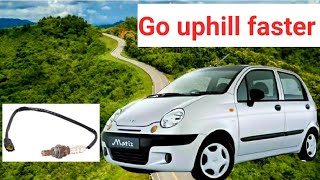
Typical fix: Replace the front (pre-cat) oxygen sensor. It is recommended to use a quality OEM or reputable aftermarket brand like NTK, Denso, or Bosch. A YouTube video shows the replacement process, noting that the sensor can be difficult to remove if seized in the exhaust manifold. 🎬 Watch: This video shows how to change the Matiz oxygen sensor.
Est. part cost: $30-$90 - Exhaust Leak Before the O2 Sensor 🟡 Medium Probability → Shop Oxygen Sensor The flexible pipe section of the exhaust system on a Matiz can be a common point for cracks or leaks over time, and the exhaust manifold gasket can also fail. This introduces outside air into the exhaust stream, which the O2 sensor reads as a lean condition (low voltage).
How to confirm: Visually inspect the exhaust manifold and the downpipe for cracks, holes, or black soot trails indicating a leak. Listen for a ticking or hissing sound from the engine bay, especially when the engine is cold. A shop can use a smoke machine to pinpoint leaks.
Typical fix: Repair the leak. This may involve replacing a gasket, tightening bolts, or welding a crack. If the flex pipe has failed, it will need to be replaced.
Est. part cost: $5-$100 - Damaged Wiring or Connector ⚪ Low Probability The wiring harness is exposed to high heat and vibration in the engine bay, which can lead to insulation becoming brittle, wires fraying, or the connector becoming corroded or loose. The O2 sensor connector is typically located under the air filter housing.
How to confirm: Visually inspect the oxygen sensor's wiring harness from the sensor to the main loom. Check for melted insulation, chafed wires, or corrosion on the connector pins. Use a multimeter to check for continuity and voltage at the connector, referencing a wiring diagram.
Typical fix: Repair the damaged section of the wiring harness or replace the connector pigtail. Ensure the repair is sealed against moisture.
Est. part cost: $10-$30
Rare But Worth Checking
- Low Fuel Pressure: If the engine is genuinely running lean due to a weak fuel pump or clogged filter, the O2 sensor will correctly report low voltage. This would typically be accompanied by other symptoms like significant power loss or difficulty starting.
- Intake Manifold / Vacuum Leak: → Shop Engine Intake Manifold A leak in the intake system allows unmetered air into the engine, causing a lean condition. This would often trigger a lean code (P0171) alongside P0131.
- Faulty Engine Coolant Temperature (ECT) Sensor: A faulty ECT sensor that tells the ECM the engine is always cold can cause the system to stay in 'open loop' and run rich, but if it fails in other ways it can affect fuel trim calculations that rely on O2 sensor data, indirectly causing issues.
Diagnosis Steps
- Connect an OBD-II scanner and confirm P0131 is the active code. Check for any other codes (like P0133 or P0171) and review freeze-frame data.
- With the engine fully warmed up and running, use the scanner's live data function to monitor the voltage of 'O2S11' (Oxygen Sensor Bank 1 Sensor 1).
- A healthy sensor's voltage should fluctuate rapidly between approximately 0.1 and 0.9 volts. If the voltage is stuck low (e.g., under 0.2 volts) and does not respond when the throttle is blipped, the sensor or its circuit is faulty.
- Turn off the engine and allow the exhaust to cool. Visually inspect the exhaust manifold and front pipe for any signs of cracks, rust holes, or black soot indicating a leak.
- Inspect the oxygen sensor's wiring harness for any signs of melting, chafing, or corrosion. Disconnect the sensor (connector is often under the air filter housing) and check the connector terminals for damage or moisture.
- If no exhaust leaks or wiring issues are found, the oxygen sensor itself is the most likely cause of the problem.
- If a new sensor does not fix the issue, investigate other potential causes like low fuel pressure, a significant vacuum leak, or a faulty ECT sensor.
Parts You'll Likely Need
- Front Oxygen Sensor (Bank 1 Sensor 1)
(OEM #96253546, 96276380, 96415639)— This is the most common failure item for code P0131. It is a consumable part that degrades over time.
Trusted brands: GM Genuine, NTK, Denso, Bosch
OEM price range: $70-$120
Aftermarket price range: $30-$80
Related Codes That Often Appear With This One
- P0171 — P0171 (System Too Lean) is a general code indicating a lean condition. If an exhaust leak or low fuel pressure is the root cause, both codes may appear 🎬 See how to diagnose and repair P0131 and P0171 codes. as the O2 sensor correctly reports the lean state.
- P0133 — P0133 (O2 Sensor Circuit Slow Response) can appear alongside P0131, especially when using a low-quality or aging sensor that is both slow to respond and has low voltage output. A forum user reported this exact sequence of codes when dealing with aftermarket vs. genuine sensors.
Technical Service Bulletins (TSBs) & Recalls
- Blue Print Technical Bulletin (Issued 01/02/07): While not for P0131 directly, it highlights the common failure of the distributor assembly on the 800cc Matiz, which can cause running issues that might be confused with fuel mixture problems.
Mechanic-Grade Diagnostic Values
- Fuel Pressure — expected: 3.5 bar (50.7 PSI). Failure: Significantly lower pressure indicates a weak pump or clogged filter, causing a genuine lean condition.
- O2 Sensor Heater Cold Resistance — expected: Approximately 3.2 ohms at 20°C (68°F). Failure: An open circuit (infinite resistance) or a reading far from the specification indicates a failed heater element within the sensor.
- O2 Sensor Signal Wire Voltage at ECU — expected: Fluctuating between 0.1V and 0.9V when engine is warm and in closed loop.. Failure: Voltage stuck below 0.2V confirms the low voltage condition seen by the ECU.
- O2 Sensor Ground Reference at ECU — expected: < 0.5 Volts. Failure: Higher voltage indicates a poor ground connection, which can skew the sensor's signal.
Scan Tool Commands That Help
- Daewoo Scan-100 or equivalent: Live Data Monitoring (O2 Sensor Voltage) — This is the primary function used to diagnose P0131. It allows the technician to see the voltage the ECU is receiving from the sensor in real-time to confirm if it is stuck low.
Wiring & Ground Locations
- O2 Sensor Signal Wire — Pin 17 on the Siemens 55-pin ECM. The wire is typically purple.. This is the specific pin to test at the ECM to verify if the low voltage signal from the sensor is reaching the control module, helping to isolate a wiring fault from a sensor fault.
- O2 Sensor Low Reference (Ground) — Pin 18 on the Siemens 55-pin ECM. The wire is typically brown/dark green.. This is the sensor's ground reference. A bad connection here can cause the signal voltage to be skewed. Verifying continuity to ground from this pin is crucial.
- G103 — Chassis ground point.. A general wiring diagram lists G103 as a chassis ground point. While not directly tied to the O2 sensor in the document, poor engine or chassis grounds can cause a variety of sensor issues, including incorrect O2 readings.
- O2 Sensor Connector — Under the air filter housing. It is a 4-pin connector on most models.. This is a common point of failure due to heat and vibration. Inspecting for corrosion, melted plastic, or loose pins is a key diagnostic step. The four wires are typically for the heater circuit (x2), signal, and ground.
Real Owner Repair Stories
- YouTube - Jerome Louvet - DIY (Chevrolet Matiz / Spark (equivalent to Daewoo Matiz)) — Check Engine Light with codes P0171 (System Too Lean) and later P0131 (O2 Sensor Low Voltage).
❌ Tried (didn't work) Initial diagnosis pointed to a lean mixture, but the problem persisted.
✅ What actually fixed it The owner tested the O2 sensor connector and found the reference voltage (0.4V) was present. After confirming the wiring was likely okay, they replaced the front oxygen sensor (Part No. 96415639), which resolved both the P0171 and P0131 codes. - Reddit user, r/cruze (2014 Chevy Cruze 1.4T (Note: Different vehicle, but illustrates a related failure pattern)) — P0131 (O2 low voltage), P0324 (knock), P0299 (underboost), oil-fouled spark plugs.
❌ Tried (didn't work) Replacing spark plugs provided a temporary improvement but the P0131 code returned.
✅ What actually fixed it The user suspected a failed PCV check valve in the intake manifold, a common issue on that engine. This failure creates a massive vacuum leak, causing a lean condition that the O2 sensor correctly reports as low voltage (P0131). The fix is to replace the intake manifold and/or valve cover.
Model Year Variations Within This Range
- 1998-2002 (approx.): Early M100 and some M150 models used a Siemens Fenix 5 or KEMSCO ECU.
- 2003-2007 (approx.): Later M150 models often used a Sirius D32 ECU. While the function is the same, pinouts and connector shapes can vary, making it critical to use a wiring diagram specific to the ECU type installed.
- All: The O2 sensor is typically a 4-wire type (heater power, heater ground, signal, signal ground). However, very early or base models could potentially have simpler sensors, so verifying the connector is important before ordering a replacement.
Diagnostic Flowchart
Other Known Issues on This Vehicle
Issues unrelated to this code that are worth knowing about as an owner of this generation:
- Distributor Failure (Cap, Rotor, or Optical Sensor) 🔴 High — Very common, especially on the 0.8L engine. Can occur at any mileage, leading to no-start, misfiring, or stalling. The internal optical sensor is a known weak point and often requires replacing the entire distributor assembly. (Ref: A Blue Print technical bulletin (01/02/07) notes the high failure rate of the distributor assembly.)
- Idle Air Control (IAC) Valve Failure/Clogging 🟠 Medium — Frequently causes unstable/rough idle, stalling, or high idle. Carbon buildup is a common cause, and cleaning can sometimes resolve the issue, but valve failure is also prevalent.
- Premature Body Corrosion (Rust) 🟠 Medium — Commonly found on rear wheel arches, sills, and the bottom of doors, especially on cars used in wet or salted-road climates. Can become a structural issue if not addressed.
- Clutch Cable Failure 🟡 Low — The clutch cable is known to fray or snap, resulting in a stiff or inoperative clutch pedal. It's considered a wear item with a shorter-than-average lifespan.
- Weak Suspension Components 🟡 Low — Ball joints and rear springs are known to wear out or sag relatively quickly, especially on poor road surfaces.
Used vs. New Parts: Buying Guide for This Vehicle
When a used part is the smart pick: For this specific code, used parts are generally not recommended for the sensor itself. However, if the cause is a cracked exhaust manifold, a used manifold from a junkyard is a perfectly acceptable and cost-effective repair.
Donor-vehicle mileage cap: roughly under 100000 miles for the part to have meaningful remaining life.
What to inspect on the donor part:
- For an exhaust manifold: check thoroughly for hairline cracks, especially around the welds and flange.
- Ensure all mounting studs are intact and not stripped.
- Look for a vehicle with no major front-end collision damage, which could stress the manifold.
Aftermarket brands forum-validated for this vehicle:
- NTK
- Denso
- Bosch
Brands owners have reported issues with on this vehicle:
- Unnamed, no-brand 'cheap' sensors from online marketplaces are frequently reported by owners to fail quickly or be dead-on-arrival.
Real Owner Stories
Aggregated from forums and TSBs cited above. Mileages and costs reflect what owners reported in those sources.
Daewoo Matiz
Symptoms: Check Engine Light with code P0131 appeared after installing an aftermarket O2 sensor to fix an original P0133 code.
What fixed it: The P0131 code was temporarily resolved by replacing the aftermarket sensor with a genuine Daewoo part, though the P0133 code eventually returned, indicating the complexity of the issue.
Source hint: Overclockers UK Forums - 'Sensor Issue' thread
Daewoo Matiz
Symptoms: Check Engine Light illuminated with a P0131 trouble code.
What fixed it: The problem was resolved by replacing the front (primary) oxygen sensor. The repair was complicated by the old sensor being seized in the exhaust manifold.
Source hint: YouTube - 'We're troubleshooting a Daewoo Matiz. P0131 is the primary oxygen sensor.'
Related OBD-II Codes
Frequently Asked Questions
Where is the Bank 1 Sensor 1 oxygen sensor located on my 1998-2007 Daewoo Matiz?
I replaced my O2 sensor with an aftermarket part and the P0131 code is still on. What's wrong?
Could an exhaust leak cause the P0131 code on my Matiz?
My Matiz is stalling and has a rough idle along with the Check Engine Light. Is this definitely the O2 sensor?
How can I test the oxygen sensor on my Matiz before replacing it?
Is the oxygen sensor difficult to replace on a Daewoo Matiz?
Helpful Videos

The information in this article is provided for general reference and educational purposes only. Vehicle specifications, procedures, and part compatibility can vary by production date, trim level, and region. Always consult your vehicle's factory service manual and verify part numbers before purchasing or performing repairs. Safety-critical components such as airbags, seat belts, and braking systems should be installed by a qualified professional.
- Daewoo Matiz:
- 🧭 Diagnostic Flowchart
- 🎬 Helpful Videos
- What's Unique About the 1998-2007 Daewoo Matiz
- Symptoms You May Notice
- Most Likely Causes
- Rare But Worth Checking
- Diagnosis Steps
- Parts You'll Likely Need
- Related Codes That Often Appear With This One
- Technical Service Bulletins (TSBs) & Recalls
- Mechanic-Grade Diagnostic Values
- Scan Tool Commands That Help
- Wiring & Ground Locations
- Real Owner Repair Stories
- Model Year Variations Within This Range
- Other Known Issues on This Vehicle
- Used vs. New Parts: Buying Guide for This Vehicle
- Real Owner Stories
- Daewoo Matiz
- Daewoo Matiz
- Related OBD-II Codes
- Frequently Asked Questions
- 🎟️ Get 5% Off