

P0131 on 2001-2005 Honda Civic: Air/Fuel Sensor Low Voltage Causes and Fixes
On a 2001-2005 Honda Civic, code P0131 is almost always caused by a failed primary Air/Fuel Ratio (A/F) sensor, which is the oxygen sensor before the catalytic converter. Replacing it with the correct Denso or NGK/NTK part is the most common fix. Cracked exhaust manifolds are another frequent cause on this platform.
- P0131 on a 7th-gen Civic almost always points to a bad upstream Air/Fuel Ratio sensor.
- You MUST use a replacement part specified as an 'Air/Fuel Ratio Sensor', not a generic 'Oxygen Sensor'. Denso and NTK are trusted brands.
- Before replacing the sensor, perform a quick visual inspection for obvious exhaust leaks (soot marks) or damaged wiring.
- This is a very DIY-friendly repair, as the sensor is located at the front of the engine on the exhaust manifold and is easy to access.
What's Unique About the 2001-2005 Honda Civic
A critical detail for the 7th generation Civic is the type of upstream sensor used. 2001-2003 models use a conventional narrowband O2 sensor, while 2004-2005 models use a more sensitive and expensive wideband Air/Fuel (A/F) sensor. Many owners and shops mistakenly install the wrong type, which will not work and fails to resolve the code. Using a direct-fit sensor from an OEM supplier like Denso or NTK is essential. Additionally, the exhaust manifold on the D17 engine is prone to cracking with age, which creates an exhaust leak right before the sensor and is a very common cause of P0131 on these cars.
Symptoms You May Notice
- Check Engine Light is on
- Reduced fuel economy
- Rough or unstable idle
- Engine hesitation or loss of power during acceleration
- Strong smell of gasoline from the exhaust (due to the ECU commanding a rich mixture)
- Audible ticking or exhaust leak sound from the engine bay, especially when cold, if caused by a cracked manifold.
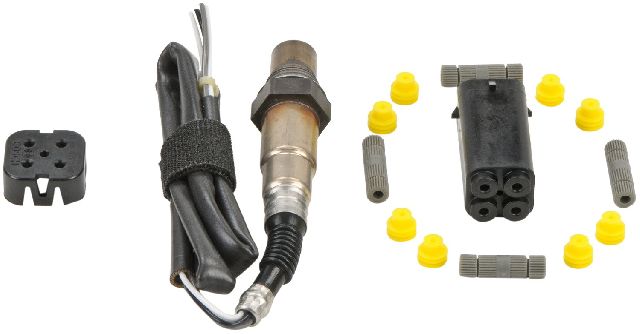
- Replacing the sensor with a cheaper, incorrect 'universal' or non-OEM brand (e.g., Bosch) sensor. Forums are filled with stories of these failing to work correctly.
- Replacing the downstream (Bank 1, Sensor 2) oxygen sensor, which is located after the catalytic converter and is used for catalyst monitoring, not primary fuel control.
- Overlooking a cracked exhaust manifold and replacing the O2 sensor multiple times, only for the code to return.
Most Likely Causes
- Failed Upstream Air/Fuel Ratio Sensor (Bank 1, Sensor 1) 🔴 High Probability → Shop Oxygen Sensor The sensor simply fails due to age, heat cycles, and contamination after many years and miles of service. It is the most common point of failure for this code. Forum users repeatedly confirm that replacing a faulty original sensor with a quality Denso or NTK part resolves the issue.
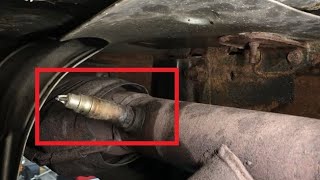
How to confirm: Use a scan tool to monitor live data for Bank 1, Sensor 1. Freeze frame data may show the sensor at 0 volts. When testing, if the voltage is stuck low (e.g., below 0.2V for narrowband) and does not fluctuate, the sensor is likely bad. 🎬 Watch: How to diagnose and fix O2 sensor low voltage You can also test the sensor's internal heater circuit for resistance between the two same-colored wires; a good sensor will typically read between 10-40 ohms. An open circuit (OL) indicates a failed heater, requiring sensor replacement.
Typical fix: Replace the upstream Air/Fuel Ratio sensor located on the exhaust manifold. Ensure you use the correct part for your model year (narrowband for '01-'03, wideband for '04-'05).
Est. part cost: $60-$150 - Cracked Exhaust Manifold 🔴 High Probability → Shop Exhaust Manifold The stock exhaust manifold on the D17 engine is notoriously prone to developing cracks over time due to thermal stress. A crack allows fresh air to be sucked into the exhaust stream, which makes the A/F sensor incorrectly read a lean condition (low voltage), triggering P0131. This is a very common failure on high-mileage 7th gen Civics.
How to confirm: Visually inspect the exhaust manifold, especially around the O2 sensor bung and between the runners. A flashlight may reveal hairline cracks. A ticking sound from the engine bay that lessens as the engine warms up is a strong indicator. A smoke test can also definitively identify leaks.
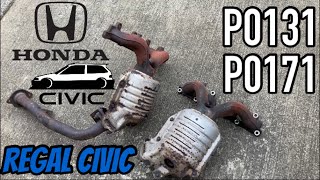
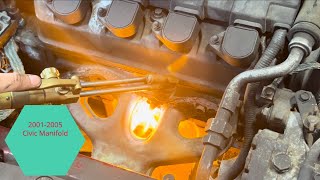
Typical fix: Replace the cracked exhaust manifold. Some owners have had success with welding, but replacement is the more permanent solution. 🎬 See this walkthrough for replacing a cracked exhaust manifold Aftermarket manifolds with integrated catalytic converters are available.
Est. part cost: $125-$350 for an aftermarket manifold/cat assembly - Damaged Wiring or Connector ⚪ Low Probability
How to confirm: Visually inspect the sensor's wiring harness for melting, chafing, or corrosion in the connector. A diagnostic test involves checking for a good ground and testing the signal return wire. With the sensor unplugged and test light connected to ground, probing the signal return wire on the harness side should make the scan tool voltage reading drop to zero, confirming wiring integrity to the PCM.
Typical fix: Repair the damaged section of wire or replace the connector pigtail.
Est. part cost: $5-$30
Rare But Worth Checking
- Low Fuel Pressure: If the engine is genuinely running lean due to a weak fuel pump or clogged filter, the A/F sensor will correctly report a low voltage. This is less common than a sensor failure but should be checked if a new sensor doesn't fix the code.
- Engine Vacuum Leak: A significant vacuum leak from a cracked hose or bad intake manifold gasket can introduce too much unmetered air, causing a lean condition that the sensor will report.
- Swapped Secondary O2 Sensor Wires: → Shop Oxygen Sensor In a documented case on Honda-Tech, a P0131 was caused by the signal and ground wires for the secondary (downstream) O2 sensor being swapped during a transmission replacement. This caused a voltage draw that affected the primary sensor's reading. This is a rare but important check if major work was recently performed.
- Faulty Powertrain Control Module (PCM): This is extremely rare. The PCM itself can fail, but all other possibilities should be exhaustively ruled out before considering PCM replacement.
Diagnosis Steps
- Connect an OBD-II scanner to confirm P0131 and check for other codes like P0171 or P0135.
- Observe live data for 'Bank 1 Sensor 1'. On a warm engine, if the voltage is stuck low (e.g., below 0.2V for narrowband models) or freeze frame data shows 0V, suspect the sensor or a major leak.
- Perform a thorough visual and auditory inspection of the exhaust manifold for cracks, especially when the engine is cold (a ticking noise is common). This is a very frequent cause on this specific vehicle.
- Inspect the A/F sensor's wiring harness and connector for melting, chafing, or corrosion. Ensure it's securely plugged in.
- If the manifold and wiring are good, test the sensor. Unplug it and measure resistance across the two heater wires (same color). A reading of ~10-40 ohms is good; OL (open) means it's bad.
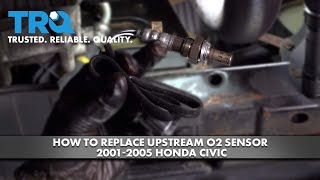
- If the heater circuit is good, the sensor itself is the most likely culprit. Proceed with replacement using a Denso or NTK part. 🎬 Watch: Step-by-step guide to replacing the upstream O2 sensor
- If a new sensor doesn't fix the code, investigate other causes like low fuel pressure, vacuum leaks, or incorrect wiring on other components if recent work was done.
- After repair, clear codes with the scanner and perform a drive cycle to ensure the light stays off.
Parts You'll Likely Need
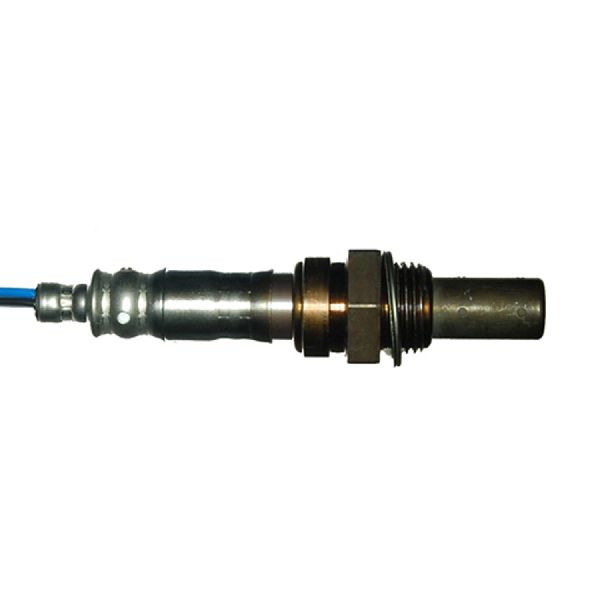
- Upstream Air/Fuel Ratio Sensor (Bank 1, Sensor 1)
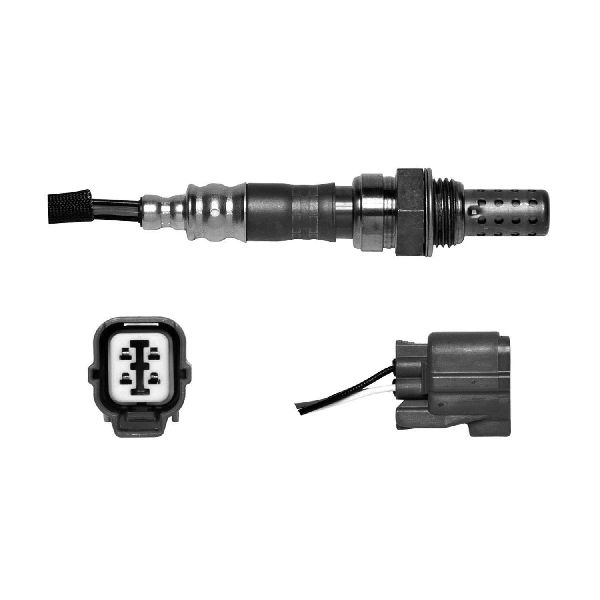
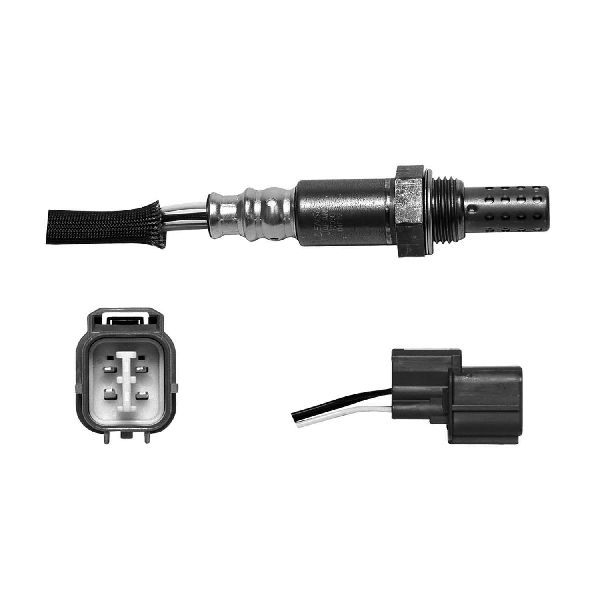
(OEM #36531-PLR-003 (for 2004-2005 models), 36531-PLM-A11 (for 2001-2003 models))— This is the primary sensor for fuel control and is the most common part to fail. Using the correct OEM-equivalent part is critical.
Trusted brands: Denso (Part #234-9005 for '04-'05 Wideband), NTK (Part #24302 for '04-'05 Wideband), Denso (Part #234-4733 for '01-'03 Narrowband)
OEM price range: $150-$250
Aftermarket price range: $80-$160 - Exhaust Manifold with Integrated Catalytic Converter
(OEM #18160-PLM-A00 or 18160-PLM-A50)— The original manifold is prone to cracking, causing an exhaust leak that triggers P0131. Replacement is often necessary on high-mileage vehicles.
Trusted brands: Walker, MagnaFlow, AP Exhaust
OEM price range: $800+
Aftermarket price range: $125-$400
Related Codes That Often Appear With This One
- P0171 — P0171 (System Too Lean Bank 1) can appear alongside P0131 if the sensor is correctly detecting a lean condition caused by a cracked exhaust manifold or a vacuum leak.
- P0135 — P0135 (O2 Sensor Heater Circuit Malfunction Bank 1 Sensor 1) often indicates the heating element inside the A/F sensor has failed. This is a common failure mode, and the sensor will need to be replaced.
Platform-Specific Known Issues
- Cracked Exhaust Manifold Commonality: → Shop Exhaust Manifold The D17 engine's exhaust manifold frequently cracks from thermal stress, especially on high-mileage cars. This leak before the primary O2 sensor is a leading cause of P0131 and should be one of the first things inspected.
- Sensor Type Varies by Year: It is critical to know that 2001-2003 models use a less expensive narrowband O2 sensor, while 2004-2005 models use a wideband A/F sensor. They are not interchangeable. Installing the wrong type will not fix the code.
Mechanic-Grade Diagnostic Values
- Primary O2/AF Sensor Heater Resistance — expected: 10 to 40 Ω (Ohms) between the two same-colored wires (usually black or white). A real-world test on a good sensor showed 13.6 Ω.. Failure: An open circuit (OL on the multimeter) or very high resistance indicates a failed heater element.
- Narrowband O2 Sensor Voltage (2001-2003 models) — expected: On a warm, running engine, the voltage should fluctuate rapidly between approximately 0.1V (lean) and 0.9V (rich). A balanced mixture averages around 0.45V.. Failure: A voltage signal that is stuck low (consistently below 0.2V - 0.3V) triggers the P0131 code.
- Wideband A/F Sensor Voltage (2004-2005 models) — expected: Unlike a narrowband sensor, the voltage does not fluctuate rapidly. The ECU adjusts current to maintain a specific voltage, often around 2.7V-3.3V depending on the specific sensor and system. The key is to watch the commanded vs. actual A/F ratio on a scan tool.. Failure: A P0131 is set when the sensor's signal circuit voltage sent to the PCM remains low, indicating a fault in the sensor or wiring, or a true lean condition the sensor cannot compensate for.
- Exhaust Manifold Bolt Torque Spec (D-Series Engine) — expected: 23 ft-lbs (31 Nm).. Failure: N/A. This is a reassembly specification. Over-tightening can strip threads in the aluminum head; under-tightening can cause an exhaust leak.
Wiring & Ground Locations
- G101 — Bolted to the thermostat housing / water pipe housing area on the engine block.. This is a primary ground termination point for the ECU. A corroded or loose G101 ground can cause a host of erratic sensor readings, including a false P0131, because it affects the sensor's ground reference.
- Primary O2 Sensor (2001-2003 ECU Connector A) — At the Powertrain Control Module (PCM/ECU), typically located behind the passenger side kick panel.. Allows for testing wiring continuity from the sensor to the ECU. Key pins are: Pin 1 (BLK/WHT) for heater control, Pin 6 (WHT) for the O2 signal, and Pins 10 (GRN/YEL) & 11 (GRN/WHT) for sensor grounds.
- Battery to Chassis/Transmission Ground — A braided cable running from the negative battery terminal to the strut tower and then to a bolt on the transmission case.. While less specific than G101, a poor main ground connection can create system-wide low voltage issues and unpredictable electrical problems that could potentially manifest as sensor codes.
Real Owner Repair Stories
- Honda-Tech forum thread 'p0131 problem *fixed*' (2001-2005 Honda Civic (specific year not stated, but applies to the generation)) — P0131 code present.
❌ Tried (didn't work) Initial troubleshooting focused on the primary O2 sensor.
✅ What actually fixed it The signal and ground wires for the SECONDARY (downstream) O2 sensor had been swapped, likely during a previous transmission replacement. This incorrect wiring on the secondary sensor was pulling voltage from the primary sensor's circuit, causing the P0131 code. Correcting the wiring on the secondary sensor connector resolved the primary sensor code. - ClubCivic.com forum thread 'P0131 error when working engine hard' (7th Gen Honda Civic 1.6L (EU model)) — P0131 Check Engine Light only appears when the engine is under heavy load for an extended period, such as overtaking or going uphill. Idling is smooth and fuel economy is normal.
❌ Tried (didn't work) Replacing the primary O2 sensor (this was done initially for a P0135 heater code)., Inspecting wiring., Replacing a leaking rear muffler.
✅ What actually fixed it The final resolution was not posted by the original user, but a moderator suggested the next diagnostic step was to check for a leaking or faulty fuel injector. A lean condition caused by a faulty injector would be most apparent under high engine load, matching the symptoms perfectly. This is a plausible root cause when the code only appears intermittently under load.
"I Checked Everything" — The Actual Cause
- A smoke test is designed to find vacuum or exhaust leaks. In the documented case where swapped wires on the secondary O2 sensor caused P0131, a smoke test would have come back clean, leading a technician to mistakenly replace the primary O2 sensor. The actual cause was an electrical fault elsewhere that was affecting the primary sensor's circuit, a problem a smoke test cannot identify.
OEM Part Supersession History
36531-PLM-A11→36531-PLM-306— Standard part number update/revision.
Heads up: Applies to 2001-2003 narrowband sensor models. These parts are not compatible with 2004-2005 models which require the wideband sensor (36531-PLR-003).36531-PLR-003→N/A— This appears to be the consistent part number for the wideband sensor.
Heads up: This wideband A/F sensor is for 2004-2005 models ONLY and will not work on 2001-2003 models. Aftermarket brands that cross-reference this number include Denso 234-9017 and NTK/NGK 24664.
Model Year Variations Within This Range
- 2001-2003 vs 2004-2005: The primary oxygen sensor is a different type. 2001-2003 models use a traditional narrowband zirconia O2 sensor (0-1V signal). 2004-2005 models use a wideband Air/Fuel ratio sensor (variable current, 0-5V signal range). The parts are physically and electrically incompatible.
Diagnostic Flowchart
Real Owner Stories
Aggregated from forums and TSBs cited above. Mileages and costs reflect what owners reported in those sources.
2001-2005 Honda Civic
Symptoms: Check Engine Light with code P0131 appeared after a transmission job.
What fixed it: Corrected the wiring for the secondary O2 sensor. The signal and ground wires had been switched, causing it to pull voltage from the primary sensor.
Source hint: Honda-Tech - 'p0131 problem *fixed*'
2002 Honda Civic — 330000 miles
Symptoms: Check Engine Light came on; a visual search revealed a large crack in the exhaust manifold.
What fixed it: Replacing or welding the cracked exhaust manifold.
Source hint: CivicForums.com - 'Cracked exhaust manifold-search lead to more ???'
2001-2005 Honda Civic
Symptoms: Experienced a recurrent P0131 code shortly after replacing the O2 sensor.
What fixed it: Replacing the non-OEM/universal sensor with a proper OEM-quality sensor.
Source hint: CivicForums.com - 'Recurrent trouble code P0131 (O2 sensor)'
2001-2005 Honda Civic
Symptoms: Check Engine Light was on with both P0131 and P0171 codes present simultaneously.
What fixed it: Replaced the cracked exhaust manifold with an aftermarket unit.
Source hint: Regal Civic YouTube - 'THIS was causing 2 codes p0131 p0171'
Related OBD-II Codes
Frequently Asked Questions
Why does my 2001-2005 Civic have a ticking sound along with the P0131 code?
Can I use a universal O2 sensor to fix P0131 on my 7th Gen Civic?
Are the upstream oxygen sensors the same for all 2001-2005 Honda Civics?
I just had my transmission replaced and now I have a P0131 code. Could they be related?
How can I test if the upstream sensor on my Civic is bad before buying a new one?
Does the Acura 1.7 EL suffer from the same P0131 issues as the Civic?
Helpful Videos
We Have This Part in Stock


The information in this article is provided for general reference and educational purposes only. Vehicle specifications, procedures, and part compatibility can vary by production date, trim level, and region. Always consult your vehicle's factory service manual and verify part numbers before purchasing or performing repairs. Safety-critical components such as airbags, seat belts, and braking systems should be installed by a qualified professional.
- Honda Civic:
- 🧭 Diagnostic Flowchart
- 🎬 Helpful Videos
- 🛍️ Shop This Part
- What's Unique About the 2001-2005 Honda Civic
- Symptoms You May Notice
- Most Likely Causes
- Rare But Worth Checking
- Diagnosis Steps
- Parts You'll Likely Need
- Related Codes That Often Appear With This One
- Platform-Specific Known Issues
- Mechanic-Grade Diagnostic Values
- Wiring & Ground Locations
- Real Owner Repair Stories
- "I Checked Everything" — The Actual Cause
- OEM Part Supersession History
- Model Year Variations Within This Range
- Real Owner Stories
- 2001-2005 Honda Civic
- 2002 Honda Civic — 330000 miles
- 2001-2005 Honda Civic
- 2001-2005 Honda Civic
- Related OBD-II Codes
- Frequently Asked Questions
- 🎟️ Get 5% Off