

P0133 on 2005-2011 Audi A6 3.2L V6: Slow O2 Sensor Response Causes and Fixes
On a 2005-2011 Audi A6 3.2L, code P0133 is most often caused by a failing front oxygen sensor on the passenger side (Bank 1, Sensor 1). Replacing the sensor is the typical fix, with parts costing between $75 for aftermarket and $150 for an OEM-branded part. However, vacuum leaks from a failed PCV valve and exhaust leaks are also common culprits on this aging platform.
- P0133 on your Audi A6 almost always points to a problem with the upstream oxygen sensor on the passenger side.
- The most likely fix is to replace the Bank 1, Sensor 1 O2 sensor. This is a manageable DIY job for many home mechanics.
- Before replacing the sensor, always perform a quick visual inspection for obvious exhaust leaks (soot trails) or damaged wiring.
- Use a quality OEM-brand replacement sensor like Bosch or NTK to ensure longevity and proper performance.
- Do not mistake this code for a bad catalytic converter; P0133 is about the sensor's speed, not the converter's efficiency.
What's Unique About the 2005-2011 Audi A6
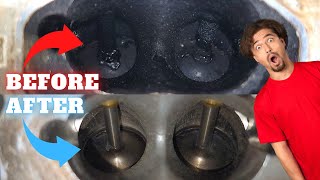
While P0133 is a universal code, the Audi A6 C6 with the 3.2L FSI V6 engine has specific characteristics. These Direct Injection (FSI) engines are known for significant carbon buildup on intake valves, which can affect combustion and, indirectly, exhaust gas readings. 🎬 See how to perform a carbon cleaning on this engine. Furthermore, the Positive Crankcase Ventilation (PCV) valve on this engine is a common failure point; when it fails, it creates a large vacuum leak that can cause a lean condition, engine misfires, and various O2 sensor-related codes, including P0133. Any exhaust or vacuum leaks, which are common on aging vehicles, can easily trigger this code by allowing unmetered air to throw off the sensor's measurements. Owners should first suspect the sensor itself, but be aware that these other platform-relevant issues can be the root cause.
Symptoms You May Notice
- Check Engine Light is on
- Reduced fuel economy
- Rough or uneven idle
- Engine hesitation during acceleration
- Possible black smoke from the exhaust if running very rich
- Hissing or whistling sounds from the engine bay if a vacuum leak is present
- Failure to pass an emissions test
- Replacing the catalytic converter. A P0133 code points to the upstream sensor's response time, not the efficiency of the catalytic converter (which would be a P0420 code).
- Replacing the wrong oxygen sensor. Ensure you are replacing Bank 1, Sensor 1 (Upstream, Passenger Side). Sensor 2 is the downstream sensor and will not fix this code.
- Ignoring a vacuum leak. Many owners replace the O2 sensor only to have the code return, because the root cause was a failed PCV valve or other vacuum leak.
Most Likely Causes
- Failing Bank 1, Sensor 1 Oxygen Sensor 🔴 High Probability → Shop Oxygen Sensor Oxygen sensors are wear items that degrade over time due to heat cycles and contamination from oil and carbon. After 100,000 miles, failure is common. The sensor's internal heating element can also fail, causing a slow response on cold starts.
How to confirm: Use an OBD-II scanner with live data graphing capabilities (like VCDS for VW/Audi) to monitor the voltage of the Bank 1, Sensor 1 O2 sensor. It should fluctuate rapidly between approximately 0.1V and 0.9V on a warm engine. A slow, lazy switching pattern or a flat line confirms the sensor is failing. Compare its waveform to the Bank 2, Sensor 1 waveform for a clear comparison.
Typical fix: Replace the Bank 1, Sensor 1 (upstream, passenger side) oxygen sensor. This often requires a special slotted 22mm (7/8") oxygen sensor socket. On the 3.2L, access is improved by removing the airbox.
Est. part cost: $75-$180 - Vacuum Leak (especially PCV Valve) 🟡 Medium Probability The diaphragm inside the PCV valve (oil separator) is known to tear on the 3.2L FSI engine, creating a significant unmetered air leak into the intake manifold. Aging plastic and rubber hoses throughout the engine bay also become brittle and crack.
How to confirm: A common symptom of a failed PCV is a strong vacuum at the oil filler cap when the engine is running, making it difficult to remove. You may also hear a loud whistling or hissing noise. The definitive method is to perform a smoke test on the intake system. Smoke will pour out of the failed PCV diaphragm or any cracked hoses.
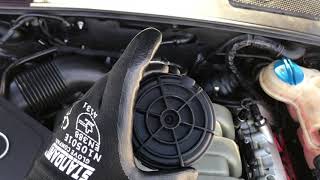
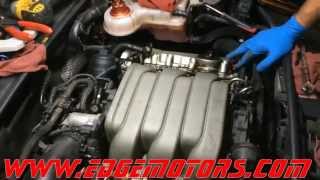
Typical fix: Replace the PCV valve/oil separator assembly and any cracked vacuum hoses. The PCV is located on the rear of the intake manifold on early models and under the intake manifold on later 3.2L engines. 🎬 Watch this step-by-step guide to replacing the PCV valve.
Est. part cost: $50-$200 - Exhaust Leak Before the O2 Sensor 🟡 Medium Probability → Shop Oxygen Sensor Exhaust manifold gaskets and the flex pipes in the downpipes can fail over time from heat cycles and corrosion, creating leaks.
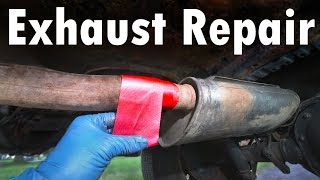
How to confirm: Perform a visual inspection of the exhaust manifold and downpipe on the passenger side for black soot trails, which indicate a leak. A smoke test can also be used to definitively locate a leak. You may also hear a ticking or puffing noise from the engine bay, especially on a cold start. 🎬 Watch: How to find and repair common exhaust leaks.
Typical fix: Replace the leaking gasket or repair/replace the leaking section of the exhaust.
Est. part cost: $20-$300 - Damaged O2 Sensor Wiring or Connector ⚪ Low Probability → Shop Oxygen Sensor The wiring harness is close to the hot exhaust and can become brittle, chafed, or melted over time. Oil leaks from the valve cover gaskets can also saturate the connector, causing poor contact.
How to confirm: Visually inspect the wiring harness and connector for the Bank 1 O2 sensor. Look for any signs of melting, chafing, corrosion, or oil contamination. Use a multimeter to check for continuity and ensure there are no shorts or open circuits in the harness.
Typical fix: Repair the damaged section of wiring or clean/replace the connector.
Est. part cost: $10-$50
Rare But Worth Checking
- Dirty or Failing Mass Airflow (MAF) Sensor: → Shop Fuel Injection Air Flow Meter A dirty MAF sensor can under-report the amount of air entering the engine, causing a lean condition that the O2 sensor may interpret as a slow response. Cleaning the MAF sensor with a dedicated cleaner is a simple diagnostic step before replacing more expensive parts.
- Low Fuel Pressure or Leaking Injectors: A weak fuel pump, failing fuel pressure regulator, or a leaking fuel injector can cause lean or rich conditions that can contribute to this code. Check fuel pressure and injector balance if other causes have been ruled out.
- Failing Engine Control Unit (ECU): This is extremely rare, but a faulty ECU driver circuit for the O2 sensor can misinterpret the data. This should only be considered after all other possibilities have been exhaustively ruled out by a professional.
Diagnosis Steps
- Plug in an OBD-II scanner (VCDS is preferred for VW/Audi) and confirm that P0133 is the active code. Check for any other accompanying codes, especially for lean conditions (P0171) or heater circuit faults (P0135).
- Use the scanner's live data function to monitor the voltage of the Bank 1, Sensor 1 O2 sensor. At a steady idle on a warm engine, the voltage should switch rapidly and consistently between ~0.1V and ~0.9V.
- If the voltage is slow to change, stuck high, or stuck low, the sensor is likely bad.
- With the engine running, carefully try to remove the oil filler cap. If there is significant suction holding it on, this strongly indicates a failed PCV valve creating a massive vacuum leak.
- Visually inspect the exhaust manifold and downpipe on the passenger side for any signs of soot, indicating an exhaust leak. Listen for a 'ticking' sound when the engine is cold.
- Inspect the O2 sensor's wiring and connector for any visible damage, melting, or corrosion.
- If no obvious issues are found, perform a smoke test on the intake manifold and vacuum lines to definitively check for leaks.
- If no leaks are found and the wiring is intact, the most probable cause is a faulty oxygen sensor.
Parts You'll Likely Need
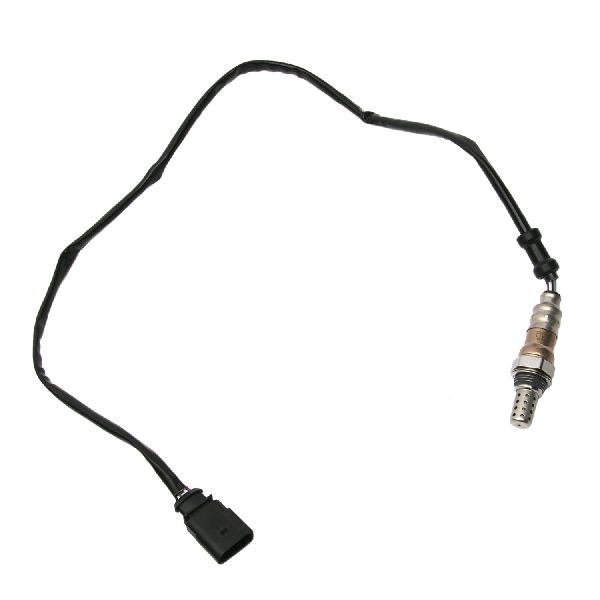
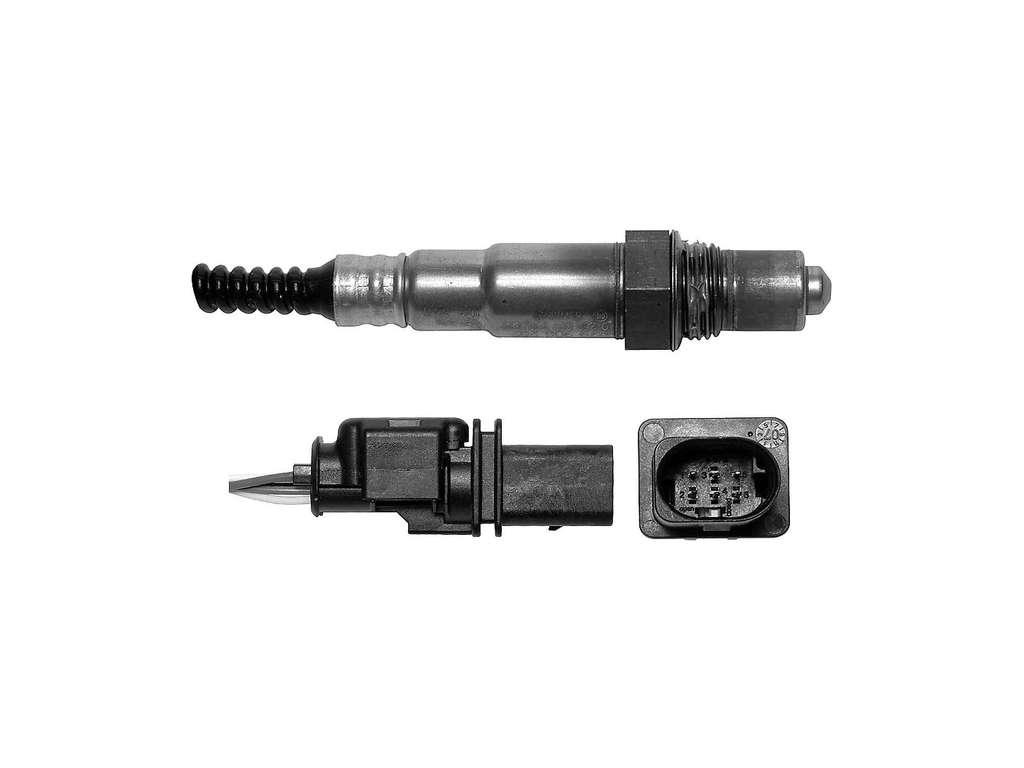
- Oxygen Sensor (Bank 1, Sensor 1)
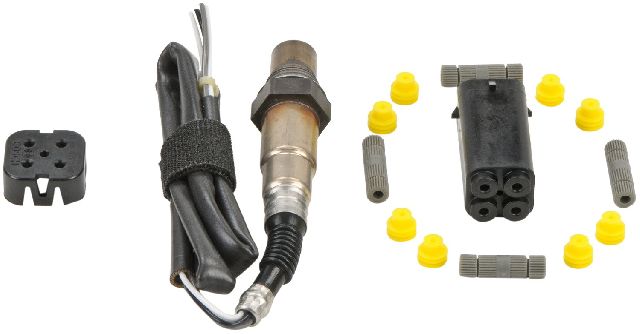
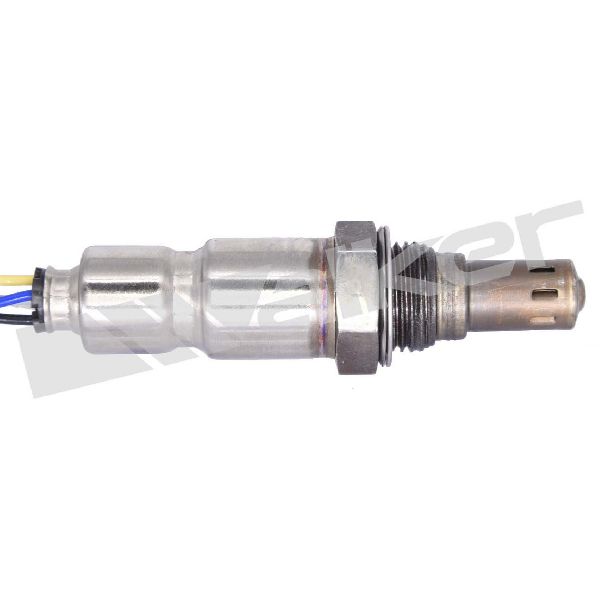
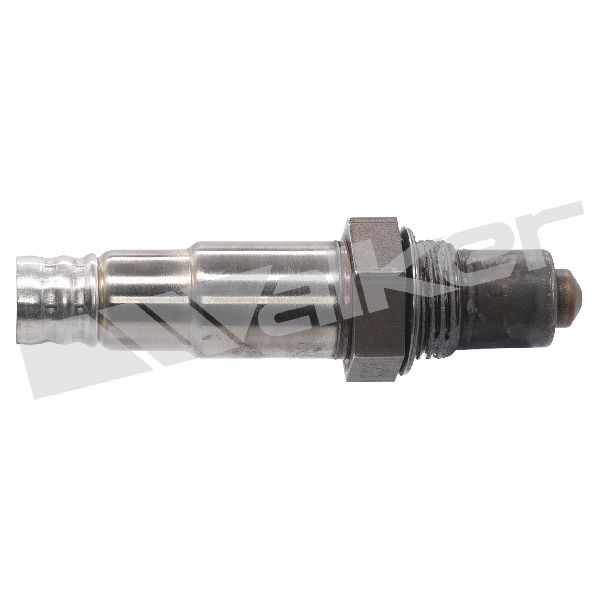
(OEM #06E906265S)— This is the upstream, pre-catalyst sensor on the passenger side. It is the most common failure point for a P0133 code.
Trusted brands: Bosch (OEM supplier, part #18089 or #17302), NTK, Denso
OEM price range: $120-$180
Aftermarket price range: $75-$120 - PCV Valve / Oil Separator
(OEM #06E103547H (example, verify by VIN))— A very common failure item on the 3.2L FSI engine that creates vacuum leaks, often leading to O2 sensor codes.
Trusted brands: Audi (OEM), Vaico, Topran
OEM price range: $150-$220
Aftermarket price range: $50-$120
Related Codes That Often Appear With This One
- P0171 — System Too Lean (Bank 1). This code often appears with P0133 if a vacuum leak or exhaust leak is the root cause, as the unmetered air creates a lean condition that the sensor struggles to react to.
- P0135 — O2 Sensor Heater Circuit (Bank 1, Sensor 1). This code points to a failure in the sensor's internal heater, which is critical for bringing it to operating temperature quickly. A failed heater directly causes a slow response, making P0133 appear alongside it.
- P0420 — Catalyst System Efficiency Below Threshold (Bank 1). If P0133 is ignored for a long time, the poor air-fuel mixture can eventually degrade the catalytic converter, leading to a P0420 code.
- P0300, P0301-P0306 — Misfire codes. A significant vacuum leak from a failed PCV valve can cause misfires, often accompanied by O2 sensor and fuel trim codes.
Platform-Specific Known Issues
- The 3.2L FSI engine is known for significant carbon buildup on the back of the intake valves. While this typically causes misfire codes (P030x), severe cases can affect airflow and combustion enough to contribute to abnormal O2 sensor readings and fuel trim issues. This is considered a routine maintenance item, often requiring walnut blasting for removal.
- A user on AudiWorld forums reported getting a P0133 code, which was ultimately resolved by replacing the O2 sensor. Another user noted that after replacing the sensor for P0133, they then got a P0132 (High Voltage) code, indicating a potential wiring or cheap sensor issue.
Mechanic-Grade Diagnostic Values
- O2 Sensor Heater Resistance — expected: < 20 Ohms. Failure: A reading of 20 Ohms or more indicates a defective heater element within the sensor.
- Low-Pressure Fuel System — expected: ~6 Bar (approx. 87 PSI). Failure: Significantly lower pressure indicates a weak in-tank fuel pump or regulator issue.
- High-Pressure Fuel System (at idle) — expected: ~35 Bar (approx. 508 PSI). Failure: Pressure that is wildly out of spec could indicate a failing High-Pressure Fuel Pump (HPFP), which can affect the air-fuel mixture and indirectly cause O2 codes.
- O2 Sensor Signal Voltage (Warm Engine, Closed Loop) — expected: Rapidly fluctuating between ~0.1V and ~0.9V. Failure: A slow, lazy, or flat-lined voltage reading indicates a failing sensor. A response time from lean (0.1V) to rich (0.9V) should be around 300 milliseconds.
Scan Tool Commands That Help
- VCDS (VAG-COM): Basic Settings - Group 140 (Fuel Pressure Relief) — This function is used to safely depressurize the high-pressure fuel system before working on components like fuel injectors or the HPFP, which might be checked when diagnosing persistent P0133 codes.
- VCDS (VAG-COM): [01-Engine] -> [Readiness - 15] -> [Set Readiness] — After a repair, this guided function attempts to run the necessary engine tests to set all emissions monitors to 'Ready'. If the O2 sensor monitor fails to set, it points to an unresolved issue.
- VCDS (VAG-COM): Basic Settings -> "IDE00553 Automatic test sequence" or "B200 Readiness Code" — If the guided [Set Readiness] button is greyed out, this manual basic setting can be initiated. The user holds the brake and accelerator while the ECU runs through a sequence of tests to set readiness monitors.
Wiring & Ground Locations
- Engine Block Ground Point (18) — On the engine block on the front right, near the alternator.. A poor engine ground can cause unstable voltage references for all engine sensors, including the oxygen sensors, leading to erratic readings and fault codes.
- Bulkhead Ground Point (645) — On the left side of the bulkhead/firewall in the engine bay.. This is a primary grounding point for various engine bay components. Corrosion or looseness here can create intermittent electrical issues that are difficult to trace.
- Small Ground Wire near Oil Filter Housing — A small, single brown ground wire that attaches to one of the bolts on the oil filter housing.. This specific ground is often forgotten or left unattached after major engine work (like an engine replacement or timing chain service), leading to immediate and confusing electrical issues, including sensor faults.
- ECM Connector T60a / T94a — The main connectors at the Engine Control Module (ECM), located in the plenum chamber (under the windshield cowl).. Technicians may need to back-probe pins at these connectors to test for continuity between the ECM and the O2 sensor connector, verifying the integrity of the wiring harness. Water intrusion in the plenum chamber can also corrode these pins.
Real Owner Repair Stories
- AudiWorld Forums (2006 Audi A6 3.2L FSI) — P2294 (Fuel Pressure Regulator Valve), rough idle, and likely other fuel trim or O2 codes.
❌ Tried (didn't work) Initial diagnosis focused solely on the fuel pressure code.
✅ What actually fixed it The user discovered severe carbon buildup on the intake valves. After performing a manual cleaning of the valves, the engine performance was restored and related codes were resolved. This highlights how carbon buildup on FSI engines can indirectly cause fuel and emissions-related codes like P0133 by disrupting proper airflow and combustion.
OEM Part Supersession History
06E906265F→06E906265S— Part revision and potential improvement by the manufacturer.
Heads up: The newer 'S' revision replaces the older 'F' part and should be used for all replacements.
Model Year Variations Within This Range
- 2005-2006 vs 2007+: The PCV valve (oil separator) location changed. On early models (e.g., 2005-2006), it is often located on the rear of the intake manifold and is relatively accessible. On later models (e.g., 2007+), it was relocated to a position buried deep under the upper intake manifold, making replacement significantly more labor-intensive.
- 2005-2009: The BKH engine code was used on some models, particularly in 2009, alongside the more common AUK. While largely identical for this repair, it's important to verify the engine code when ordering certain specific parts like the High Pressure Fuel Pump.
Diagnostic Flowchart
Other Known Issues on This Vehicle
Issues unrelated to this code that are worth knowing about as an owner of this generation:
- Timing Chain Tensioner & Guide Failure 🔴 High — Common after 80,000-150,000 miles. A 'rattle' on cold start is the primary warning sign. Failure is due to wear on plastic guides and hydraulic tensioners.
- Intake Valve Carbon Buildup 🟠 Medium — A universal issue for FSI engines. Noticeable performance degradation (misfires, rough idle, power loss) can occur as early as 40,000-60,000 miles. Considered a routine maintenance cleaning (walnut blasting).
- Intake Manifold Runner Flap Failure 🟠 Medium → Shop Engine Intake Manifold — Common at higher mileage. The plastic linkage arms and bushings wear out, causing the flaps to become stuck open or closed, triggering codes like P2006, P2007, or P2015 and causing poor performance.
- PCV Valve / Oil Separator Failure 🟠 Medium — Very common. The internal diaphragm tears, causing high crankcase vacuum, oil leaks, whistling noises, and lean/misfire codes.
- Thermostat Failure 🟡 Low — The thermostat can fail, typically sticking open, which leads to the engine not reaching full operating temperature and poor heater performance. It is a relatively common replacement item.
Used vs. New Parts: Buying Guide for This Vehicle
When a used part is the smart pick: For this repair, using used parts is generally not recommended for the key components. However, if a large assembly like an exhaust manifold or downpipe is needed due to a cracked flange, a used part from a non-corroded donor car can be a cost-effective alternative to a new OEM unit.
Donor-vehicle mileage cap: roughly under 80000 miles for the part to have meaningful remaining life.
What to inspect on the donor part:
- For exhaust components: Inspect for rust, especially at welds and flex joints. Look for the absence of black soot trails which indicate cracks.
- For any electronic connector: Ensure the plastic is not brittle or cracked and the locking tabs are intact.
- For PCV/hoses: Squeeze rubber/plastic hoses to check for brittleness or mushiness. Avoid anything that feels overly hard or soft.
OEM-only on this vehicle (don't cheap out):
- PCV Valve / Oil Separator: While aftermarket is available, the OEM part is known to have the best longevity. Given the labor involved in replacing it on later models, using a quality OEM part is a wise investment to avoid a repeat failure.
Aftermarket brands forum-validated for this vehicle:
- Oxygen Sensor: Bosch (often the original OEM supplier), NTK, and Denso are highly regarded and reliable alternatives to the dealer part.
Brands owners have reported issues with on this vehicle:
- Unnamed, 'white box' or generic eBay/Amazon oxygen sensors and PCV valves. These often have poor quality control, fail to meet the ECU's strict performance parameters, and can cause the code to return shortly after installation.
Real Owner Stories
Aggregated from forums and TSBs cited above. Mileages and costs reflect what owners reported in those sources.
2019 Audi A6 3.2L
Symptoms: P0133 and related heater circuit codes; confirmed Bank 1 is the passenger side.
What fixed it: Replaced the O2 sensor (OEM part 06E906265S) by removing the airbox for access.
Source hint: AudiWorld Forums - "O2 Sensor Errors" (2019)
2007 Audi A6 3.2L (BKH)
Symptoms: Multiple oil leaks and a strong vacuum at the oil cap.
What fixed it: Identified as a failed PCV valve (oil separator), which is a known root cause for O2 sensor faults and lean codes.
Source hint: AudiWorld Forums - "Can you explain the PCV valve??" (2023)
2006 Audi A6 3.2L FSI
Symptoms: Misfires in one bank and engine burning rich; complex fuel trim issues.
What fixed it: Diagnostic investigation into O2 sensor readings, camshaft timing, and engine faults.
Source hint: Ross-Tech Forums - "Misfires in One Bank & Burning Rich" (2016)
Related OBD-II Codes
Frequently Asked Questions
Where is the Bank 1, Sensor 1 O2 sensor located on my 3.2L A6, and how do I access it?
Could my P0133 code be caused by the common PCV valve failure on the BKH engine?
I replaced my sensor with a cheap part and now have a P0132 code. What happened?
Does the carbon buildup issue on the 3.2L FSI cause P0133?
Is there a specific part number I should look for when replacing the Bank 1 sensor?
Can an exhaust leak cause a slow response code on this Audi?
Helpful Videos
We Have This Part in Stock

The information in this article is provided for general reference and educational purposes only. Vehicle specifications, procedures, and part compatibility can vary by production date, trim level, and region. Always consult your vehicle's factory service manual and verify part numbers before purchasing or performing repairs. Safety-critical components such as airbags, seat belts, and braking systems should be installed by a qualified professional.
- Audi A6:
- 🧭 Diagnostic Flowchart
- 🎬 Helpful Videos
- 🛍️ Shop This Part
- What's Unique About the 2005-2011 Audi A6
- Symptoms You May Notice
- Most Likely Causes
- Rare But Worth Checking
- Diagnosis Steps
- Parts You'll Likely Need
- Related Codes That Often Appear With This One
- Platform-Specific Known Issues
- Mechanic-Grade Diagnostic Values
- Scan Tool Commands That Help
- Wiring & Ground Locations
- Real Owner Repair Stories
- OEM Part Supersession History
- Model Year Variations Within This Range
- Other Known Issues on This Vehicle
- Used vs. New Parts: Buying Guide for This Vehicle
- Real Owner Stories
- 2019 Audi A6 3.2L
- 2007 Audi A6 3.2L (BKH)
- 2006 Audi A6 3.2L FSI
- Related OBD-II Codes
- Frequently Asked Questions
- 🎟️ Get 5% Off