

P0133 on 2010-2015 Kia Sorento: O2 Sensor Slow Response Causes and Fixes
For the 2010-2015 Kia Sorento, code P0133 almost always means the upstream oxygen sensor (Bank 1, Sensor 1) is failing. Replacing this sensor is the most common fix. Expect to pay $60-$150 for an aftermarket part and $150-$250 for OEM. DIY difficulty is easy for the 4-cylinder but difficult for the V6's firewall-side sensor, often requiring special tools and significant disassembly.
- P0133 on a 2010-2015 Sorento almost always points to a failed upstream oxygen sensor (Bank 1, Sensor 1).
- For V6 models, be prepared for a difficult repair, as the sensor is on the firewall side of the engine and access is extremely limited.
- Always inspect for exhaust leaks and wiring damage before replacing the sensor, as these can cause the same code.
- Use a quality OEM or reputable aftermarket brand like Denso or NGK; cheap sensors are known to fail prematurely or provide inaccurate readings.
What's Unique About the 2010-2015 Kia Sorento
The 2010-2015 Sorento spans two generations, with different engines. For V6 models (3.5L, 3.3L), Bank 1 is the cylinder bank located against the firewall, making the P0133-related sensor notoriously difficult to access compared to the front bank (Bank 2) or the sensor on the 4-cylinder engines. Some owners have found it necessary to remove the intake surge tank to gain adequate access from the top. While the cause is almost always the sensor itself, the repair difficulty varies significantly based on which engine the Sorento has.
Generation note: The specified year range covers two Sorento generations. The 2010 model year is a carryover of the first generation (BL). The 2011-2015 model years are the second generation (XM). While the code's meaning is identical, the engine options (2.4L I4, 3.5L V6, etc.) and specific part numbers for the oxygen sensors differ between these generations. The 2.4L engines in 2012-2015 models were part of the Theta II engine family, known for significant recalls.
Symptoms You May Notice
- Check Engine Light is on
- Decreased fuel economy
- Rough idling or engine hesitation
- Slower acceleration or weaker throttle response
- Failing an emissions test
- Increased exhaust emissions
- Replacing the wrong oxygen sensor (e.g., replacing the downstream Sensor 2 instead of the upstream Sensor 1).
- Replacing the Bank 2 sensor on V6 models instead of the correct Bank 1 sensor.
- Immediately replacing the catalytic converter. A P0133 code points to a sensor issue, not necessarily a converter failure. A lazy sensor can even cause a false P0420 code.
- Replacing the sensor without first checking for exhaust leaks or wiring damage, which can mimic a bad sensor.
Most Likely Causes
- Failing Upstream Oxygen Sensor (Bank 1, Sensor 1) 🔴 High Probability → Shop Oxygen Sensor Oxygen sensors are wear-and-tear items with a finite lifespan, typically 60,000-100,000 miles. Contamination from carbon, oil, or coolant can also cause premature failure by coating the sensor tip.
How to confirm: Use an OBD-II scanner with live data to monitor the B1S1 voltage. A healthy sensor's voltage will fluctuate rapidly between approximately 0.1 and 0.9 volts on a warm engine. A slow sensor will show sluggish, lazy fluctuations or get stuck. Modern sensors should respond within 100-300 milliseconds. The heater element resistance can be tested and should be between 2.5 and 4.0 Ohms at room temperature.
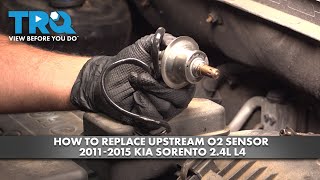
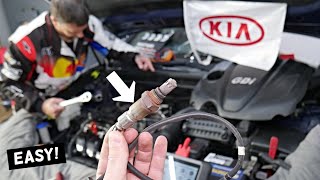
Typical fix: Replace the Bank 1, Sensor 1 oxygen sensor. On 4-cylinder engines, this is the sensor on the exhaust manifold. 🎬 Watch: Step-by-step upstream O2 sensor replacement for 2.4L engines. On V6 engines, this is the upstream sensor on the firewall side of the engine. A special slotted 22mm (7/8") oxygen sensor socket is often required.
Est. part cost: $60 - $250 - Exhaust Leak 🟡 Medium Probability Leaks can develop at the exhaust manifold gasket or flex pipe over time due to heat cycles and corrosion. An exhaust leak before the sensor can draw in outside air, which dilutes the exhaust gases and causes the sensor to send inaccurate, slow, or biased-lean readings to the ECU.
How to confirm: Visually inspect the exhaust manifold and downpipe for black soot marks, which indicate a leak. You may also hear a ticking or hissing sound from the engine bay, especially when the engine is cold. A smoke test is a definitive way to identify hard-to-see leaks.
Typical fix: Replace the leaking gasket or repair/replace the cracked exhaust component.
Est. part cost: $20 - $300 - Damaged Wiring or Connector ⚪ Low Probability The sensor wiring is close to the hot exhaust and can become brittle, melted, or frayed over time. Corrosion can also build up in the connector pins, disrupting the signal.
How to confirm: Visually inspect the oxygen sensor's wiring harness and connector for any signs of melting, corrosion, or physical damage. Check for a secure connection. Test the wiring for continuity with a multimeter if a visual inspection is inconclusive.
Typical fix: Repair the damaged section of the wiring harness or replace the connector pigtail.
Est. part cost: $15 - $50
Rare But Worth Checking
- Vacuum Leak: A significant vacuum leak can alter the air-fuel mixture enough to make the O2 sensor readings appear slow or erratic. This would typically be accompanied by other codes like P0171 (System Too Lean).
- Faulty Mass Air Flow (MAF) Sensor: → Shop Fuel Injection Air Flow Meter A dirty or failing MAF sensor can provide incorrect airflow data to the computer, affecting fuel calculations and potentially triggering a P0133 code.
- Low Fuel Pressure: Incorrect fuel pressure from a weak pump or clogged filter can impact the air-fuel ratio and cause O2 sensor codes.
- Blown O2 Sensor Fuse: → Shop Oxygen Sensor The oxygen sensor heater circuit is protected by a fuse, often located in the engine bay fuse box and labeled 'SENSOR 1' or similar. A blown fuse will prevent the heater from working, causing the sensor to warm up too slowly and trigger a P0133, often accompanied by a heater circuit code like P0135.
- Swapped O2 Sensor Connectors: → Shop Oxygen Sensor Extremely rare in normal circumstances, but can happen after major engine or exhaust work. If the upstream and downstream sensor connectors are accidentally swapped, the PCM will receive illogical data (e.g., a fast-switching signal on the post-cat circuit) and can set a P0133 code. This can be diagnosed by unplugging one sensor and seeing which sensor shows as disconnected on a scan tool.
Diagnosis Steps
- Connect an OBD-II scanner to confirm P0133 is the active code and check for any other stored codes, especially heater circuit codes (P0135).
- Use the scanner's live data feature to observe the voltage of the Bank 1 Sensor 1 (B1S1) O2 sensor with the engine fully warmed up. It should switch rapidly between ~0.1V and ~0.9V. If it's slow, stuck, or has a flat waveform, the sensor 🎬 Watch: How to diagnose and fix a P0133 slow response. is likely faulty.
- Perform a thorough visual inspection of the exhaust system from the engine manifold to the catalytic converter. Look for any signs of black soot, indicating an exhaust leak. Listen for ticking noises when cold.
- Inspect the wiring harness and connector for the B1S1 sensor. Look for any signs of melting, corrosion, or loose pins. Ensure the connector is securely plugged in.
- Check the fuse for the O2 sensor heater circuit in the engine compartment fuse box.
- If no issues are found with the exhaust or wiring, the most likely cause is the oxygen sensor itself.
- For V6 models, confirm the location of Bank 1 🎬 See this video to locate the Bank 1 sensor. (firewall side) before proceeding with any replacement. Access from below may be possible, but removing the intake surge tank from above may be required for better access.
Parts You'll Likely Need
- Upstream Oxygen Sensor (Bank 1, Sensor 1)
(OEM #39210-2G100 (for 2.4L I4), 39210-3CCA0 (for 3.5L/3.3L V6 Bank 1))— This is the sensor identified by the P0133 code. It is a common wear item and the most frequent cause of the fault.
Trusted brands: Denso, NGK/NTK, Bosch, Mando
OEM price range: $150-$250
Aftermarket price range: $60-$150
Related Codes That Often Appear With This One
- P0135 — This code indicates a fault in the O2 sensor's internal heater circuit. A failed heater will prevent the sensor from warming up quickly, almost always causing a P0133 slow response code to appear as well.
- P0171 — This code for 'System Too Lean' can be caused by an exhaust leak before the O2 sensor. The same leak can cause the sensor to respond slowly, triggering both codes.
- P0420 — While P0420 indicates 'Catalyst System Efficiency Below Threshold', a lazy upstream O2 sensor (P0133) can provide incorrect data, leading to an inaccurate assessment of the catalytic converter's health.
Technical Service Bulletins (TSBs) & Recalls
- SC147 - This safety recall addresses potential engine failure in 2012-2014 Sorento models with the 2.4L GDI engine. While not directly for P0133, an engine replacement under this recall would incidentally resolve any related emissions codes originating from the engine itself.
Platform-Specific Known Issues
- On V6 models, the Bank 1 (firewall side) upstream sensor is very difficult to access, significantly increasing labor time and DIY difficulty compared to the 4-cylinder engine.
- A forum member reported that on a Sorento V6, removing the intake surge tank was the only way to get proper access to the firewall-side Bank 1 sensor from above.
Mechanic-Grade Diagnostic Values
- Upstream O2 Sensor (B1S1) Heater Resistance — expected: 2.5 - 4.0 Ω at 20°C (68°F). Failure: An open circuit (infinite resistance) or a reading outside this range indicates a failed heater element.
- Upstream O2 Sensor (B1S1) Live Data Response Time — expected: Less than 100-300 milliseconds to switch between rich and lean.. Failure: A lazy waveform that takes longer than the specified time to switch, or a voltage that is stuck.
- ECM Detection Time for P0133 — expected: The ECM will set the code if the response time for the sensor's voltage to change from rich to lean (or vice versa) is 0.8 seconds or more during idle after the engine is warm.. Failure: Response time > 0.8 seconds.
Wiring & Ground Locations
- O2 Sensor Fuse — In the engine compartment fuse box.. This fuse powers the sensor's heater circuit. If blown, the sensor will not heat up to operating temperature quickly, causing it to respond slowly and trigger a P0133 code, often along with a P0135 heater circuit code. It is often labeled 'SENSOR 1' or similar.
- V6 O2 Sensor Connectors — On the 3.3L V6, the connectors for the firewall-side (Bank 1) sensors are often color-coded. One video for a 2015 Sorento shows a brown connector for the upstream sensor and a blue one for the downstream sensor.. Correctly identifying the upstream sensor connector is critical to avoid replacing the wrong part, especially since access is difficult. Tracing the wire from the sensor to its specific connector is the most reliable method.
Real Owner Repair Stories
- Go-Parts.com Repair Guide (citing a forum discussion) (2013 Kia Optima (shares powertrain with Sorento)) — P0133 code returned shortly after replacing the upstream O2 sensor.
❌ Tried (didn't work) Replacing the Bank 1 Sensor 1 O2 sensor
✅ What actually fixed it A smoke test was clean, but a very close visual inspection found a hairline crack in the exhaust manifold near the O2 sensor bung. The crack would open when hot, letting in just enough air to slow the sensor's reading without setting a P0171 lean code. Replacing the exhaust manifold resolved the P0133 code permanently. - NHTSA ODI #11513767 — An owner reported a complex situation where P0133 appeared alongside numerous other codes including P0087, P0506, P2096, and multiple misfire codes (P0300-P0306), noting that these symptoms were part of a larger fuel and propulsion system issue.
"I Checked Everything" — The Actual Cause
- In one documented case on a similar Kia platform, a P0133 code persisted after an O2 sensor replacement and a smoke test that showed no leaks. The actual cause was a hairline crack in the exhaust manifold that only opened up under thermal expansion when the engine was hot, allowing a small amount of unmetered air to enter the exhaust stream and slow the sensor's response. This was only found via a meticulous visual inspection of the manifold.
OEM Part Supersession History
39210-3CAA0, 39210-3C520, 39210-3C550→39210-3CCA0 is the common replacement, but it also cross-references with 39210-3CCC0.— Standard part updates and consolidation.
Heads up: While many part numbers exist for the V6 Bank 1 sensor, 39210-3CCA0 is the most frequently cited OEM number for the 2011-2015 Sorento 3.3L/3.5L V6. Always verify with VIN.
Model Year Variations Within This Range
- 2012-2015: Models equipped with the 2.4L GDI (Gasoline Direct Injection) engine may be more prone to oil consumption issues that can lead to premature O2 sensor fouling and failure compared to the earlier 2.4L MPI (Multi-Point Injection) engines. If a P0133 code recurs after sensor replacement on a GDI model, investigating oil consumption is a critical next step.
Diagnostic Flowchart
Other Known Issues on This Vehicle
Issues unrelated to this code that are worth knowing about as an owner of this generation:
- Catastrophic Theta II Engine Failure 🔴 High — Widespread in 2.4L GDI engines (2012-2015 models) and some 2.0L Turbo models, often occurring between 60,000 and 100,000 miles. Caused by metallic debris from manufacturing leading to bearing failure. (Ref: Safety Recall SC147 was issued to inspect and, if necessary, replace the engine long block. A class-action lawsuit resulted in a lifetime warranty for the short block assembly for affected vehicles that received a software update.)
- Engine Compartment Fire Risk 🔴 High — Affects 2011-2015 models. Can be caused by multiple issues, including ABS module (HECU) short circuits or other electrical faults. (Ref: Multiple recalls, including NHTSA campaign 23V877000, have been issued, but not all vehicles are covered.)
- Faulty Ignition Coils 🟠 Medium — Common failure item leading to rough running, misfires, and a Check Engine Light. The rear three coils on V6 models are difficult to access as the intake manifold must be removed.
- Prematurely Burnt Out Headlight Bulbs/Connectors 🟡 Low — Owners report headlight bulbs burning out frequently. In some cases, the wiring harness connector itself melts, requiring replacement of the connector or the entire headlight assembly.
- Exterior Door Handles Failing 🟠 Medium — A widely reported issue where the exterior door latch mechanism fails, preventing the door from being opened from the outside.
Used vs. New Parts: Buying Guide for This Vehicle
When a used part is the smart pick: It is almost never a smart choice to buy a used oxygen sensor, as it is a wear-and-tear item with a finite lifespan. A used wiring harness connector (pigtail) or a used exhaust manifold (if cracked) from a low-mileage, non-rusted donor vehicle could be a cost-effective option.
Donor-vehicle mileage cap: roughly under 30000 miles for the part to have meaningful remaining life.
What to inspect on the donor part:
- For an exhaust manifold: Check for hairline cracks, especially around welds and the collector. Ensure mounting surfaces are not warped.
- For a wiring pigtail: Ensure the plastic is not brittle, the locking tab is intact, and there is no corrosion on the pins.
OEM-only on this vehicle (don't cheap out):
- While not strictly 'OEM-only', using reputable brands is critical for oxygen sensors. Cheap, no-name aftermarket sensors are a common source of recurring codes and drivability issues.
Aftermarket brands forum-validated for this vehicle:
- Denso (often the OEM supplier)
- NGK / NTK (often the OEM supplier)
- Bosch
Brands owners have reported issues with on this vehicle:
- Unbranded, 'economy' sensors from online marketplaces like AliExpress or Temu are frequently reported by mechanics and owners to fail quickly or be dead-on-arrival.
Real Owner Stories
Aggregated from forums and TSBs cited above. Mileages and costs reflect what owners reported in those sources.
2011 Kia Sorento LX 2.4L — 150000 miles
Symptoms: Check engine light was on with codes P0133, P0136, and P0140, in the context of a larger issue with a persistent P0420 code after aftermarket catalytic converters were installed.
What fixed it: Replacing the downstream O2 sensor
Source hint: Reddit r/MechanicAdvice
2010-2015 Kia Sorento V6
Symptoms: Extreme difficulty accessing the firewall-side Bank 1 sensor from above or below.
What fixed it: Removing the intake surge tank to gain proper access to the sensor.
Source hint: Go-Parts.com Repair Guide (Sorento 3.5L V6)
2014 Kia Sorento
Symptoms: The owner reported multiple diagnostic codes appearing, including P0133, P0137, P0087, P0506, P2096, and misfire codes P0300 through P0306, related to the fuel and propulsion system.
What fixed it: Documented via NHTSA ODI #11513767 as part of a larger engine and fuel system investigation.
Source hint: NHTSA ODI #11513767
Related OBD-II Codes
Frequently Asked Questions
I have a V6 Sorento; why is the labor for P0133 so much higher than the 4-cylinder model?
Could the Theta II engine recall (SC147) be related to my P0133 code?
What are the specific voltage specs I should look for when testing the O2 sensor on my Sorento?
Can I test the heater element of the O2 sensor with a multimeter?
Is there a specific tool I need to change the sensor on my 2010-2015 Sorento?
Could a ticking sound from my engine bay be causing the P0133 code?
Helpful Videos

We Have This Part in Stock


The information in this article is provided for general reference and educational purposes only. Vehicle specifications, procedures, and part compatibility can vary by production date, trim level, and region. Always consult your vehicle's factory service manual and verify part numbers before purchasing or performing repairs. Safety-critical components such as airbags, seat belts, and braking systems should be installed by a qualified professional.
- Kia Sorento:
- 🧭 Diagnostic Flowchart
- 🎬 Helpful Videos
- 🛍️ Shop This Part
- What's Unique About the 2010-2015 Kia Sorento
- Symptoms You May Notice
- Most Likely Causes
- Rare But Worth Checking
- Diagnosis Steps
- Parts You'll Likely Need
- Related Codes That Often Appear With This One
- Technical Service Bulletins (TSBs) & Recalls
- Platform-Specific Known Issues
- Mechanic-Grade Diagnostic Values
- Wiring & Ground Locations
- Real Owner Repair Stories
- "I Checked Everything" — The Actual Cause
- OEM Part Supersession History
- Model Year Variations Within This Range
- Other Known Issues on This Vehicle
- Used vs. New Parts: Buying Guide for This Vehicle
- Real Owner Stories
- 2011 Kia Sorento LX 2.4L — 150000 miles
- 2010-2015 Kia Sorento V6
- 2014 Kia Sorento
- Related OBD-II Codes
- Frequently Asked Questions
- 🎟️ Get 5% Off