

P0133 on 2010-2013 Kia Soul 2.0L: Slow O2 Sensor Response Causes and Fixes
For a 2010-2013 Kia Soul with a 2.0L engine, code P0133 almost always points to a failing upstream oxygen sensor (Bank 1, Sensor 1). This is a common wear-and-tear item. Expect to pay $60-$120 for a quality aftermarket sensor (like Denso or NTK) and $130-$180 for an OEM part. It's a straightforward DIY replacement for many, but the sensor can be difficult to remove if rusted.
- P0133 on your 2010-2013 Soul means the upstream oxygen sensor (before the catalytic converter) is slow to respond.
- The most probable cause is the sensor itself has worn out and needs to be replaced. Use a quality brand like OEM, Denso, or NTK.
- Before buying a new sensor, perform a quick visual inspection of the exhaust manifold and flex pipe for leaks (soot marks) and check the sensor's wiring for damage.
- Replacing the sensor is a DIY-friendly job for many, but requires a special O2 sensor socket and penetrating oil, as the old sensor is often seized.
- Ignoring this code will lead to poor gas mileage and will cause your vehicle to fail an emissions test.
What's Unique About the 2010-2013 Kia Soul
The 2010-2013 Kia Soul (Generation 1) with the 2.0L 'Beta II' engine is generally reliable, but like any vehicle, its oxygen sensors have a finite lifespan. There are no widespread, unique design flaws that make this specific model prone to P0133 outside of normal wear. However, it's important to rule out exhaust leaks, as some owners have reported leaks at the manifold gasket or the flexible pipe section of the exhaust triggering this code before the sensor itself has failed. Always check for the simple things first. Some owners report the code returning even after replacing the sensor, which can point to a small exhaust leak or a wiring issue.
Symptoms You May Notice
- Check Engine Light is on
- Reduced fuel economy
- Rough or hesitant idling
- Slower than normal acceleration
- Unstable idle or engine shaking
- Rotten egg smell from the exhaust
- Replacing the downstream (Sensor 2) oxygen sensor. The code P0133 specifically refers to Sensor 1, which is the upstream sensor before the catalytic converter. Replacing the wrong sensor will not fix the issue.
- Using a cheap, no-name universal oxygen sensor. Owners and technicians often report that these vehicles are sensitive to the quality of the O2 sensor, and using a low-quality part can result in the code returning. Sticking with OEM, Denso, or NTK is highly recommended.
Most Likely Causes
- Failing Upstream Oxygen Sensor (Bank 1, Sensor 1) 🔴 High Probability → Shop Oxygen Sensor Oxygen sensors are wear items with a typical lifespan of 60,000 to 100,000 miles. Contamination from carbon, oil, or fuel additives can degrade their performance over time. The sensor's internal heater can also fail, which is critical for quick response on startup.
How to confirm: Use a scan tool to monitor the live data for the B1S1 O2 sensor. The voltage should fluctuate rapidly between approximately 0.1V and 0.9V. If the switching is slow, lazy, or stuck, the sensor is bad. Visual inspection may also show heavy carbon deposits. The sensor can be extremely difficult to remove; applying penetrating oil (like Liquid Wrench) beforehand and using a dedicated O2 sensor socket is highly recommended.
Typical fix: Replace the upstream oxygen sensor. This sensor is typically located on the front of the exhaust manifold, making it relatively accessible.
Est. part cost: $60-$120 - Exhaust Leak Before the O2 Sensor 🟡 Medium Probability → Shop Oxygen Sensor Gaskets, particularly the one between the exhaust manifold and the cylinder head, can fail over time due to heat cycles. Some owners have also reported leaks in the flexible exhaust pipe section causing this code.
How to confirm: Visually inspect the exhaust manifold, gaskets, and welds for cracks or black soot trails indicating a leak. You can also have a helper temporarily block the tailpipe with a rag while the engine is running (cold) to make leaks more audible. A professional may use a smoke machine to pinpoint small leaks.
Typical fix: Replace the leaking gasket or repair the cracked component. The manifold-to-head gasket is a common failure point.
Est. part cost: $10-$40 - Damaged Wiring or Connector ⚪ Low Probability
How to confirm: Visually inspect the wiring harness leading to the upstream O2 sensor. Look for any signs of melting, chafing, corrosion in the connector, or loose pins. Use a multimeter to check for continuity and proper voltage at the connector, which may require a wiring diagram for your specific model year.
Typical fix: Repair the damaged section of the wiring harness or clean/replace the connector.
Est. part cost: $5-$50
Rare But Worth Checking
- Failing Mass Airflow (MAF) Sensor: → Shop Fuel Injection Air Flow Meter A dirty or failing MAF sensor can provide incorrect airflow data to the ECM, which can affect the air/fuel mixture and sometimes trigger an O2 sensor code. This is less common than a bad O2 sensor itself.
- Engine Control Module (ECM) Issue: → Shop Engine Control Module (ECM) In very rare cases, the fault can be with the ECM's internal driver for the O2 sensor circuit. This should only be considered after all other possibilities have been exhaustively ruled out. Some Kia/Hyundai vehicles have had TSBs issued for ECM software updates to adjust O2 sensor monitoring sensitivity, so it's worth checking for your specific VIN.
- Failing Catalytic Converter: A partially clogged or failing catalytic converter can alter exhaust flow and temperature, sometimes leading to an upstream O2 sensor code. This is more common on higher-mileage vehicles and is usually a last resort after replacing the sensor and checking for leaks.
Diagnosis Steps
- Read the code with an OBD-II scanner to confirm P0133 is the primary code.
- Inspect the O2 sensor wiring harness and connector for any visible damage, melting, or corrosion.
- Start the engine (when cold) and inspect the exhaust manifold, the pipe leading to the catalytic converter, and the flex pipe for any audible or visible signs of an exhaust leak (soot, cracks).
- Use a scan tool with live data capability to monitor the Bank 1 Sensor 1 voltage. At operating temperature, the voltage should switch rapidly and consistently between below 0.2V and above 0.8V.
- If the voltage is slow to respond, biased to one side, or flat, the sensor is the most likely cause.
- If the sensor appears to be working but the code persists, more thoroughly check for small exhaust leaks (a smoke test may be required) or other issues affecting the air/fuel ratio, such as vacuum leaks or a dirty MAF sensor.
- If a new, high-quality sensor does not resolve the code, investigate the possibility of a wiring fault or a rare ECM issue.
Parts You'll Likely Need
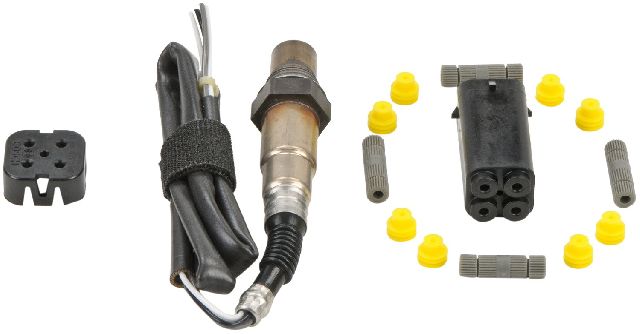
- Upstream Oxygen Sensor (Air/Fuel Ratio Sensor)
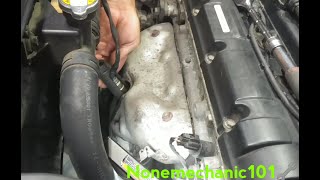
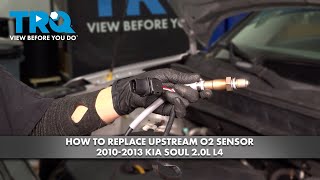
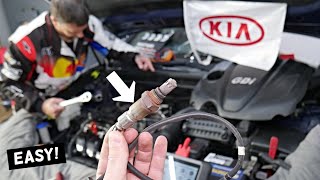
(OEM #39210-23800 (for 2010-2011 2.0L Beta II). Note: 2012-2013 2.0L Nu engine may use a different part number like 39210-2G100. Always verify with VIN.)— This is the component that measures the exhaust gases and is identified by the code as responding too slowly. 🎬 Watch: How to locate and swap the Bank 1 Sensor 1. It is a common wear item and the most frequent cause of P0133.
Trusted brands: Denso (e.g., 234-4433, verify fitment), NGK/NTK, Bosch
OEM price range: $130-$180
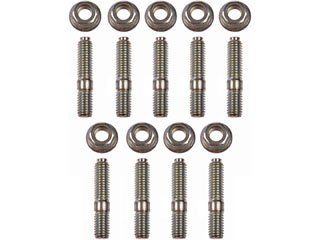
Aftermarket price range: $60-$120 - Exhaust Manifold to Cylinder Head Gasket
(OEM #28521-23005 (for 2.0L Beta II))— If an exhaust leak is found to be the cause, this gasket is a common failure point that allows unmetered air to enter the exhaust stream, skewing the O2 sensor's readings.
Trusted brands: Fel-Pro (e.g., MS 97102), Victor Reinz, Mahle
OEM price range: $20-$40
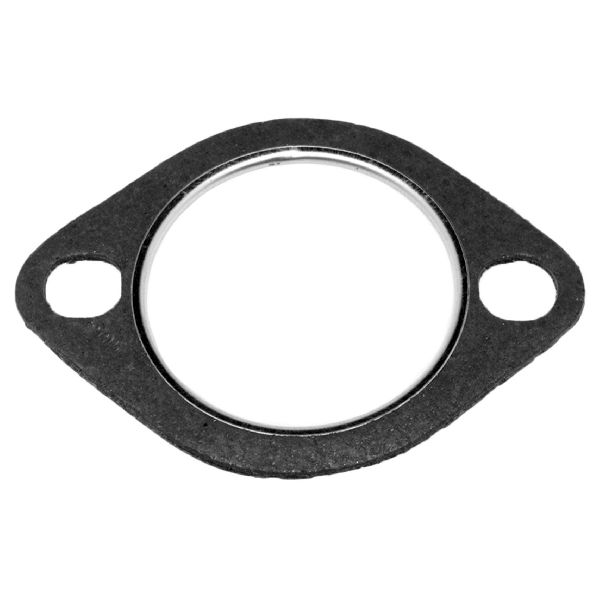
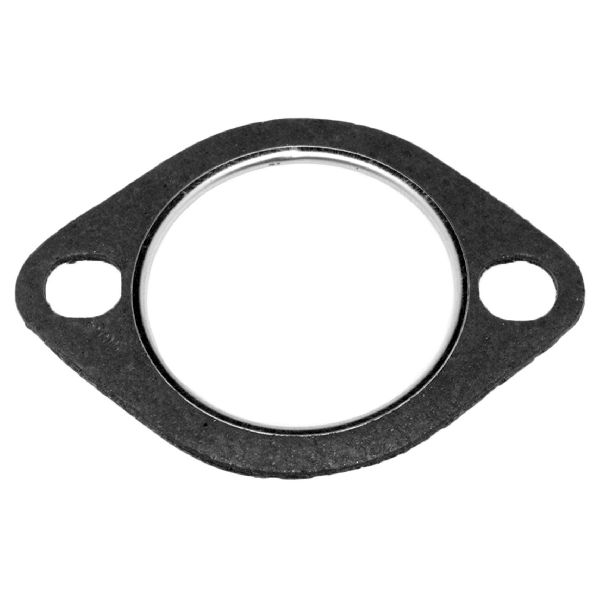
Aftermarket price range: $10-$25 - Exhaust Pipe to Manifold Gasket (Flange Gasket)
(OEM #28751-2B300 (verify with VIN))— This donut or ring-style gasket seals the connection between the exhaust manifold and the front pipe. It is another common source of leaks that can trigger P0133.
Trusted brands: Walker, Bosal, AP Exhaust
OEM price range: $10-$20
Aftermarket price range: $5-$15
Technical Service Bulletins (TSBs) & Recalls
- While no specific TSB for the 2010-2013 Soul and P0133 was found in the search, Kia/Hyundai have released TSBs for other models involving ECM reprogramming to adjust O2 sensor monitoring parameters. If the issue persists after replacing the sensor and confirming no leaks, checking for available ECM updates with a dealer is a valid diagnostic step.
Platform-Specific Known Issues
- Recurring Code After Replacement: A Reddit user on r/kia reported that the P0133 code returned even after replacing the sensor twice, once as a DIY and once by a professional shop. This highlights the importance of checking for secondary causes like exhaust leaks or wiring issues if a new, high-quality sensor doesn't fix the problem.
- Exhaust Flex Pipe Leak: On the r/MechanicAdvice subreddit, a user with a 2011 Soul and code P0133 was advised that a split in the exhaust flex pipe is a very common cause for this code on similar Kia/Hyundai platforms.
- Difficulty of Sensor Removal: Multiple DIY videos emphasize that the original sensor can be seized in the exhaust manifold due to rust and heat cycles. Soaking the sensor threads with penetrating oil for an hour or more before attempting removal is a common recommendation. A proper 22mm O2 sensor socket is considered essential.
Mechanic-Grade Diagnostic Values
- B1S1 O2 Sensor Heater Circuit Resistance — expected: Typically between 2 and 16 ohms, but varies by sensor manufacturer. Check spec for the replacement part.. Failure: An open circuit (infinite resistance) or a dead short (zero resistance) indicates a failed heater element.
- B1S1 O2 Sensor Heater Circuit Voltage Supply (KOEO) — expected: Approximately 12V (battery voltage) at the harness connector.. Failure: No voltage suggests a blown fuse or a break in the power supply wire.
- B1S1 O2 Sensor Cross Counts — expected: At least 8-10 switches from rich (>0.8V) to lean (<0.2V) within a 10-second window on a fully warmed engine at a steady RPM.. Failure: Fewer cross counts indicate a lazy or slow-responding sensor.
- B1S1 O2 Sensor Heater Current Draw — expected: Varies by design, but a healthy heater should have a noticeable current draw.. Failure: A very low current draw (e.g., under 0.5A) may indicate high resistance in the circuit or a weak ground/power feed, preventing the sensor from heating up properly.
Scan Tool Commands That Help
- Kia GDS (Global Diagnostic System): DTC Analysis / Data Analysis (Live Data) — To graph the B1S1 O2 sensor voltage in real-time. This allows a technician to visually confirm if the sensor's waveform is lazy, erratic, or flat, and to check the cross count frequency, which is the core of diagnosing P0133.
- Kia GDS (Global Diagnostic System): Actuation Test — To manually command the O2 sensor's heater circuit on and off. This can verify the integrity of the wiring, fuse, and the ECM's control driver, helping to distinguish between a failed sensor heater and a circuit problem.
Wiring & Ground Locations
- ECM Connector C100-MA, Pin 5 — At the Engine Control Module (ECM). The ECM is typically located in the engine bay.. This specific pin is the 'Heater Control Output' for the Bank 1 Sensor 1 O2 sensor. A technician can test for a signal at this pin to verify if the ECM is commanding the heater to turn on, which is crucial for ruling out an ECM fault.
- Engine Ground Strap — There are multiple grounds. One key ground strap connects the engine block or transmission case to the vehicle's chassis/frame to ensure a good ground path for all engine-mounted sensors.. A corroded or loose engine ground can create electrical noise and voltage drops, affecting the O2 sensor's reference ground and heater performance, potentially causing a slow response code even with a good sensor.
- O2 Sensor Connector — On the wiring harness side, connecting to the upstream O2 sensor located on the exhaust manifold.. For the 2011 Soul, this is a 4-terminal rectangular connector. The terminals for the heater circuit (power and ground) and the sensor signal (signal and signal ground) must be clean and free of corrosion. Testing for voltage and ground at this connector is a primary diagnostic step.
When the Usual Fixes Don't Work
- In a documented case for a 2010 Kia Soul, the owner replaced the Bank 1 Sensor 1 oxygen sensor twice—once as a DIY project and a second time at a professional shop—but the P0133 code returned both times. This serves as strong evidence that while the sensor itself is the most common cause, it is not the only cause. In such cases, the root problem is almost certainly a secondary issue that was overlooked, such as a hairline crack in the exhaust manifold, a poor electrical ground, or a subtle wiring fault that isn't immediately obvious.
OEM Part Supersession History
39210-23800→39210-23800 (current)— N/A, part number remains current for the specified application.
Heads up: This part is specific to the 2010-2011 Kia Soul with the 2.0L Beta II engine. It is not compatible with the 2012-2013 models which use the 2.0L Nu engine and a different part number (e.g., 39210-2G100). VIN verification is critical.
Model Year Variations Within This Range
- 2010-2011: These models use the 2.0L 'Beta II' engine. The correct upstream oxygen sensor is OEM Part Number 39210-23800.
- 2012-2013: These models use the updated 2.0L 'Nu' GDI engine. This engine uses different components, including a different upstream oxygen sensor (e.g., 39210-2G100), engine ground wiring assembly (91861-2K120), and has different VVT solenoids with a production changeover in early 2012. Parts are generally not interchangeable between the Beta II and Nu engines.
Diagnostic Flowchart
Real Owner Stories
Aggregated from forums and TSBs cited above. Mileages and costs reflect what owners reported in those sources.
2010 Kia Soul — 150000 miles
Symptoms: Check Engine Light with P0133 (O2 slow response for the bank 1 sensor).
What fixed it: The issue was not resolved; the code returned even after a second replacement of the O2 sensor (once DIY with an OEM part, once by a trusted shop).
Source hint: Reddit r/kia thread '2010 Soul P0133 O2 sensor code' (Jan 2024)
2010 Kia Soul 2.0L
Symptoms: P0133 code present and needed to pass emissions.
What fixed it: Identified a tear in the exhaust flex pipe as the likely cause after a sensor replacement didn't fix it.
Source hint: Reddit r/KiaSoulClub thread 'I have a 2010 kia soul 2.0 with P0133 code and need to pass emissions' (Feb 2024)
2002 Hyundai Elantra 2.0L
Symptoms: Recurring P0133 code on the shared 2.0L Beta engine.
What fixed it: Professional mechanics noted that replacing the sensor with a cheap aftermarket brand, or failing to fix small exhaust leaks, causes the code to return.
Source hint: iATN - P0133 Diagnostic Trouble Code Discussion (Jul 2010)
Documented NHTSA Reports
Kia Sorento (Cross-Model Reference)
Symptoms: An owner reported a series of diagnostic trouble codes including P0133, P0087, P0506, P2096, and multiple misfire codes (P0300-P0306).
Details: NHTSA ODI #11513767 describes a situation where these codes appeared intermittently and then disappeared, highlighting potential complexities in the fuel and propulsion systems of Kia vehicles.
Related OBD-II Codes
Frequently Asked Questions
Why is my 2010-2013 Kia Soul throwing a P0133 code even after I replaced the upstream oxygen sensor?
Is there a specific tool I need to remove the O2 sensor on my 2.0L Kia Soul?
Are there any TSBs (Technical Service Bulletins) for the P0133 code on the 2010-2013 Kia Soul?
Can a cracked exhaust flex pipe cause a P0133 code on my Soul?
What should the live data voltage look like for a healthy Bank 1 Sensor 1 on my 2.0L engine?
Helpful Videos


We Have This Part in Stock



The information in this article is provided for general reference and educational purposes only. Vehicle specifications, procedures, and part compatibility can vary by production date, trim level, and region. Always consult your vehicle's factory service manual and verify part numbers before purchasing or performing repairs. Safety-critical components such as airbags, seat belts, and braking systems should be installed by a qualified professional.
- Kia Soul:
- 🧭 Diagnostic Flowchart
- 🎬 Helpful Videos
- 🛍️ Shop This Part
- What's Unique About the 2010-2013 Kia Soul
- Symptoms You May Notice
- Most Likely Causes
- Rare But Worth Checking
- Diagnosis Steps
- Parts You'll Likely Need
- Technical Service Bulletins (TSBs) & Recalls
- Platform-Specific Known Issues
- Mechanic-Grade Diagnostic Values
- Scan Tool Commands That Help
- Wiring & Ground Locations
- When the Usual Fixes Don't Work
- OEM Part Supersession History
- Model Year Variations Within This Range
- Real Owner Stories
- 2010 Kia Soul — 150000 miles
- 2010 Kia Soul 2.0L
- 2002 Hyundai Elantra 2.0L
- Documented NHTSA Reports
- Kia Sorento (Cross-Model Reference)
- Related OBD-II Codes
- Frequently Asked Questions
- 🎟️ Get 5% Off