

P0134 on 2017-2025 Chrysler Pacifica 3.6L: O2 Sensor No Activity Causes and Fixes
This code almost always points to a failed upstream oxygen sensor on the rear cylinder bank (Bank 1, Sensor 1). The sensor is in a tight spot against the firewall, making replacement tricky and often requiring a special O2 sensor socket. Before replacing, always inspect the wiring connector for oil contamination from a common valve cover leak. Expect to pay $40-$80 for an aftermarket sensor or $80-$130 for an OEM part. DIY difficulty is 3/5.
- P0134 on your Pacifica means the upstream O2 sensor on the rear cylinder bank isn't working.
- The most likely fix is replacing the sensor, but always check the wiring for oil contamination from a leaky valve cover gasket first.
- The repair is more difficult than on other vehicles because the sensor is in a very tight space against the firewall.
- Use a quality OEM (Mopar) or OEM-equivalent (NTK, Denso) sensor for best results. The Mopar part number is 68229566AB.
What's Unique About the 2017-2025 Chrysler Pacifica
On the Chrysler Pacifica, the 3.6L Pentastar V6 is mounted transversely (sideways). This configuration places 'Bank 1'—the rear cylinder bank—up against the firewall, making the associated oxygen sensors notoriously difficult to access compared to the front 'Bank 2' sensors. While the code itself is common, the repair is more labor-intensive on this specific vehicle due to the tight workspace. Access is possible from above after removing some components for a better reach, but it remains a challenging job. Before replacing the sensor, it's also wise to check for oil leaks from the rear valve cover, as oil dripping onto the O2 sensor connector is a known issue on this engine platform that can cause this fault by degrading the connector seal and wicking into the terminals.
Symptoms You May Notice
- Check Engine Light is on
- Decreased fuel economy
- Rough or hesitant idling
- Failing a vehicle emissions test
- Black smoke from exhaust (in rare cases)
- Replacing the wrong O2 sensor. The code is specific to Bank 1 (rear bank) and Sensor 1 (upstream). It is easy to mistakenly replace the more accessible front sensor (Bank 2, Sensor 1).
- Replacing the sensor without checking for oil contamination on the connector. If the source of the oil leak (e.g., valve cover gasket) is not fixed, the new sensor's connection may also fail.
Most Likely Causes
- Failed Upstream Oxygen Sensor (Bank 1, Sensor 1) 🔴 High Probability → Shop Oxygen Sensor O2 sensors are wear items that live in a harsh exhaust environment. Failure of the internal heating element is a common reason for the 'no activity' fault, as the sensor cannot reach operating temperature to produce a signal.
How to confirm: Use a scan tool to monitor live data for 'O2S11' (or similar). A healthy sensor's voltage will fluctuate rapidly between ~0.1V and ~0.9V. A flat line reading near 0.45V or no reading at all indicates a failed sensor.
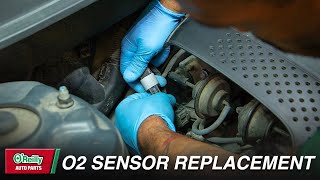
Typical fix: Replace the Bank 1, Sensor 1 oxygen sensor. This sensor is located on the rear exhaust manifold, between the engine and the firewall. A special tool like an O2 sensor socket or crowfoot wrench is highly recommended for removal. 🎬 Watch: This walkthrough shows how to change an O2 sensor.
Est. part cost: $40-$130 - Damaged Wiring or Connector 🟡 Medium Probability The rear valve cover gasket on the 3.6L Pentastar can leak oil directly onto the O2 sensor harness and connector, causing a short or poor connection. The heat from the nearby exhaust can also make the wiring brittle and prone to damage. Oil contamination degrades the connector's weather-pack seal and can wick up into the pins, disrupting the sensitive voltage signal.
How to confirm: Visually inspect the wiring harness and connector for the Bank 1 upstream O2 sensor. Look for signs of oil saturation, corrosion in the pins, melted plastic, or chafed wires. The connector is often clipped to the back of the cylinder head.
Typical fix: If oil-soaked, clean the connector with electrical contact cleaner and repair the valve cover gasket leak to prevent recurrence. If the wiring or connector is physically damaged, it will need to be repaired with a new pigtail connector or section of harness.
Est. part cost: $5-$50 for cleaning supplies or connector pigtail - Blown Fuse for O2 Sensor Heater ⚪ Low Probability → Shop Oxygen Sensor
How to confirm: Check the vehicle's fuse box for any fuses related to 'O2 Heater' or 'Emissions'. A wiring diagram for your specific model year will help locate the correct fuse in the under-hood fuse panel (Totally Integrated Power Module). On related Chrysler platforms, fuse F25 (20A) is often used for O2 sensor heaters.
Typical fix: Replace the blown fuse. If the fuse blows again immediately, it indicates a short circuit in the O2 sensor heater or its wiring that must be diagnosed.
Est. part cost: $1-$5
Rare But Worth Checking
- Exhaust Leak: An exhaust leak upstream of the O2 sensor can introduce fresh oxygen, causing the sensor to send an inaccurate signal. While more likely to cause a lean code, a significant leak at the manifold-to-head gasket could potentially contribute to this fault by affecting sensor readings.
- Powertrain Control Module (PCM) Failure: → Shop Engine Control Module (ECM) This is extremely rare. Before suspecting the PCM, all other possibilities, including the sensor, wiring, and fuses, must be exhaustively ruled out.
Diagnosis Steps
- Confirm the code P0134 is present using an OBD-II scanner. Check for any other codes, especially heater circuit codes (P0135) or misfire codes, and address them first.
- Using the scanner's live data function, monitor the voltage for 'O2 Bank 1 Sensor 1'. Warm the engine to operating temperature. The voltage should switch rapidly. If it is a flat, unchanging line (often around 0.45V), the sensor or its circuit is faulty.
- Locate the sensor on the rear exhaust manifold. Visually inspect its electrical connector and wiring for any signs of damage, melting, or oil contamination from a leaky valve cover.
- If wiring looks good, check the fuse for the O2 sensor heater circuit in the under-hood fuse box. On similar Chrysler vehicles, this is often a 20A fuse labeled F25.
- If the fuse is good, disconnect the sensor and test the sensor's internal heater circuit with a multimeter. A reading of 'OL' (open loop) or a very high resistance indicates a failed heater element, and the sensor needs replacement.
- With the key on (engine off), check for battery voltage at the heater power wire on the vehicle's harness connector. This confirms the circuit to the sensor is intact.
- If the sensor and wiring test good, check for any exhaust leaks between the cylinder head and the sensor. A ticking noise when cold is a common sign.
- If all other tests pass, the issue may be with the PCM, but this is highly unlikely and should be the last consideration.
Parts You'll Likely Need
- Upstream Oxygen Sensor (Bank 1, Sensor 1)
(OEM #68229566AB (supercedes 68248739AA))— This is the most common failure point for code P0134. The sensor's internal heating element or sensing capabilities degrade over time.
Trusted brands: Mopar, NTK, Denso (Part #234-4411), Bosch (Part #15510)
OEM price range: $80-$130
Aftermarket price range: $40-$80 - O2 Sensor Socket Set — A special tool with a side cutout for the wire is almost essential for removing and installing the O2 sensor, especially in the tight space of Bank 1.
Trusted brands: Lisle, OEMTOOLS
Aftermarket price range: $15-$40
Related Codes That Often Appear With This One
- P0135 — P0135 indicates a malfunction in the heater circuit for the same sensor (Bank 1, Sensor 1). Since a failed heater is a common cause of P0134 ('No Activity'), these codes often appear together.
Technical Service Bulletins (TSBs) & Recalls
- As of early 2026, no specific Technical Service Bulletins (TSBs) have been issued by Chrysler for the P0134 code on the 2017-2025 Pacifica. Diagnosis relies on standard procedure.
Platform-Specific Known Issues
- Access to the Bank 1 (rear) upstream O2 sensor is very tight due to its location between the engine and the firewall. Many owners report needing a combination of extensions and a swivel joint, along with the proper O2 sensor socket, to reach it from above. 🎬 See this video for tips on accessing tight Chrysler sensors.
- The 3.6L Pentastar engine is known for potential valve cover gasket leaks, which can drip oil directly onto the Bank 1 O2 sensor connector, causing electrical faults.
- The plastic oil filter/cooler housing in the engine valley is a very common failure point, leading to oil and coolant leaks. While not a direct cause of P0134, it speaks to the general issue of oil leaks in the engine bay that can contaminate wiring.
Mechanic-Grade Diagnostic Values
- O2 Sensor Heater Element Resistance — expected: 3 to 30 Ohms at ambient temperature. A healthy sensor is often in the 4-10 Ohm range.. Failure: A multimeter reading of 'OL' (infinite resistance) indicates a burned-out open circuit, while near-zero Ohms indicates a short circuit.
- O2 Sensor Heater Circuit Power Supply (at harness connector) — expected: Approximately 12V (Battery Voltage) with Key On, Engine Off (KOEO).. Failure: A reading near 0V points to a blown fuse, a bad relay in the TIPM, or an open in the power supply wire.
- Upstream O2 Sensor (Narrowband) Signal Voltage — expected: Rapidly fluctuating between approximately 0.1V (lean) and 0.9V (rich) when the engine is warm and in closed loop.. Failure: A flat, unchanging voltage (often stuck near 0.45V) indicates no activity.
Scan Tool Commands That Help
- wiTECH or other professional scan tool: A/F Control Active Test — This bidirectional command allows a technician to manually force the fuel mixture rich or lean (-12.5% to +25%). By observing the O2 sensor's voltage response on the scan tool's data list, you can confirm if the sensor is capable of reading the change. If the command is sent and the voltage for B1S1 remains flat, it strongly confirms a dead sensor or a complete circuit failure.
Wiring & Ground Locations
- Bank 1 Sensor 1 Connector Pins — On the 4-wire connector for the B1S1 O2 sensor, located on the rear of the engine near the firewall.. Knowing the wire functions allows for targeted testing. For many Chrysler/Denso/NTK 4-wire sensors: two wires of the same color (often white or black) are for the heater circuit. The other two (often blue and black, or gray and black) are for the sensor signal and sensor ground. Always verify with a vehicle-specific diagram if possible.
- Engine Ground Strap (68316197AA) — Provides electrical grounding between the engine and chassis.. While not a direct cause of a single sensor code, a corroded or loose main engine ground strap can cause widespread, bizarre electrical issues, including erratic sensor readings. It's a known issue on Chrysler platforms for grounds behind the headlight assembly to corrode. Checking the main grounds is a good practice when diagnosing any electrical fault.
- G305 Ground Point — On older Pacifica models (pre-2017), this was located at the base of the left 'B' pillar. The location may be similar on newer models.. A poor body ground can cause modules to behave erratically. While the O2 sensor circuit is typically grounded through the PCM, the PCM itself relies on clean chassis grounds. A user on a Pacifica forum traced a host of bizarre electrical issues to a bad star connector ground above the glove box.
Real Owner Repair Stories
- AliExpress Review for Pentastar 3.6L O2 Sensor (Dodge with 3.6L Pentastar V6 (engine shared with Pacifica)) — Check Engine Light with code P0135 (heater circuit malfunction, often paired with P0134). Engine hesitation.
❌ Tried (didn't work) Initial thought was an expensive OEM-only part was needed.
✅ What actually fixed it The owner tested the failed sensor's heater circuit and found it had failed (flatlined below 0.1V). To confirm the vehicle wiring was good, they temporarily swapped in a known-good sensor, which immediately worked correctly. They then permanently fixed the issue by installing a new aftermarket sensor (cross-referenced by the OEM number 5149141AF) which resolved the code and hesitation.
OEM Part Supersession History
68248739AA→68229566AB— Standard part revision by manufacturer.
Diagnostic Flowchart
Other Known Issues on This Vehicle
Issues unrelated to this code that are worth knowing about as an owner of this generation:
- Cracked Oil Filter/Cooler Housing 🔴 High — Very common. The plastic housing, located in the engine valley, becomes brittle from heat cycles and cracks, causing significant oil and/or coolant leaks. Often misdiagnosed as a rear main seal leak.
- Rocker Arm / Lifter Failure ('Pentastar Tick') 🔴 High — Common, especially on earlier Pentastar versions, but still occurs. Needle bearings in the rocker arms fail, causing a distinct ticking sound, misfires, and potential camshaft damage. (Ref: A class-action lawsuit was filed regarding this issue.)
- Leaking Valve Cover Gaskets 🟠 Medium → Shop Engine Valve Cover — Moderately common. The gaskets become hard and brittle over time, allowing oil to leak. The rear (Bank 1) gasket leak is particularly problematic as it can drip directly onto the hot exhaust and the O2 sensor wiring.
Used vs. New Parts: Buying Guide for This Vehicle
When a used part is the smart pick: It is almost never a smart choice to buy a used oxygen sensor. It is a wear-and-tear part with a finite lifespan, and its remaining life is impossible to determine. The labor involved in replacing the difficult-to-access Bank 1 sensor on the Pacifica makes it impractical to risk using a used part that might fail shortly after installation.
What to inspect on the donor part:
- Not applicable. Do not purchase used O2 sensors.
OEM-only on this vehicle (don't cheap out):
- While not strictly OEM-only, many professional technicians strongly prefer using OEM (Mopar) or the original OE supplier (NTK or Denso) for oxygen sensors on Chrysler products. Some aftermarket brands, particularly budget or 'universal' sensors, have been known to cause compatibility issues, fail prematurely, or not meet the PCM's strict performance parameters, leading to the code returning.
Aftermarket brands forum-validated for this vehicle:
- NTK (part of NGK) is a highly regarded OE supplier for many manufacturers, including Chrysler.
- Denso is another top-tier OE supplier known for high quality and reliability.
Brands owners have reported issues with on this vehicle:
- Universal sensors that require splicing wires. The sensitive nature of the O2 sensor signal can be compromised by a poor connection, and the labor saved on the part is not worth the risk of having to do the job twice.
- Unbranded or 'white-box' parts from online marketplaces without a clear warranty or reputation.
Real Owner Stories
Aggregated from forums and TSBs cited above. Mileages and costs reflect what owners reported in those sources.
2017-2025 Chrysler Pacifica 3.6L — 84000 miles
Symptoms: Owner noticed an oil leak and required multiple repairs including the oil cooler and valve cover gasket.
What fixed it: Replacement of the oil cooler and valve cover gasket (spark plugs were also replaced due to labor overlap).
Cost: $1500-$1500
Source hint: reddit.com/r/ChryslerPacifica
2017-2025 Chrysler Pacifica 3.6L
Symptoms: Owners report smelling oil or coolant and finding puddles in the engine valley.
What fixed it: Repair of the common oil cooler/filter housing leak, often covered under powertrain warranty.
Source hint: pacificaforums.com
Related OBD-II Codes
Frequently Asked Questions
Is there a specific TSB for P0134 on my 2017-2025 Chrysler Pacifica?
Why is the Bank 1, Sensor 1 O2 sensor so difficult to replace on the Pacifica?
Can an oil leak cause my P0134 code?
Which fuse should I check for the O2 sensor heater circuit?
Could my cracked oil filter housing be related to this O2 sensor issue?
What should the voltage reading look like for a healthy Bank 1 Sensor 1?
Helpful Videos

The information in this article is provided for general reference and educational purposes only. Vehicle specifications, procedures, and part compatibility can vary by production date, trim level, and region. Always consult your vehicle's factory service manual and verify part numbers before purchasing or performing repairs. Safety-critical components such as airbags, seat belts, and braking systems should be installed by a qualified professional.
- Chrysler Pacifica:
- 🧭 Diagnostic Flowchart
- 🎬 Helpful Videos
- What's Unique About the 2017-2025 Chrysler Pacifica
- Symptoms You May Notice
- Most Likely Causes
- Rare But Worth Checking
- Diagnosis Steps
- Parts You'll Likely Need
- Related Codes That Often Appear With This One
- Technical Service Bulletins (TSBs) & Recalls
- Platform-Specific Known Issues
- Mechanic-Grade Diagnostic Values
- Scan Tool Commands That Help
- Wiring & Ground Locations
- Real Owner Repair Stories
- OEM Part Supersession History
- Other Known Issues on This Vehicle
- Used vs. New Parts: Buying Guide for This Vehicle
- Real Owner Stories
- 2017-2025 Chrysler Pacifica 3.6L — 84000 miles
- 2017-2025 Chrysler Pacifica 3.6L
- Related OBD-II Codes
- Frequently Asked Questions
- 🎟️ Get 5% Off