

P0134 on 2008-2012 Ford Escape Hybrid: Causes and Fixes for O2 Sensor Inactivity
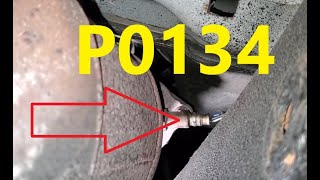
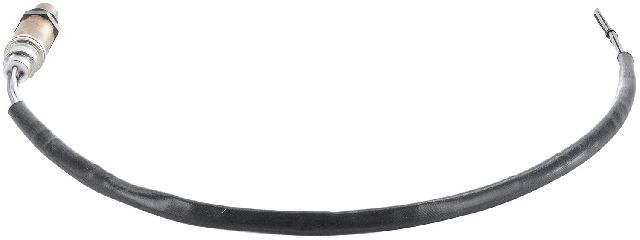
For a 2008-2012 Ford Escape Hybrid, code P0134 almost always means the upstream oxygen sensor (Bank 1, Sensor 1) has failed. This sensor is on the exhaust manifold against the firewall. Expect to pay $70-$120 for an OEM-quality replacement part, with a DIY difficulty of 3/5 due to tight access. The most common OEM part number is Motorcraft DY1123.
- P0134 on your Escape Hybrid points directly to a problem with the upstream oxygen sensor (Bank 1, Sensor 1).
- The most probable fix is replacing the sensor itself, a common wear-and-tear part. The OEM part is Motorcraft DY1123.
- The sensor is located on the exhaust manifold toward the back of the engine (firewall side), and access can be tight, often requiring a special tool.
- Before buying parts, check the O2 sensor heater fuse and inspect the sensor's wiring for obvious damage like melting or chafing.
- Use a scan tool to confirm a 'flat-line' voltage from the sensor to verify its failure before starting the repair.
What's Unique About the 2008-2012 Ford Escape
The 2.5L hybrid engine in the second-generation Escape uses a specific type of wideband oxygen sensor (often called a UEGO or Air-Fuel Ratio sensor) to meet the precise demands of the Atkinson cycle engine and the frequent transitions between gas and electric modes. While the P0134 code itself is common across many vehicles, the specific part and its location on the rear of the engine, tucked against the firewall, can make replacement more challenging than on other vehicles. There are no widespread, documented systemic issues causing this code beyond normal part wear and tear, confirmed by numerous owner experiences in forums.
Symptoms You May Notice
- Check Engine Light is on
- Decreased fuel economy
- Rough or hesitant idle
- Failing a state emissions or smog test
- Engine may feel sluggish or unresponsive during acceleration
- Replacing the downstream (Bank 1, Sensor 2) oxygen sensor. P0134 specifically refers to Sensor 1, the upstream sensor.
Most Likely Causes
- Failed Upstream Oxygen Sensor (Bank 1, Sensor 1) 🔴 High Probability → Shop Oxygen Sensor Oxygen sensors are wear-and-tear items that typically have a finite lifespan of 80,000-100,000 miles. Heat and contaminants eventually cause them to fail, and this is the most common cause of P0134.
How to confirm: Use an OBD-II scanner with live data to monitor the Bank 1 Sensor 1 voltage. If the voltage is flat, unchanging, or stuck at a specific value (e.g., 0.45V) when the engine is warm, the sensor has likely failed. A healthy sensor's voltage should fluctuate rapidly.
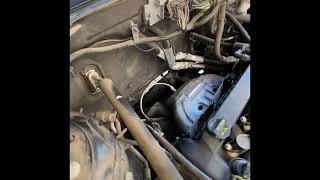
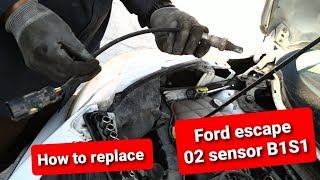
Typical fix: Replace the Bank 1, Sensor 1 oxygen sensor. The sensor is located on the exhaust manifold, on the side of the engine facing the firewall. Access is tight and often requires a specialized O2 sensor socket and patience. 🎬 See this step-by-step replacement guide for the 4-cylinder Escape.
Est. part cost: $70-$150 - Damaged Wiring or Connector 🟡 Medium Probability The wiring harness for the sensor is located in a high-heat area of the engine bay. Over time, the plastic loom can become brittle and break, exposing wires to abrasion or melting against the engine or exhaust components, leading to shorts or open circuits.
How to confirm: Visually inspect the entire wiring harness leading from the upstream O2 sensor to the main engine harness. Look for any signs of burning, chafing, or breaks. Check the connector for corrosion, moisture, or loose pins. Use a multimeter to check for continuity and proper voltage at the connector per the vehicle's service manual.
Typical fix: Repair the damaged section of the wiring harness or replace the connector pigtail.
Est. part cost: $10-$40 - Blown O2 Sensor Heater Circuit Fuse ⚪ Low Probability → Shop Oxygen Sensor A short in the sensor's internal heater or its wiring can cause the associated fuse to blow. This will prevent the sensor from reaching its required operating temperature, causing it to remain inactive and trigger P0134.
How to confirm: Consult the owner's manual or the fuse box diagram to locate the fuse for the O2 sensor heater circuit. Visually inspect the fuse to see if it is blown. If a new fuse blows immediately, it indicates a short circuit in the sensor or wiring that must be found and repaired.
Typical fix: Replace the blown fuse. If the fuse blows again, diagnose the short circuit.
Est. part cost: $1-$5 - Exhaust Leak ⚪ Low Probability Leaks can occur at the exhaust manifold gasket or any flange/weld near the sensor, especially on higher-mileage vehicles. An exhaust leak before the sensor can introduce outside oxygen, causing the sensor to send inaccurate (but not inactive) readings. A large leak could potentially disrupt readings enough to be interpreted as inactivity.
How to confirm: Listen for a ticking or hissing sound from the engine bay that gets louder with RPM. Visually inspect the exhaust manifold and nearby pipes for black soot trails, which indicate a leak. A smoke test can also be used to pinpoint the leak's location.
Typical fix: Replace the leaking gasket or repair the cracked exhaust component.
Est. part cost: $20-$100
Rare But Worth Checking
- Faulty Powertrain Control Module (PCM): → Shop Engine Control Module (ECM) This is extremely rare. The PCM should only be considered after all other possibilities, including the sensor and its entire circuit, have been thoroughly tested and ruled out.
Diagnosis Steps
- Read the code with an OBD-II scanner to confirm P0134 is present.
- Use the scanner's live data feature to observe the voltage for 'O2S11' (Oxygen Sensor, Bank 1, Sensor 1). The reading should fluctuate rapidly. If it is flat or unresponsive, the sensor is likely faulty.
- Check the fuse box for a blown fuse related to the O2 sensor heater circuit. This is a quick check that is often overlooked.
- Perform a thorough visual inspection of the oxygen sensor's wiring harness and connector for any signs of damage, melting, or corrosion. Pay close attention to areas where the harness is near hot exhaust components.
- Inspect the exhaust manifold and downpipe for any signs of an exhaust leak (soot, audible ticking).
- If the wiring and fuse are good, and there are no exhaust leaks, the most likely cause is the oxygen sensor itself. Proceed with replacement.
Parts You'll Likely Need
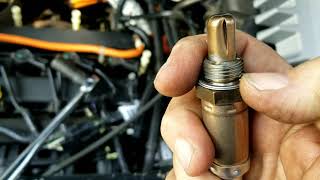
- Upstream Oxygen Sensor / Air-Fuel Ratio Sensor (Bank 1, Sensor 1)
(OEM #Motorcraft DY1123 (replaces DY997))— This is the component that directly measures the data reported in the code and is the most common failure point due to age and wear.
Trusted brands: Motorcraft, Denso, Bosch, NGK/NTK
OEM price range: $100-$180
Aftermarket price range: $70-$120
Platform-Specific Known Issues
- Real-World Repair Story: A user on the 'escape-city.com' forum with a 2009 Escape Hybrid reported a P0134 code at 115,000 miles. After confirming a flat voltage on their scan tool, they replaced the upstream O2 sensor (Motorcraft DY-997, now DY1123). They noted the most difficult part was the tight access against the firewall, requiring a 7/8" offset O2 sensor socket and working from both the top and bottom of the engine bay to complete the job. The new sensor resolved the code. 🎬 Watch: A mechanic's walkthrough of this specific 2.5L sensor replacement.
Mechanic-Grade Diagnostic Values
- Upstream O2 Sensor Heater Resistance — expected: 3 to 30 Ohms (measured at the sensor connector, across the two wires of the same color). Failure: A reading of infinite resistance (open circuit) or near-zero Ohms (short circuit) indicates a failed internal heater.
- Upstream O2 Sensor Signal Voltage (Live Data) — expected: For a wideband sensor, the voltage should remain relatively steady near a reference point (e.g., 3.3V) at idle, changing with air/fuel ratio. Some scan tools interpret this as a conventional 0.1V-0.9V fluctuating signal.. Failure: A flat, unchanging voltage that does not respond to changes in engine load or RPM indicates no activity.
Wiring & Ground Locations
- C175B — This is one of the main connectors for the Powertrain Control Module (PCM), which is located at the center rear of the firewall.. This connector contains the primary signal and heater circuit pins for the upstream O2 sensor, making it a key test point for diagnosing wiring issues between the sensor and the PCM.
- C175B - Pin 8 — Pin 8 of the C175B connector at the PCM.. This is the pin for the upstream O2 sensor signal (HO2S11). The wire color is typically Violet/Brown (VIO/BRN). A technician can test for continuity and shorts on this circuit from this pin.
- C175B - Pin 69 — Pin 69 of the C175B connector at the PCM.. This is the pin for the upstream O2 sensor heater control (HTR11). The wire color is typically Green/Brown (GRN/BRN). This is the circuit to test if a heater-related fault is suspected or if a fuse blows repeatedly.
- G109 — Located on the firewall at the rear of the engine compartment.. This is a primary power ground point for the engine controls. A loose or corroded ground here can cause a variety of sensor issues, including erratic or missing O2 sensor signals.
Real Owner Repair Stories
- Community discussion on CarTalk.com (Illustrative example for recurring P0134 (originally on a Chrysler, but the principle applies universally)) — Check engine light with code P0134 returns shortly after replacing the upstream O2 sensor. This happens multiple times with new sensors.
❌ Tried (didn't work) Replacing the Bank 1 Sensor 1 oxygen sensor (multiple times).
✅ What actually fixed it The discussion pointed to two high-level diagnostic traps, not a final fix. 1) The new O2 sensors were being contaminated and destroyed by an underlying engine issue, such as a small coolant leak into the combustion chamber or the use of non-sensor-safe RTV silicone during a previous repair. 2) The P0134 was being triggered by a fuel mixture problem (e.g., leaking fuel injector, vacuum leak) that the O2 sensor was correctly detecting, but the code itself misleadingly points to the sensor as the failure. The root cause was not the sensor, but what the sensor was reading.
OEM Part Supersession History
DY997→DY1123— Standard part update/revision by Ford/Motorcraft.
Heads up: Beware that many online auto parts retailers incorrectly list the Motorcraft DY1123 part as a 'Vehicle Speed Sensor' or 'ABS Wheel Speed Sensor'. This is a common cataloging error. The DY1123 is the correct OEM part number for the upstream oxygen sensor for this application.
Model Year Variations Within This Range
- 2008 vs 2009-2012: The 2008 Escape Hybrid used a 2.3L I-4 engine. In 2009, this was updated to a more powerful 2.5L I-4 engine, which continued through 2012. While the P0134 code can occur on both, the specific oxygen sensor part numbers are different. This article's part numbers (DY1123) and wiring details are for the 2.5L (2009-2012) models.
Diagnostic Flowchart
Other Known Issues on This Vehicle
Issues unrelated to this code that are worth knowing about as an owner of this generation:
- Motor Electronics Coolant Pump (MECS) Failure 🔴 High — Common issue, can occur at any mileage. Failure leads to overheating of hybrid electronics and a 'Stop Safely Now' warning, causing powertrain shutdown. (Ref: Recall 14S26 / NHTSA 14V526000 was issued for 2005-2008 models, but the issue persists in later years.)
- Electronic Throttle Body (ETB) Failure 🟠 Medium — A well-documented problem where the ETB fails, causing the vehicle to enter 'limp mode' with a wrench light on the dash, resulting in sudden loss of power. (Ref: Ford had a Customer Satisfaction Program (13N03) for this issue on some models, extending the warranty on the part.)
- Blend Door Actuator Failure 🟡 Low — Very common; owners report a clicking or percolating sound from behind the dashboard. It results in an inability to control cabin temperature correctly. Multiple actuators exist, with the upper one being notoriously difficult to replace.
- Power Steering Failure 🔴 High — Numerous complaints of sudden loss of power steering assist, sometimes intermittent. The EPAS torque sensor is a common failure point. (Ref: Recall 14S05 was issued, but some owners report problems even after the recall was performed.)
- Leaking Driver's Side Axle Seal 🟠 Medium — Common on 2009-2012 models, causing a transmission fluid leak from the left front area. Requires replacement of the seal and sometimes the inner CV-joint housing.
Used vs. New Parts: Buying Guide for This Vehicle
When a used part is the smart pick: For this repair, a used part only makes sense for a replacement wiring harness connector (pigtail) if the original is melted or damaged. A used Powertrain Control Module (PCM) could be a cost-effective last resort, but it will require programming by a dealer or specialist to work with the vehicle's keys and hybrid system.
Donor-vehicle mileage cap: roughly under 120000 miles for the part to have meaningful remaining life.
What to inspect on the donor part:
- For a wiring pigtail, ensure the plastic is not brittle and the locking tab is intact.
- Check for any signs of overheating, melting, or corrosion on the connector pins.
- Ensure at least 6 inches of wire is attached to make splicing easy.
OEM-only on this vehicle (don't cheap out):
- Powertrain Control Module (PCM) - Aftermarket or improperly programmed used units can cause significant issues with the hybrid system.
Aftermarket brands forum-validated for this vehicle:
- NTK (part of NGK)
- Denso
Brands owners have reported issues with on this vehicle:
- Off-brand, no-name sensors from online marketplaces are frequently reported as being dead-on-arrival or failing within a few months.
Real Owner Stories
Aggregated from forums and TSBs cited above. Mileages and costs reflect what owners reported in those sources.
2009 Ford Escape Hybrid 2.5L — 115000 miles
Symptoms: Check engine light with P0134 code and a flat voltage reading on a scan tool.
What fixed it: Replacement of the upstream O2 sensor using a Motorcraft DY-997 (DY1123) and a 7/8" offset O2 sensor socket.
Source hint: Real-World Repair Story / escape-city.com forum thread 'P0134 Bank 1 Sensor 1 No Activity'
2009 Ford Escape Hybrid 2.5L — ~105000 miles
Symptoms: P0134 code triggered; owner confirmed the sensor was the root cause after reaching the 100k+ mile mark.
What fixed it: Replacement of the Bank 1 Sensor 1 oxygen sensor using specific tools for the difficult access.
Source hint: ford-trucks.com discussion '2009 Escape Hybrid O2 Sensor'
Related OBD-II Codes
Frequently Asked Questions
Where is the Bank 1, Sensor 1 oxygen sensor located on my 2008-2012 Ford Escape Hybrid?
What specific replacement part should I use for the upstream O2 sensor on my 2009 Escape Hybrid?
Are there any special tools required to fix P0134 on this vehicle?
Could a blown fuse be causing my P0134 code?
Does the Mercury Mariner Hybrid share this same O2 sensor issue?
My Escape Hybrid has over 100,000 miles; is it common for the O2 sensor to fail now?
Helpful Videos
We Have This Part in Stock


The information in this article is provided for general reference and educational purposes only. Vehicle specifications, procedures, and part compatibility can vary by production date, trim level, and region. Always consult your vehicle's factory service manual and verify part numbers before purchasing or performing repairs. Safety-critical components such as airbags, seat belts, and braking systems should be installed by a qualified professional.
- Ford Escape:
- 🧭 Diagnostic Flowchart
- 🎬 Helpful Videos
- 🛍️ Shop This Part
- What's Unique About the 2008-2012 Ford Escape
- Symptoms You May Notice
- Most Likely Causes
- Rare But Worth Checking
- Diagnosis Steps
- Parts You'll Likely Need
- Platform-Specific Known Issues
- Mechanic-Grade Diagnostic Values
- Wiring & Ground Locations
- Real Owner Repair Stories
- OEM Part Supersession History
- Model Year Variations Within This Range
- Other Known Issues on This Vehicle
- Used vs. New Parts: Buying Guide for This Vehicle
- Real Owner Stories
- 2009 Ford Escape Hybrid 2.5L — 115000 miles
- 2009 Ford Escape Hybrid 2.5L — ~105000 miles
- Related OBD-II Codes
- Frequently Asked Questions
- 🎟️ Get 5% Off