

P0135 on 2005-2012 Porsche 911: O2 Sensor Heater Circuit Causes and Fixes
On a 2005-2012 Porsche 911, code P0135 almost always means the Bank 1, Sensor 1 (passenger side, pre-catalyst) oxygen sensor's internal heater has failed. The most likely fix is replacing the sensor. Expect to pay $150-$220 for an OEM-quality Bosch sensor and ensure you buy the correct part for your car's generation (997.1 vs. 997.2). Before replacing, check the relevant fuse in the driver's side footwell.
- P0135 on a 997-generation 911 points directly to a fault in the heater circuit of the passenger-side, pre-catalytic converter oxygen sensor.
- Before buying parts, always check the O2 sensor heater circuit fuse in the driver's footwell. If P0155 is also present, the fuse is the most likely culprit.
- You MUST buy the correct oxygen sensor for your car's specific generation: 997.1 (2005-2008, M97 engine) and 997.2 (2009-2012, 9A1 engine) use different parts.
- The most common fix is to replace the sensor itself. Bosch is the original equipment manufacturer (OEM) and offers a high-quality part for less than the Porsche-branded equivalent.
- Ignoring this code will lead to failed emissions tests, poor fuel mileage, and can eventually harm the catalytic converter.
What's Unique About the 2005-2012 Porsche 911
The most critical factor for this code on the 911 from this era is the generational split. The 2005-2012 range covers both the 997.1 (2005-2008) with its M96/M97 engine and the 997.2 (2009-2012) with the newer 9A1 Direct Fuel Injection (DFI) engine. These two generations use different front oxygen sensors with different part numbers. Ordering the correct sensor for your specific model year is essential for a successful repair. While the cause is almost always the sensor itself, access can be tight in the compact 911 engine bay. However, many owners report that removing the airbox provides sufficient access without needing to remove the rear bumper or exhaust components.
Generation note: This guide covers two Porsche 911 generations: the 997.1 (2005-2008) and the 997.2 (2009-2012). They use different engines and require different front oxygen sensors. It is crucial to verify the correct part number for your specific vehicle year before purchasing a replacement. 997.1 uses Porsche part #99760616801 (Bosch 17307), while 997.2 uses #9A160616801 or its successors (Bosch 17222).
Symptoms You May Notice
- Check Engine Light is on.
- No noticeable change in performance, especially once the engine is warm.
- Slightly rough idle during a cold start.
- Reduced fuel economy, potentially by 10-20%.
- Failing an emissions test.
- Replacing the oxygen sensor without first checking the fuse. If the fuse is blown, a new sensor will not fix the problem and the code will return instantly.
- Assuming the sensor is bad when the wiring harness is damaged from heat or abrasion near the exhaust manifolds.
Most Likely Causes
- Failed Bank 1, Sensor 1 Oxygen Sensor 🔴 High Probability → Shop Oxygen Sensor The internal heating element of the oxygen sensor is a common failure point over time due to constant, rapid heat cycles. These sensors have a typical lifespan of 60,000 to 100,000 miles, though some Porsche service recommendations suggest replacement as early as 30,000-50,000 miles to maintain peak performance.
How to confirm: Disconnect the sensor's electrical connector (located in the engine bay after removing the airbox) and measure the resistance between the two heater circuit pins using a multimeter. A good sensor will have a low resistance (typically 2-10 Ohms), while a failed sensor will show infinite resistance (an open circuit). A live test on a similar sensor showed 4 Ohms.
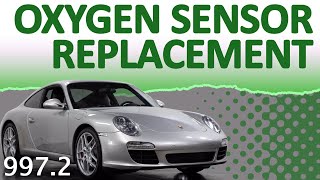
Typical fix: Replace the Bank 1, Sensor 1 oxygen sensor. Ensure you purchase the correct part number for your 997.1 or 997.2 generation. A 22mm wrench, often a specialized O2 sensor socket or crowfoot wrench, is required. Torque the new sensor to 50 Nm (37 ft-lb). 🎬 Watch: Step-by-step oxygen sensor replacement for 997.2 models
Est. part cost: $150-$220 - Blown Fuse for O2 Sensor Heater Circuit 🟡 Medium Probability → Shop Oxygen Sensor A short circuit in the wiring or within either the Bank 1 or Bank 2 upstream sensor can blow the shared fuse, causing this code. If P0135 appears with P0155 (Bank 2 heater fault), a blown fuse is highly likely.
How to confirm: Locate the fuse box in the driver's side footwell. Check the fuse that powers the O2 sensor heaters. Based on diagrams for the 997, this is often a 15A or 25A fuse in Row C or D (e.g., C4, D3). Always consult your owner's manual or a specific fuse diagram for your model year. If the fuse is blown, replace it. If it blows again immediately, one of the sensors or its wiring has a dead short.
Typical fix: Replace the blown fuse. If the fuse blows again, disconnect both upstream O2 sensors. If the new fuse doesn't blow, plug in one sensor at a time to identify which one is causing the short, then replace that sensor.
Est. part cost: $1-$5 - Damaged Wiring or Connector ⚪ Low Probability
How to confirm: Visually inspect the wiring harness leading from the sensor up into the engine bay for signs of melting, chafing against the engine or exhaust heat shields, or brittle insulation. Check the electrical connector pins for corrosion, moisture, or damage. On a 997.2, the pre-cat sensor has a blue cable.
Typical fix: Repair the damaged section of the wiring harness or clean/replace the connector. Wires can sometimes be repaired with heat-shrink butt connectors, but harness replacement may be necessary if damage is extensive.
Est. part cost: $10-$50
Rare But Worth Checking
- Faulty Engine Control Module (DME): → Shop Engine Control Module (ECM) This is extremely rare. The DME's internal driver for the heater circuit can fail, but all other possibilities (sensor, fuse, wiring) should be exhausted before considering DME replacement or repair. A user on a forum with a similar heater circuit code (P0031) on a 996 Turbo concluded the DME was at fault after exhausting all other options, including isolating pins at the ECU connector.
Diagnosis Steps
- Read the fault codes with an OBD-II scanner to confirm P0135 is the primary code. Note if P0155 is also present.
- Locate and inspect the fuse for the oxygen sensor heater circuit in the driver's footwell fuse panel. This is the most important first step. 🎬 Watch: Easy first checks for the O2 sensor heater circuit Replace if blown and see if the code returns.
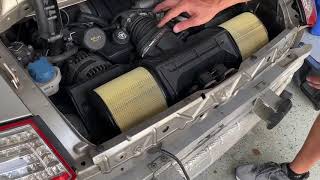
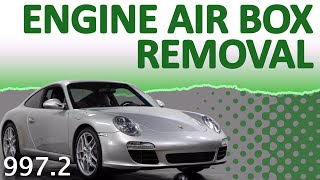
- If the fuse is good, gain access to the sensor connectors by removing the engine airbox. 🎬 See how to remove the airbox in under 7 minutes
- Locate the Bank 1, Sensor 1 oxygen sensor (passenger side, pre-catalyst). The pre-cat sensors on a 997.1 have a blue sheathed wire, and on a 997.2 the pre-cat sensor also has a blue cable. Inspect the sensor's wiring and connector for any visible damage like melting, fraying, or corrosion.
- Disconnect the sensor's electrical connector. Using a multimeter set to Ohms, measure the resistance between the two pins for the heater circuit (often the two same-colored wires). A reading of 2-10 Ohms is expected; a very high or infinite reading (OL) indicates the heater has failed and the sensor must be replaced.
- If the resistance is normal, turn the ignition ON (engine off) and carefully use a multimeter to check for voltage at the corresponding pins on the harness side of the connector. The DME should supply power (some sources suggest 5V, others 12V) to the heater circuit.
- If power is present and the sensor's heater resistance is good, the issue may be in the ground control side of the circuit back to the DME, which would require more advanced diagnostics. However, at this point, an intermittent sensor failure is still highly probable.
Parts You'll Likely Need
- Front Oxygen Sensor (Bank 1, Sensor 1)
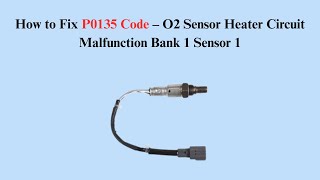
(OEM #99760616801 (for 997.1) or 9A160616801 / 9A160616802 (for 997.2))— This is the component that contains the heater element that fails, triggering the P0135 code. It is critical to use the correct part for the 997.1 (2005-2008) or 997.2 (2009-2012) generation.
Trusted brands: Bosch (OEM), Porsche (Genuine)
OEM price range: $200-$280
Aftermarket price range: $150-$220
Related Codes That Often Appear With This One
- P0155 — P0155 is the same heater circuit fault but for Bank 2 (driver's side). If both codes appear together, it strongly suggests a problem with the shared power supply, such as a blown fuse.
- P0134 — P0134 indicates 'No Activity' from the same sensor. A failed heater can prevent the sensor from reaching operating temperature, leading to a lack of signal and triggering this additional code.
Platform-Specific Known Issues
- Accessing the sensor connectors requires removing the airbox assembly, which is a straightforward DIY job according to forum members.
- A standard 22mm O2 sensor socket or a long 22mm wrench is necessary for removal. Access can be tight but is achievable from underneath the car without removing exhaust components.
- A user on Rennlist reported solving a recurring P0135 and P0155 by discovering a short in the Bank 2 sensor that was blowing the shared fuse. This highlights the importance of checking both sensors if a fuse repeatedly blows.
Mechanic-Grade Diagnostic Values
- O2 Sensor Heater Element Resistance — expected: 2-10 Ohms when measured across the two heater pins on the sensor's connector. Some sources narrow this to 2-4 Ohms. A demonstration showed a reading of 4 Ohms.. Failure: Infinite resistance (OL - Open Loop) indicates a broken heater element. Very low resistance (near zero) indicates an internal short.
- Heater Circuit Voltage (Key On, Engine Off) — expected: Approximately 12V (battery voltage) should be present at the harness-side connector pin that supplies power to the heater circuit. Some sources suggest the DME may supply a lower voltage, like 5V, but 12V is more common for heater circuits.. Failure: 0V indicates a blown fuse, a wiring problem, or a failed DME driver. Voltage significantly lower than battery voltage could indicate high resistance in the circuit.
- O2 Sensor Torque Specification — expected: 50 Nm (37 ft-lb). Failure: N/A
Hidden / Shadow Codes Worth Checking
- P2271: O2 Sensor Signal Biased/Stuck Rich, Bank 1 Sensor 2. While not directly a P0135 code, a user on Rennlist found this code stored using a PIWIS scanner when a generic OBD-II reader showed nothing. This indicates the dealer-level tool can see fault history that other tools miss, which can be crucial for diagnosing intermittent issues. (see via Porsche PIWIS dealer/specialist diagnostic tool.)
Scan Tool Commands That Help
- Porsche PIWIS: Read all fault codes / Check readiness monitor status — To identify stored 'shadow' codes that generic OBD-II scanners may not see, and to get a more accurate reading of emissions system readiness, which can be affected by a faulty heater.
- Advanced Bi-Directional Scan Tool (e.g., PIWIS): Heater Driver Output Test — As a final diagnostic step if the sensor and wiring test good. This command attempts to activate the heater circuit directly from the DME. If the command fails to activate the heater, it strongly points to a failure in the DME's driver circuit.
Wiring & Ground Locations
- GP (Ground Point) — Porsche wiring diagrams use 'GP' to designate ground points, with a corresponding overview sheet showing their physical location in the vehicle. Key engine and chassis grounds are located near the battery, under the dashboard, and on the engine block/bell housing.. A corroded or loose engine ground could potentially cause erratic behavior or high resistance in sensor circuits, including the O2 sensor heater.
- X-Number (Connector) — Connectors in Porsche wiring diagrams are identified by an 'X' and a number. The O2 sensor connectors for the 997.2 are located in the engine bay, behind the motor mounts.. Knowing the specific connector designation is essential for tracing wires from the sensor back to the DME when diagnosing a wiring fault.
- Fuse C4 / D3 — In the fuse box located in the driver's side footwell.. This is the most likely fuse location for the O2 sensor heater circuit. Checking this fuse is the first and most critical diagnostic step after reading the codes.
Real Owner Repair Stories
- Rennlist Forum User (2009 Porsche 911 C4S (997.2)) — Car was fine, but after filling up with gas, the Check Engine Light came on with a slightly rough idle. Codes P0135 and others related to Bank 1 Sensor 1 were present.
❌ Tried (didn't work) Clearing the codes (they returned immediately).
✅ What actually fixed it The discussion pointed towards a coincidental failure of the O2 sensor's internal heater element. The user was advised to inspect the wiring and connections, and if they were okay, to replace the Bank 1 Sensor 1 O2 sensor. - Rennlist Forum User (Porsche 996 Turbo (similar heater circuit design)) — Intermittent Check Engine Light with code P0031 (HO2S Heater Control Circuit Low - Bank 1).
❌ Tried (didn't work) Replaced both Bank 1 O2 sensors., Replaced the signal wire from the ECU to the O2 sensor., Disconnected both O2 sensors to see how the fault codes changed.
✅ What actually fixed it The user performed advanced diagnostics by removing the O2 sensor heater pins from the ECU connector to completely isolate the circuit. The P0031 'low circuit' code persisted instead of changing to an 'open circuit' code. This led the user to conclude the fault was internal to the ECU (DME) itself, a very rare but possible outcome. - Reddit r/MechanicAdvice User (Not specified, but general automotive context for P0135/P0155) — Check Engine Light with codes P0135 and P0155 after other repairs.
❌ Tried (didn't work) Replaced the Bank 1 Sensor 1 O2 sensor because its wires were visibly damaged.
✅ What actually fixed it The codes for both banks remained after replacing one sensor. The top-voted advice, and the logical next step, was to check the fuse for the O2 sensor heater circuit. The simultaneous failure of both heater circuits strongly points to a common power supply issue, which is almost always the fuse.
OEM Part Supersession History
9A160616801→9A160616802— Standard part revision by Porsche, likely for minor improvements in manufacturing or material. They are functionally identical and interchangeable.
Heads up: The critical incompatibility is not between these revisions, but between the 997.1 generation part (99760616801 / Bosch 17307) and the 997.2 generation part (9A160616801/02 / Bosch 17222). They are not interchangeable.
Model Year Variations Within This Range
- 2005-2008 (997.1): Uses M96/M97 engine. Requires front O2 sensor part number 99760616801 or OEM-equivalent Bosch 17307.
- 2009-2012 (997.2): Uses 9A1 DFI engine. Requires front O2 sensor part number 9A160616801 (or successor 9A160616802) or OEM-equivalent Bosch 17222.
Diagnostic Flowchart
Other Known Issues on This Vehicle
Issues unrelated to this code that are worth knowing about as an owner of this generation:
- Cylinder Bore Scoring (997.1) 🔴 High — Affects a minority of M96/M97 engines, more common in cars from cold climates. Symptoms include a rhythmic ticking noise, increased oil consumption, and a sooty tailpipe on one side (typically Bank 2, driver's side).
- Intermediate Shaft (IMS) Bearing Failure (997.1) 🔴 High — A well-known potential failure on M96/M97 engines. The risk is highest on 2005 models with the smaller, serviceable bearing. 2006-2008 models have a larger, more robust non-serviceable bearing with a much lower failure rate. Failure is often catastrophic and without warning.
- High-Pressure Fuel Pump (HPFP) Failure (997.2) 🟠 Medium — A known issue on the direct-injection 9A1 engines. Failure can cause the car to enter limp mode or stall. It was common enough that Porsche issued a TSB for it, and many cars had the pump replaced by dealers. (Ref: TSB exists)
- Cracked Ignition Coil Packs 🟡 Low — A common maintenance item. The plastic coil packs can crack over time due to heat cycles, leading to misfires. It's a relatively inexpensive and straightforward DIY repair.
- Coolant Pipe Leaks 🟠 Medium — The metal coolant pipes running the length of the car can corrode and leak over time. On Mezger engines (Turbo/GT3), glued-in fittings can fail. Look for pink or green crusty residue. Ignoring leaks can lead to overheating.
Used vs. New Parts: Buying Guide for This Vehicle
When a used part is the smart pick: For this specific repair, using a used part is almost never a smart choice. The only exception might be for a section of wiring harness or a connector if a new one is unavailable, but never for the sensor itself.
What to inspect on the donor part:
- N/A for sensor. For a wiring connector, check for non-brittle plastic, clean pins, and flexible wire insulation.
OEM-only on this vehicle (don't cheap out):
- While not strictly 'OEM-only', it is highly recommended to use either a Genuine Porsche sensor or the OEM-equivalent Bosch sensor. Avoid no-name, cheap internet brands.
Aftermarket brands forum-validated for this vehicle:
- Bosch (This is the Original Equipment Manufacturer)
Brands owners have reported issues with on this vehicle:
- Any unbranded or generic 'universal' oxygen sensors. These often have incorrect resistance values or slow response times that can cause persistent issues on sensitive European vehicles like a Porsche.
Real Owner Stories
Aggregated from forums and TSBs cited above. Mileages and costs reflect what owners reported in those sources.
2005-2008 Porsche 911 (997.1) C2
Symptoms: Owner noted the need to access sensor connectors by removing the airbox and confirmed the pre-cat sensor wires are blue.
What fixed it: Replacement of the oxygen sensor using a 22mm wrench/socket after airbox removal.
Source hint: Rennlist.com: Thread 'DIY Oxygen Sensor Replacement Notes: 997.1 C2'
2009-2012 Porsche 911 (997.2)
Symptoms: Vehicle had a catalyst efficiency code; owner performed a DIY replacement.
What fixed it: Replacement of the oxygen sensor; the job took approximately 45 minutes.
Source hint: Rennlist.com: Thread '997.2 Oxygen Sensor DIY Replacement'
2005-2012 Porsche 911 (997)
Symptoms: Recurring P0135 and P0155 codes appearing together.
What fixed it: Discovered a short in the Bank 2 sensor that was blowing the shared fuse for both heater circuits.
Source hint: vehicle_specific_issues: Rennlist report regarding shared fuse failure
Related OBD-II Codes
Frequently Asked Questions
I have a 997.1 Carrera; where is the Bank 1, Sensor 1 oxygen sensor located and what color is the wiring?
Do I need to remove the exhaust to replace the O2 sensor on my 2005-2012 Porsche 911?
My 911 is throwing both P0135 and P0155; could this be a single failure?
What specific tools are required for a DIY O2 sensor replacement on a 997?
Is there a TSB for the High-Pressure Fuel Pump on my 997.2?
How can I test if my Porsche's O2 sensor heater has actually failed using a multimeter?
Helpful Videos

We Have This Part in Stock


The information in this article is provided for general reference and educational purposes only. Vehicle specifications, procedures, and part compatibility can vary by production date, trim level, and region. Always consult your vehicle's factory service manual and verify part numbers before purchasing or performing repairs. Safety-critical components such as airbags, seat belts, and braking systems should be installed by a qualified professional.
- Porsche 911:
- 🧭 Diagnostic Flowchart
- 🎬 Helpful Videos
- 🛍️ Shop This Part
- What's Unique About the 2005-2012 Porsche 911
- Symptoms You May Notice
- Most Likely Causes
- Rare But Worth Checking
- Diagnosis Steps
- Parts You'll Likely Need
- Related Codes That Often Appear With This One
- Platform-Specific Known Issues
- Mechanic-Grade Diagnostic Values
- Hidden / Shadow Codes Worth Checking
- Scan Tool Commands That Help
- Wiring & Ground Locations
- Real Owner Repair Stories
- OEM Part Supersession History
- Model Year Variations Within This Range
- Other Known Issues on This Vehicle
- Used vs. New Parts: Buying Guide for This Vehicle
- Real Owner Stories
- 2005-2008 Porsche 911 (997.1) C2
- 2009-2012 Porsche 911 (997.2)
- 2005-2012 Porsche 911 (997)
- Related OBD-II Codes
- Frequently Asked Questions
- 🎟️ Get 5% Off