

P0136 on 2010-2017 Hyundai Accent: O2 Sensor Circuit Malfunction Causes and Fixes
This code almost always means the downstream oxygen sensor (Bank 1, Sensor 2) has failed. Replacing the sensor is the most common fix. Expect to pay $40-$90 for an aftermarket sensor and $100-$290 for an OEM part. It's a straightforward DIY repair for many home mechanics.
- P0136 on a Hyundai Accent points directly to the downstream O2 sensor (Sensor 2).
- The most likely fix is replacing the sensor itself. This is a common DIY job with the right tool (an O2 sensor socket).
- Always verify your model year before buying a new sensor; the 2010-2011 and 2012-2017 models use different parts.
- Before replacing the sensor, perform a quick visual check of the wiring for any melting or damage and check the 'SENSOR 1' fuse in the engine bay.
- Do not replace the catalytic converter for this code unless it has been properly diagnosed as failed, which is separate from a P0136 code.
What's Unique About the 2010-2017 Hyundai Accent
The 2010-2017 Hyundai Accent spans two distinct generations with different engines, which use different part numbers for the O2 sensor. The 2010-2011 models (MC generation) use the 1.6L 'Alpha II' engine, while the 2012-2017 models (RB generation) feature the more modern 1.6L 'Gamma' GDI engine. While the cause of P0136 is typically the same for both—a failed sensor—it is critical to buy the correct part for your specific model year. There are no widespread, unique design flaws that make this code unusually common on the Accent; it's generally a standard wear-and-tear failure.
Generation note: The 2010-2017 range covers two generations: - 2010-2011 (MC Generation): Uses the 1.6L Alpha II G4ED engine. - 2012-2017 (RB Generation): Uses the 1.6L Gamma GDI G4FD engine. The downstream oxygen sensors are not interchangeable between these two generations, so ensure you purchase the correct part for your specific model year.
Symptoms You May Notice
- Check Engine Light is on
- Failure to pass an emissions test
- Reduced fuel economy
- Engine may run rough or hesitate in some cases
- Exhaust may smell different or stronger
- Replacing the upstream oxygen sensor (Bank 1, Sensor 1) instead of the downstream one (Bank 1, Sensor 2).
- Replacing the catalytic converter when the actual problem is the sensor 🎬 Watch: How to find the downstream sensor location. that monitors it.
Most Likely Causes
- Failed Downstream Oxygen Sensor (Bank 1, Sensor 2) 🔴 High Probability → Shop Oxygen Sensor Oxygen sensors are wear-and-tear items that degrade over time from heat and contaminants in the exhaust, typically having a lifespan of 80,000-100,000 miles.
How to confirm: Using a scan tool's live data, observe the Bank 1 Sensor 2 voltage with the engine warm and running. A healthy sensor should show a relatively stable voltage (e.g., ~0.6-0.8V). A bad sensor will often be stuck at a specific voltage (like 0.45V), show zero activity, or fluctuate erratically. You can also test the internal resistance of the sensor's heater circuit with a multimeter; an open circuit (OL) or a resistance value over 40 Ω can confirm failure.
Typical fix: Replace the downstream oxygen sensor. This requires a 22mm O2 sensor socket to remove and install the new part.
Est. part cost: $40-$290 - Damaged Wiring or Connector 🟡 Medium Probability The sensor wiring runs under the car near the hot exhaust. Plastic clips can break, allowing the harness to touch the exhaust pipe, melt, and cause a short circuit. Corrosion can also form in the connector pins from moisture and road salt.
How to confirm: Visually inspect the entire wiring harness from the O2 sensor to its connection point. Look for any signs of melting, chafing, corrosion in the connector, or broken wires. A user on hyundai-forums.com reported finding their wire had been chewed by a rodent, causing the P0136 code.
Typical fix: Repair the damaged section of wiring or replace the connector pigtail. Secure the harness away from the exhaust.
Est. part cost: $10-$30 - Blown Fuse ⚪ Low Probability An internal short in the O2 sensor's heater element can sometimes blow the fuse that powers it, which can also trigger a circuit code.
How to confirm: Check the fuse box in the engine compartment. On many Hyundai models, the fuse for the O2 sensors is labeled 'SENSOR 1'. If the fuse is blown, it points to an electrical issue.
Typical fix: Replace the blown fuse. If it blows again immediately, the O2 sensor is likely shorted internally and must be replaced.
Est. part cost: $1-$5 - Exhaust Leak ⚪ Low Probability
How to confirm: Listen for hissing or ticking sounds from the exhaust system, especially when the engine is cold. You can also visually inspect the exhaust pipes and gaskets for black soot marks, which indicate a leak. A leak before the sensor allows extra oxygen in, skewing the readings.
Typical fix: Repair the leak. This may involve replacing a gasket or using exhaust putty for a small hole. For larger cracks or rusted pipes, the affected section may need to be replaced.
Est. part cost: $10-$200
Rare But Worth Checking
- Faulty Powertrain Control Module (PCM): This is very uncommon. It should only be considered after all other possibilities (sensor, wiring, fuses, leaks) have been definitively ruled out. Sometimes, a shorted O2 sensor can damage the driver circuit within the PCM, requiring the PCM to be repaired or replaced.
Diagnosis Steps
- Read the trouble codes with an OBD-II scanner to confirm P0136 is the primary code.
- Check the fuse for the oxygen sensors in the engine bay fuse box (often labeled 'SENSOR 1'). Replace if blown.
- Visually inspect the downstream O2 sensor's wiring harness and connector. Look for any signs of melting, chafing, corrosion, or loose connections.
- Inspect the exhaust system for any leaks between the engine and the downstream O2 sensor.
- Use a scan tool to monitor live data for 'O2 Bank 1 Sensor 2'. With the engine fully warmed up, the voltage should be relatively stable between 0.6V and 0.8V. If the voltage is stuck (e.g., at 0.45V), shows no activity, or is fluctuating rapidly like the upstream sensor, the sensor has likely failed.
- If the sensor signal looks dead and the wiring appears intact, use a multimeter to check for battery voltage and ground at the sensor's harness connector (with the key on) to rule out a circuit issue before the sensor.
- If the wiring, fuse, and power/ground are all good, the oxygen sensor itself is the culprit and should be replaced.
Parts You'll Likely Need
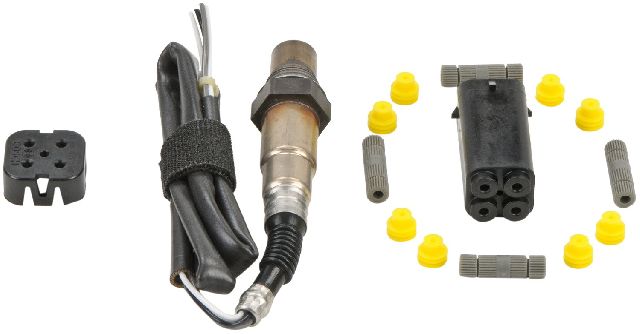
- Downstream Oxygen Sensor (Bank 1, Sensor 2)
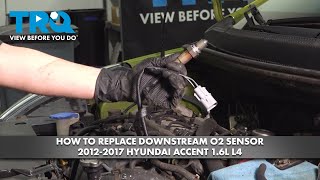
(OEM #2010-2011 (Alpha II): 39210-22610 (replaces 39210-22600) | 2012-2017 (Gamma GDI): 39210-2B220)🎬 See this replacement walkthrough for 2012-2017 Hyundai Accents. — This sensor is the most frequent point of failure for the P0136 code due to age and exposure to exhaust gases.
Trusted brands: Denso, Bosch, NGK/NTK, Walker
OEM price range: $108-$287
Aftermarket price range: $40-$90
Related Codes That Often Appear With This One
- P0141 — This code is for the 'O2 Sensor Heater Circuit Malfunction (Bank 1, Sensor 2)'. The heater and signal circuits are part of the same sensor assembly, so a failure in one can often accompany a failure in the other.
- P0420 — This code means 'Catalyst System Efficiency Below Threshold'. Since the P0136 sensor's job is to monitor the catalyst, a faulty sensor can provide incorrect data, leading the ECM to mistakenly believe the catalytic converter has failed.
Technical Service Bulletins (TSBs) & Recalls
- Hyundai TSB 15-01-033: Describes the procedure for replacing the faulty stop lamp switch as part of Recall 131 for 2009-2011 Accent models.
- Hyundai Service Campaign T9M: A service campaign to apply rust-proofing materials to the underbody of certain 2008-2011 Accent vehicles to combat corrosion.
Mechanic-Grade Diagnostic Values
- Downstream O2 Sensor (B1S2) Heater Circuit Resistance — expected: Approximately 9.0 Ω at 20°C (68°F). A general acceptable range is often cited as 4-20 Ω.. Failure: An internal resistance over 40 Ω, an open circuit (infinite resistance), or a short circuit (near 0 Ω).
- Downstream O2 Sensor (B1S2) Voltage at Steady State (Warm Engine) — expected: Relatively stable voltage around 0.5V - 0.8V.. Failure: The ECM may set P0136 if the voltage is stuck in a narrow range of 0.4V to 0.52V for an extended time (e.g., 600 seconds).
- Downstream O2 Sensor (B1S2) Voltage during Fuel Cut Deceleration — expected: Voltage should drop to 200mV (0.2V) or lower when suddenly releasing the accelerator from a high RPM (e.g., 4000 RPM).. Failure: Voltage does not drop, indicating a slow or non-responsive sensor.
- O2 Sensor Heater Power Supply Voltage — expected: Battery Voltage (approx. 12V) at the harness connector with key on, engine off.. Failure: No voltage or significantly low voltage indicates a problem with the fuse, relay, or wiring from the power source.
Scan Tool Commands That Help
- Hyundai GDS (Global Diagnostic System): Live Data Monitoring & Graphing — The OEM scan tool allows for detailed graphing of O2 sensor voltage. A technician can observe the B1S2 waveform to see if it's flatlined, lazy, or mirroring the B1S1 sensor's activity (which would suggest a failing catalytic converter, not a sensor).
- Hyundai GDS (Global Diagnostic System): Actuation Test — While there isn't a direct actuation test for the O2 sensor signal, a technician can use the GDS to command other functions (like fuel pump relay on/off) to verify circuit integrity and observe effects on the system, which can help isolate wiring issues.
- Hyundai GDS (Global Diagnostic System): Flight Record Function — For intermittent faults, the GDS can retrieve historical diagnostic data, including previous fault codes and freeze-frame data, even if the code is not currently active. This can help identify a pattern or condition that triggers the P0136 code.
Wiring & Ground Locations
- ECM Connector EGG-K (2012+ RB) — On the Engine Control Module, located in the engine compartment.. Pin 66 is the Heated Oxygen Sensor (Sensor 2) output signal, and Pin 71 is the heater control for Sensor 2. Pin 86 is the sensor ground. Testing for continuity and voltage at these specific pins can rule out wiring faults between the sensor and the ECM.
- Ground GGG04 (2012+ RB) — Located on the right rear of the engine compartment.. This is a key ground point for the engine control system. A corroded or loose GGG04 ground can cause a variety of erratic sensor readings and seemingly unrelated engine codes, including O2 sensor circuit faults.
- Ground GGG05 (2012+ RB) — Located on the right rear of the engine compartment, near GGG04.. Similar to GGG04, this is another critical engine control ground. Verifying both GGG04 and GGG05 are clean and tight is a crucial step when diagnosing any electrical fault in the engine management system.
Real Owner Repair Stories
- Reddit r/MechanicAdvice user (2009 Hyundai Accent 1.6L) — CEL with codes P0031, P0134, P2096. Old O2 sensor stuck at 0.4V.
❌ Tried (didn't work) Replaced the original O2 sensor with a new Walker brand sensor (part 350-34617).
✅ What actually fixed it The new Walker sensor was also faulty, getting stuck at 1.2V and throwing a new P0132 code. The user was advised by the community to seek a higher-quality brand like NTK or Denso, implying the aftermarket Walker part was defective out of the box. - BobIsTheOilGuy.com forum user (Hyundai Accent (year not specified)) — CEL for O2 sensor.
❌ Tried (didn't work) Replaced the original sensor with a Bosch aftermarket sensor from a local auto parts store.
✅ What actually fixed it The aftermarket Bosch sensor failed after only 50,000 miles. The owner reinstalled the old OEM sensor (which had 100k miles) and it worked for another 25k miles. The final fix was purchasing a new OEM sensor, which resolved the issue long-term. The user's advice was to use OEM sensors for longevity.
Diagnostic Flowchart
Other Known Issues on This Vehicle
Issues unrelated to this code that are worth knowing about as an owner of this generation:
- Carbon Buildup on Intake Valves (GDI Engines) 🟠 Medium — Common on 2012-2017 GDI engines, especially over 60,000 miles. Symptoms include rough idle, misfires, and loss of power.
- Faulty Brake Light Switch 🔴 High — Widespread enough to trigger a recall (NHTSA #15V566000, Hyundai Recall 131) for 2009-2011 models. Can cause brake lights to fail, ESC light to illuminate, and prevent shifting from Park. (Ref: Recall 131 / TSB 15-01-033)
- Engine Misfires / Ignition Coil Failure 🟠 Medium — Frequently reported issue, often starting between 30,000-60,000 miles, leading to rough idling and hesitation.
- Underbody/Subframe Corrosion 🔴 High — Primarily affects vehicles in regions using road salt. A service campaign (T9M) was issued for 2008-2011 models to apply rust-proofing. A class-action lawsuit was also settled regarding this issue on older Hyundai models. (Ref: Service Campaign T9M)
- Chafing of Engine Wiring Harness 🔴 High — The harness can rub against brackets near the brake master cylinder, causing shorts, blown fuses, and intermittent stalling.
Used vs. New Parts: Buying Guide for This Vehicle
When a used part is the smart pick: For this repair, a used part is almost never a smart choice. Oxygen sensors are wear-and-tear items with a finite lifespan, measured in heat cycles and exposure to exhaust contaminants. A used sensor from a junkyard has unknown remaining life and could fail shortly after installation, wasting time and money.
Donor-vehicle mileage cap: roughly under 15000 miles for the part to have meaningful remaining life.
What to inspect on the donor part:
- If forced to use one in an emergency, look for a donor vehicle with very low mileage.
- Inspect the sensor tip for heavy black soot (rich running), white deposits (coolant/oil burning), or physical damage.
- Ensure the wiring and connector are completely intact with no signs of melting or corrosion.
OEM-only on this vehicle (don't cheap out):
- While not strictly 'OEM-only', forum and mechanic consensus strongly favors OEM or OEM-supplier brands for this part. The vehicle's computer is calibrated for the specific response curve of the original sensor.
Aftermarket brands forum-validated for this vehicle:
- Denso
- NGK / NTK
Brands owners have reported issues with on this vehicle:
- Unbranded 'economy' or 'chinesium' sensors from online marketplaces.
- Some users report premature failure with lower-tier aftermarket brands like Walker or even some non-OEM Bosch applications, suggesting they can be a gamble.
Real Owner Stories
Aggregated from forums and TSBs cited above. Mileages and costs reflect what owners reported in those sources.
2012 Hyundai Accent 1.6L GDI
Symptoms: The owner reported getting both P0136 and P0141 codes simultaneously. Replacing the sensor did not resolve the issue.
What fixed it: A thorough inspection revealed that a rodent had chewed through the oxygen sensor's wiring harness.
Source hint: hyundai-forums.com: P0136 and P0141
2010-2017 Hyundai Accent
Symptoms: The check engine light was on. Using a scan tool, the technician observed that the oxygen sensor B1S2 signal remained fixed at a specific voltage and did not change state even when engine speed was increased to 2,000 RPM.
What fixed it: Replacement of the downstream oxygen sensor (Bank 1, Sensor 2).
Source hint: youtube_comment: P0136, P0141 Hyundai Accent 2010-2017 02 Sensor Heater Circuit Problem
Related OBD-II Codes
Frequently Asked Questions
Where is the fuse for the oxygen sensors located on my Hyundai Accent?
Does Hyundai Recall 131 or TSB 15-01-033 relate to my P0136 code?
What is the expected lifespan of the downstream oxygen sensor on this vehicle?
Could the P0136 code be caused by the underbody corrosion mentioned in Service Campaign T9M?
I have a 2012 Accent with a P0136; could it be a wiring issue rather than a bad sensor?
What should the voltage reading be for Bank 1 Sensor 2 on a healthy 2010-2017 Accent?
Helpful Videos


We Have This Part in Stock


The information in this article is provided for general reference and educational purposes only. Vehicle specifications, procedures, and part compatibility can vary by production date, trim level, and region. Always consult your vehicle's factory service manual and verify part numbers before purchasing or performing repairs. Safety-critical components such as airbags, seat belts, and braking systems should be installed by a qualified professional.
- Hyundai Accent:
- 🧭 Diagnostic Flowchart
- 🎬 Helpful Videos
- 🛍️ Shop This Part
- What's Unique About the 2010-2017 Hyundai Accent
- Symptoms You May Notice
- Most Likely Causes
- Rare But Worth Checking
- Diagnosis Steps
- Parts You'll Likely Need
- Related Codes That Often Appear With This One
- Technical Service Bulletins (TSBs) & Recalls
- Mechanic-Grade Diagnostic Values
- Scan Tool Commands That Help
- Wiring & Ground Locations
- Real Owner Repair Stories
- Other Known Issues on This Vehicle
- Used vs. New Parts: Buying Guide for This Vehicle
- Real Owner Stories
- 2012 Hyundai Accent 1.6L GDI
- 2010-2017 Hyundai Accent
- Related OBD-II Codes
- Frequently Asked Questions
- 🎟️ Get 5% Off