

P0138 on 1996-2001 Jeep Cherokee: O2 Sensor Circuit High Voltage Fixes
On a 1996-2001 Jeep Cherokee, code P0138 almost always points to a failed downstream (post-catalytic converter) oxygen sensor or its wiring. Before replacing the sensor, check the 15-amp O2 sensor fuse in the Power Distribution Center (PDC) under the hood, as a blown fuse is a common and easy fix.
- Before buying any parts for a P0138 code, check the 15-amp O2 sensor fuse in the under-hood fuse box.
- If the fuse is good, carefully inspect the downstream O2 sensor's wiring harness for any signs of heat damage, chafing, or breaks, especially near the driveshaft.
- If the fuse and wiring are good, the downstream O2 sensor itself has likely failed.
- When replacing the sensor, use an NTK or Denso branded part, as many Cherokee owners report problems with Bosch sensors.
- The downstream sensor (Sensor 2) is located after the catalytic converter.
What's Unique About the 1984-2001 Jeep Cherokee
The Jeep Cherokee XJ is a robust but simple vehicle, and this code is very common. The primary issue specific to this platform is the vulnerability of the downstream O2 sensor's wiring harness. It is frequently damaged by heat from the exhaust, chafing against the transmission, or getting snagged and rubbing on the spinning rear driveshaft. A broken harness hanger is often the culprit, allowing the wiring to droop onto the driveshaft. Additionally, a surprisingly common cause is a blown 15-amp fuse in the Power Distribution Center under the hood, which powers the O2 sensor heaters; some owners report this is in slot 17 or 24, so it's best to check the PDC cover diagram. Owners often replace the sensor when only the fuse was needed.
Generation note: This guide applies to the OBD-II equipped Jeep Cherokee (XJ) models from 1996 to 2001. The pre-1996 models were OBD-I and have different diagnostic systems and sensor configurations. There are no significant differences related to this code within the 1996-2001 model years, though some very late 1999 models may have a coil pack ignition instead of a distributor. The core issue with the downstream O2 sensor, its wiring, and fuse remains consistent.
Symptoms You May Notice
- Check Engine Light (CEL) is on
- Failure to pass emissions inspection
- Slightly decreased fuel economy
- Rough or erratic idle in some cases
- Black smoke from exhaust or a 'rotten egg' smell in rare, extreme rich-running conditions
- Replacing the upstream O2 sensor. P0138 specifically refers to Sensor 2, which is the downstream sensor after the catalytic converter.
- Replacing the catalytic converter. While a bad cat can be related to O2 sensor codes, P0138 by itself points to a sensor circuit issue, not converter efficiency (which is code P0420).
- Using a Bosch oxygen sensor. Many owners report that Bosch sensors have incorrect internal resistance for the Jeep 4.0L engine's computer, leading to persistent codes even with a new part.
Most Likely Causes
- Failed Downstream Oxygen Sensor 🔴 High Probability → Shop Oxygen Sensor Oxygen sensors are wear items with a finite lifespan, typically failing after 100,000+ miles due to heat, contaminants, and carbon buildup. The downstream sensor on the XJ is also susceptible to physical damage. It is highly recommended to use NTK brand sensors, as they are the OEM supplier; Bosch sensors are widely reported to cause compatibility issues with the Jeep PCM.
How to confirm: After checking the fuse and wiring, this is the most likely component failure. Use a scan tool with live data to monitor the voltage from Bank 1 Sensor 2. With the engine running, if the voltage is stuck high (typically >0.9V) and not fluctuating, the sensor has likely failed. You can also bench test the sensor with a multimeter and a propane torch.
Typical fix: Replace the downstream (post-catalytic converter) oxygen sensor. Soaking the old sensor's threads with a penetrating oil like PB Blaster beforehand is highly recommended. Apply anti-seize to the new sensor's threads before installation. A special 22mm (or 7/8") O2 sensor socket is recommended.
Est. part cost: $30-$80 - Damaged O2 Sensor Wiring or Connector 🟡 Medium Probability → Shop Oxygen Sensor The wiring harness for the rear O2 sensor is notoriously routed near the hot exhaust, transmission, and spinning driveshaft, making it highly susceptible to melting, chafing, or physical damage. A broken plastic hanger clip often allows the harness to sag onto the driveshaft, which chews through the insulation, causing a short.
How to confirm: Visually inspect the entire length of the wiring from the sensor to where it enters the main harness. Look for melted insulation, frayed wires, or a shiny, clean spot on the rear driveshaft where the harness may have been rubbing. Check the connector for corrosion, damage, or poorly done previous repairs using crimp connectors.
Typical fix: Repair the damaged section of wire with solder and heat shrink tubing for a permanent, sealed repair. If the connector is damaged, replace it. Secure the repaired harness away from heat sources and moving parts with high-quality zip ties.
Est. part cost: $5-$25 - Blown O2 Sensor Heater Fuse 🟡 Medium Probability → Shop Oxygen Sensor A short in the O2 sensor heater circuit (often from the aforementioned wiring damage) or an internal short in the sensor itself will cause the fuse to blow. This is a well-documented issue on XJ forums.
How to confirm: Check the 15-amp fuse for the O2 sensor heater circuit in the Power Distribution Center (the black box with fuses and relays) under the hood. The specific slot can vary, but it is often labeled 'O2 SENSOR' or similar on the box lid. Forum members report it being in slot 17 or 24 on different years.
Typical fix: Replace the blown 15-amp fuse. If the fuse blows again immediately, it confirms a short circuit in the heater element of one of the O2 sensors or in the wiring that must be found and repaired before proceeding.
Est. part cost: $1-$5
Rare But Worth Checking
- Exhaust Leak: An exhaust leak upstream of the sensor can introduce oxygen into the exhaust stream, potentially causing confusing readings. This is less likely to cause a high voltage code but is worth checking.
- Failing Catalytic Converter: While the downstream sensor's job is to monitor the cat, a failing converter can sometimes cause erratic readings. This is usually accompanied by other codes like P0420 (Catalyst Efficiency Below Threshold).
- PCM (Engine Computer) Fault: This is extremely rare. The PCM should only be considered a potential cause after all other possibilities (sensor, wiring, fuses) have been exhaustively ruled out.
Diagnosis Steps
- Read the code with an OBD-II scanner to confirm P0138 is present. Note any other codes, especially P0141 or P0135.
- Open the Power Distribution Center (PDC) under the hood and check the 15-amp O2 sensor fuse. It may be in slot 17 or 24. Replace if blown. If it blows again, you have a short to find.
- If the fuse is good, safely raise the vehicle and perform a thorough visual inspection of the downstream O2 sensor and its wiring harness. Pay extremely close attention to the area where the harness passes over the transmission crossmember and near the rear driveshaft. Look for any signs of melting, chafing, or bare wires.
- If the wiring appears intact, the most likely culprit is the sensor itself. Use a scan tool with live data to monitor the voltage from Bank 1 Sensor 2. With the engine running, the voltage should fluctuate slowly. If it is stuck high (typically >0.9V), the sensor has failed.
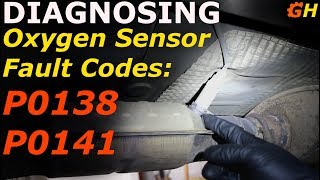
- If you do not have a scanner, you can test the sensor's internal heater resistance with a multimeter (should be between 4-7 ohms typically). 🎬 Watch: Diagnostic steps for P0138 and P0141 heater circuit issues.
- If the sensor and wiring test good, check for exhaust leaks between the engine and the catalytic converter.
- If all else fails, the issue could be with the PCM, but this is highly unlikely.
Parts You'll Likely Need
- Downstream Oxygen Sensor (Post-Catalytic)
(OEM #Mopar 56041344AA (superseded by other numbers), NTK 23099 (verify by year))— This is the most common component to fail and trigger a P0138 code after years of exposure to high heat and exhaust gases. NTK is the OEM supplier.
Trusted brands: NTK, Denso
OEM price range: $70-$150
Aftermarket price range: $30-$80 - 15A Mini Fuse — Powers the O2 sensor heater circuit. A short in the wiring or sensor can cause this fuse to blow, disabling the sensor and triggering a code.
OEM price range: $1-$5
Aftermarket price range: $1-$5
Related Codes That Often Appear With This One
- P0141 — P0141 indicates a fault in the heater circuit for the same sensor (Bank 1, Sensor 2). They often appear together when the sensor fails internally, the wiring is damaged, or if the shared 15A fuse is blown.
- P0135 — P0135 indicates a fault in the heater circuit for the upstream sensor (Bank 1, Sensor 1). If both P0135 and P0141/P0138 appear, it strongly points to the shared 15A fuse being blown, as this single fuse powers both heater circuits.
Platform-Specific Known Issues
- Many owners on forums for Jeep Cherokees report issues with Bosch-branded oxygen sensors, suggesting they can be incompatible with the Jeep's PCM and cause persistent codes. It is highly recommended to use NTK (the original OEM supplier) or Denso sensors for this vehicle.
- The wiring harness for the downstream sensor is frequently damaged by rubbing against the rear driveshaft after its retaining clip breaks. A visual inspection of this area is critical.
Mechanic-Grade Diagnostic Values
- Downstream O2 Sensor Heater Element Resistance — expected: 4.5 to 7.0 Ohms at ~70°F (21°C).. Failure: Infinite resistance (OL) indicates an open heater circuit. Very low resistance (near 0 Ohms) indicates a short. A reading of 3.8 Ohms has been observed on a sensor that was still considered close enough to function.
- Downstream O2 Sensor Signal Voltage (Live Data) — expected: On a healthy, warm engine with a good catalytic converter, the voltage should be relatively stable and lazy, typically hovering around 0.5 to 0.8 volts.. Failure: A voltage signal that is stuck high, consistently above 0.9V or 1.1V, for an extended period. This indicates the condition that sets the P0138 code.
- O2 Sensor Heater Circuit Voltage (at connector) — expected: Approximately 12V (battery voltage) should be present at the heater power pin on the harness-side connector with the key on, engine off.. Failure: Zero or low voltage points to a blown fuse (check PDC slot 17 or 24) or a break in the power supply wire from the ASD relay.
Wiring & Ground Locations
- Downstream O2 Sensor PCM Pins (1997-2001) — At the Powertrain Control Module (PCM) connectors. The PCM is located on the driver's side firewall in the engine bay.. For advanced diagnosis, you can test for continuity from the sensor connector to the PCM. The O2 1/2 Signal wire (often Dark Green/Orange) goes to Pin A25 of the C1 (Black) connector. The O2 Sensor Ground wire (often Black/Dark Green) goes to Pin A4 of the C1 (Black) connector. This allows you to rule out a wiring break between the sensor and the computer.
- G102 / Dipstick Tube Stud Ground — A stud on the engine block where the oil dipstick tube is mounted.. This is a critical ground point for multiple sensors, including the oxygen sensor. A corroded or loose connection here can cause erratic sensor readings, including high voltage faults. This ground is often overlooked and is a known weak point on Renix-era and later 4.0L engines.
- G108 Ground — Located under the dashboard on the far left (driver's) side, near the lower dash brace.. While primarily grounding interior components and the instrument cluster, it is part of the main body ground network. Poor body grounds can cause the PCM to see floating voltages from sensors, and cleaning all major grounds is a best practice when chasing electrical gremlins like a persistent P0138.
Real Owner Repair Stories
- CherokeeForum user Apostle2 (Jeep Cherokee XJ (year not specified)) — P0138 code present.
❌ Tried (didn't work) Initial diagnosis pointed towards a bad sensor, but further inspection was performed before replacement.
✅ What actually fixed it The previous owner had replaced the O2 sensor using unsealed crimp connectors. Over time, corrosion built up in the splices, causing a voltage drop that the PCM interpreted incorrectly, triggering the high voltage code. The fix was to cut out the corroded crimp connectors, solder the wires properly, and seal the connection with heat shrink tubing. - GearHeads Garage YouTube Channel (Jeep Cherokee XJ) — P0138 (O2 Sensor Shorted High) and P0141 (Heater Failure) codes.
❌ Tried (didn't work) Replacing the O2 sensor without diagnosis.
✅ What actually fixed it A visual inspection revealed a shiny, clean spot on the rear driveshaft. Following the wiring harness from the downstream O2 sensor showed that the harness had been rubbing on the driveshaft, chafing through the insulation and causing a short circuit. The fix was to repair the damaged wires and properly secure the harness away from the driveshaft.
Model Year Variations Within This Range
- 2000-2001: Models sold in or built to California emissions standards have a more complex exhaust system with two pre-catalytic converters integrated into the exhaust manifold and a total of four oxygen sensors (two upstream, two downstream). Federal emissions models for all years (1996-2001) use a simpler setup with one upstream and one downstream sensor. This is critical because a California-spec vehicle has two B1S2 sensors (one for each bank of 3 cylinders), and the code P0138 would still refer to the first bank's downstream sensor. The connectors and wire lengths for these sensors are different.
- 1997-2001: The specific fuse slot in the Power Distribution Center (PDC) for the O2 sensor heaters can vary. While often reported as slot 17 or 24, forum discussions show that the layout changed slightly over the years. It is essential to check the diagram on the inside of the PDC cover rather than relying on a single reported slot number.
Diagnostic Flowchart
Used vs. New Parts: Buying Guide for This Vehicle
When a used part is the smart pick: For this repair, a used part is only a smart choice for the wiring harness connector. If your connector is melted or damaged, sourcing a pigtail from a junkyard vehicle is a cost-effective and reliable repair method, provided the donor wires are soldered and heat-shrunk properly.
Donor-vehicle mileage cap: roughly under 150000 miles for the part to have meaningful remaining life.
What to inspect on the donor part:
- For a wiring pigtail, ensure the plastic is not brittle or cracked.
- Check that the locking tab on the connector is intact.
- Look for clean, corrosion-free terminals inside the connector.
- Ensure you get at least 6-8 inches of wire to make splicing easy.
OEM-only on this vehicle (don't cheap out):
- Oxygen Sensor
Aftermarket brands forum-validated for this vehicle:
- NTK (OEM supplier)
- Denso
Brands owners have reported issues with on this vehicle:
- Bosch (widely reported to cause compatibility issues with the Jeep PCM)
Real Owner Stories
Aggregated from forums and TSBs cited above. Mileages and costs reflect what owners reported in those sources.
Jeep Cherokee
Symptoms: Check Engine Light with P0138 code. The owner could still see a voltage swing from the rear sensor, but it was too small.
What fixed it: The owner discovered the previous owner had used unsealed crimp splices to connect the O2 sensor wires. These had corroded, causing a voltage drop. The fix was to cut out the bad splices, solder the wires properly, and seal them with heat shrink tubing.
Source hint: CherokeeForum - 'If you have ever had a P0138 code click here!'
Related OBD-II Codes
Frequently Asked Questions
What brand of oxygen sensor should I use for my 1984-2001 Jeep Cherokee to fix a P0138 code?
I'm getting a P0138 code. Where is the O2 sensor fuse located on my XJ?
Before I replace the O2 sensor for P0138, what's the most important thing to check first on this specific vehicle?
My scan tool shows the downstream O2 sensor (Bank 1 Sensor 2) voltage is stuck high, above 0.9V. What does this mean?
Are other Jeeps from the same era, like the Wrangler or Grand Cherokee, also prone to this P0138 issue?
What tools do I need to replace the downstream O2 sensor on my Cherokee?
Helpful Videos

The information in this article is provided for general reference and educational purposes only. Vehicle specifications, procedures, and part compatibility can vary by production date, trim level, and region. Always consult your vehicle's factory service manual and verify part numbers before purchasing or performing repairs. Safety-critical components such as airbags, seat belts, and braking systems should be installed by a qualified professional.
- Jeep Cherokee:
- 🧭 Diagnostic Flowchart
- 🎬 Helpful Videos
- What's Unique About the 1984-2001 Jeep Cherokee
- Symptoms You May Notice
- Most Likely Causes
- Rare But Worth Checking
- Diagnosis Steps
- Parts You'll Likely Need
- Related Codes That Often Appear With This One
- Platform-Specific Known Issues
- Mechanic-Grade Diagnostic Values
- Wiring & Ground Locations
- Real Owner Repair Stories
- Model Year Variations Within This Range
- Used vs. New Parts: Buying Guide for This Vehicle
- Real Owner Stories
- Jeep Cherokee
- Related OBD-II Codes
- Frequently Asked Questions
- 🎟️ Get 5% Off