

P0140 on 2012-2018 Jeep Wrangler JK 3.6L: O2 Sensor Inactivity Causes and Fixes
This code almost always means the Bank 1, Sensor 2 (passenger side, downstream) oxygen sensor has failed. It's a common issue caused by age or contamination. Expect to pay $40-$80 for a quality replacement sensor and about an hour of DIY labor. Crucially, only use Mopar or NTK brand sensors to avoid immediate recurrence of the code.
- P0140 on a 2012-2018 Wrangler JK almost certainly means the passenger-side, downstream O2 sensor has failed.
- To ensure a lasting repair, you MUST use either a genuine Mopar or an NTK branded oxygen sensor.
- Before replacing the sensor, inspect its wiring for heat or physical damage and check for any engine oil leaks from above that could have caused the part to fail.
- This is a very manageable DIY job for a home mechanic with basic tools and a specific O2 sensor socket.
What's Unique About the 2012-2018 Jeep Wrangler JK
The Jeep Wrangler JK is notoriously sensitive to the brand of oxygen sensor used. Owners and mechanics widely report that many aftermarket brands, such as Bosch, will not work correctly and can cause the code to return. It is highly recommended to use only the OEM Mopar part or a sensor from the original equipment manufacturer, NTK. Additionally, the sensor's location under the vehicle makes its wiring vulnerable to damage during off-roading, and the 3.6L Pentastar engine is widely known for oil leaks from the plastic oil filter housing/cooler assembly that sits in the engine valley. This oil drips down the back of the engine and contaminates the passenger-side downstream sensor, causing premature failure.
Generation note: This guide covers the 2012-2018 Jeep Wrangler JK equipped with the 3.6L Pentastar V6. The user's original request for 2007-2018 spans the full JK generation, but the 2007-2011 models used a different 3.8L engine which has its own distinct issues. The 2018 model year was also a transition year, with both the JK and the new JL generation being sold. This guide is specific to the 2012-2018 JK platform.
Symptoms You May Notice
- Check Engine Light is illuminated.
- Vehicle will fail an emissions inspection.
- No noticeable change in engine performance or fuel economy in most cases.
- Replacing the catalytic converter. A P0140 code alone indicates a sensor circuit issue, not a failed converter. A bad converter typically sets a P0420 (Catalyst Efficiency) code.
- Replacing the wrong O2 sensor. Ensure you are replacing Bank 1 (passenger side) and Sensor 2 (downstream, after the catalytic converter).
- Using an incompatible aftermarket sensor brand. Many brands other than Mopar or NTK are known to be incompatible with the JK's computer system and will not resolve the code.
Most Likely Causes
- Failed Bank 1, Sensor 2 Oxygen Sensor 🔴 High Probability → Shop Oxygen Sensor O2 sensors are wear items that fail from age, heat cycles, and exposure. The location on the JK makes it susceptible to contamination from road debris and engine oil leaks.
How to confirm: Check for no voltage activity from the B1S2 sensor using an OBD-II scanner's live data function. A dead sensor will show a flat, unresponsive voltage reading, often stuck near 0V. A healthy downstream sensor should have a relatively stable voltage above 0.5V when the engine is warm.
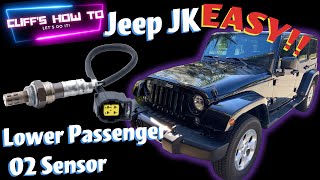
Typical fix: Replace the Bank 1, Sensor 2 oxygen sensor. It is critical to use a Mopar (p/n 05149180AB) or NTK (p/n 23162) branded part.
Est. part cost: $40-$80 - Oil Contamination from Oil Filter Housing Leak 🔴 High Probability The 3.6L Pentastar's plastic oil filter/cooler housing, located in the engine 'V', is a very common failure point. It cracks or its gaskets fail, leaking oil down the back of the engine directly onto the Bank 1 exhaust pipe and the B1S2 O2 sensor and wiring, causing it to fail.
How to confirm: Use a flashlight to inspect the valley at the top-center of the engine, below the intake manifold. Look for pooled oil. Also, inspect the transmission bellhousing and the passenger-side exhaust for signs of fresh or caked-on oil. The sensor itself may be saturated.
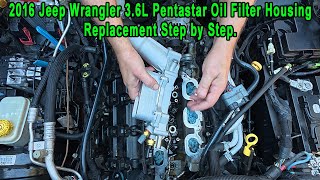
Typical fix: First, repair the source of the oil leak by replacing the entire oil filter housing assembly (upgrading to a metal version is recommended). 🎬 See this walkthrough on replacing the Pentastar oil filter housing. Then, replace the contaminated oxygen sensor.
Est. part cost: $40-$80 for the sensor, plus $100-$250 for the oil filter housing assembly and several hours of labor. - Damaged Wiring or Connector 🟡 Medium Probability The wiring harness is routed under the vehicle and can be damaged by road debris, snagged during off-road use, or melted by contact with the hot exhaust pipe. Water intrusion into the connector is also possible.
How to confirm: Visually inspect the entire wiring harness leading to the sensor for any signs of melting, chafing, or breaks. Unplug the connector and check for corrosion, moisture, or pushed-out pins.
Typical fix: Repair the damaged section of wire or replace the connector pigtail.
Est. part cost: $10-$30 - Blown O2 Sensor Heater Circuit Fuse ⚪ Low Probability → Shop Oxygen Sensor
How to confirm: The sensor's internal heater must work for the sensor to become active. On the JK, there is no simple, single fuse for the O2 heaters in the main fuse box. Power is supplied by the Totally Integrated Power Module (TIPM). A fault in the heater circuit (often a short to ground in the wiring) can cause the driver within the TIPM to shut down power to the sensor, mimicking a blown fuse. This condition usually sets a P0141 heater circuit code along with P0140.
Typical fix: Diagnose and repair the short in the O2 sensor heater wiring. If the TIPM driver is damaged, the TIPM may need repair or replacement, which is a complex and expensive job.
Est. part cost: $1-$5 for wiring repair, $500+ for TIPM repair/replacement.
Rare But Worth Checking
- Exhaust Leak: An exhaust leak before or near the sensor can introduce outside oxygen, causing erratic readings. While this more commonly triggers performance codes (like lean/rich conditions), a major leak could potentially contribute to a no-activity code.
- Powertrain Control Module (PCM) Failure: → Shop Engine Control Module (ECM) In very rare cases, the internal circuit in the PCM that reads the O2 sensor can fail. This should only be considered after all other possibilities, including sensor, wiring, and TIPM, have been exhaustively ruled out.
Diagnosis Steps
- Connect an OBD-II scanner and confirm P0140 is the active code. Note any other codes present, especially P0141.
- Use the scanner to monitor live data for 'O2S B1S2 Voltage'. With the engine fully warmed up and running, observe the voltage. If it is flatlined (unchanging) near 0V or another static value, this confirms the 'no activity' condition. A good downstream sensor should show a relatively steady voltage between 0.5V and 0.9V.
- Perform a detailed visual inspection. Look for signs of an oil leak from the top-center of the engine (the oil filter housing) dripping down onto the passenger side exhaust.
- Trace the O2 sensor wiring harness from the sensor to the main loom. Look for obvious damage, such as melting on the exhaust pipe, chafing against the frame, or breaks from debris/off-roading. Check the connector for corrosion or damage.
- If an oil leak is present, address the leak first by replacing the oil filter housing assembly before replacing the sensor.
- If wiring appears intact and there are no leaks, the oxygen sensor itself is the most likely cause of failure.
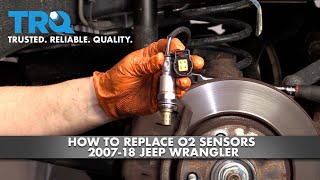
- Replace the Bank 1, Sensor 2 oxygen sensor using a Mopar or NTK part. An O2 sensor socket is recommended.
- After replacement, clear the codes with the scanner and perform a complete drive cycle to ensure the code does not return.
Parts You'll Likely Need
- Oxygen Sensor (Bank 1, Sensor 2)
(OEM #05149180AB)— This sensor is the primary component that fails, leading to the P0140 code. It is a wear-and-tear item exposed to extreme heat and is often contaminated by leaking engine oil on this specific platform.
Trusted brands: Mopar (p/n: 05149180AB), NTK (p/n: 23162)
OEM price range: $60-$80
Aftermarket price range: $40-$60 - Oil Filter / Cooler Housing Assembly
(OEM #68105583AF (example, verify by VIN))— This is the most common source of oil leaks on the 3.6L Pentastar. If found to be leaking, it MUST be replaced to prevent repeat failure of the new O2 sensor. Many owners upgrade to a more durable all-aluminum aftermarket version.
Trusted brands: Mopar, Dorman (Aluminum OE-Fix)
OEM price range: $150-$200
Aftermarket price range: $100-$180
Related Codes That Often Appear With This One
- P0141 — This code is for 'O2 Sensor Heater Circuit Malfunction (Bank 1 Sensor 2)'. The heater is required for the sensor to function. A failure in the heater element or its circuit will prevent the sensor from reaching operating temperature, thus it will show no activity and trigger both P0141 and P0140.
- P2096 — 'Post Catalyst Fuel Trim System Too Lean Bank 1'. This code can sometimes appear if the B1S2 sensor is failing but not completely dead, providing a biased, incorrect reading before it fails entirely and triggers P0140.
Technical Service Bulletins (TSBs) & Recalls
- TSB 18-031-13: While this TSB is for P0157/P0158 codes on 2012-2013 models, its procedure includes inspecting for oil contamination from the cylinder head cover gasket as a potential cause. This officially supports the diagnostic path of checking for oil leaks when troubleshooting any O2 sensor code on this engine.
- Chrysler TSB #68105583A... (partial number found): Specifically lists P0140 as a potential fault code related to O2 sensors on 3.6L engines, indicating a known issue.
Platform-Specific Known Issues
- The Jeep Wrangler JK computer is highly sensitive and often rejects non-OEM sensor brands. Using NTK (the OEM supplier) or genuine Mopar parts is strongly advised to prevent the code from returning.
- A TSB for Chrysler vehicles with the 3.6L engine (TSB #68105583A...) mentions O2 sensor fault codes including P0140 as a known issue, reinforcing this is a recognized problem on the Pentastar platform.
- The plastic oil filter housing assembly is a well-documented, high-failure-rate part across all vehicles with the 3.6L Pentastar engine, making oil contamination the leading cause of premature B1S2 sensor failure on the JK.
Mechanic-Grade Diagnostic Values
- Downstream O2 Sensor (B1S2) Voltage - Live Data — expected: Relatively stable voltage between 0.5V and 0.9V on a warm, running engine with a healthy catalytic converter.. Failure: A flat, unchanging voltage, typically stuck near 0V, indicates no activity.
- O2 Sensor Heater Circuit Resistance — expected: A good NTK sensor heater should measure around 3.6 to 3.9 ohms.. Failure: An open circuit (infinite resistance) or a reading significantly different from the expected value. Some aftermarket sensors may have different resistance (e.g., 6+ ohms), which can cause issues with the Jeep's monitoring system.
- O2 Sensor Signal Circuit at PCM — expected: With the key on, engine off, the circuit should read approximately 0.45V.. Failure: A reading of 0V or a full system voltage may indicate a short to ground or a short to power in the wiring harness.
Wiring & Ground Locations
- B1S2 PCM Pins — At the Powertrain Control Module (PCM) connectors.. For testing continuity and shorts without cutting wires. The B1S2 Signal wire is on connector C1, Pin 31. The Heater Control is on connector C3, Pin 9. This allows a technician to test the entire circuit from the PCM to the sensor connector.
- G101 / G104 — These are primary engine grounds located on the engine block itself.. A poor engine ground can cause a variety of sensor issues, including incorrect O2 sensor readings. The PCM relies on a solid ground reference. If major engine work was performed, ensuring these grounds are clean and tight is critical.
- G201 / G203 — Under the kick panel in the passenger footwell.. These are interior body grounds. While less likely to be the primary cause for a P0140, they are part of the overall vehicle grounding scheme. A user on a forum used a nearby factory ground stud in this area for accessories, indicating it's a known grounding point.
- B1S2 Connector — On the passenger side, the downstream sensor (B1S2) has a white connector, while the upstream sensor (B1S1) has a black connector.. This color coding provides a quick visual confirmation to ensure the correct sensor is being diagnosed or replaced, preventing a common misdiagnosis error.
Real Owner Repair Stories
- YouTube video by KT Garage (2017 Jeep Wrangler) — Check Engine Light with codes P2096 and P0137 (a low voltage code closely related to P0140).
❌ Tried (didn't work) The owner was concerned the catalytic converter was old and might be the cause.
✅ What actually fixed it During the diagnosis, the owner discovered a significant oil leak from the valve cover gasket dripping down onto the exhaust and sensor area. The video proceeds with replacing the sensor and adding an extender as a preventative measure for the catalyst code, but the visual evidence of the oil leak directly above the sensor is a classic example of the oil-contamination failure pattern.
OEM Part Supersession History
5149180AA→05149180AB— Standard part revision by the manufacturer.
Heads up: The part is listed as a direct replacement. It is used across a wide variety of Chrysler/Jeep/Dodge vehicles with the 3.6L engine, indicating broad compatibility within this platform.
Model Year Variations Within This Range
- 2012-2018: The 2012 model year marked the introduction of the 3.6L Pentastar V6 engine and the WA580 5-speed automatic transmission, a significant upgrade from the previous 3.8L V6 and 42RLE 4-speed automatic used from 2007-2011. While the P0140 code can occur on both, the diagnosis and common related failures (like the oil filter housing leak) are specific to the 3.6L Pentastar engine.
Diagnostic Flowchart
Real Owner Stories
Aggregated from forums and TSBs cited above. Mileages and costs reflect what owners reported in those sources.
2012 Jeep Wrangler 3.6L — 5 miles
Symptoms: Check engine light illuminated when the vehicle had only 5 miles on the odometer.
What fixed it: The dealer initially diagnosed a faulty PCM, but ultimately replaced both O2 sensors to fix the issue.
Source hint: jk-forum.com - Thread 'O2 sensor problem on a 2012 Wrangler already? Really???'
2007 Jeep Wrangler
Symptoms: Replaced all four oxygen sensors, but the O2 sensor codes returned shortly after.
What fixed it: Users suggested checking for exhaust leaks or bad catalytic converters as alternative root causes, highlighting that replacing the sensor isn't always the final fix.
Source hint: jk-forum.com - Thread 'oxygen sensor problems'
Jeep Wrangler JK 3.6L
Symptoms: O2 sensor codes persisted after installing aftermarket replacement sensors.
What fixed it: Switched to NTK or genuine Mopar O2 sensors, as the JK computer frequently rejects brands like Bosch.
Source hint: wranglerforum.com - Multiple threads
Jeep Wrangler 3.6L
Symptoms: Downstream O2 sensor failed due to oil leaking from the passenger side of the engine.
What fixed it: Identified and fixed the oil leak from the engine before replacing the contaminated downstream O2 sensor.
Source hint: jlwranglerforums.com - Forum discussions
Related OBD-II Codes
Frequently Asked Questions
Why does my 3.6L Pentastar keep ruining the Bank 1 Sensor 2 oxygen sensor?
Which brand of oxygen sensor should I buy for my 2007-2018 Jeep Wrangler?
Does TSB 18-031-13 apply to my P0140 code?
I replaced the O2 sensor but the P0140 code came back. What else could it be?
Where is the O2 sensor heater fuse located on the JK Wrangler?
Is there a specific TSB for the P0140 code on the 3.6L engine?
Helpful Videos

The information in this article is provided for general reference and educational purposes only. Vehicle specifications, procedures, and part compatibility can vary by production date, trim level, and region. Always consult your vehicle's factory service manual and verify part numbers before purchasing or performing repairs. Safety-critical components such as airbags, seat belts, and braking systems should be installed by a qualified professional.
- Jeep Wrangler:
- 🧭 Diagnostic Flowchart
- 🎬 Helpful Videos
- What's Unique About the 2012-2018 Jeep Wrangler JK
- Symptoms You May Notice
- Most Likely Causes
- Rare But Worth Checking
- Diagnosis Steps
- Parts You'll Likely Need
- Related Codes That Often Appear With This One
- Technical Service Bulletins (TSBs) & Recalls
- Platform-Specific Known Issues
- Mechanic-Grade Diagnostic Values
- Wiring & Ground Locations
- Real Owner Repair Stories
- OEM Part Supersession History
- Model Year Variations Within This Range
- Real Owner Stories
- 2012 Jeep Wrangler 3.6L — 5 miles
- 2007 Jeep Wrangler
- Jeep Wrangler JK 3.6L
- Jeep Wrangler 3.6L
- Related OBD-II Codes
- Frequently Asked Questions
- 🎟️ Get 5% Off