

P0141 on 2017-2024 Subaru Crosstrek: O2 Heater Circuit Causes and Fixes
On a 2017-2024 Subaru Crosstrek, code P0141 almost always means the rear (downstream) oxygen sensor's internal heater has failed. A DIY replacement is common, with an OEM sensor costing around $150-$250. A shop repair will likely cost between $250 and $450. The sensor is located after the catalytic converter and is accessible from underneath the vehicle.
- P0141 points directly to a fault in the rear O2 sensor's heater circuit.
- The most likely fix is replacing the rear (downstream) O2 sensor with an OEM-quality part (Denso or NTK).
- The car is safe to drive in the short term as long as the CEL isn't flashing, but you will fail an emissions test.
- This is a common DIY repair that requires an O2 sensor socket and safely lifting the vehicle. Be prepared for rusted bolts.
- Subaru has acknowledged this issue with TSB 09-115-24 and released an improved sensor.
What's Unique About the 2017-2024 Subaru CROSSTREK

The 2017-2024 Subaru Crosstrek spans three different vehicle generations, but the P0141 code remains a common and straightforward issue across all of them. Subaru has issued Technical Service Bulletin (TSB) 09-115-24, which announces a new, more robust oxygen sensor design to address P0141 and related codes (P0137, P0138, P0140). The bulletin states the new sensors have an optimized coating to prevent internal cracking, reducing the chance of short/open circuits. For this vehicle, the cause is overwhelmingly the sensor itself rather than a more complex wiring or computer problem.
Diagnostic Flowchart

Tap your situation to follow the diagnostic path that matches what you're seeing on this vehicle.
Generation note: The 2017-2024 range covers three Crosstrek generations: the first (model year 2017), second (2018-2023), and third (2024+). While the meaning of P0141 is identical for all, the exact part number for the O2 sensor may differ. TSB 09-115-24 applies to all 2017-2024 Crosstreks. Always verify the part number with your vehicle's VIN. For example, part number 22690AA960 fits the 2017 Crosstrek, while 22690AB08A (which supersedes 22690AB070) fits 2018-2025 models.
Symptoms You May Notice
- Check Engine Light is on
- Vehicle fails emissions testing
- Other warning lights may illuminate (e.g., traction control, hill assist, EyeSight disabled) as a standard Subaru response to any check engine light. 🎬 Watch: A quick overview of P0141 causes and fixes.
- Replacing the front (upstream) Air/Fuel ratio sensor instead of the rear (downstream) oxygen sensor.
- Replacing the catalytic converter, which is not indicated by this specific heater circuit code.
- Using a cheap, non-OEM sensor. Forum users strongly advise against brands other than Denso or NTK, as they may fail quickly or not work at all, causing the code to return.
Most Likely Causes

- Failed Rear Oxygen Sensor 🔴 High Probability → Shop Oxygen Sensor The internal heater element is a common failure point due to constant, rapid heat cycles. It's a wear-and-tear item. TSB 09-115-24 acknowledges this pattern by introducing an improved sensor design.
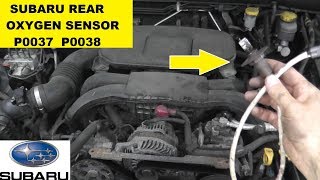
How to confirm: Disconnect the sensor and use a multimeter to test the resistance between the two heater circuit pins (typically the two same-colored wires). A specification for a 2018 Crosstrek is 5.6 Ohms +/- 0.8 at 68°F. A reading of infinite resistance (OL) or a value far outside the typical 5-15 ohm range confirms the heater has failed. 🎬 See how to test and replace the rear sensor.
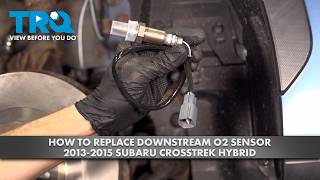
Typical fix: Replace the rear (downstream) oxygen sensor. This requires a 22mm (or 7/8") O2 sensor socket, a ratchet, and potentially a breaker bar and penetrating oil 🎬 Watch this walkthrough for replacing the Crosstrek O2 sensor. if the sensor is rusted in place.
Est. part cost: $120-$250 - Damaged Wiring or Connector 🟡 Medium Probability The sensor wiring is routed under the vehicle and is exposed to road debris, moisture, and heat, which can cause damage over time. Rodent damage is also a possibility, as is chafing on the frame or exhaust components.
How to confirm: Visually inspect the wiring harness leading to the rear O2 sensor for any breaks, burns, or chafing. Check that the connector is clean, dry, and securely plugged in. Check for 12V power at the harness-side connector with the key on, engine off.
Typical fix: Repair the damaged section of wiring or clean/replace the connector.
Est. part cost: $5-$50 - Blown Fuse ⚪ Low Probability A short in the heater circuit or the sensor itself can cause the associated fuse to blow as a protective measure.
How to confirm: Consult the owner's manual to locate the fuse for the O2 sensor heater circuit (may be labeled 'A/F Heater' or similar) and visually inspect it or test for continuity.
Typical fix: Replace the blown fuse. If it blows again immediately, a short circuit exists that must be diagnosed.
Est. part cost: $1-$5
Rare But Worth Checking
- Engine Control Module (ECM) Fault: → Shop Engine Control Module (ECM) This is extremely rare. All other possibilities, especially the sensor and its wiring, should be exhaustively ruled out before considering the ECM as the cause.
Diagnosis Steps
- Confirm the presence of code P0141 with an OBD-II scanner.
- Visually inspect the entire wiring harness for the rear O2 sensor, from the sensor to the main harness connection. Look for damage, melting, or corrosion. The connector is often located on the frame rail.
- Check the O2 sensor heater circuit fuse in the vehicle's fuse box (often labeled 'A/F Heater').
- If wiring and fuse are good, disconnect the sensor.
- Using a multimeter set to Ohms, measure the resistance across the heater element pins on the sensor side of the connector (usually the two wires of the same color). A correct reading for a 2018+ model is around 5.6 Ohms. An open circuit (OL) or very high resistance indicates a failed heater element.
- If sensor resistance is within spec, test for power at the vehicle-side connector. With the ignition on (engine off), probe the power pin (check a wiring diagram for your specific year). You should see battery voltage (~12V).
- If power is present and the sensor tests good, there may be an intermittent connection issue, a problem with the ground signal from the ECM, or a rare ECM fault.
Parts You'll Likely Need
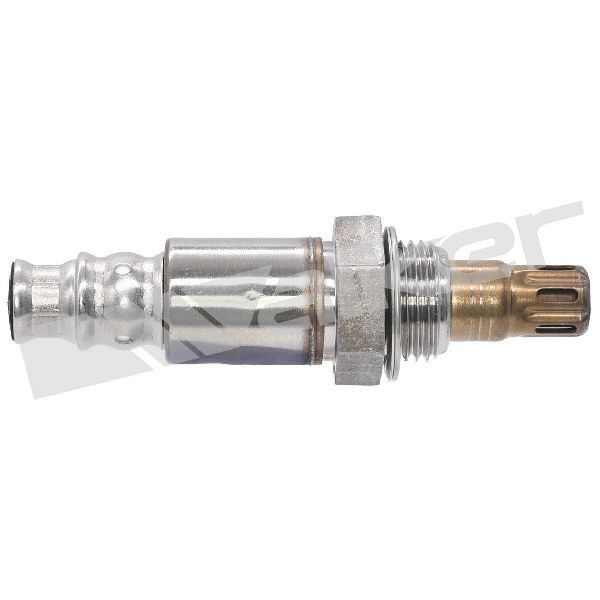
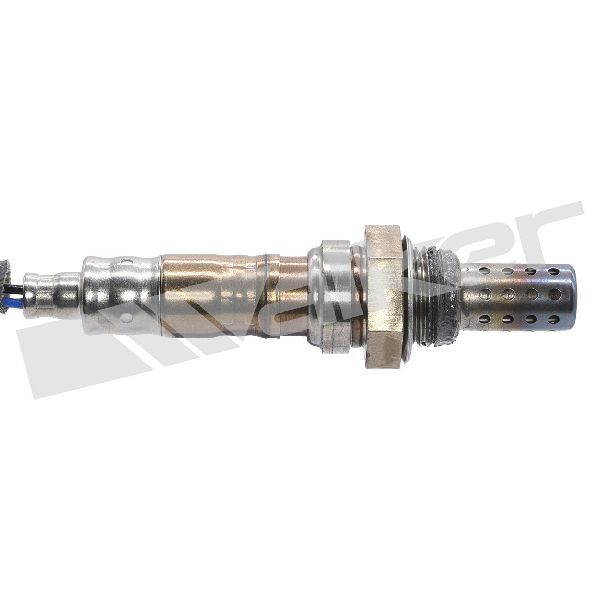
- Rear Oxygen Sensor (Downstream)
(OEM #22690AB08A (for 2018-2024 models, supersedes 22690AB070), 22690AA960 (for 2017 models))— This is the most common failure. The internal heater element burns out, requiring the replacement of the entire sensor unit.
Trusted brands: Denso (OEM supplier), NTK (OEM supplier)
OEM price range: $150-$250
Aftermarket price range: $40-$120
Related Codes That Often Appear With This One
- P0137 — Both codes relate to the rear O2 sensor (Bank 1, Sensor 2). P0137 indicates low voltage, which can occur alongside a heater fault. See TSB #09-115-24.
- P0138 — Both codes relate to the rear O2 sensor (Bank 1, Sensor 2). P0138 indicates high voltage. See TSB #09-115-24.
- P0140 — Both codes relate to the rear O2 sensor (Bank 1, Sensor 2). P0140 indicates no activity, which can be a result of the sensor not heating up properly. See TSB #09-115-24.
Technical Service Bulletins (TSBs) & Recalls
- 09-115-24: Announces a design change for the rear oxygen sensor to address DTCs P0137, P0138, P0140, and P0141 on 2017-24 Crosstreks. The new sensor has an optimized coating to prevent internal cracks.
- 09-115-24R: A revised bulletin that also includes P0141 for the O2 Sensor Heater Circuit Bank 1 Sensor 2.
Platform-Specific Known Issues
- Subaru TSB 09-115-24, released May 2024, specifically addresses DTC P0141 (and others) for the 2017-2024 Crosstrek. It introduces a new sensor with an 'optimized coating' to prevent internal cracks and short circuits. The part numbers did not change, but the new parts can be identified by the Denso part number engraved on the sensor itself.
- In some cases, a faulty or broken engine-to-frame grounding strap near the O2 sensor connector has been noted, which can cause electrical issues. It's worth inspecting while working in the area.
Mechanic-Grade Diagnostic Values
- Rear O2 Sensor Heater Resistance — expected: 5.6 Ohms +/- 0.8 at 68°F (20°C) for 2018+ models. Generally 3-15 Ohms is a common range for many vehicles.. Failure: A reading of OL (Open Loop/infinite resistance) or a value significantly outside the specified range indicates a failed heater element.
- Voltage at Heater Circuit Power Wire — expected: Battery voltage (~12V) with the key in the ON position, engine off.. Failure: No voltage suggests a blown fuse or a break in the power-side wiring from the fuse box.
- Heater Circuit Ground — expected: The ECM provides a controlled ground to the heater circuit, often in a pulsed-width modulated (PWM) signal. A test light connected between the power and ground pins on the harness side should flash or pulse.. Failure: No ground signal (test light does not illuminate or pulse) when power is confirmed present can indicate a wiring issue back to the ECM or a rare ECM driver failure.
Hidden / Shadow Codes Worth Checking
- Mode 6, Test ID $81: This is a manufacturer-defined test ID that, on some Subaru models, corresponds to the O2 Sensor Circuit (B1S2). A failure on this test ID can point to the same issue as P0141, sometimes before the main DTC is set. (see via An advanced OBD-II scanner capable of displaying Mode $06 data.)
Scan Tool Commands That Help
- Subaru Select Monitor: O2 Heater Diagnosis — This is a self-test status flag within the dealer scan tool. It will show 'Complete' or 'Incomplete'. If the monitor is complete and P0141 is present, it confirms the ECM has run its internal test and detected a fault.
Wiring & Ground Locations
- Engine Ground Strap (Driver's Side) — On the 2018 Crosstrek, a ground strap connects from the engine block to the frame rail on the driver's side, just in front of the tire.. While not directly part of the O2 sensor circuit, a corroded or broken main engine ground can cause a variety of unpredictable electrical issues, including phantom codes. The ECU relies on solid grounding, and a poor connection can affect sensor readings and actuator functions. It is worth inspecting as it is in the general vicinity of the exhaust and underbody wiring.
- ECU Main Ground — The main grounding point for the Subaru ECU is on the top of the intake manifold, not directly to the chassis or engine block.. This is a critical, often-overlooked location. If the intake manifold's ground connection to the block is compromised (e.g., by plastic TGV spacers without a proper grounding bridge), it can cause widespread, hard-to-diagnose electrical problems, including sensor circuit faults. The ECM controls the ground side of the O2 heater circuit, so a faulty ECU ground can directly impact its operation.
- Rear O2 Sensor Connector (E23) — The connector for the rear O2 sensor is typically a gray plug clipped to a bracket on the frame rail, near the transmission.. This is the primary point for testing. The two same-colored wires (often black or white) are for the heater circuit. One will have ~12V with key-on, and the other is the ground controlled by the ECM.
Real Owner Repair Stories
- Reddit r/Crosstrek user StockTrue7378 (2018 Subaru Crosstrek) — Noticed a disconnected ground wire while fixing a rattling heat shield.
✅ What actually fixed it Another user confirmed the disconnected wire was the driver-side engine-to-frame ground strap and that it's a common issue. They noted it can be replaced with a generic ground strap from an auto parts store. While not directly linked to a P0141 in this thread, it highlights a known electrical weak point in the vehicle's underbody area.
OEM Part Supersession History

22690AB070→22690AB08A— Design improvement. TSB 09-115-24 introduced a sensor with an 'optimized coating' to prevent internal cracking and heater circuit failures.
Model Year Variations Within This Range
- 2017 vs 2018-2024: The rear oxygen sensor part number is different. 2017 models use part number 22690AA960, while 2018 and newer models use 22690AB08A. This aligns with the transition from the first to the second generation of the Crosstrek.
Helpful Videos

We Have This Part in Stock

The information in this article is provided for general reference and educational purposes only. Vehicle specifications, procedures, and part compatibility can vary by production date, trim level, and region. Always consult your vehicle's factory service manual and verify part numbers before purchasing or performing repairs. Safety-critical components such as airbags, seat belts, and braking systems should be installed by a qualified professional.
- Subaru CROSSTREK:
- 🧭 Diagnostic Flowchart
- 🎬 Helpful Videos
- 🛍️ Shop This Part
- What's Unique About the 2017-2024 Subaru CROSSTREK
- Symptoms You May Notice
- Most Likely Causes
- Rare But Worth Checking
- Diagnosis Steps
- Parts You'll Likely Need
- Related Codes That Often Appear With This One
- Technical Service Bulletins (TSBs) & Recalls
- Platform-Specific Known Issues
- Mechanic-Grade Diagnostic Values
- Hidden / Shadow Codes Worth Checking
- Scan Tool Commands That Help
- Wiring & Ground Locations
- Real Owner Repair Stories
- OEM Part Supersession History
- Model Year Variations Within This Range
- 🎟️ Get 5% Off