

P0141 on 2002-2006 Toyota Camry: O2 Sensor Heater Fixes & Causes
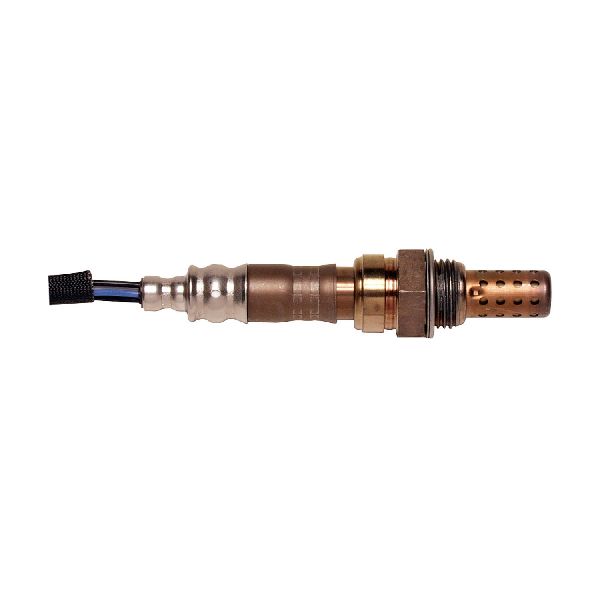
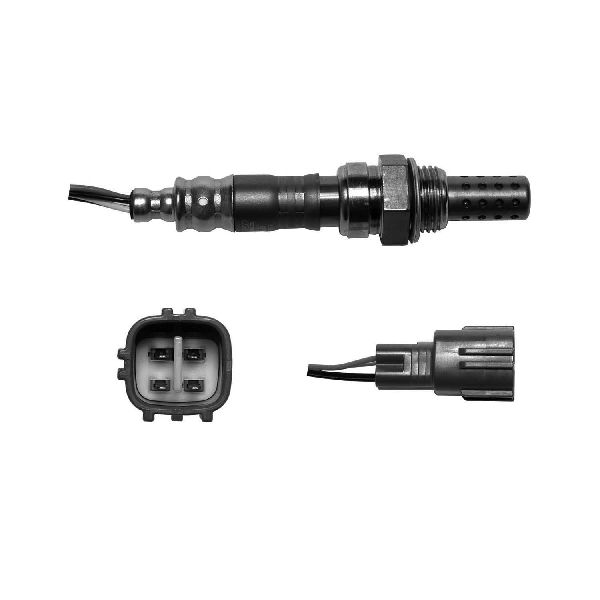
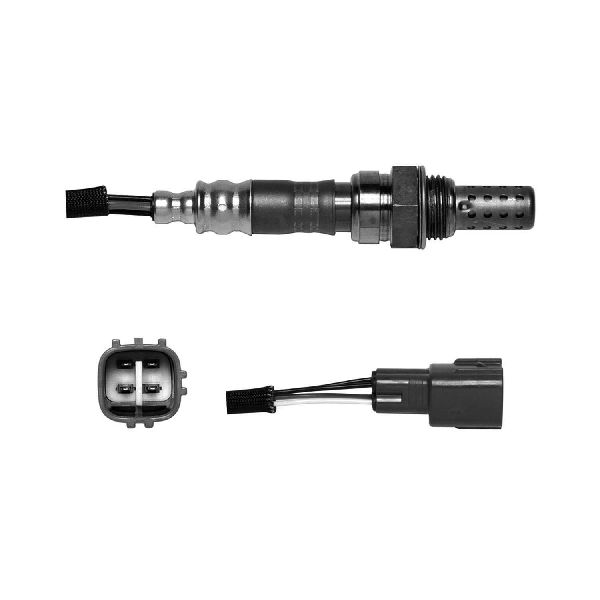
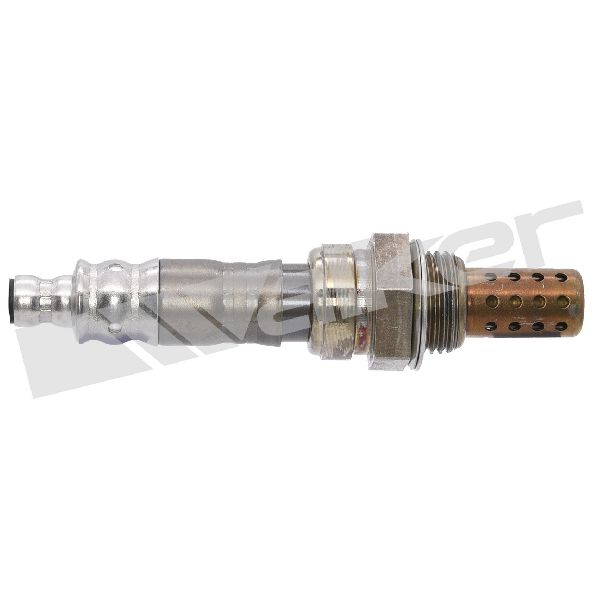
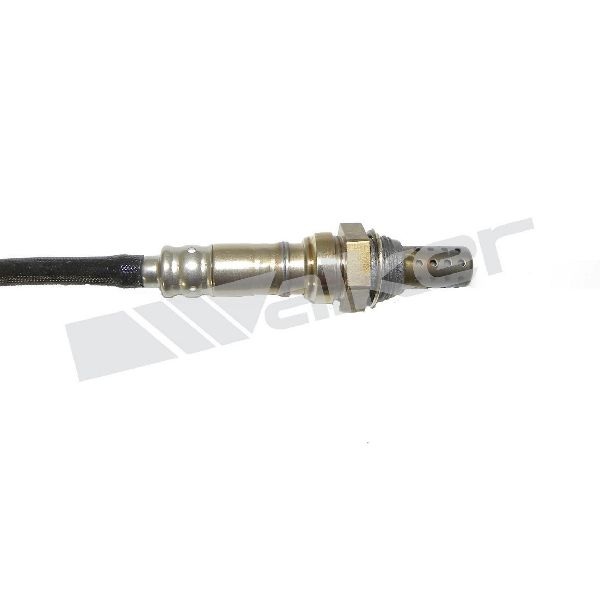
This code points to a failure in the heater circuit of the downstream oxygen sensor (Bank 1, Sensor 2). The most common fix is replacing the sensor itself, which is a straightforward DIY job. The OEM equivalent Denso part number is 234-4260. Expect to pay $50-$90 for this high-quality aftermarket sensor.
- P0141 on a 2002-2006 Camry almost always means the downstream (post-catalytic converter) oxygen sensor's internal heater has failed.
- Before buying parts, take 5 minutes to check the 'EFI' or 'A/F HTR' fuse in the engine bay and visually inspect the sensor's wiring for damage.
- Use a multimeter to confirm the sensor's internal heater has failed by checking for resistance. A reading outside 5-20 ohms (especially an open circuit) confirms it's bad.
- This is a great DIY-friendly repair. The sensor is usually accessible from under the car, but on 4-cylinder models, be prepared to pull back the driver's side carpet to access the connector.
- Do not replace the catalytic converter; this code is not related to its performance.
- Stick with a Denso (like part #234-4260
What's Unique About the 2002-2006 Toyota Camry
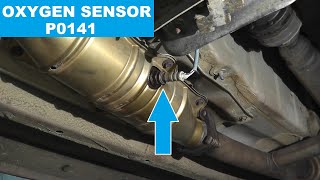
On the 2002-2006 (XV30 generation) Camry, this is a very common and straightforward code. Whether you have the 4-cylinder (2AZ-FE) or V6 (1MZ-FE/3MZ-FE) engine, the cause is almost always the original Denso sensor's heater element failing due to age and heat cycles. On the 4-cylinder model, the sensor is easily accessible on the exhaust pipe under the car, but the connector is located inside the cabin under the driver's side carpet. On V6 models, Bank 1 is the cylinder bank against the firewall, but the downstream Sensor 2 is still located accessibly after the catalytic converter. Diagnosis is simple, and access is generally easy, making it a popular DIY repair.
Symptoms You May Notice
- Check Engine Light is on
- Failure to pass an emissions inspection
- Slightly reduced fuel economy in some cases
- Engine may take longer to enter closed-loop operation, potentially causing brief rough idle on a cold start
- Replacing the catalytic converter. P0141 is unrelated to converter efficiency, which is typically code P0420.
- Replacing the upstream Air/Fuel Ratio sensor (Sensor 1). This code is specific to the downstream sensor (Sensor 2) located after the catalytic converter.
Most Likely Causes
- Failed Downstream Oxygen Sensor 🔴 High Probability → Shop Oxygen Sensor The internal heater element is a high-resistance circuit that wears out over time from thousands of heat cycles. On a vehicle of this age, it is the most likely component to fail.
How to confirm: Disconnect the sensor and measure the resistance between the two same-colored wires (usually black) for the heater circuit. A healthy sensor should read between 5-20 ohms at room temperature; new Denso sensors often measure around 13-14 ohms. An open circuit (infinite resistance) or a dead short (near zero ohms) confirms the heater has failed.
Typical fix: Replace the Bank 1, Sensor 2 oxygen sensor. The direct-fit Denso 234-4260 is a highly recommended and widely used replacement.
Est. part cost: $50-$90 - Damaged Wiring or Connector 🟡 Medium Probability The sensor wiring is located under the vehicle and is exposed to road debris, moisture, and heat, which can cause wires to fray, break, or the connector pins to corrode. On 4-cylinder models, the wire passes through a grommet in the floor to a connector under the carpet, which can sometimes be a point of failure.
How to confirm: Visually inspect the wiring harness from the sensor to where it connects to the main harness. Check for chafing, melting, or breaks. Unplug the connector and check for corrosion or bent pins. With the key on, test for battery voltage at one of the heater circuit pins on the harness side.
Typical fix: Repair the damaged section of wiring or replace the connector pigtail.
Est. part cost: $10-$30 - Blown Fuse or Faulty Relay ⚪ Low Probability
How to confirm: Check the fuse box in the engine compartment. The O2 sensor heater circuit is often powered by the 'EFI' fuse or a fuse/relay labeled 'A/F HTR'. If the fuse is blown, it indicates a short circuit in the wiring or sensor that must be found before replacing the fuse.
Typical fix: Replace the blown fuse after diagnosing the underlying short circuit. If there is no short, the fuse may have failed from age.
Est. part cost: $1-$5
Rare But Worth Checking
- Faulty Engine Control Module (ECM): → Shop Engine Control Module (ECM) This is extremely rare. The ECM's internal driver for the heater circuit can fail, causing the P0141 code to persist even with a new sensor and good wiring. This should only be considered after all other possibilities have been exhausted. A forum user on CamryForums.com reported this exact issue on a 1999 V6 Camry, where replacing the ECM was the final solution after two new sensors and wiring checks failed to resolve the code.
- Exhaust Leak: While an exhaust leak before the sensor can throw off readings and potentially trigger other codes like P0136, it's less likely to trigger a specific heater circuit code like P0141. However, it can contribute to sensor damage over time.
Diagnosis Steps
- Read the code with an OBD-II scanner to confirm P0141 is the only code present.
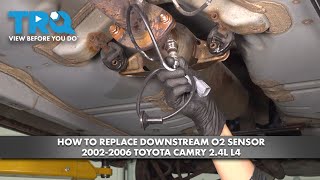
- Locate Bank 1, Sensor 2. On 4-cylinder models, it's the only downstream sensor, located on the exhaust pipe under the car. The connector is inside the car, under the driver-side carpet near the center console. On V6 models, Bank 1 is the cylinder bank near the firewall; Sensor 2 is after the catalytic converter on that bank. 🎬 Watch: How to replace the downstream sensor on V6 models.
- Visually inspect the sensor's wiring harness and connector for any obvious signs of damage, such as chafing, melting, or corrosion.
- Check the fuse for the heater circuit. In the engine bay fuse box, inspect the fuse labeled 'EFI' or 'A/F HTR'. If it's blown, investigate for a short before replacing.
- If the wiring and fuse are good, test the sensor's heater element. Disconnect the sensor and use a multimeter set to Ohms. Measure the resistance across the two wires of the same color (usually black). A reading of infinity (open circuit) or well outside the 5-20 Ohm range indicates a bad sensor. A good new sensor often reads around 13-14 Ohms.
- If the sensor's resistance is good, check for power at the vehicle's harness connector. With the ignition key in the 'ON' position, one of the heater circuit pins should have battery voltage (~12V).
- If power is present and the sensor resistance is good, the issue may be in the ground control wire back to the ECM or, in very rare cases, the ECM's internal driver circuit itself.
Parts You'll Likely Need
- Downstream Oxygen Sensor (Bank 1, Sensor 2)
(OEM #89465-33180, 89465-06050 (Verify by VIN))— The internal heater element fails from age and heat cycles, which is the direct cause of the P0141 code.
Trusted brands: Denso (OEM Manufacturer), Bosch, NGK/NTK
OEM price range: $120-$180
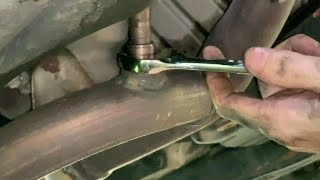
Aftermarket price range: $50-$90 - Oxygen Sensor Socket — A special 22mm socket with a slot for the wire is often required to easily remove and install the sensor without damaging the wiring.
Trusted brands: Lisle, OEMTools, GearWrench
Aftermarket price range: $10-$20
Platform-Specific Known Issues
- On 4-cylinder (2AZ-FE) models, the sensor connector is not under the car but is located inside the cabin. The wire passes through a grommet in the floor under the driver's seat/center console area. You must pull back the carpet to access and disconnect it, 🎬 Watch: Step-by-step replacement guide for the 4-cylinder Camry. as shown in several DIY videos.
Mechanic-Grade Diagnostic Values
- Downstream O2 Sensor Heater Resistance — expected: 11 - 16 Ω at ambient temperature.. Failure: An open circuit (infinite resistance) or a reading outside the specified range indicates a failed heater element.
- Heater Circuit Voltage at Harness Connector — expected: 10 - 12 Volts DC with Key On, Engine Off (KOEO).. Failure: No voltage suggests a blown fuse (A/F HTR or EFI), a bad relay, or an open in the power wire from the fuse block.
- Continuity from ECM to O2 Sensor Connector — expected: 1 Ω or less.. Failure: High resistance indicates a break or corrosion in the wire between the ECM (Terminal HT1B) and the sensor connector.
Scan Tool Commands That Help
- Toyota Techstream: Active Test: 'Control the Injection Volume for A/F Sensor' — While this test is primarily for Air/Fuel ratio sensors (upstream), it can be used to verify ECM communication and response. A technician can command a rich or lean condition (+/- 12.5%) and observe if the ECM is actively controlling the fuel system, which can help rule out broader ECM issues before focusing solely on the downstream sensor circuit.
Wiring & Ground Locations
- B1S2 Heater Power Wire (Harness Side) — At the downstream O2 sensor connector, this is typically a Black with Yellow stripe wire.. This pin must have 10-12V with the key on. No power here points to a fuse, relay, or wiring issue upstream, not a bad sensor.
- B1S2 Heater Ground Wire (Harness Side) — At the downstream O2 sensor connector, this is the wire controlled by the ECM, often Pink with a Black stripe.. The ECM provides a path to ground to activate the heater. If power is present on the other wire but the heater doesn't work, the problem could be this control wire back to the ECM or the ECM driver itself.
- ECM Connector E7, Terminal HT1B — This is the specific terminal on the Engine Control Module connector that controls the Bank 1 Sensor 2 heater circuit for the 2AZ-FE engine.. For advanced diagnosis, a technician can check for continuity from this pin directly to the sensor connector to definitively rule out a wiring break.
Real Owner Repair Stories
- YouTube video by 'ScannerDanner' (Vehicle exhibiting P0141, specific year/model not central to the diagnostic lesson.) — Check Engine Light with code P0141.
❌ Tried (didn't work) Replacing the oxygen sensor is often the first step, but in this case, the problem persisted.
✅ What actually fixed it A visual inspection revealed the O2 sensor wiring harness was chafing against the vehicle's frame, causing an intermittent short in the heater circuit. Repairing the damaged section of the wire and securing it away from the frame resolved the code.
Model Year Variations Within This Range
- 2002-2006 (California Emissions): Some 4-cylinder Camry models sold in California were equipped with two catalytic converters to meet PZEV standards. These vehicles have a third oxygen sensor (Bank 1, Sensor 3) to monitor the second converter. While P0141 still refers to Sensor 2 (the middle sensor), it's a critical distinction to be aware of during diagnosis or parts ordering.
Diagnostic Flowchart
Real Owner Stories
Aggregated from forums and TSBs cited above. Mileages and costs reflect what owners reported in those sources.
2005 Camry
Symptoms: Check engine light on, scan tool indicated rear O2 sensor heating problem.
What fixed it: The user reported that replacing the front and rear O2 sensors did not solve the issue, and the code kept returning (diagnostic dead end).
Source hint: Camry Forums - P0141 Code Won't Go Away!
2003 Camry XLE (4 cyl)
Symptoms: User reported having 'similar problems' to another user who had a persistent P0141 code after replacing O2 sensors.
What fixed it: Not specified in the quote.
Source hint: Camry Forums - P0141 Code Won't Go Away!
2002-2006 Toyota Camry (general advice)
Symptoms: Check Engine Light with code P0141.
What fixed it: Checking the AF heater fuse and wiring first; if intact, replacing the failed O2 sensor resolves the issue.
Source hint: HVAC Mechanic (YouTube comment)
Related OBD-II Codes
Frequently Asked Questions
Where is the Bank 1 Sensor 2 connector located on my 4-cylinder Camry?
Should I buy a Bosch or Denso oxygen sensor for my 2002-2006 Camry?
I replaced the downstream O2 sensor on my 2005 Camry but the P0141 code keeps coming back. What else could it be?
How can I test if the downstream oxygen sensor is actually bad before replacing it?
Which fuse controls the oxygen sensor heater circuit on this generation of Camry?
Helpful Videos

We Have This Part in Stock


The information in this article is provided for general reference and educational purposes only. Vehicle specifications, procedures, and part compatibility can vary by production date, trim level, and region. Always consult your vehicle's factory service manual and verify part numbers before purchasing or performing repairs. Safety-critical components such as airbags, seat belts, and braking systems should be installed by a qualified professional.
- Toyota Camry:
- 🧭 Diagnostic Flowchart
- 🎬 Helpful Videos
- 🛍️ Shop This Part
- What's Unique About the 2002-2006 Toyota Camry
- Symptoms You May Notice
- Most Likely Causes
- Rare But Worth Checking
- Diagnosis Steps
- Parts You'll Likely Need
- Platform-Specific Known Issues
- Mechanic-Grade Diagnostic Values
- Scan Tool Commands That Help
- Wiring & Ground Locations
- Real Owner Repair Stories
- Model Year Variations Within This Range
- Real Owner Stories
- 2005 Camry
- 2003 Camry XLE (4 cyl)
- 2002-2006 Toyota Camry (general advice)
- Related OBD-II Codes
- Frequently Asked Questions
- 🎟️ Get 5% Off