

P0148 on 2013-2018 Hyundai Santa Fe 3.3L V6: Fuel Delivery Error Causes and Fixes
Code P0148 on a 2013-2018 Santa Fe 3.3L V6 almost always indicates a failing High-Pressure Fuel Pump (HPFP). This is a very common issue on Hyundai GDI engines. Expect to replace the pump (OEM #35320-3C220), the cam follower beneath it, and the one-time-use high-pressure fuel pipe. The repair is moderately difficult and can cost between $400 and $900.
- P0148 on your Santa Fe 3.3L V6 is a serious code that points directly to a problem with the high-pressure fuel system.
- The most likely cause by a wide margin is a failing High-Pressure Fuel Pump (HPFP), a known issue for this engine.
- Do not drive the vehicle. A sudden stall could be dangerous, and an internal pump leak can contaminate your engine oil.
- When replacing the HPFP, you must also replace the small cam follower (tappet) it rests on to prevent a repeat failure.
- Before authorizing repairs, check with a Hyundai dealer using your VIN to see if any warranty extensions apply to your vehicle for this specific part.
What's Unique About the 2013-2018 Hyundai Santa Fe
The 3.3L Lambda II GDI engine, like many early direct-injection engines from Hyundai and Kia, has a well-documented history of issues with the camshaft-driven High-Pressure Fuel Pump (HPFP). The failure is often traced to the fuel control valve (FCV) plunger inside the pump, which can wear unevenly and get stuck, causing erratic fuel pressure. While other causes are possible, the HPFP is the overwhelming point of failure for this code on this platform. Hyundai has issued a warranty extension (TXX8) for the engine assembly on these vehicles for up to 15 years/150,000 miles for abnormal noise and damage, which is often related to the fuel system issues. A key diagnostic clue on this vehicle is checking for the smell of gasoline in the engine oil, which points directly to a failed internal seal on the HPFP.
Symptoms You May Notice
- Check Engine Light is on
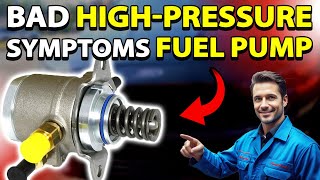
- Significant loss of engine power, 🎬 See a breakdown of common high-pressure fuel pump failure symptoms. especially under acceleration
- Engine hesitation or sputtering, often between 2,000 and 4,000 RPM
- Rough, unstable idle
- Engine stalling, sometimes at low speeds or at a stop
- Hard starting (engine cranks longer than usual)
- Reduced fuel economy
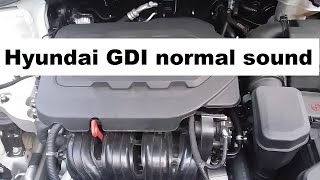
- Rattling or loud ticking noise from the top of the engine, specifically from the HPFP area 🎬 Listen to the difference between a normal and faulty pump.
- Strong smell of fuel in the engine oil
- Replacing only the in-tank (low-pressure) fuel pump without checking the high-pressure system.
- Replacing fuel injectors when the issue is fuel pressure, not delivery at the cylinder.
- Replacing only the HPFP without also replacing the worn cam follower and one-time-use fuel pipe, leading to a repeat failure or leaks.
Most Likely Causes
- Failing High-Pressure Fuel Pump (HPFP) 🔴 High Probability → Shop Fuel Pump The HPFP is a known high-failure part on this generation of Hyundai/Kia GDI engines. The internal fuel control valve (FCV) plunger can wear out and stick, or internal seals can fail, leading to low pressure or fuel leaking into the crankcase.
How to confirm: Use an OBD-II scanner to monitor requested vs. actual fuel rail pressure; a significant deviation under load points to the pump. Also, check the engine oil dipstick for a strong gasoline smell, which indicates a failed internal pump seal. Listen for a loud ticking/rattling noise from the pump on top of the engine.
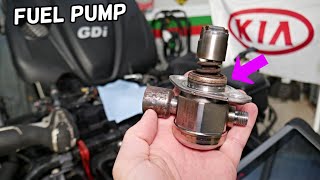
Typical fix: Replace the High-Pressure Fuel Pump, the cam follower (tappet) it rides on, and the one-time-use high-pressure fuel pipe connecting the pump to the fuel rail. It is critical to replace all three components to ensure a lasting, leak-free repair. 🎬 Watch this step-by-step guide to replacing the high-pressure pump.
Est. part cost: $250-$500 - Worn HPFP Cam Follower (Tappet) 🟡 Medium Probability → Shop Fuel Pump The small mechanical tappet that the HPFP plunger rides on is a high-stress part that can wear out, creating noise and preventing the pump from generating sufficient pressure.
How to confirm: This part is difficult to inspect without removing the HPFP. It is typically diagnosed by a loud rattling noise from the pump area or replaced preventatively during an HPFP replacement.
Typical fix: Replace the cam follower. This should always be done when replacing the HPFP.
Est. part cost: $40-$80 - Faulty Fuel Rail Pressure Sensor ⚪ Low Probability → Shop Fuel Pressure Sensor While not as common as pump failure, the sensor that measures high-side fuel pressure can fail and send incorrect data to the PCM, triggering the code.
How to confirm: Diagnosis requires comparing the sensor's readings on a scan tool to a known-good mechanical pressure gauge, which is difficult on a high-pressure GDI system. Often diagnosed by exclusion after confirming the fuel pumps are working correctly.
Typical fix: Replace the fuel rail pressure sensor. Access may require removing the upper intake manifold.
Est. part cost: $70-$150 - Failing Low-Pressure Fuel Pump or Clogged Filter ⚪ Low Probability → Shop Fuel Pump The in-tank low-pressure pump is responsible for feeding the HPFP. If it weakens or the integrated filter becomes clogged, it can starve the HPFP for fuel, causing a pressure drop under load.
How to confirm: Connect a fuel pressure gauge to the low-pressure feed line. The pressure should be stable and within the manufacturer's specification (typically 64-66 PSI for the low-pressure side on similar GDI engines).
Typical fix: Replace the in-tank fuel pump module.
Est. part cost: $200-$400
Diagnosis Steps
- Scan for all stored trouble codes. Note if P0087 or P0088 are present alongside P0148.
- Check the engine oil. Pull the dipstick and smell the oil for any trace of a gasoline odor. If fuel is present, the HPFP has failed internally and must be replaced immediately.
- Listen to the engine while running. A loud, rhythmic ticking or rattling from the top of the engine points to a mechanical failure in the HPFP or its cam follower.
- Using an advanced OBD-II scanner, monitor 'Commanded Fuel Rail Pressure' and 'Actual Fuel Rail Pressure' data streams. At idle, they should be close. Briefly rev the engine or drive under load; if the actual pressure cannot keep up with the commanded pressure, the HPFP or its supply is weak.
- If possible, test the low-pressure fuel system. Verify the in-tank pump is delivering adequate pressure (spec for a similar Hyundai GDI engine is 64.5 - 66.0 PSI) to the HPFP.
- If the low-pressure side is good and the high-pressure side is weak, the fault is almost certainly the HPFP and/or its cam follower.
- If fuel pressure readings are erratic but the pump seems to function, the fuel rail pressure sensor may be at fault.
- Before ordering parts, check with a Hyundai dealer for any open campaigns or warranty extensions, such as TXX8, that may apply to your vehicle's VIN.
Parts You'll Likely Need
- High-Pressure Fuel Pump
(OEM #35320-3C220)— This is the most common failure point for code P0148 on this engine. Internal wear leads to an inability to generate the required fuel pressure.
Trusted brands: Hyundai Genuine
OEM price range: $400-$600
Aftermarket price range: $250-$450 - HPFP Cam Follower / Tappet
(OEM #35325-3L100)— This part wears along with the pump and can cause noise or low pressure. It is considered essential to replace this with the HPFP to ensure a lasting repair.
Trusted brands: Hyundai Genuine
OEM price range: $40-$80
Aftermarket price range: $30-$60 - High-Pressure Fuel Pipe
(OEM #35305-3L100)— This is a one-time-use part that connects the HPFP to the fuel rail. It must be replaced anytime the pump is removed to ensure a proper, high-pressure seal and prevent dangerous fuel leaks.
Trusted brands: Hyundai Genuine
OEM price range: $40-$80
Aftermarket price range: $30-$60 - Fuel Rail Pressure Sensor — Replaced less frequently, this sensor can fail and send incorrect pressure readings to the computer, causing this code.
Trusted brands: Bosch, NTK, Hyundai Genuine
OEM price range: $100-$180
Aftermarket price range: $70-$150
Related Codes That Often Appear With This One
- P0087 — This code for 'Fuel Rail/System Pressure - Too Low' is a more specific version of P0148 and often appears with it, confirming the pressure is below the target.
- P0088 — This code for 'Fuel Rail/System Pressure - Too High' can also appear if the pump's internal regulator fails in a closed position, causing excessive pressure. This is common on platform mates with the same engine.
- P0300-P0306 — Misfire codes for single or multiple cylinders are common secondary codes, as incorrect fuel pressure leads to poor combustion and engine misfires.
Technical Service Bulletins (TSBs) & Recalls
- TSB 25-EM-008H (TXX8): Describes a warranty extension for the 3.3L Lambda II GDI engine in 2013-2019 Santa Fe models to 15 years/150,000 miles for abnormal noise and related engine damage.
Platform-Specific Known Issues
- There is a widespread history of High-Pressure Fuel Pump (HPFP) failures across many Hyundai and Kia models using GDI engines from this era. While no specific recall for the 2013-2018 Santa Fe 3.3L HPFP is listed, Hyundai has issued a warranty extension TXX8 (TSB 25-EM-008H) for the engine assembly due to abnormal noise and damage, extending coverage to 15 years or 150,000 miles. Owners experiencing P0148 should inquire with a dealer about this campaign, as the HPFP failure is a direct contributor to related engine issues.
- Platform mates like the Kia Sorento and Cadenza have a more direct warranty extension (WTY034) for the HPFP itself, covering replacement for 15 years or 180,000 miles, which confirms the manufacturer's acknowledgement of the defect in this engine family.
Mechanic-Grade Diagnostic Values
- Low-Pressure Fuel Pump (In-tank) Pressure at Idle — expected: 445 - 455 kPa (64.5 - 66.0 psi). Failure: Pressure below this range indicates a weak in-tank pump or clogged filter, starving the HPFP.
- High-Pressure Fuel System Pressure Range — expected: 290 - 3,626 PSI (20 - 250 Bar). Failure: At idle, pressure should be in the hundreds of PSI. Under load, it should rise into the thousands. If the actual pressure on a scan tool significantly lags behind the commanded pressure, the HPFP is failing.
- Fuel Rail Pressure Sensor (FRPS) Power Supply Voltage — expected: 5V (with connector unplugged, ignition ON, testing between power and ground wires). Failure: No voltage or incorrect voltage points to a problem with the PCM or the wiring harness, not the sensor itself.
- Fuel Rail Pressure Sensor (FRPS) Wiring Continuity — expected: Less than 1.0 ohm. Failure: High resistance (ohms) or an open circuit (OL) on any of the three wires (power, ground, signal) between the sensor connector and the ECM connector indicates a broken wire or corroded connection.
Scan Tool Commands That Help
- Hyundai GDS (Global Diagnostic System): Flight Record / Trigger Module — For intermittent stalling or hesitation issues. This function allows a technician to record live data streams (like commanded vs. actual fuel pressure) while driving. When the fault occurs, the technician can press a trigger button to save the data from the moments before, during, and after the event for precise analysis, capturing a pressure drop that might not be visible in the shop.
- Hyundai GDS (Global Diagnostic System): Data Analysis - Fuel System — This is the primary function for viewing live data. A technician would graph 'Target Fuel Pressure' against 'Actual Fuel Pressure' while revving the engine or under load to visually confirm if the actual pressure can keep up with the PCM's request. A significant lag or drop-off is a classic sign of a failing HPFP.
- Hyundai GDS (Global Diagnostic System): DTC Deletion after Fuel Pressure Release — When performing a manual low-side pressure test, the service procedure requires pulling the fuel pump relay and running the engine until it stalls to depressurize the system. This action will set fault codes. The GDS tool is required to clear these specific codes after the repair is complete.
Wiring & Ground Locations
- GE04 — Left rear of the engine compartment.. This is a primary engine ground point. High resistance or a loose connection here can cause erratic behavior from engine-mounted sensors and actuators, including the High-Pressure Fuel Pump's control solenoid and the Fuel Rail Pressure Sensor, potentially leading to incorrect readings or function.
- Engine Ground Strap — Typically a braided metal strap connecting the engine block or cylinder head to the vehicle's chassis/frame.. A corroded or broken main engine ground strap can cause a host of electrical issues. The PCM and its sensors rely on a solid ground reference. A poor ground can create voltage offsets that lead the PCM to misinterpret sensor data, potentially triggering a P0148 code even if the fuel pump is mechanically sound.
- PCM (ECM) Location — Located in the left rear of the engine compartment.. Knowing the location of the Powertrain Control Module is essential for advanced diagnostics, such as checking for continuity or shorts in the wiring harness between the PCM connectors and the fuel rail pressure sensor or HPFP solenoid.
Real Owner Repair Stories
- Reddit user 'turlian' in r/Hyundai (2014 Hyundai Santa Fe) — Code P0087 (Fuel Rail Pressure Too Low), engine took 5+ seconds of cranking to start, vehicle was stuck in limp mode.
❌ Tried (didn't work) Initial diagnosis considered fuel pressure sensor and clogged filter.
✅ What actually fixed it The user replaced the High-Pressure Fuel Pump (HPFP). They posted a comparison picture showing the broken plunger on their old pump next to the new one, confirming a mechanical failure.
OEM Part Supersession History
Unknown, pre-2014 part→35320-3C220— Part revision or supplier change.
Heads up: According to OEM parts diagrams, the HPFP part number 35320-3C220 is specified for Santa Fe 3.3L models built 'From 4/15/14'. This implies that vehicles built before this date may use a different part number. It is critical to verify the correct part number using the vehicle's VIN before ordering.
Model Year Variations Within This Range
- 2013 - Early 2014: The High-Pressure Fuel Pump (HPFP) part number may be different for vehicles produced before April 15, 2014. The common replacement part, 35320-3C220, is listed for vehicles made after this date. While potentially interchangeable, using a VIN to confirm the exact OEM part number is crucial.
Diagnostic Flowchart
Used vs. New Parts: Buying Guide for This Vehicle
When a used part is the smart pick: For this specific repair, using used parts is generally not recommended. The primary failure components (HPFP, cam follower) are high-wear mechanical parts. A used part from a salvage yard carries a very high risk of having the same wear or being close to failure.
Donor-vehicle mileage cap: roughly under 30000 miles for the part to have meaningful remaining life.
What to inspect on the donor part:
- If considering a used HPFP (not recommended), only select one from a verified low-mileage vehicle that was wrecked due to collision, not engine failure.
- Inspect the plunger tip of the used HPFP for any signs of scoring, chipping, or uneven wear. Compare it to a photo of a new one.
- Avoid any parts that show signs of heavy corrosion or have been sitting exposed to the elements.
OEM-only on this vehicle (don't cheap out):
- High-Pressure Fuel Pump (HPFP): Due to the high failure rate and the precision required, a new Hyundai Genuine part is the most reliable choice to ensure a lasting repair.
- HPFP Cam Follower / Tappet: This is an inexpensive but critical wear item. There is no logical reason to install a used one.
- High-Pressure Fuel Pipe: This is a one-time-use, torque-to-yield part designed to crush-seal. It MUST be replaced with a new part anytime it is loosened to prevent catastrophic, high-pressure fuel leaks.
Brands owners have reported issues with on this vehicle:
- Unbranded, no-name HPFPs from online marketplaces should be avoided. While cheaper, their internal components and quality control are highly suspect and can lead to premature failure, leaving you stranded.
Real Owner Stories
Aggregated from forums and TSBs cited above. Mileages and costs reflect what owners reported in those sources.
2013 Hyundai Santa Fe Sport 2.0T
Symptoms: The owner experienced engine stalling and a loss of power, which triggered both P0148 and P0087 trouble codes.
What fixed it: Forum discussion pointed towards the high-pressure fuel pump (HPFP) as the primary suspect for the failure.
Source hint: hyundai-forums.com thread titled '2013 Santa Fe Sport 2.0T P0087 and P0148'
Related OBD-II Codes
Frequently Asked Questions
Is there a recall for the high-pressure fuel pump on my 2014 Santa Fe 3.3L?
I smell gas in my engine oil. Is this related to the P0148 code?
My engine is making a loud ticking or rattling noise. Could this be the cause of my P0148 code?
My mechanic is replacing the HPFP. Is there anything else that should be replaced at the same time?
My Kia Sorento has the same 3.3L engine and a similar code. Does it have the same problem?
How can I be sure the High-Pressure Fuel Pump is the problem before buying parts?
Helpful Videos
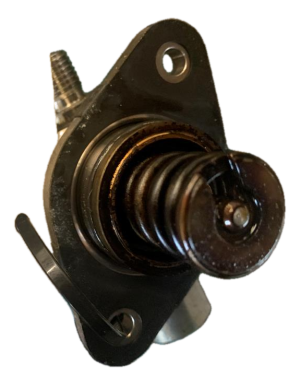
Used OEM Parts in Stock
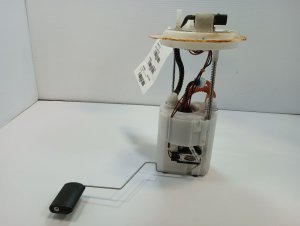
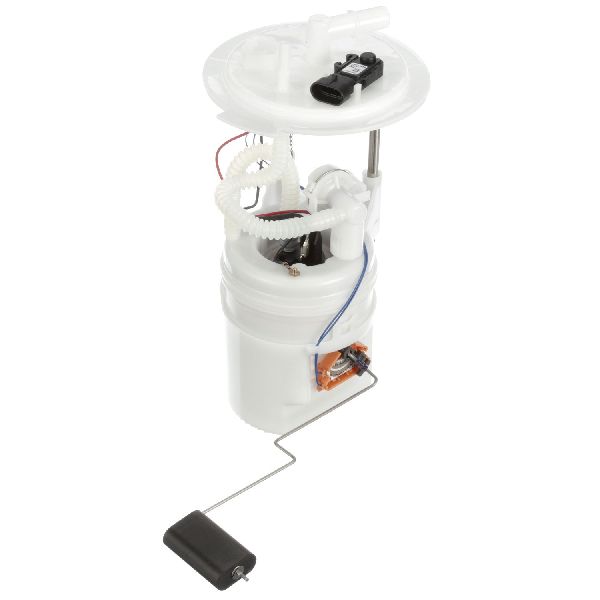
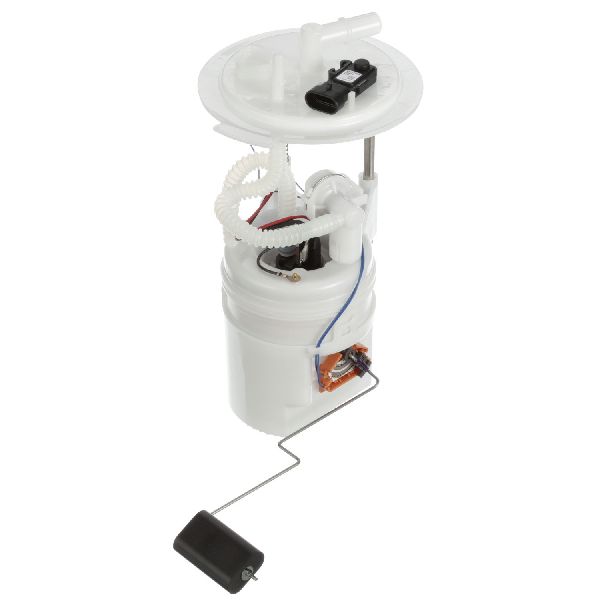
New Aftermarket Parts Available


The information in this article is provided for general reference and educational purposes only. Vehicle specifications, procedures, and part compatibility can vary by production date, trim level, and region. Always consult your vehicle's factory service manual and verify part numbers before purchasing or performing repairs. Safety-critical components such as airbags, seat belts, and braking systems should be installed by a qualified professional.
- Hyundai Santa Fe:
- 🧭 Diagnostic Flowchart
- 🎬 Helpful Videos
- 🛍️ Shop This Part
- What's Unique About the 2013-2018 Hyundai Santa Fe
- Symptoms You May Notice
- Most Likely Causes
- Diagnosis Steps
- Parts You'll Likely Need
- Related Codes That Often Appear With This One
- Technical Service Bulletins (TSBs) & Recalls
- Platform-Specific Known Issues
- Mechanic-Grade Diagnostic Values
- Scan Tool Commands That Help
- Wiring & Ground Locations
- Real Owner Repair Stories
- OEM Part Supersession History
- Model Year Variations Within This Range
- Used vs. New Parts: Buying Guide for This Vehicle
- Real Owner Stories
- 2013 Hyundai Santa Fe Sport 2.0T
- Related OBD-II Codes
- Frequently Asked Questions
- 🎟️ Get 5% Off