

P0149 on 2015-2020 GMC Yukon: Fuel Timing Error Causes and Fixes
This code indicates a fuel timing error, most often caused by a failing high-pressure fuel pump (HPFP) on these direct-injection V8 engines. Expect a significant repair cost, as the pump is located under the intake manifold and is a critical component. A key symptom is a strong gasoline smell in the engine oil.
- P0149 on a 2015-2020 Yukon almost always points to a problem with the high-pressure fuel system.
- The most likely culprit is a failing High-Pressure Fuel Pump (HPFP), which is a known issue on these L83/L86 engines.
- A strong smell of gasoline in the engine oil is a definitive symptom of HPFP failure. If you detect this, an immediate oil change is required along with the pump replacement.
- This is not a beginner-friendly DIY repair. It involves working with a high-pressure fuel system and requires removing the intake manifold. Professional service is strongly recommended.
- Do not ignore this code. It can lead to dangerous engine stalling and can cause severe, expensive engine damage if fuel contamination of the oil is left unaddressed.
What's Unique About the 2015-2020 GMC Yukon
The 2015-2020 GMC Yukon uses the L83 and L86 direct-injection engines, which require both a low-pressure fuel pump in the tank and a high-pressure fuel pump (HPFP) driven by the camshaft. Code P0149 almost always points to a problem with this mechanical high-pressure pump or its related components. A common failure mode for the HPFP on these engines is an internal seal failure, which leaks fuel into the engine crankcase, contaminating the oil and causing a rich running condition. This fuel contamination is then pulled into the intake manifold via the PCV system, leading to rich codes like P0172 and P0175.
Symptoms You May Notice
- Engine stalling, sometimes unexpectedly while driving.
- Hesitation or stumbling during acceleration.
- Rough or uneven idle.
- Noticeable loss of engine power.
- Hard starting or engine cranks but won't start.
- Strong smell of gasoline in the engine oil.
- Check Engine Light (MIL) is on.
- Black smoke from the exhaust.
- Increased fuel consumption.
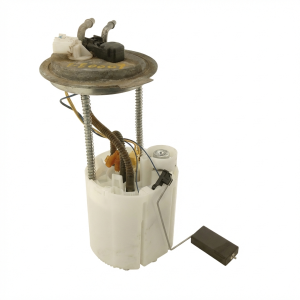
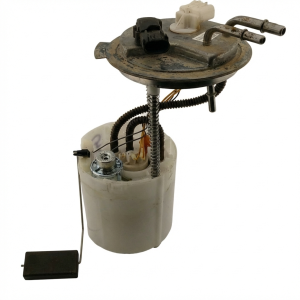
- Replacing the in-tank (low-pressure) fuel pump. P0149 is almost always related to the high-pressure fuel system located on the engine.
- Replacing oxygen sensors. While a rich condition from a leaking HPFP might cause O2 sensor codes (like P0172/P0175), the root cause is the fuel system, not the sensors.
Most Likely Causes
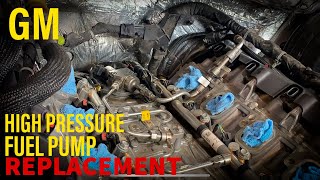
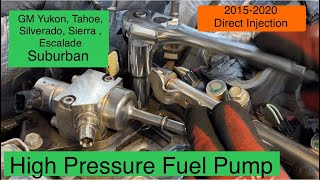
- Failing High-Pressure Fuel Pump (HPFP) 🔴 High Probability → Shop Fuel Pump The HPFP is a mechanical pump driven by a special lobe on the camshaft. It's a very common failure point on this engine platform, often due to internal seal degradation that allows fuel to leak into the crankcase. This issue is well-documented across forums for trucks with these engines.
How to confirm: Check for a strong gasoline smell on the oil dipstick; this is the most definitive sign. Monitor fuel trims with a scan tool; a failing pump often causes very negative fuel trims (-20% or more) as the PCM tries to compensate for the extra fuel entering the intake via the PCV system. A professional will test fuel rail pressure against commanded pressure; a significant deviation confirms the issue.
Typical fix: Replace the high-pressure fuel pump, the high-pressure fuel line, and the intake manifold gaskets. An oil change is mandatory to remove fuel-contaminated oil.
Est. part cost: $400-$700 - Faulty Fuel Rail Pressure Sensor 🟡 Medium Probability → Shop Fuel Pressure Sensor The sensor provides the pressure reading to the PCM. If it sends inaccurate data, the PCM can misinterpret it as a timing error. These sensors operate in a high-heat, high-vibration environment. GM has a TSB (PIP5279A) that addresses checking the sensor if pressure readings are erratic.
How to confirm: Monitor the fuel rail pressure reading on a scan tool. If the reading is erratic, stuck at a certain value, or clearly incorrect (e.g., reading high pressure with the engine off), the sensor is likely faulty.
Typical fix: Replace the fuel rail pressure sensor. On these V8 engines, it is located at the back of the driver's side fuel rail.
Est. part cost: $50-$100 - Leaking Fuel Injectors ⚪ Low Probability → Shop Fuel Injector Direct injectors can sometimes leak or short internally, causing a drop in fuel rail pressure that the PCM might interpret as a timing or pressure fault. This can also contribute to fuel in the oil.
How to confirm: This is harder to diagnose and may be accompanied by specific injector circuit codes or misfire codes (P0300-P0308). It often requires a professional to perform an injector balance test or to remove the injectors for bench testing.
Typical fix: Replace the faulty fuel injector(s). This is a labor-intensive job that requires special tools to pull the injectors from the fuel rail.
Est. part cost: $70-$150 per injector
Rare But Worth Checking
- Worn Camshaft Lobe: The HPFP is driven by a specific lobe on the camshaft. If this lobe becomes worn, it cannot provide the necessary lift to the pump's plunger, resulting in low pressure. This is a major mechanical repair and is usually a last resort after other components have been ruled out. This is more common with lifter failures on these engines but can happen independently.
- Faulty Fuel Pump Driver Module (FPDM): → Shop Fuel Pump The FPDM (also called a Fuel Pump Power Control Module) controls the in-tank low-pressure fuel pump. If the HPFP is being starved of fuel from the tank, it can cause pressure-related codes. This is less likely to set P0149 alone but is a possibility, often seen with code P0087.
- PCM Software or Circuit Fault: In rare cases, a glitch in the Powertrain Control Module's software or an internal circuit fault can cause it to misinterpret sensor data and incorrectly flag a P0149 code. This is a diagnosis of last resort after all mechanical and sensor issues have been ruled out.
Diagnosis Steps
- Verify the code with a reliable OBD-II scanner.
- Check for accompanying codes, especially P0172, P0175, or P0087, which strongly point towards the HPFP.
- Perform a sensory check: Open the oil cap or pull the dipstick and smell for gasoline. A strong fuel smell is a near-certain indicator of a failed HPFP.
- With a scan tool, monitor live data for Fuel Rail Pressure (commanded vs. actual) and long-term fuel trims. Extremely negative fuel trims (e.g., -25%) at idle are a strong sign of a leaking HPFP.
- If fuel trims are normal and there is no fuel in the oil, inspect the wiring and connector for the fuel rail pressure sensor at the back of the driver's side fuel rail.
- If the sensor and wiring are good, the issue is most likely the High-Pressure Fuel Pump. To replace it, the engine must be set to a specific position to ensure the pump's cam lobe is at its base circle, preventing damage during installation.
- Due to the complexity and safety risks, professional diagnosis is highly recommended if the issue isn't immediately obvious from the fuel-in-oil smell.
Parts You'll Likely Need
- High-Pressure Fuel Pump
(OEM #12679992, 12625817, HPM1006)— This is the most common failure part for code P0149 on these engines. The internal seals fail, causing fuel to leak into the crankcase. HPM1006 is a common ACDelco part number for this pump.
Trusted brands: ACDelco (OEM), GM Genuine
OEM price range: $400-$600
Aftermarket price range: $250-$450 - High-Pressure Fuel Line
(OEM #12679993)— This is a one-time-use line that connects the HPFP to the fuel rail. It must be replaced whenever the pump is replaced to ensure a proper seal against extremely high pressure.
Trusted brands: ACDelco (OEM), GM Genuine
OEM price range: $40-$60
Aftermarket price range: $25-$40 - Intake Manifold Gasket Set
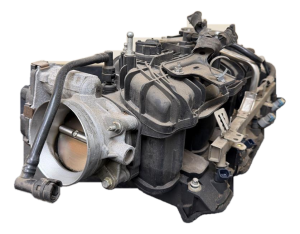
(OEM #12679999)— The intake manifold must be removed to access the HPFP. The gaskets are one-time-use and must be replaced to prevent vacuum leaks.
Trusted brands: ACDelco (OEM), Fel-Pro
OEM price range: $30-$50
Aftermarket price range: $20-$40
Related Codes That Often Appear With This One
- P0172 / P0175 — System Too Rich (Bank 1 / Bank 2). This is very common when the HPFP fails and leaks fuel into the crankcase. The fuel vapor is drawn into the intake through the PCV system, creating a rich condition that the oxygen sensors detect.
- P0087 — Fuel Rail/System Pressure - Too Low. This code can appear alongside P0149 if the HPFP is failing to generate the commanded pressure.
- P0300 — Random/Multiple Cylinder Misfire Detected. A failing HPFP can cause misfires due to incorrect fuel pressure or timing, leading to this code.
Technical Service Bulletins (TSBs) & Recalls
- GM Bulletin #14858 (NHTSA #14V614000): Recall for leaking high-pressure fuel pumps on certain 2014-2015 models.
- GM TSB 14-06-04-004H: Describes the normal ticking sound of the HPFP, advising against replacement for noise alone.
- GM TSB PIP5279A: Provides diagnostic steps for checking the fuel rail pressure sensor if readings are erratic.
Platform-Specific Known Issues
- GM issued a voluntary emissions recall (NHTSA #14V614000, GM Bulletin #14858) for potential leaks from the high-pressure fuel pump on some early 2014-2015 models, including the Yukon. While this recall may no longer be active for all vehicles, it highlights the known issues with this component.
- A faint ticking noise from the engine bay is normal for these direct-injection engines and is often the sound of the HPFP operating correctly, per GM TSB 14-06-04-004H. Do not replace the pump based on noise alone without other symptoms.
Mechanic-Grade Diagnostic Values
- Low-Pressure Fuel System (In-tank pump) — expected: 45-75 PSI. Some sources state 55-62 PSI is the target range for the 5.3L V8.. Failure: Pressure below 45 PSI indicates a weak in-tank pump, which can starve the HPFP.
- High-Pressure Fuel Rail (at idle) — expected: 500-700 PSI.. Failure: Significantly lower or wildly fluctuating pressure at idle can indicate a failing HPFP or sensor issue.
- High-Pressure Fuel Rail (cranking) — expected: 300-400 PSI.. Failure: Inability to build sufficient pressure during cranking will result in a no-start or extended crank condition.
- High-Pressure Fuel Rail (Wide Open Throttle) — expected: Up to 2,500+ PSI.. Failure: Failure to reach commanded pressure under load will cause hesitation and power loss.
- Fuel Rail Pressure Sensor (unplugged, KOEO) — expected: Scan tool should read 0 PSI.. Failure: If the sensor is unplugged and the reading is not zero, it may indicate a wiring or ECM issue.
- Fuel Rail Pressure Sensor (signal shorted to 5V reference, KOEO) — expected: Scan tool should read a default high value, such as 4,626 PSI.. Failure: This is a diagnostic test. If shorting the wires does not produce a max-value reading, it points to a wiring or ECM problem rather than a faulty sensor.
Scan Tool Commands That Help
- GDS2 (GM Dealer Software): Fuel System Depressurize — Used before servicing the high-pressure fuel system to safely relieve pressure. It can also be used as a diagnostic test; after the engine stalls from depressurization, a healthy sensor should read near zero PSI. A sensor that still shows residual pressure (e.g., 30-40 PSI) may be faulty.
- GDS2 (GM Dealer Software): Fuel Pump On/Off Command — Allows a technician to command the low-pressure (in-tank) fuel pump on to test its volume and pressure delivery to the HPFP without the engine running.
- GDS2 (GM Dealer Software): Injector Balance Test — This function individually commands each fuel injector to fire and measures the corresponding pressure drop in the fuel rail. It helps identify leaking or clogged injectors that could contribute to pressure faults.
Wiring & Ground Locations
- Fuel Pump Driver Module (FPDM) — On the driver's side frame rail, near the rear of the second door.. The FPDM controls the low-pressure fuel pump. A faulty module or a bad ground for the module can starve the high-pressure pump of fuel, leading to low-pressure codes like P0087 and potentially P0149.
- Fuel Rail Pressure Sensor Connector — At the back of the driver's side fuel rail, underneath the intake manifold.. This connector is the primary source of fuel pressure data for the ECM. Corrosion or damage to the pins or wires can cause incorrect readings, leading to a P0149 code. The sensor uses a 5V reference, a low reference (ground), and a signal wire.
Real Owner Repair Stories
- GM-Trucks.com forum user (2015 Silverado 5.3L) — Running rough, downshifting rough, MIL on with codes P0308 (Cyl 8 misfire), P219B (Bank 2 air-fuel ratio imbalance), and P050D (Cold start rough idle).
❌ Tried (didn't work) Swapped spark plug, coil, and wire from cylinder 8 to 4; misfire did not move., Performed an injector balance test which showed all injectors were within spec.
✅ What actually fixed it The user did not post the final fix, but the diagnostic path after ruling out spark and injectors would lead towards a mechanical issue like a collapsed lifter, a known problem on these engines which can cause misfires and rough running.
OEM Part Supersession History
12625817→12744840. Other replacement numbers include 12697966 and 12711662.— Standard part evolution for design improvements and reliability updates.
Model Year Variations Within This Range
- Approx. 2014-2016 vs 2017+: The Fuel Rail Pressure Sensor changed from a 4-pin (analog) design to a 3-pin (digital/SENT protocol) design around the 2016 model year. The ECM and wiring harness are different between the two types. They are not interchangeable, and the correct harness must be matched to the sensor and ECM.
Diagnostic Flowchart
Other Known Issues on This Vehicle
Issues unrelated to this code that are worth knowing about as an owner of this generation:
- 8-Speed (8L90/8L45) Transmission Shudder 🔴 High — Very common on 2015-2019 models. Feels like driving over rumble strips at light throttle between 25-60 mph. (Ref: TSB 18-NA-355: Recommends a complete transmission fluid flush with an updated Mobil 1 Synthetic LV ATF HP fluid.)
- Leaking A/C Condenser 🔴 High — Extremely common on 2015-2018 models. A crack develops from thermal stress where the transmission cooler is integrated, causing refrigerant to leak out. (Ref: Special Coverage Adjustment 17336: Extends the warranty for this specific leak, but coverage is limited by time/mileage.)
- AFM/DFM Lifter Failure 🔴 High — A persistent issue across Gen V V8s. The Active/Dynamic Fuel Management systems can lead to lifter and camshaft failure, requiring major engine repair. More common on the 5.3L L83 but also affects the 6.2L L86.
- Intake Valve Carbon Buildup 🟠 Medium — Inherent to all direct-injection (GDI) engines, including the L83/L86. Since fuel is not sprayed over the intake valves, carbon deposits from the PCV system build up over time (50k-100k miles), causing reduced performance and potential misfires. (Ref: TSB 16-NA-383: Describes a cleaning procedure using GM Top Engine Cleaner to address carbon buildup.)
- Cracked Piston / Ringland Failure 🔴 High — Less common than lifter failure but a known catastrophic issue, particularly on tuned or heavily loaded engines. Can be exacerbated by Low-Speed Pre-Ignition (LSPI).
Used vs. New Parts: Buying Guide for This Vehicle
When a used part is the smart pick: For this repair, using a used part is generally not recommended for the core components. The high-pressure fuel pump is a known high-failure item, and a used pump carries a significant risk of premature failure. Ancillary components like the intake manifold could be sourced from a reputable salvage yard if the original is damaged during removal.
Donor-vehicle mileage cap: roughly under 50000 miles for the part to have meaningful remaining life.
What to inspect on the donor part:
- For a high-pressure fuel pump, there are no reliable visual cues. It's a high-risk part to buy used.
- For an intake manifold, check for cracks, warping, and ensure all threaded inserts are intact.
- Verify the donor vehicle was not in a severe front-end collision.
OEM-only on this vehicle (don't cheap out):
- High-Pressure Fuel Pump (HPFP)
- High-Pressure Fuel Line
- Fuel Rail Pressure Sensor
Aftermarket brands forum-validated for this vehicle:
- ACDelco (OEM supplier)
- GM Genuine
Brands owners have reported issues with on this vehicle:
- Unnamed, no-brand 'white box' parts from online marketplaces are extremely risky for a critical, high-pressure fuel system component.
Real Owner Stories
Aggregated from forums and TSBs cited above. Mileages and costs reflect what owners reported in those sources.
2018 GMC Sierra L83 5.3L
Symptoms: Fuel getting into the engine oil; owners discussed significant fuel dilution issues on the L83/L86 platform.
What fixed it: Replacement of the high-pressure fuel pump (HPFP).
Source hint: GM-Trucks.com - 'Fuel getting in engine oil' thread (2018)
2015 GMC Yukon L83 5.3L
Symptoms: Hard-starting issue traced back to fuel system components.
What fixed it: Replacement of fuel system components/high-pressure fuel pump.
Source hint: TahoeYukonForum.com - 'Bad fuel Pump? (Solved)' thread
2014 GMC Sierra L83 5.3L
Symptoms: P0149 paired with P0172 and P0175; gas smell in the oil.
What fixed it: High-pressure fuel pump (HPFP) replacement.
Source hint: SilveradoSierra.com
Related OBD-II Codes
Frequently Asked Questions
I hear a faint ticking noise from my L83 engine; does this mean my high-pressure fuel pump is failing?
Is there a recall for the high-pressure fuel pump on my 2014 GMC Yukon?
How can I quickly check if the P0149 code on my Yukon is caused by the HPFP?
Where is the fuel rail pressure sensor located on the 5.3L L83 V8?
My Yukon has erratic fuel pressure readings; is there a specific diagnostic procedure I should follow?
What else should be replaced when I change the high-pressure fuel pump?
Helpful Videos
![What is P0149 Engine Code [Quick Guide]](https://img.youtube.com/vi/WHw3pBDXDk8/mqdefault.jpg)
Used OEM Parts in Stock
New Aftermarket Parts Available

The information in this article is provided for general reference and educational purposes only. Vehicle specifications, procedures, and part compatibility can vary by production date, trim level, and region. Always consult your vehicle's factory service manual and verify part numbers before purchasing or performing repairs. Safety-critical components such as airbags, seat belts, and braking systems should be installed by a qualified professional.
- GMC Yukon:
- 🧭 Diagnostic Flowchart
- 🎬 Helpful Videos
- 🛍️ Shop This Part
- What's Unique About the 2015-2020 GMC Yukon
- Symptoms You May Notice
- Most Likely Causes
- Rare But Worth Checking
- Diagnosis Steps
- Parts You'll Likely Need
- Related Codes That Often Appear With This One
- Technical Service Bulletins (TSBs) & Recalls
- Platform-Specific Known Issues
- Mechanic-Grade Diagnostic Values
- Scan Tool Commands That Help
- Wiring & Ground Locations
- Real Owner Repair Stories
- OEM Part Supersession History
- Model Year Variations Within This Range
- Other Known Issues on This Vehicle
- Used vs. New Parts: Buying Guide for This Vehicle
- Real Owner Stories
- 2018 GMC Sierra L83 5.3L
- 2015 GMC Yukon L83 5.3L
- 2014 GMC Sierra L83 5.3L
- Related OBD-II Codes
- Frequently Asked Questions
- 🎟️ Get 5% Off