

P0149 on 2010-2017 Volkswagen Golf: Fuel Timing Error Causes and Fixes
P0149 on a VW Golf indicates a 'Fuel Timing Error.' This is often caused by a failing high-pressure fuel pump (HPFP), a worn-out HPFP cam follower, or issues with fuel pressure sensors. The cam follower is a critical, inexpensive wear item that should be checked first. Expect a repair cost of $300 to $1500 at a shop, depending on the failed component.
- P0149 is a serious code indicating a fuel timing problem that can cause poor performance and potential engine damage.
- On a 2010-2017 VW Golf, the most likely culprit is the high-pressure fuel pump (HPFP).
- This code is often accompanied by P0087 (Low Fuel Pressure) and misfire codes (P030x).
- Diagnosis and repair should be left to a professional due to the high pressures and specialized tools involved.
- Do not ignore this code; address it promptly to avoid stalling and more expensive repairs down the line.
What's Unique About the 2010-2017 Volkswagen GOLF
The 2010-2017 VW Golf, spanning the Mk6 and Mk7 generations, primarily uses Gasoline Direct Injection (GDI) engines like the EA888. These systems operate under very high fuel pressure and require exact timing. A key feature is the camshaft-driven High-Pressure Fuel Pump (HPFP). A small, sacrificial 'cam follower' or 'tappet' sits between the camshaft lobe and the HPFP's plunger. This follower is a designed wear item and a notorious failure point; as it wears down, it reduces the pump's stroke, leading directly to pressure and timing errors (P0149, P0087). If it fails completely, it can destroy both the HPFP and the intake camshaft, making its inspection critical on this platform.
Diagnostic Flowchart
Tap your situation to follow the diagnostic path that matches what you're seeing on this vehicle.
Generation note: This range covers the Volkswagen Golf Mk6 (2010-2014) and Mk7 (2015-2017). While both generations use direct injection EA888 engines, there are variations (e.g., Gen 1/2 on Mk6, Gen 3 on Mk7). The fundamental causes related to the HPFP and cam follower are similar, but specific part numbers for pumps and sensors will differ. For example, the Mk6 GTI uses a Gen 1/2 EA888 engine, while the Mk7 GTI uses the updated Gen 3 EA888.
Symptoms You May Notice
- Check Engine Light is on
- Rough or fluctuating idle
- Engine hesitation or stumbling during acceleration
- Noticeable loss of engine power, especially above 3000 RPM
- Engine is hard to start or cranks but won't start
- Decreased fuel economy
- Engine misfires, which may trigger other codes like P0300-P0304
- Car enters 'limp mode' with reduced power
- Replacing the in-tank low-pressure fuel pump when the issue is with the high-pressure system.
- Replacing spark plugs or ignition coils to fix misfires without first diagnosing the underlying fuel system fault.
- Replacing the HPFP without first inspecting the cam follower, leading to repeat failure of the new pump.
Most Likely Causes
- Worn High-Pressure Fuel Pump (HPFP) Cam Follower Very High Probability → Shop Engine Valve Tappet The cam follower is a known, high-wear component on VW's FSI/TSI engines. It is designed to wear down over time. Tuned vehicles or those with infrequent oil changes can experience accelerated wear. Its failure is a primary cause of low fuel pressure and timing codes.
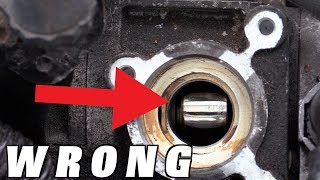
How to confirm: Remove the HPFP from the cylinder head. The bucket-shaped cam follower can then be pulled out and visually inspected. Look for 🎬 Watch: How to inspect and replace the cam follower and HPFP a worn-through black coating or a complete hole in the follower's surface.
Typical fix: Replacement of the HPFP cam follower. This is often done preventatively every 10,000-30,000 miles, depending on modifications.
Est. part cost: $25-$50 - Failing High-Pressure Fuel Pump (HPFP) 🔴 High Probability → Shop Fuel Pump The HPFP is a known failure point, often as a direct result of a neglected, worn-through cam follower which damages the pump's plunger. Internal seals can also fail, causing fuel to leak into the engine oil.
How to confirm: A technician will use a scan tool to monitor requested vs. actual fuel rail pressure. A significant lag or inability to meet pressure targets, especially under load, points to a failing HPFP. Physical inspection may reveal a damaged plunger tip if the cam follower has failed.
Typical fix: Replacement of the high-pressure fuel pump and almost always the cam follower at the same time.
Est. part cost: $250-$600 - Faulty Fuel Pressure Sensor 🟡 Medium Probability → Shop Fuel Pressure Sensor
How to confirm: If the fuel pressure readings on a scan tool are erratic, nonsensical (e.g., stuck at a single value), or do not change under different engine loads, the sensor itself may be faulty. This is diagnosed by comparing scan tool data with manual pressure gauge readings where possible.
Typical fix: Replacement of the fuel rail pressure sensor (often referred to as the G247 sensor).
Est. part cost: $50-$150 - Faulty Fuel Injectors ⚪ Low Probability → Shop Fuel Injector Direct injectors can become clogged with carbon or leak over time, affecting the fuel delivery pattern and timing.
How to confirm: An injector balance test can be performed with an advanced scan tool. A mechanic may also remove the injectors for flow testing and inspection.
Typical fix: Cleaning or replacing the faulty fuel injector(s).
Est. part cost: $50-$200 per injector
Rare But Worth Checking
- Worn Camshaft Intake Lobe: This is a severe consequence of a completely failed cam follower. The HPFP plunger grinds directly against the camshaft lobe, destroying it. This requires camshaft replacement and is a very expensive repair.
- Wiring or Connector Issues: Damaged wiring or corroded connectors for the HPFP, fuel pressure sensor, or injectors can cause intermittent signals and lead to this code.
- Air in the Fuel System: If the car was recently run out of fuel or if fuel system components were replaced improperly, air can enter the lines and disrupt pressure and timing.
- Engine Control Module (ECM) Fault: → Shop Engine Control Module (ECM) In very rare cases, a software glitch or internal failure of the ECM can cause it to incorrectly command or interpret fuel timing.
Diagnosis Steps
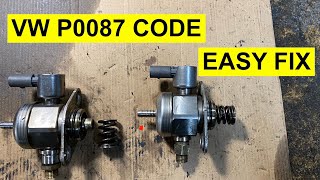
- Connect an OBD-II scanner and check for any other stored codes, paying close attention to fuel pressure codes (P0087, P053F, P2293) and 🎬 See this diagnostic walkthrough for the P0087 low pressure code misfire codes.
- CRITICAL STEP FOR VW TSI/FSI: Before replacing any parts, relieve fuel pressure and remove the High-Pressure Fuel Pump (HPFP) to visually inspect the cam follower. Look for excessive wear, scoring, or a hole. If the follower is damaged, the HPFP and potentially the camshaft are also suspect.
- Using a scan tool with live data, monitor 'Commanded Fuel Rail Pressure' and 'Actual Fuel Rail Pressure'. Observe the values at idle, during steady cruising, and under hard acceleration. A large discrepancy points to a mechanical fuel delivery issue.
- If the cam follower is intact but pressure is low, the focus shifts to the HPFP itself. Test its performance according to the manufacturer's diagnostic procedure.
- If fuel pressure readings on the scan tool are erratic, stuck, or implausible, test the fuel pressure sensor (G247) and its wiring harness for continuity and correct voltage.
- Inspect the entire fuel line system for visible leaks from the tank to the engine.
- If fuel pressure and sensors appear to be working correctly, the issue may be with the fuel injectors. Perform an injector balance test or have them professionally cleaned and tested.
- As a final step, if all components test good, check for any available ECM software updates from the manufacturer, as a reflash can sometimes correct logic errors.
Parts You'll Likely Need
- HPFP Cam Follower
(OEM #06D109309C (for many EA113/EA888 Gen1 engines, verify for your specific vehicle))— This is the single most common failure point leading to P0149/P0087. It is a sacrificial part that protects the HPFP and camshaft. It should be inspected immediately and replaced if worn.
Trusted brands: INA, Genuine Volkswagen
OEM price range: $40-$60
Aftermarket price range: $25-$45 - High-Pressure Fuel Pump (HPFP)
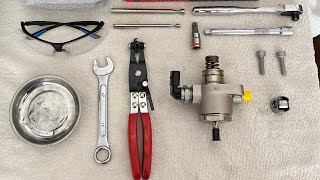
(OEM #06H127025Q / 06L127025R (Examples, varies by engine generation, e.g., Mk6 vs Mk7. Verify with VIN). 🎬 Watch: Step-by-step HPFP installation guide for the Mk7 GTI)— This is the second most frequent cause, often failing due to a worn cam follower. It is responsible for creating the high pressure needed for precise injection timing.
Trusted brands: Bosch, Hitachi, Genuine Volkswagen
OEM price range: $400-$700
Aftermarket price range: $250-$600 - Fuel Rail Pressure Sensor (G247)
(OEM #06J906051C / 06J906051F (Examples for Mk6, verify with VIN).)— This sensor reports fuel rail pressure to the ECM. If it provides incorrect readings, the ECM may set a P0149 code even if the mechanical parts are working correctly.
Trusted brands: Bosch, Genuine Volkswagen
OEM price range: $70-$120
Aftermarket price range: $50-$90
Related Codes That Often Appear With This One
- P0087 — This code means 'Fuel Rail/System Pressure - Too Low,' which is a direct consequence of a worn cam follower or failing HPFP that also causes the P0149 timing error. These codes frequently appear together. This is confirmed by VW TSB #VIN4APIN20211026 and #VIN4APIN20211013.
- P053F — This code for 'Cold Start Fuel Pressure Performance' often appears with P0149 and P0087, indicating the fuel system is unable to build sufficient pressure, especially when the engine is cold. This is also confirmed by the cited VW TSBs.
- P0300-P0304 — These are random or specific cylinder misfire codes. Incorrect fuel timing and pressure directly lead to poor combustion, causing the engine to misfire.
- P2293 — 'Fuel Pressure Regulator 2 Performance' is another code that points directly to the high-pressure fuel system and is often caused by a worn cam follower.
Technical Service Bulletins (TSBs) & Recalls
- VIN4APIN20211026: Customer states MIL-on with P0087 P0149 P053F in the ECM
- VIN4APIN20211013: Customer states MIL-on with P0087 P0149 P053F in the ECM
- VW TSB 2015153/3: Relates to noisy or failing high-pressure fuel pumps on certain 2.0T engines.
Platform-Specific Known Issues
- Cam Follower Wear is Endemic: → Shop Engine Valve Tappet On forums like golfmk6.com and VWVortex, the overwhelming consensus is that the HPFP cam follower is the first part to check for any high-pressure fuel codes like P0149 or P0087. Owners report replacing them as preventative maintenance every 10-20k miles on tuned cars, or 30-40k miles on stock cars, to avoid catastrophic failure of the pump and camshaft.
- TSB Connection to Timing Chain Issues: → Shop Engine Timing Chain While not the primary cause, VW TSB 2060799 (for other models but relevant logic) notes that fuel pressure codes like P0087 can be triggered if the engine's main timing chain has stretched, causing the HPFP (which is driven by the camshaft) to be out of time with the crankshaft. If cam follower and HPFP are good, checking camshaft adaptation values (>8 degrees deviation) can point to a stretched timing chain.
- NHTSA TSBs: Volkswagen issued Technical Service Bulletins (TSBs) #VIN4APIN20211026 and #VIN4APIN20211013 for 2014 models that list P0149 alongside fuel pressure codes P0087 and P053F, pointing to a known issue in the fuel delivery system. These appear to be internal dealer tracking numbers.
Mechanic-Grade Diagnostic Values
- High-Pressure Fuel Pump (HPFP) Rail Pressure at Idle — expected: 40 - 50 bar (approx. 580 - 725 PSI). Failure: Pressure is significantly below requested value, or is erratic. For example, reading 7 bar when 50 bar is requested.
- High-Pressure Fuel Pump (HPFP) Rail Pressure Under Load — expected: Rises with RPM to 110 - 130 bar (approx. 1600 - 1885 PSI), depending on tune.. Failure: Actual pressure fails to rise with requested pressure during acceleration, leading to a large deviation.
- Low-Pressure Fuel Pump (LPFP) Pressure — expected: 4.5 bar at idle, rising to 5.5 - 6.0 bar under load.. Failure: Pressure does not rise under load, which will starve the HPFP.
- VCDS Fuel Rail Pressure Deviation (Measuring Block 230) — expected: Max 5.0 bar.. Failure: Deviation between specified and actual fuel pressure exceeds 5.0 bar.
- Fuel Pressure Regulator Valve (N276) Resistance — expected: 1 to 5 Ω.. Failure: Resistance is outside of this range, indicating a faulty valve.
- Post-Shutdown Fuel Rail Pressure (Hot Engine) — expected: Pressure should rise above the idle value (e.g., to >60 bar) due to heat soak.. Failure: Pressure quickly drops after shutdown, indicating a leak from an injector or a check valve in the HPFP.
Scan Tool Commands That Help
- VCDS (VAG-COM): Output Test: Fuel Pump Electronics — To test the function of the in-tank low-pressure fuel pump (LPFP) and to prime the fuel system after replacing a filter or pump. This helps rule out a fuel supply issue to the HPFP.
- VCDS (VAG-COM) for UDS Modules: Basic Settings: Transfer Fuel Pump (FP) Test — This is the equivalent of the Output Test for newer vehicles using the UDS protocol. It serves the same purpose of activating the LPFP for testing and priming.
- VCDS (VAG-COM): Measuring Blocks / Advanced Measuring Values — Use Measuring Block groups 106, 140, or 230 (for non-UDS) or Advanced Measuring Values (for UDS) to log 'Specified' vs 'Actual' fuel rail pressure. This is the primary method for diagnosing HPFP performance.
Wiring & Ground Locations
- J623 — Engine Control Unit (ECU), located in the engine bay, typically within the plenum/cowl area.. The J623 ECU is the control center for the entire fuel system. All wiring from the fuel pressure sensor (G247) and the high-pressure fuel pump's regulating valve (N276/N290) terminates here. Any diagnosis of persistent electrical faults for P0149 will involve checking for continuity and voltage at the ECU connector.
- HPFP Electrical Connector — On the High-Pressure Fuel Pump itself, mounted to the cylinder head.. This connector provides power to the fuel pressure regulating valve (N276 or N290). Corrosion or damage to this connector or its wiring can cause a loss of control over the HPFP, directly leading to pressure and timing errors.
- Ground Point 366 — In the right front footwell area.. While not directly tied to the fuel pump in documentation, a poor main ground connection for the chassis or wiring harness can cause a host of difficult-to-diagnose electronic issues, including erratic sensor readings that could trigger a P0149.
Real Owner Repair Stories
- Reddit user /u/ewokslikebacon on /r/GolfGTI (2015 VW Golf GTI Mk7) — Struggled to start after the engine was driven and then sat for about 45 minutes. It would crank but not fire unless given throttle, then would idle rough.
❌ Tried (didn't work) The user went straight for the suspected cause based on research.
✅ What actually fixed it Replacement of the High-Pressure Fuel Pump (HPFP). - BobIsTheOilGuy forum user 'skyactiv' (VW GTI with 126,000 miles (likely Mk6)) — Check engine light came on with significant power loss. Code P0087 was stored.
❌ Tried (didn't work) Initial diagnosis pointed directly to the fuel system.
✅ What actually fixed it Replacing the High-Pressure Fuel Pump with a revised OEM part number. The owner noted the roller lifter (cam follower) looked fine, indicating a pump failure independent of follower wear. - Reddit user on /r/GolfGTI (2012 VW Golf GTI Mk6) — Check Engine Light with code P0149. Car ran and drove fine initially.
❌ Tried (didn't work) Resetting the code.
✅ What actually fixed it The user was advised that this code points to a failing injector or, more likely, a failing high-pressure or low-pressure fuel pump. The resolution was implied to be pump replacement. - MK5 Golf GTI Forum user (VW Golf GTI Mk5 (engine architecture similar to early Mk6)) — After replacing the cam follower, codes P0087 and P310B (Low Fuel Pressure Regulation) appeared.
❌ Tried (didn't work) Replacing the cam follower alone.
✅ What actually fixed it The confirmed fix was not posted, but the expert advice given was to inspect the intake camshaft's tri-lobe for wear and the HPFP's pressure regulator (N276) for cracks, as these are common secondary failures after a cam follower wears out.
OEM Part Supersession History
06H127025E, G, K, M, N, P→06H127025Q (for many 2.0T TSI engines)— Multiple revisions by VW to improve reliability and address internal failures.
Heads up: A forum user noted their 2011 model's pump had already been revised twice by 2013, indicating frequent updates. Always verify the latest part number with a VIN.06F127025H, J, K, L→06F127025M (for early 2.0T FSI engines)— Revisions to improve durability.
Heads up: Very early models (circa 2006) used a banjo bolt fuel line connection. The newer style pumps require an adapter kit (e.g., line fitting 06F127213B) to be installed.
Model Year Variations Within This Range
- 2010-2014 (Golf Mk6): These models primarily use the EA888 Gen 1/2 engine (or EA113 FSI in early GTIs), which features a flat-tappet cam follower. This follower is a well-known, high-wear maintenance item that is a primary cause of P0149 and related fuel pressure codes. It requires regular inspection (e.g., every 20,000-30,000 miles).
- 2015-2017 (Golf Mk7): These models use the EA888 Gen 3 engine. The HPFP is driven by a much more durable roller-style cam follower, which is not considered a common wear item. While the HPFP itself can still fail, the root cause is less likely to be follower wear. Diagnosis on a Mk7 should focus more on the pump itself, the sensors, or wiring.
Helpful Videos
Used OEM Parts in Stock
New Aftermarket Parts Available


The information in this article is provided for general reference and educational purposes only. Vehicle specifications, procedures, and part compatibility can vary by production date, trim level, and region. Always consult your vehicle's factory service manual and verify part numbers before purchasing or performing repairs. Safety-critical components such as airbags, seat belts, and braking systems should be installed by a qualified professional.
- Volkswagen GOLF:
- 🧭 Diagnostic Flowchart
- 🎬 Helpful Videos
- 🛍️ Shop This Part
- What's Unique About the 2010-2017 Volkswagen GOLF
- Symptoms You May Notice
- Most Likely Causes
- Rare But Worth Checking
- Diagnosis Steps
- Parts You'll Likely Need
- Related Codes That Often Appear With This One
- Technical Service Bulletins (TSBs) & Recalls
- Platform-Specific Known Issues
- Mechanic-Grade Diagnostic Values
- Scan Tool Commands That Help
- Wiring & Ground Locations
- Real Owner Repair Stories
- OEM Part Supersession History
- Model Year Variations Within This Range
- 🎟️ Get 5% Off