

P0170 on 2005-2010 Toyota Camry: Fuel Trim Malfunction Causes and Fixes
On a 2005-2010 Camry, P0170 is most often caused by a faulty intake manifold gasket on the 2.4L 4-cylinder engine or a dirty Mass Airflow (MAF) sensor on either engine. Start by cleaning the MAF sensor; if that doesn't work, suspect a vacuum leak, especially the intake gasket.
- Start your diagnosis by cleaning the Mass Airflow (MAF) sensor with a dedicated cleaner; this is a cheap and easy first step that often fixes the problem.
- If you have the 2.4L 4-cylinder engine, a leaking intake manifold gasket is a highly probable cause. A smoke test is the best way to confirm this.
- Do not replace the oxygen (A/F) sensor unless you have ruled out vacuum leaks and a faulty MAF sensor first.
- For the 3.5L V6 engine, remember that Bank 1 is the rear cylinder bank against the firewall, which is more difficult to access.
What's Unique About the 2005-2010 Toyota Camry
For the 2005-2010 Camry, the cause of P0170 is overwhelmingly engine-specific. The 2.4L 4-cylinder (2AZ-FE) engine is widely known for having its original orange intake manifold gaskets fail over time. These gaskets become brittle, flatten, and crack, creating a vacuum leak that is a primary cause of this code. For both the 4-cylinder and the 3.5L V6 (2GR-FE), a dirty Mass Airflow (MAF) sensor is also a very frequent culprit, often due to dust or oil contamination from the PCV system, which can be exacerbated by the 2AZ-FE's tendency to consume oil. Because these issues are so common, they should be the first things you check.
Generation note: This range covers two Camry generations: the XV30 (2005-2006) and the XV40 (2007-2010). The most notable difference is the introduction of the 3.5L 2GR-FE V6 engine in the XV40 generation, alongside the 2.4L 2AZ-FE 4-cylinder engine which was present in both. The 2010-2011 models introduced the more reliable 2.5L 2AR-FE engine, which is not known for the same intake gasket issues. While causes are similar, the V6 has two cylinder banks, and Bank 1 is the one against the firewall, making access to its sensors more difficult.
Symptoms You May Notice
- Check Engine Light is on
- Rough or unstable idle
- Engine hesitation or stumbling during acceleration
- Reduced fuel economy
- Engine misfiring
- Black smoke from tailpipe (if running rich)
- Replacing the oxygen (A/F) sensor without first checking for vacuum leaks or cleaning the MAF sensor. Vacuum leaks and dirty MAF sensors are more common and cheaper to fix on this platform.
Most Likely Causes
- Leaking Intake Manifold Gasket (2.4L 2AZ-FE Engine) 🔴 High Probability → Shop Engine Intake Manifold The original rubber gaskets on the 2.4L engine (often orange in color) are known to become brittle, flatten, and crack with age and heat cycles, creating a significant vacuum leak. This is a very well-documented failure point for this specific engine, frequently discussed in owner forums.
How to confirm: Perform a smoke test on the intake system. Smoke will be seen escaping from the area where the intake manifold meets the cylinder head. You can also spray short bursts of brake cleaner or an unlit propane torch near the gasket with the engine running; a change in idle RPM indicates a leak. A hissing sound may also be audible near the manifold.
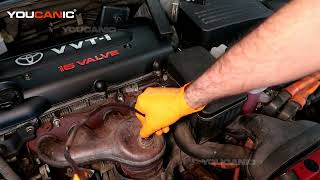
Typical fix: Replace the intake manifold gasket with an updated, more durable version. The OEM part is recommended. 🎬 Watch: How to remove the intake manifold
Est. part cost: $15-$40 - Dirty or Faulty Mass Airflow (MAF) Sensor 🔴 High Probability → Shop Fuel Injection Air Flow Meter The MAF sensor wire can become contaminated with dust, oil, and other debris, causing it to send inaccurate airflow readings to the ECM. This is a common issue on many Toyota vehicles, and the 2AZ-FE's oil consumption issue can contribute to oil vapor contaminating the sensor.
How to confirm: Remove the MAF sensor from the air intake tube and inspect the small wires inside. If they appear dirty, clean them ONLY with a dedicated MAF sensor cleaner spray. Never touch the wires. A faulty sensor can also be diagnosed by monitoring its readings with an OBD-II scanner; the values may be erratic or out of specification.
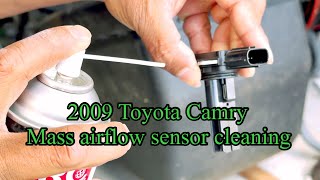
Typical fix: Clean the MAF sensor with a specialized cleaner. If cleaning does not resolve the issue, the sensor must be replaced. Denso is the OEM supplier. 🎬 See how to clean the MAF sensor
Est. part cost: $5 (cleaner) - $150 (new sensor) - Cracked or Disconnected Air Intake Hose 🟡 Medium Probability The flexible rubber hose between the air filter box and the throttle body can become brittle and crack over time, especially in the ribbed sections, allowing unmetered air to enter the engine and causing a lean condition.
How to confirm: Visually inspect the entire length of the air intake hose for cracks, especially in the ribbed, flexible sections. Squeeze the hose to reveal hidden cracks. Ensure all clamps are tight.
Typical fix: Replace the cracked air intake hose.
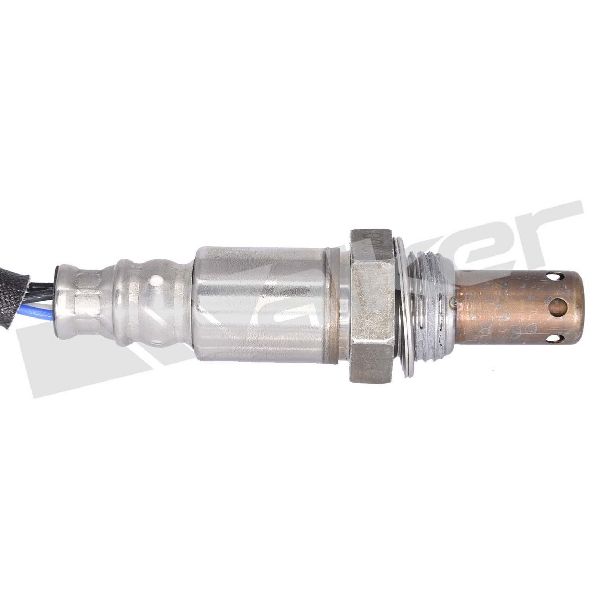
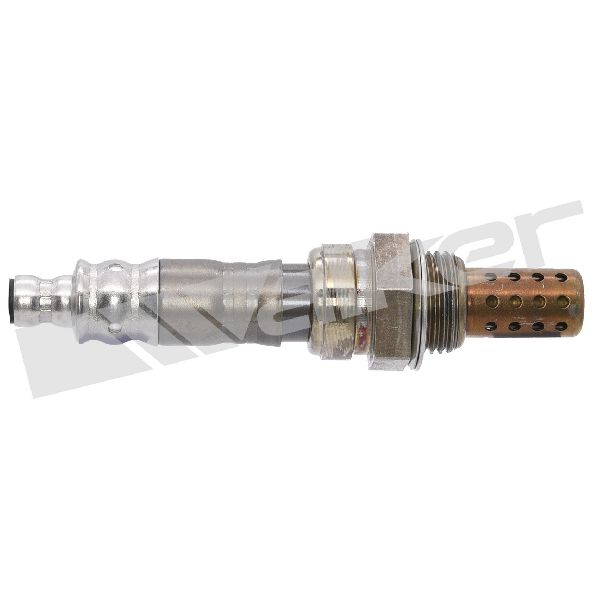
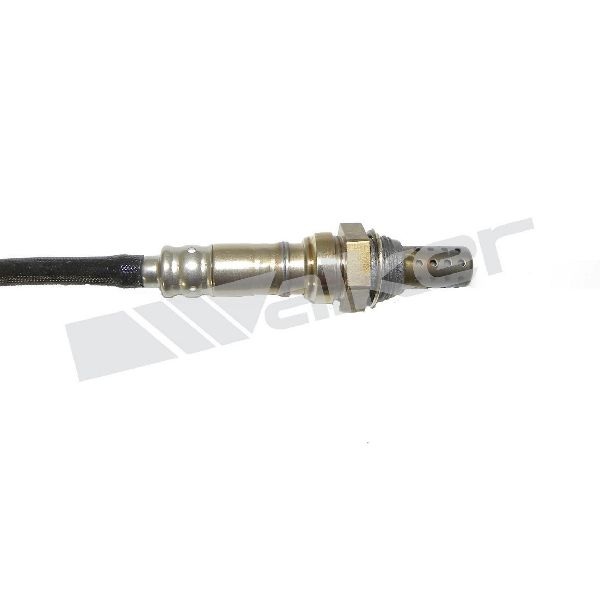
Est. part cost: $30-$70 - Faulty Air/Fuel Ratio Sensor (Upstream O2 Sensor) 🟡 Medium Probability → Shop Oxygen Sensor Like any sensor, the A/F sensor (Bank 1, Sensor 1) degrades over time. After 100,000+ miles, it can become slow to respond or send inaccurate voltage signals, tricking the ECM into making incorrect fuel adjustments. Oil burning in the 2AZ-FE engine can also lead to premature sensor failure.
How to confirm: Use an OBD-II scanner with live data capabilities to graph the sensor's voltage. A healthy upstream sensor should fluctuate rapidly. A slow or flat-lined reading indicates a problem. On the 3.5L V6, Bank 1 is the rear bank against the firewall.
Typical fix: Replace the Bank 1, Sensor 1 Air/Fuel Ratio sensor. Denso is the OEM supplier.
Est. part cost: $80-$200
Rare But Worth Checking
- Weak Fuel Pump or Clogged Fuel Filter: → Shop Fuel Filter This can cause low fuel pressure, leading to a lean condition. It would typically be accompanied by hesitation under heavy load. A fuel pressure test is required for diagnosis.
- Clogged Fuel Injectors: If one or more injectors on Bank 1 are clogged, they won't deliver enough fuel. This is less common than other causes and usually happens gradually.
- Exhaust Leak: An exhaust leak before the A/F sensor can draw in outside air, making the sensor read a false lean condition and causing the ECM to add too much fuel (running rich).
Diagnosis Steps
- Read the codes with an OBD-II scanner and check for any other pending or stored codes. Note the freeze frame data to see engine conditions when the code was set.
- Visually inspect the engine bay. Look for obviously disconnected vacuum hoses or large cracks in the air intake boot between the air filter and throttle body.
- Remove and clean the Mass Airflow (MAF) sensor using dedicated MAF sensor cleaner. Let it dry completely before reinstalling. Clear the code and drive to see if it returns.
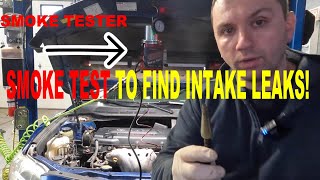
- If the code returns, perform a smoke test to check for vacuum leaks. Pay close attention to the intake manifold gasket area, especially on the 2.4L engine. 🎬 Watch: How to find vacuum leaks with a smoke machine
- If no vacuum leaks are found, use a scanner to monitor live data. Check the long-term and short-term fuel trims (LTFT and STFT). High positive numbers (e.g., >15%) confirm a lean condition, while high negative numbers confirm a rich condition.
- Observe the Bank 1, Sensor 1 (A/F sensor) voltage graph. It should fluctuate rapidly. If it's slow, stuck, or flat, the sensor is likely faulty.
- If other diagnostics have not identified the issue, check the fuel pressure using a fuel pressure gauge to rule out a weak fuel pump or faulty regulator.
Parts You'll Likely Need
- Intake Manifold Gasket (for 2.4L 2AZ-FE)
(OEM #17177-0H020 (replaces 17177-28010, 17177-0H010, 17177-28031))— This is the most probable cause of a vacuum leak on the 4-cylinder engine, leading to P0170/P0171 codes.
Trusted brands: Toyota OEM, Fel-Pro, Mahle
OEM price range: $25-$40
Aftermarket price range: $10-$20 - Mass Airflow (MAF) Sensor
(OEM #Denso 197-6110 (fits 2007-2010 models). For 2005-2006 models, verify with VIN, may use Denso 197-6020.)— A dirty or failed MAF sensor is a very common cause for fuel trim issues on these vehicles.
Trusted brands: Denso (OEM), Hitachi
OEM price range: $120-$180
Aftermarket price range: $50-$100 - Air/Fuel Ratio Sensor (Bank 1 Sensor 1)
(OEM #Denso 234-9049 (for 2.4L 2AZ-FE). Denso 234-9008 (for 3.5L V6 2GR-FE, Bank 1/Upstream Left). Always verify with VIN.)— A worn-out upstream oxygen sensor provides bad data to the computer, directly causing fuel trim problems.
Trusted brands: Denso (OEM), Bosch, NTK
OEM price range: $150-$200
Aftermarket price range: $70-$120
Related Codes That Often Appear With This One
- P0171 — P0171 ('System Too Lean Bank 1') is a more specific version of P0170. If the computer detects a persistent lean condition that it cannot correct, it will often set P0171. They share the exact same causes.
- P0300, P0301, P0302... — A lean or rich condition can cause misfires. If the problem is severe enough to cause a cylinder to misfire, you may get a random misfire code (P0300) or a cylinder-specific code (e.g., P0301 for cylinder 1).
Technical Service Bulletins (TSBs) & Recalls
- T-SB-0094-11: Addresses excessive engine oil consumption in some 2007-2009 Camry models with the 2AZ-FE engine. The fix involves replacing the piston assembly. While not a direct cause, the oil consumption can foul sensors.
Platform-Specific Known Issues
- The intake manifold gasket on the 2.4L 2AZ-FE engine is a known failure point that commonly causes vacuum leaks and sets lean codes like P0170 and P0171.
- The excessive oil consumption issue on the 2AZ-FE engine (TSB T-SB-0094-11) can indirectly cause P0170 by fouling the MAF sensor with oil vapor or damaging the A/F sensor over time.
Mechanic-Grade Diagnostic Values
- Fuel Injector Resistance (2.4L 2AZ-FE & 3.5L 2GR-FE) — expected: 11.6 to 12.4 Ω at 68°F (20°C). Failure: A reading outside this range indicates an internal failure of the injector coil. No reading (open circuit) or zero resistance (short) also indicates failure.
- Mass Airflow (MAF) Sensor Signal Voltage at Idle (2.4L 2AZ-FE) — expected: Approximately 1.1V - 1.5V at warm idle with no load.. Failure: A voltage that is significantly lower, higher, or completely static (e.g., 0V or 5V) suggests a faulty sensor or wiring issue. The voltage should increase smoothly with engine RPM.
- Long Term Fuel Trim (LTFT) & Short Term Fuel Trim (STFT) — expected: Ideally between -10% and +10% combined.. Failure: P0170 is set when trims exceed the computer's correctable limit, often beyond +/- 20%. Consistently high positive trims (e.g., +25%) indicate the engine is compensating for a lean condition (vacuum leak, bad MAF). High negative trims indicate a rich condition (leaking injector).
Hidden / Shadow Codes Worth Checking
- Mode 6, Test ID $81, Component ID $11: This area within Mode 6 data on a professional scan tool monitors the Bank 1 A/F sensor response rate. Failing values here can indicate a slow or lazy sensor that hasn't yet triggered a specific sensor performance code but is contributing to the P0170 fuel trim issue. (see via A professional-grade scan tool with Mode 6 capabilities, such as Toyota's Techstream.)
Scan Tool Commands That Help
- Toyota Techstream: Active Test: Control the Injection Volume — This function allows a technician to manually increase or decrease the amount of fuel injected. By observing the change in the A/F sensor and O2 sensor data, a technician can confirm if the fuel system responds correctly and if the sensors are reading the change, helping to isolate a bad injector from a bad sensor.
- Toyota Techstream: Reset Memory — After replacing a component like a MAF sensor, A/F sensor, or fixing a large vacuum leak, it is critical to perform a 'Reset Memory' function. This clears the learned long-term fuel trim values, forcing the ECU to relearn the fuel strategy from a clean slate with the new parts. Simply clearing codes does not always reset these learned values.
Wiring & Ground Locations
- EB1 (2AZ-FE) — On the left (driver's side) back of the cylinder head, where the engine wire and sensor wire connect.. This is a critical ground point for various engine sensors. Corrosion or a loose connection here can cause erratic sensor readings for components like the A/F sensor, leading to incorrect fuel trim adjustments and a P0170 code.
- EG (2AZ-FE) — On the left side of the cylinder head.. Another key engine ground. A poor connection at this point can affect the reference voltage for sensors involved in the fuel control system.
- MAF Sensor Connector (A24 on 2008 2AZ-FE) — On the air intake tube, between the air filter box and throttle body.. For a 2008 2.4L, Pin 5 is the signal wire, Pin 4 is the ground, and Pins 2 & 3 are ignition power. Back-probing these pins allows for live voltage testing to confirm the sensor is receiving power and sending a valid signal, helping to distinguish a bad sensor from a wiring problem.
Real Owner Repair Stories
- YouTube Commenter (1996 Lexus LS400 (Similar P0170 cause)) — P0170 code, underpowered, slow/jumpy when letting off throttle.
❌ Tried (didn't work) Considered replacing Bank 1 Sensor 1 O2 sensor or an injector.
✅ What actually fixed it While visually inspecting the engine bay, the owner discovered a completely loose hose clamp on the main intake pipe between the MAF and throttle body. The pipe was allowing unmetered air in. Tightening the clamp resolved all symptoms and the code. The clamp was likely left loose from a valve cover gasket job 10 months prior. - Tacoma World Forum User (Toyota Tacoma (Similar P0170 cause)) — P0170, hesitation, poor performance.
❌ Tried (didn't work) Cleaning the MAF sensor.
✅ What actually fixed it The user concluded that after cleaning the MAF sensor did not work, the next most likely cause was a failing fuel pump that was not providing adequate pressure, leading to a lean condition. Replacing the fuel pump fixed the issue.
"I Checked Everything" — The Actual Cause
- An exhaust leak before the Bank 1 A/F sensor (e.g., a cracked exhaust manifold or a leaking manifold gasket) can introduce oxygen into the exhaust stream. The A/F sensor interprets this extra oxygen as a lean condition and commands the ECU to add more fuel. This can cause the engine to actually run rich, but the sensor reading makes the computer think it's lean, leading to confusing fuel trim data and a P0170 code, even when a smoke test on the intake shows no leaks.
OEM Part Supersession History
17177-28010, 17177-0H010, 17177-28031→17177-0H020— The original intake manifold gaskets for the 2AZ-FE engine were prone to becoming brittle and failing. The updated part number 17177-0H020 is made of a more durable material to better withstand heat cycles and prevent premature vacuum leaks.Denso 197-6020→Denso 197-6110 (for later models)— Change in sensor design or calibration for the updated XV40 generation Camry starting in 2007.
Heads up: The 2005-2006 Camry (XV30) typically uses Denso 197-6020, while the 2007-2010 Camry (XV40) uses Denso 197-6110. While they may look similar, their calibration can differ. Using the wrong sensor can result in persistent fuel trim issues. Always verify the correct part number for the specific model year.
Model Year Variations Within This Range
- 2005-2006 vs 2007-2010: The MAF sensor part number changes between the XV30 (2005-2006) and XV40 (2007-2010) generations. The earlier models generally use Denso 197-6020, while the later models use Denso 197-6110. It is crucial to use the correct sensor for the vehicle's specific year range.
- 2010-2011: In 2010, Toyota began phasing in the 2.5L 2AR-FE engine to replace the 2.4L 2AZ-FE. The 2AR-FE does not share the same notorious intake manifold gasket issue, so for a 2010 Camry, it is critical to first identify which 4-cylinder engine is installed before diagnosing a P0170 code.
Diagnostic Flowchart
Other Known Issues on This Vehicle
Issues unrelated to this code that are worth knowing about as an owner of this generation:
- Excessive Oil Consumption (2.4L 2AZ-FE) 🔴 High — Very common in 2007-2009 models. Caused by defective piston ring design. Can manifest as early as 60,000 miles. (Ref: TSB T-SB-0094-11 was issued, and a warranty enhancement program (ZE7) was later launched following a class-action lawsuit.)
- Melting / Sticky Dashboard 🟠 Medium — Widespread on 2007-2011 models, especially in hot, humid climates. The dash material degrades, becomes sticky, and creates a dangerous glare on the windshield. (Ref: Toyota issued a Warranty Enhancement Program (ZE6) to replace affected dashboards, though the program has since expired.)
- Stripped Cylinder Head Bolt Threads (2.4L 2AZ-FE) 🔴 High — A known design flaw where the rear cylinder head bolt threads in the aluminum block can strip, causing head gasket failure, overheating, and coolant leaks. (Ref: TSB SB-0015-11 addresses this issue.)
- Transmission Hesitation/Slippage 🟠 Medium — Commonly reported on 2007-2009 models, symptoms include harsh shifting, jerking, and hesitation to accelerate or engage reverse.
- Unintended Acceleration 🔴 High — A major issue for the XV40 generation, leading to massive recalls. It was attributed to both sticking accelerator pedals and floor mat interference. (Ref: Multiple major recalls were issued in 2009 and 2010 to address the issue.)
Used vs. New Parts: Buying Guide for This Vehicle
When a used part is the smart pick: Used parts make sense for simple mechanical components like the air intake hose/resonator assembly or a fuel rail. A used PCV valve can be tested before purchase. For this specific P0170 repair, most key components are sensors or wear items where new is strongly preferred.
Donor-vehicle mileage cap: roughly under 80000 miles for the part to have meaningful remaining life.
What to inspect on the donor part:
- For an intake hose, check for any signs of dry rot or cracking, especially in the flexible accordion sections. Squeeze it to reveal hidden cracks.
- For a MAF sensor, ensure the connector pins are not corroded and the sensing wires inside are physically intact (though cleanliness is not a reliable indicator).
- Avoid parts from vehicles with signs of front-end damage or engine fires.
OEM-only on this vehicle (don't cheap out):
- Air/Fuel Ratio Sensor
- Mass Airflow (MAF) Sensor
Aftermarket brands forum-validated for this vehicle:
- Denso (for A/F and MAF sensors - they are the Original Equipment Manufacturer)
- NTK (for A/F sensors)
- Fel-Pro (for intake manifold gasket)
Brands owners have reported issues with on this vehicle:
- Unnamed, no-brand 'white box' electronic sensors (MAF, A/F) from online marketplaces. These often have incorrect calibrations that cause persistent codes and drivability issues, even when new.
Real Owner Stories
Aggregated from forums and TSBs cited above. Mileages and costs reflect what owners reported in those sources.
2007-2009 Toyota Camry 2.4L 2AZ-FE — ~60000 miles
Symptoms: Excessive engine oil consumption which can lead to fouled sensors.
What fixed it: Replacing the piston assembly as per TSB T-SB-0094-11.
Source hint: TSB T-SB-0094-11
2002-2011 Toyota Camry 2.4L 2AZ-FE
Symptoms: P0171 code present, but a smoke test was inconclusive for finding a vacuum leak.
What fixed it: Replacing the intake manifold gasket.
Source hint: ToyotaNation Forum - 'P0171, but no vacuum leak found?'
2005-2010 Toyota Camry 2.4L 2AZ-FE — ~115000 miles
Symptoms: The Air/Fuel sensor became slow to respond or sent inaccurate voltage signals, tricking the ECM into incorrect fuel adjustments.
What fixed it: Replace the Bank 1, Sensor 1 Air/Fuel Ratio sensor (Denso OEM).
Source hint: common_causes - Faulty Air/Fuel Ratio Sensor (Upstream O2 Sensor)
Related OBD-II Codes
Frequently Asked Questions
Does TSB T-SB-0094-11 apply to my 2008 Toyota Camry with the 2.4L engine?
I have a 2.4L 2AZ-FE engine; why is the intake manifold gasket a common culprit for P0170?
Should I use a specific brand when replacing the MAF sensor or A/F sensor on my Camry?
Can the 'melting dashboard' issue on my 2007-2011 Camry cause engine codes like P0170?
Is there a warranty program for the oil consumption issue that might be fouling my sensors?
How can I confirm if my 2.4L Camry's intake gasket is leaking without a smoke machine?
Helpful Videos
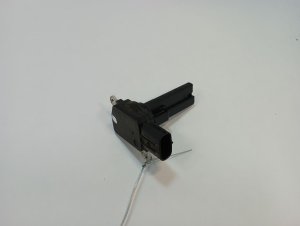
Used OEM Parts in Stock
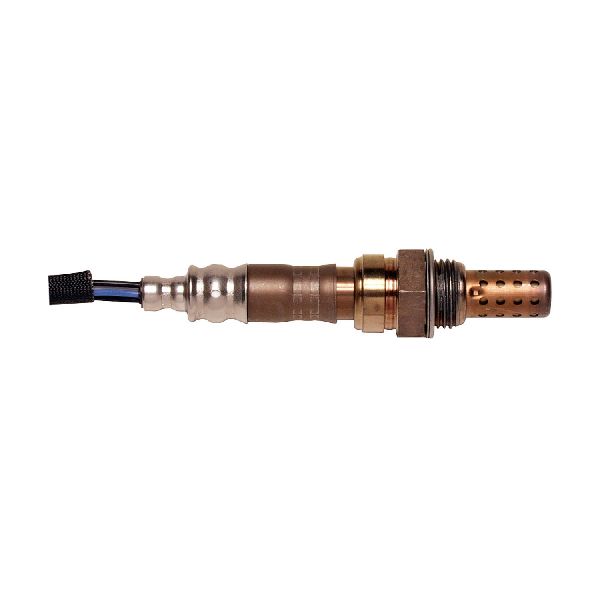
New Aftermarket Parts Available



The information in this article is provided for general reference and educational purposes only. Vehicle specifications, procedures, and part compatibility can vary by production date, trim level, and region. Always consult your vehicle's factory service manual and verify part numbers before purchasing or performing repairs. Safety-critical components such as airbags, seat belts, and braking systems should be installed by a qualified professional.
- Toyota Camry:
- 🧭 Diagnostic Flowchart
- 🎬 Helpful Videos
- 🛍️ Shop This Part
- What's Unique About the 2005-2010 Toyota Camry
- Symptoms You May Notice
- Most Likely Causes
- Rare But Worth Checking
- Diagnosis Steps
- Parts You'll Likely Need
- Related Codes That Often Appear With This One
- Technical Service Bulletins (TSBs) & Recalls
- Platform-Specific Known Issues
- Mechanic-Grade Diagnostic Values
- Hidden / Shadow Codes Worth Checking
- Scan Tool Commands That Help
- Wiring & Ground Locations
- Real Owner Repair Stories
- "I Checked Everything" — The Actual Cause
- OEM Part Supersession History
- Model Year Variations Within This Range
- Other Known Issues on This Vehicle
- Used vs. New Parts: Buying Guide for This Vehicle
- Real Owner Stories
- 2007-2009 Toyota Camry 2.4L 2AZ-FE — ~60000 miles
- 2002-2011 Toyota Camry 2.4L 2AZ-FE
- 2005-2010 Toyota Camry 2.4L 2AZ-FE — ~115000 miles
- Related OBD-II Codes
- Frequently Asked Questions
- 🎟️ Get 5% Off