

P0171 on 2016-2020 Acura RLX: System Too Lean Causes and Fixes
On a 2016-2020 Acura RLX, code P0171 is very often caused by faulty fuel injectors, a known issue acknowledged by Acura through warranty extensions on similar models with the same engine family. If the code appears with misfire codes (P030x), this is the most likely cause. Before suspecting injectors, always check for simpler issues like a cracked air intake tube or a dirty Mass Airflow (MAF) sensor, which are common Honda/Acura problems.
- For the 2016-2020 Acura RLX, P0171 is not just a generic lean code; it's often a symptom of a known fuel injector problem, especially if misfire codes (P030x) are also present.
- Before assuming an expensive injector repair, perform simple visual checks. The most common DIY fix is replacing a cracked rubber air intake tube.
- A cheap and easy diagnostic step is to clean the Mass Airflow (MAF) sensor with a dedicated spray cleaner.
- If you have P0171 along with misfire codes, contact an Acura dealership to inquire about warranty extensions related to fuel injectors before paying for repairs.
- Bank 1 on this engine is the rear cylinder bank, closer to the firewall.
What's Unique About the 2016-2020 Acura RLX
What makes this code unique on the 2016-2020 RLX and related Acura V6 models is the high probability of it being caused by faulty or clogged fuel injectors. Acura has issued Technical Service Bulletins (TSBs) and warranty extensions for other models with the same direct-injection 3.5L engine family (like the MDX and TLX) for this exact issue. For example, TSB 22-015 for the TLX and TSB 23-011 for the MDX explicitly link P0171 with misfires (P030x) and air-fuel imbalance codes (P219A/B) to a known fuel injector problem. The problem is so specific that Acura issued a bulletin (BTI&05102022901) seeking vehicles with this exact code cluster to study the condition. This indicates that if you have this combination of codes, the issue is almost certainly the injectors, not a simple vacuum leak.
Diagnostic Flowchart
Tap your situation to follow the diagnostic path that matches what you're seeing on this vehicle.
Symptoms You May Notice
- Check Engine Light is on
- Rough or unstable idle
- Engine hesitation or stumbling during acceleration
- Reduced engine power
- Decrease in fuel economy
- Engine misfires, which may feel like a shudder or vibration
- Car may stall when coming to a stop, especially if a vacuum leak is the cause
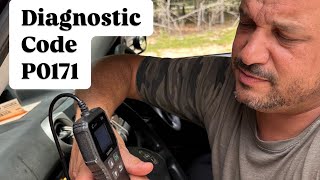
- Replacing the Air/Fuel (O2) sensor immediately. The sensor is often correctly reporting a lean condition caused by something else, like a vacuum leak or bad injector. Always diagnose other causes first. 🎬 Watch: A guide to diagnosing the P0171 lean code
Most Likely Causes
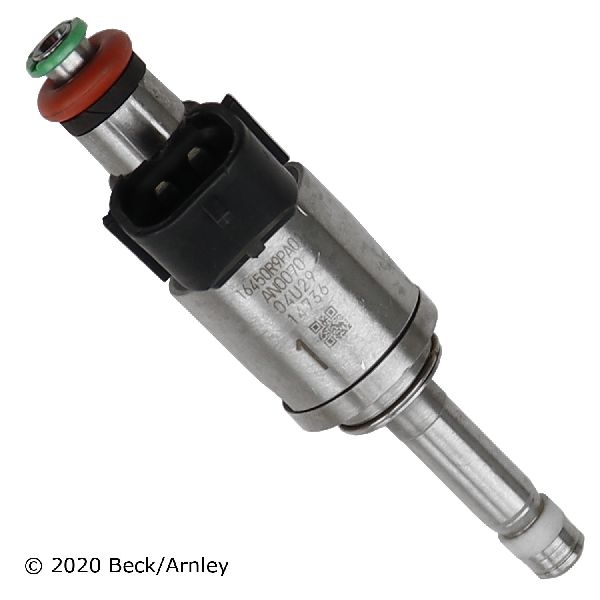
- Faulty or Clogged Fuel Injectors 🔴 High Probability → Shop Fuel Injector This is a well-documented issue on Acura's direct-injection 3.5L V6 engine family, as noted in TSBs for related models like the MDX (TSB 23-011) and TLX (TSB 22-015). The provided TSB BTI&05102022901 specifically investigates this code cluster, pointing to a known defect. The issue often stems from injectors not being installed to proper specification, leading to wear and reduced fuel flow.
How to confirm: Confirm the presence of related codes, especially P0300-P0306 (misfires) and P219A/B (A/F imbalance). A professional can perform a fuel injector balance test. High positive long-term fuel trims (>20%) on a scan tool that don't resolve after fixing vacuum leaks are a strong indicator. Check with an Acura dealer about warranty extensions for this issue on your specific VIN.
Typical fix: Replace the full set of six fuel injectors and often the fuel joint pipe. This may be covered under a warranty extension; check with an Acura dealer. Some TSBs for similar models also require a PGM-FI software update after replacement.
Est. part cost: $800-$1700 - Vacuum Leak (Cracked Air Intake Tube) 🟡 Medium Probability The flexible rubber air intake tube between the air filter housing and the throttle body is a common failure point on many Honda and Acura vehicles. The rubber becomes brittle with age and heat, developing cracks that allow unmetered air to enter the engine post-MAF sensor.
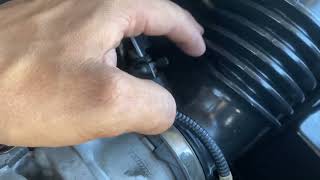
How to confirm: Visually inspect the entire air intake tube, especially in the ribbed, flexible sections for cracks. With the engine running, you can carefully spray short bursts of brake cleaner or starter fluid around the tube; if the engine idle changes or stumbles, you've found the leak. A smoke test is a more definitive way to find leaks.
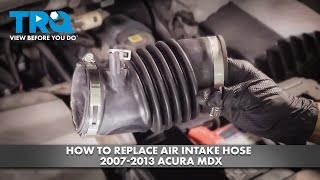
Typical fix: Replace the cracked air intake tube. Using OEM parts is recommended for better longevity. 🎬 See how to replace a cracked air intake hose
Est. part cost: $40-$65 - Dirty Mass Airflow (MAF) Sensor 🟡 Medium Probability → Shop Fuel Injection Air Flow Meter
How to confirm: The MAF sensor is located in the intake tube after the air filter. It can be carefully removed (usually with two screws) and its delicate wires inspected. If they appear dirty, they can be cleaned ONLY with a dedicated MAF sensor cleaner spray. Do not touch the wires or use other chemicals. A dirty sensor under-reports airflow, causing the ECU to inject too little fuel.
Typical fix: Clean the MAF sensor. If cleaning does not resolve the issue, the sensor may need to be replaced.
Est. part cost: $15 (cleaner) or $200-$350 (replacement sensor) - Faulty Air/Fuel Ratio Sensor (Bank 1, Sensor 1) ⚪ Low Probability → Shop Oxygen Sensor
How to confirm: This sensor is located in the rear exhaust manifold, before the catalytic converter. A scan tool can graph the sensor's voltage. A healthy sensor will fluctuate rapidly. A lazy or flat-lined sensor is faulty. This is often misdiagnosed; always rule out vacuum leaks and fuel issues first, as the sensor is usually just accurately reporting a problem.
Typical fix: Replace the Bank 1 Air/Fuel Ratio sensor.
Est. part cost: $100-$200 - Stuck or Faulty PCV Valve ⚪ Low Probability → Shop PCV Valve
How to confirm: A Positive Crankcase Ventilation (PCV) valve that is stuck open will create a vacuum leak. You can often test it by removing it and shaking it; a good valve should rattle. If it's silent or gummy, it's likely bad. Its hose should also be inspected for cracks.
Typical fix: Replace the PCV valve and grommet.
Est. part cost: $20-$40
Rare But Worth Checking
- Low Fuel Pressure: While less common than injector issues on this platform, a weak fuel pump or clogged fuel filter can cause lean conditions, typically on both banks (P0171 & P0174). A fuel pressure test is required for diagnosis. An Acurazine thread mentions checking fuel pressure as a primary step for dual lean codes.
- Exhaust Leak: An exhaust leak before the primary A/F sensor can draw in outside air, making the sensor read a false lean condition. This is less common but possible.
Diagnosis Steps
- Check for additional codes. The presence of P0174, P030x, or P219A/B strongly points towards the known fuel injector issue. Contact an Acura dealer with your VIN to check for warranty extensions.
- Inspect the air intake system thoroughly for cracks, especially the flexible rubber intake tube between the air filter box and the throttle body. This is a very common failure point.
- Inspect all vacuum hoses connected to the intake manifold for cracks or disconnections, including the PCV hose.
- With the engine cool, remove and inspect the Mass Airflow (MAF) sensor. If dirty, clean it with dedicated MAF sensor cleaner and reinstall.
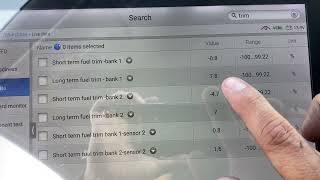
- Use a scan tool to monitor short-term and long-term fuel trims (STFT and LTFT). High positive numbers (e.g., LTFT > 15-20%) confirm the lean condition. 🎬 Watch: How to check fuel trims on an Acura V6 Observe if the trims decrease when engine RPM is raised to ~2500 RPM; if they do, a vacuum leak is the most likely cause.
- Check the PCV valve to ensure it rattles when shaken and is not stuck open.
- If no vacuum leaks are found and the MAF is clean, and especially if misfire codes are present, the fuel injectors are the primary suspect. A professional fuel injector balance test is the definitive diagnostic step.
- As a final check, test fuel pressure to rule out a weak fuel pump, though this is less common on this platform.
Parts You'll Likely Need
- Fuel Injector Set
(OEM #16010-R9P-305)— This is the most probable cause on the 3.5L V6 engine when P0171 is accompanied by misfire codes, due to a known issue acknowledged by Acura on platform mates. Note: This part may be part of a larger kit or have superse
Related Codes That Often Appear With This One
- P0174 — System Too Lean (Bank 2). This indicates the front cylinder bank is also running lean. When both appear, it points to a problem affecting the entire engine, like faulty fuel injectors, a large vacuum leak, a dirty MAF sensor, or low fuel pressure.
- P0300-P0306 — Cylinder Misfire Detected. A severe lean condition prevents proper combustion, causing misfires. Acura TSBs for platform mates specifically link these codes with P0171 as a primary symptom of faulty fuel injectors.
- P219A / P219B — Bank 1 / Bank 2 Air-Fuel Ratio Imbalance. These codes indicate an imbalance between cylinders on the same bank, which is another key symptom of the known fuel injector issue on this platform, as cited in TSBs for the MDX and TLX.
Technical Service Bulletins (TSBs) & Recalls
- BTI&05102022901
- Acura TSB 22-015 (for TLX)
- Acura TSB 23-011 (for MDX)
- Acura TSB 22-013 (for RDX)
Platform-Specific Known Issues
- Acura has acknowledged a problem with fuel injectors on its 3.5L V6 engines from this era, which causes a specific cluster of diagnostic codes including P0171, P0174, P030x, and P219A/B. The issue is so prevalent that a Technical Service Bulletin (BTI&05102022901) was issued to investigate the problem further. Owners should check with an Acura dealer about potential warranty extensions covering this repair.
Mechanic-Grade Diagnostic Values
- Long-Term Fuel Trim (LTFT) — expected: Close to 0%, typically within +/- 5%.. Failure: Sustained positive values greater than +15% to +20% indicate the PCM is adding significant fuel to compensate for a lean condition, triggering the code.
- Mass Airflow (MAF) Sensor Reading at Idle — expected: Approximately 3.5 g/s. A general rule is ~1 gram/second per liter of engine displacement.. Failure: A significantly lower reading (e.g., 1.5-2.5 g/s) at idle suggests the sensor is dirty or faulty, under-reporting airflow and causing a lean condition. A higher reading could indicate a vacuum leak after the sensor.
- Mass Airflow (MAF) Sensor Reading at 2500 RPM — expected: Approximately 13-15 g/s. The reading should increase linearly with RPM.. Failure: A non-linear or flat response as RPMs increase indicates a failing MAF sensor.
- Fuel Trim Response to RPM Change — expected: N/A. Failure: If high positive fuel trims at idle return to normal (near 0%) when RPMs are raised to ~2500, a vacuum leak is highly probable. If the trims remain high across the RPM range, the issue is more likely fuel delivery related (injectors, pump).
Scan Tool Commands That Help
- Acura HDS (Honda Diagnostic System): PGM-FI Software Update — After replacing the fuel injectors for the known issue, Acura TSBs for related models (like TLX TSB 22-015) require a software update to the PGM-FI (engine computer) to work correctly with the new parts and prevent the code from returning.
Real Owner Repair Stories
- Reddit user on r/AcuraTSX (2008 Acura TSX (200k miles) - different model but illustrates a key diagnostic trap.) — Persistent P0171 code, poor MPG, but vehicle runs fine.
❌ Tried (didn't work) Replaced upstream and downstream O2 sensors (Denso), Replaced PCV valve and hose (OEM), Replaced fuel pump (Delphi), Performed smoke test on vacuum lines, exhaust, and EVAP system (no leaks found), Used carb cleaner/propane method to find leaks (no idle change)
✅ What actually fixed it The user suspected the previous owner had installed incorrectly sized aftermarket fuel injectors. After noticing a damaged O-ring and temporarily improving trims, they planned to swap in factory injectors as the final solution. This highlights a scenario where all common tests pass, but an incorrect part is the root cause. - YouTube channel 'vertexaisearch' (2016 Acura MDX (same 3.5L engine family)) — P0171 and P0174 codes with very high fuel trims (~43% positive).
❌ Tried (didn't work) Initial diagnosis focused on vacuum leaks and MAF sensor issues, which were ruled out.
✅ What actually fixed it The technician found the throttle body was excessively dirty, causing the throttle plate position to read high at idle (1.4%). Cleaning the throttle body and performing a throttle body relearn procedure resolved the high fuel trims and codes.
"I Checked Everything" — The Actual Cause
- A Reddit user with a persistent P0171 code on a high-mileage Acura reported that multiple smoke tests for vacuum, exhaust, and EVAP systems all came back clean. After replacing O2 sensors, the PCV system, and the fuel pump with no success, the final suspected cause was incorrectly sized aftermarket fuel injectors installed by the previous owner. This is a high-value edge case where standard diagnostic procedures fail because an incorrect (but functioning) part was installed.
OEM Part Supersession History
16790-R9P-A01, 16790-R9S-A01, 16790-5J6-A01→16790-5J6-305— This is the part number for the high-pressure fuel pump assembly, which is related to the direct injection system. Part numbers are often superseded due to design improvements, manufacturer changes, or to consolidate inventory.
Model Year Variations Within This Range
- 2018-2020: The 2018 model year marked a significant mid-cycle refresh (MMC) for the RLX. While the 3.5L V6 engine remained fundamentally the same, the standard front-wheel-drive (P-AWS) model received a new 10-speed automatic transmission, replacing the previous 6-speed. The Sport Hybrid model continued with its 7-speed dual-clutch transmission. This change primarily affects transmission diagnostics but is a key differentiator within the 2016-2020 range.
Helpful Videos

We Have This Part in Stock


The information in this article is provided for general reference and educational purposes only. Vehicle specifications, procedures, and part compatibility can vary by production date, trim level, and region. Always consult your vehicle's factory service manual and verify part numbers before purchasing or performing repairs. Safety-critical components such as airbags, seat belts, and braking systems should be installed by a qualified professional.
- Acura RLX:
- 🧭 Diagnostic Flowchart
- 🎬 Helpful Videos
- 🛍️ Shop This Part
- What's Unique About the 2016-2020 Acura RLX
- Symptoms You May Notice
- Most Likely Causes
- Rare But Worth Checking
- Diagnosis Steps
- Parts You'll Likely Need
- Related Codes That Often Appear With This One
- Technical Service Bulletins (TSBs) & Recalls
- Platform-Specific Known Issues
- Mechanic-Grade Diagnostic Values
- Scan Tool Commands That Help
- Real Owner Repair Stories
- "I Checked Everything" — The Actual Cause
- OEM Part Supersession History
- Model Year Variations Within This Range
- 🎟️ Get 5% Off